The morning routine has a rhythm to it, and a shower that refuses to join in breaks the whole thing. You pull the cord, step in, and get either silence, or a flow of confidently cold water. An electric shower not working is one of the most common calls we take across Bristol, and the encouraging truth is that the cause is usually one of a handful of suspects, several of which you can identify from the symptoms alone, without a screwdriver in sight. In this guide we split the fault into its three families, walk through the checks that are safe to do yourself, explain where the rules say to stop, and give honest numbers for what each fix costs.
One thing before we start. If your shower runs and then cuts out with a click from the fuse board, that is a different fault covered in our guide to an electric shower tripping the fuse box. This article is for the shower showing no signs of life, or running but refusing to heat.
Table of Contents
- First Question: Which Kind of Not Working?
- Electric Shower Not Working at All: Start With Three Switches
- Water Runs but Stays Cold: The No-Heat Faults
- What You Can Safely Check Yourself, and Where to Stop
- When an Electric Shower Not Working Means Replacement, Not Repair
- A Worked Example: The Shower That Died on a Monday
- Straight Answers for South Bristol Bathrooms
TL;DR
- A completely dead electric shower is usually a power path problem: the pull cord isolator, the breaker at the consumer unit, or a worn switch that has stopped passing current.
- A shower that runs cold is usually a failed heater element or a tripped thermal cutout. Elements that fail open circuit give cold water without tripping anything, which is why this fault gets misdiagnosed so often.
- Safe checks are limited to switches, breakers and your own senses. Never open the shower unit or the isolator: every bathroom circuit must have 30mA RCD protection under BS 7671, and the casing is where your side of the job ends.
- Repair only makes economic sense on younger showers where the faulty part is cheap. A failed element on a typical domestic unit usually means a like-for-like replacement at roughly £250 to £450 supplied and fitted.
- Our diagnostic visit is a fixed £140 + VAT (£168 including VAT), and most dead-shower faults are identified, and often fixed, within it.
First Question: Which Kind of Not Working?
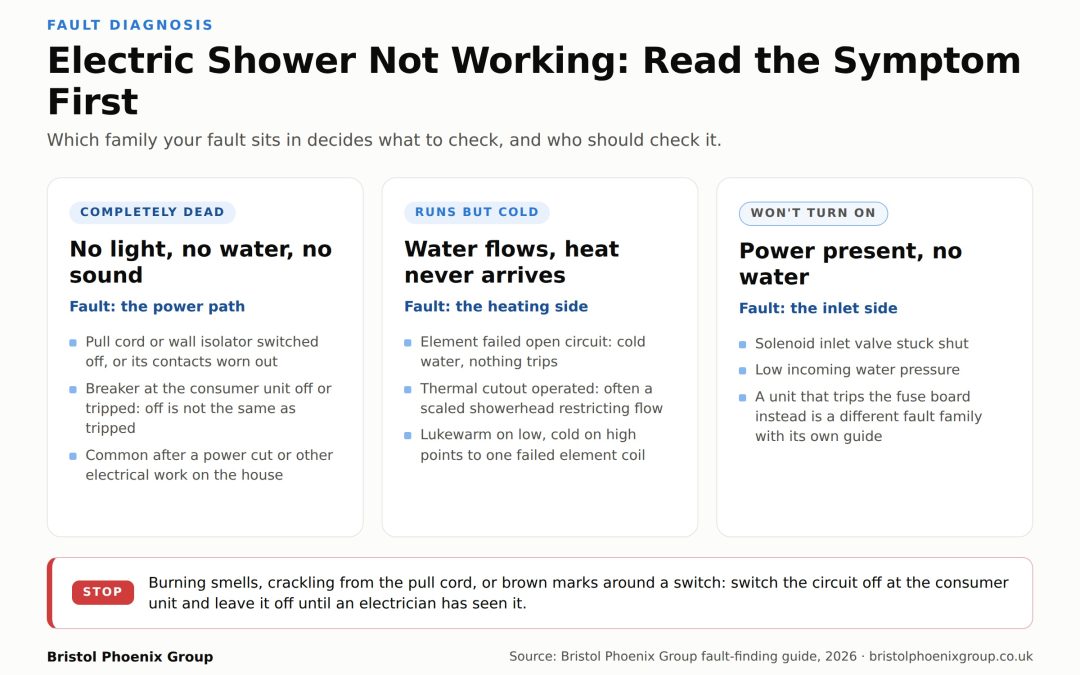
“Electric shower not working” covers three different faults that get bundled together in every phone call we take on the subject: the shower with no power at all, the shower that runs cold, and the shower that won’t turn on despite having a live supply. Separating them is half the diagnosis, because each points at different components, and the symptom you have tells you which family you are in before anyone opens a toolbox.
| Symptom | Most likely area | Where it points |
|---|---|---|
| Completely dead: no light, no water, no sound | The power path | Isolator switch, breaker at the board, or a worn pull cord |
| Water flows but will not heat | The heating side | Failed element, tripped thermal cutout, or a control microswitch |
| No water at all, but the unit has power | The inlet side | Solenoid valve stuck shut, or low incoming water pressure |
| Runs, then cuts out with a click from the fuse board | Earth leakage or overload | A different fault family: see our shower tripping guide |
Notice what is not on the list: “the whole shower is broken”. Something specific has let go, and the pattern of what still works narrows it down fast.
Electric Shower Not Working at All: Start With Three Switches
An electric shower with no power, no indicator light and no response to the controls has lost its supply somewhere between the consumer unit and the unit on the wall. That journey passes through exactly three things you can look at safely, and in our experience a dead electric shower turns out to be one of them more often than a fault inside the shower itself.
The isolator: pull cord or wall switch
Every electric shower has a local isolator, usually a ceiling pull cord with a neon indicator, sometimes a wall switch outside the bathroom. Check it first: pull cords get switched off by guests, children and enthusiastic dusting more often than anyone admits. Neon lit means power is reaching that point and the fault is downstream. Neon dark means the switch is off, the circuit is dead at the board, or the switch itself has failed.
That last one deserves respect rather than a shrug. A shower pull cord carries 40 amps or more every time the shower runs, through a small set of contacts operated by a piece of string. Worn contacts arc, arcing builds heat, and eventually the switch stops passing current at all. A pull cord that crackles, shows brown discolouration or gives off a hot plastic smell has been cooking for months: leave the circuit off at the board and treat it as a fault to be looked at, not lived with. The one consolation: a failed isolator switch is among the cheapest fixes on this entire page.
The consumer unit: off is not the same as tripped
Open the consumer unit door and find the way marked shower, usually a 40A, 45A or 50A device, and look closely, because position matters. A breaker fully down was probably switched off at some point and never restored. A breaker sitting in the middle has tripped on a fault. The distinction changes everything: an off breaker you simply switch back on, while a tripped one is reporting a live problem.
Reset a tripped breaker once. If it holds and the shower works, move on with your morning. If it trips again, stop resetting: a protective device that keeps letting go is doing its job, and forcing it is how a protection problem becomes a fire problem. At that point the fault is earth leakage or overload territory, and our guides to an electric shower that trips the board and an RCD that keeps tripping pick up the story.
Electric shower not working after a power cut
A surprising number of dead showers date precisely from the last power cut or fuse board work. When supply returns after an outage, an RCD can trip on everything re-energising at once, and a shower way sharing that RCD goes dark along with half the house. Other times an electrician on an unrelated job switched the shower way off for safety and it never went back on. If your shower stopped working the same week as a power interruption or any electrical work, check the board first. It is the thirty-second check that saves a call-out fee.
Water Runs but Stays Cold: The No-Heat Faults
An electric shower not heating is a different animal from a dead one. Flowing water tells you the power path is alive; what has failed is the heating side, and here the suspects rank themselves by age and water quality.
The heater element: the usual culprit
Inside the shower is a compact heater can whose element does the brutal work of taking mains-cold water to comfortable in about a second. Elements fail in two ways, and the symptom tells you which. An element that cracks and leaks current to earth trips the RCD, which is the other article’s territory. An element that fails open circuit simply stops conducting: the water flows, nothing trips, and the shower delivers cold water with complete confidence. The lack of drama at the fuse board is exactly why this fault confuses people.
Some units fail halfway. Many domestic showers heat with two element coils, and when one goes you get lukewarm water that turns properly cold on the higher setting. Tepid on low and cold on high means a coil has very likely gone, and the second is on borrowed time.
The thermal cutout, and what it is trying to tell you
Every modern unit carries a thermal cutout, a safety device that kills the heating circuit if the can overheats. When it operates, you get exactly the symptom above: flowing, unheated water. Cutouts do not operate for fun. The common causes are a scaled showerhead restricting flow, a kinked hose, or scale inside the can making the element run hot. Clearing the showerhead is the one genuinely useful bit of maintenance a homeowner can do here: descale the head, check the hose, and if the heat comes back and stays back, you have found your fault for the price of some descaler.
Limescale, and why Bristol is hard on shower elements
Scale is the quiet killer in all of this, and locally we do not get to opt out. Bristol Water classes all the water in its supply area as moderately hard to very hard, thanks to the limestone geology it moves through before reaching the tap. Every litre a shower heats leaves mineral content behind on the hottest surface in the system, which is the element. Scale insulates it, the element runs hotter to compensate, and the extra heat accelerates its death. It is why the same model lasts noticeably longer in a soft water city than in a Totterdown terrace.
What You Can Safely Check Yourself, and Where to Stop
There is a short list of checks a homeowner can do without tools, and it genuinely helps. Work through it in order.
- Confirm the scope. Do the bathroom lights and other circuits work? A dead shower alongside other dead circuits points at the board, not the shower.
- Check the isolator. Pull cord or wall switch, and the neon if fitted. Cycle it once. Note whether the neon lights.
- Read the board. Find the shower way. Fully down means off, mid-position means tripped. Photograph it before you touch anything, then reset once at most.
- Run the cold test. If water flows, note whether it is cold on every setting or lukewarm on low flow. That observation alone tells an electrician a great deal.
- Descale the showerhead. The one repair-adjacent job that is genuinely yours: a scaled head restricts flow and can operate the thermal cutout. Clean it and retest.
- Use your nose and ears. Burning smells, crackling from the pull cord, browning around a switch: any of these means switch the circuit off at the board and leave it off.
That is the whole list, and the boundary around it is not ours, it is the regulation’s. A bathroom is what BS 7671 calls a special location, and under Section 701 of the IET Wiring Regulations every circuit in a room containing a bath or shower must have RCD protection rated at no more than 30mA, because a wet human is a spectacularly good conductor. The inside of the shower unit, the isolator internals and the circuit itself all sit on the professional side of that line, and under Part P of the Building Regulations new or altered bathroom circuits are notifiable work too.
We make the point firmly because the national appetite for electrical DIY is bigger than the national skill base. The Institution of Engineering and Technology found that 27% of people have taken apart or replaced fittings such as sockets or switches, and 6% have attempted rewiring, while around 19,300 accidental domestic fires each year are linked to electricity, about 53% of all accidental house fires in England. In a room full of water, fed by the most heavily loaded circuit in the house, those are not odds worth joining. Government figures make the same case from a different angle: of the 23,795 accidental dwelling fires in England in the year ending March 2026, 27% were caused by misuse of equipment or appliances, and improvising around a safety device is a reliable way to join that column.
When an Electric Shower Not Working Means Replacement, Not Repair
Repairing a shower is sometimes the right call and often not, and the deciding factors are age, part and price.
Parts on the control side, a pull cord isolator, and on some models a microswitch or solenoid, are cheap enough that replacing them on a younger unit is usually worthwhile. The element is different. On most domestic showers it lives inside a sealed heater can, and the practical repair is replacing that whole assembly. Between the part, the labour and the age of the surrounding unit, the numbers usually land within sight of a brand-new shower carrying a fresh guarantee, at which point repair stops making sense. A scaled, hard-worked Bristol unit past its fifth birthday with a dead element is nearly always a replacement conversation.
| Job | Typical cost | Notes |
|---|---|---|
| Diagnostic visit (our fixed price) | £140 + VAT (£168 inc VAT) | Up to around an hour on site: safe isolation, testing, and the fix there and then where possible |
| Isolator or pull cord switch replacement | Often the cheapest fix on the page | Frequently done within the diagnostic visit, plus the modest cost of the switch |
| Like-for-like shower replacement | Roughly £250 to £450 supplied and fitted | The usual outcome of a failed element on a standard unit |
| New dedicated shower circuit | From £480 + VAT for the electrics; roughly £500 to £900 as a general range | Needed when upgrading to a more powerful unit; notifiable work |
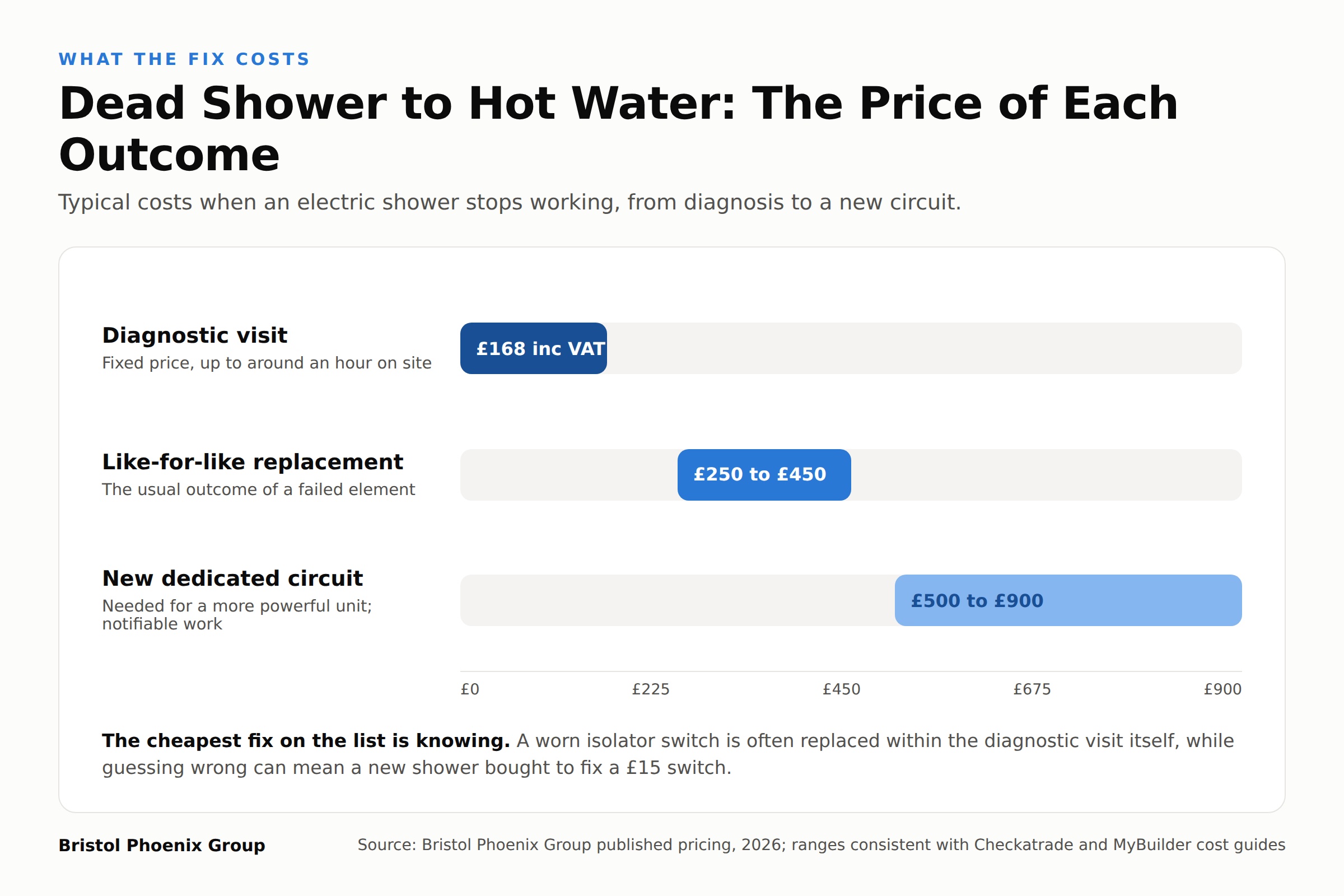
Those figures sit comfortably against the national guides. Checkatrade puts a standard electric shower installation at around £400 for supply and installation, with a like-for-like swap taking about two hours, and MyBuilder quotes roughly £300 to £800 depending on the job. One caution from the sharp end: a swap is only like-for-like if the kilowatt rating matches. Moving from an 8.5kW unit to a 9.5 or 10.5kW model pushes more current through a cable sized for less, and that means a new circuit built for the load. Our electric shower installation page sets out what that involves, and our diagnostic pricing is fixed and published on our electrical fault finding page, so you know the price of an answer before we arrive.
A Worked Example: The Shower That Died on a Monday
Take a typical case. Picture a Victorian terrace in Bedminster with a 9.5kW shower, seven years old, used daily by a family of three. On Monday morning it is simply dead: no neon on the ceiling switch, no response, no water. The board shows the shower breaker up and untripped, and everything else in the house works.
The pattern already carries most of the answer. An untripped breaker with a dark isolator neon puts the fault between the board and the shower, and the prime suspect is the pull cord switch, seven years of 41-amp mornings having slowly cooked its contacts. On a job like this the electrician isolates the circuit, opens the switch, and finds the classic evidence: browned terminals and pitted contacts that have finally stopped conducting. A new 50A pull cord switch goes in, the connections at the board and shower terminals get checked while everything is open, and the circuit is tested and back in service within the diagnostic hour.
The arithmetic: £168 including VAT for the visit, plus the modest cost of the switch. Now run the alternative version, where the neon was lit but the water ran cold on every setting. Same visit, but the continuity tests point at an element failed open circuit, and on a seven-year-old scaled unit the honest advice is a like-for-like replacement inside the £250 to £450 range rather than a heater can transplant into a tired shower. Two different Mondays, one diagnostic, and in both cases the cost of guessing wrong, a new shower bought to fix a £15 switch, is comfortably more than the cost of knowing.
Straight Answers for South Bristol Bathrooms
The housing stock we work in shapes the faults we find. The Victorian and Edwardian terraces around Bedminster, Southville, Totterdown and Knowle were never designed with a 40-amp bathroom appliance in mind, and the water they heat is hard enough to shorten any element’s life. That combination is why a dead or cold shower here deserves a proper diagnosis rather than a parts lottery from a search engine.
As a NAPIT-approved contractor based in South Bristol, we test rather than guess: safe isolation, proper readings at the terminals, and a plain-English explanation of what failed, what it costs to put right, and whether repair or replacement is the honest answer. If your electric shower is not working, whether it is dead to the world or running defiantly cold, get in touch through our contact page and describe the symptom. We will tell you which of the faults on this page it sounds like, what the visit costs, and what we would do if it were our bathroom.