Ask ten homeowners what the Part P building regulations actually require and you will usually get ten polite shrugs. It is the rule that governs almost every piece of electrical work done in a home in England, yet most people only hear about it when a solicitor asks for a certificate they have never seen, usually three weeks before a house sale is due to complete. We are Bristol Phoenix Group, a NAPIT registered electrical contractor based in South Bristol, and we spend a fair amount of time untangling exactly that situation. This guide sets out Part P explained in plain English: what it covers, which jobs must be notified, the paperwork you should be handed, and what it costs you to ignore it.
Table of Contents
- What Are the Part P Building Regulations?
- Why Part P Exists: The Fire and Injury Numbers
- Part P Electrical Work: What Is Notifiable and What Is Not
- Special Locations: Bathrooms, Pools and Saunas
- Part P Building Regulations Compliance: The Three Legal Routes
- The Paperwork You Should End Up Holding
- What Happens If Part P Is Ignored
- A Worked Example: The Consumer Unit That Nearly Sank a Sale
- Part P in Bristol Homes
- How to Check Your Electrician Can Self Certify
- Final Thoughts
TL;DR
- Part P is the section of the Building Regulations covering electrical safety in homes in England. It applies to all domestic electrical work, whether done by a professional or a DIYer.
- Three types of job are notifiable: installing a new circuit, replacing a consumer unit, and any addition or alteration to circuits in a special location such as the zones around a bath or shower.
- An electrician registered with a government authorised competent person scheme, such as NAPIT or NICEIC, can self certify notifiable work. Otherwise you must involve building control, which is slower and costs more.
- Compliant notifiable work earns two documents: an electrical installation certificate and a Building Regulations compliance certificate, which should arrive within 30 days.
- Failure to comply with the Building Regulations is a criminal offence, and missing paperwork has a habit of surfacing at the worst possible moment, usually when you sell.
What Are the Part P Building Regulations?
Part P is one of the technical parts of the Building Regulations for England, sitting alongside better known sections like Part B for fire safety and Part L for energy. It was introduced in 2005, and the current guidance is Approved Document P: Electrical safety, Dwellings, the 2013 edition published by the government.
The legal requirement itself is a single sentence. Requirement P1 says: “Reasonable provision shall be made in the design and installation of electrical installations in order to protect persons operating, maintaining or altering the installations from fire or injury.” That is the whole of Part P. Everything else, the notification rules, the certificates, the competent person schemes, exists to prove that sentence has been satisfied.
Two things trip people up. First, Part P applies to all electrical work in dwellings, not just the big jobs. The Institution of Engineering and Technology’s Part P guidance is blunt about this: it applies whether the work is carried out by professionals or DIYers. A homeowner swapping a light fitting on a Sunday afternoon is working under Part P just as much as we are when we rewire a house. Second, complying with Part P and notifying building control are related but separate ideas. All work must comply. Only some work must be notified. That distinction is where the next section comes in.
Why Part P Exists: The Fire and Injury Numbers
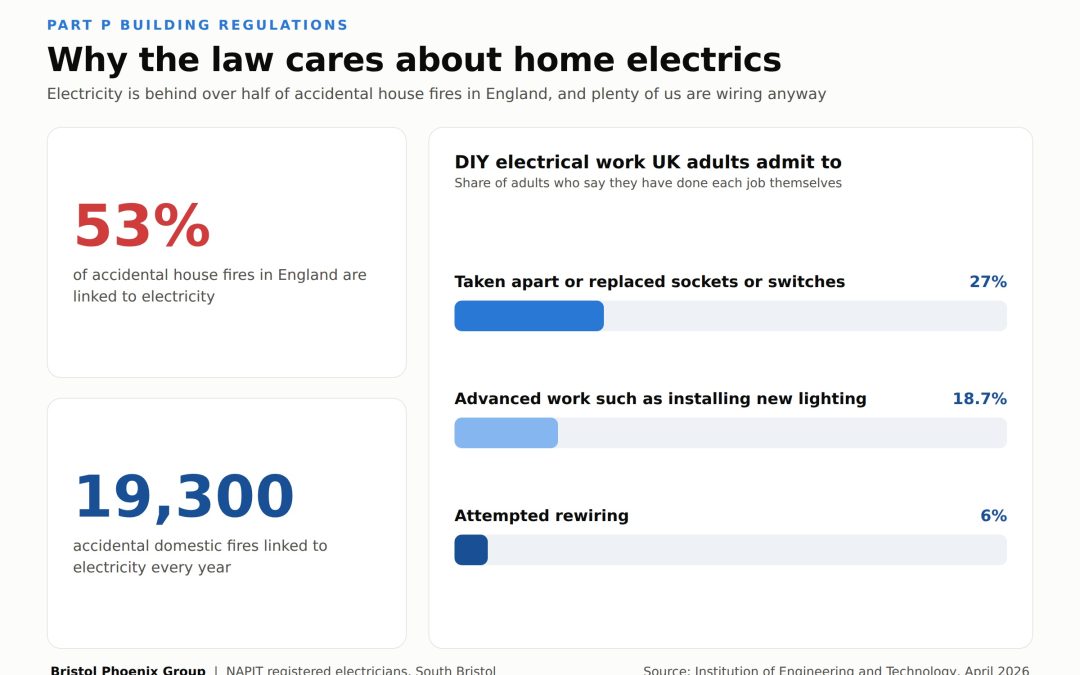
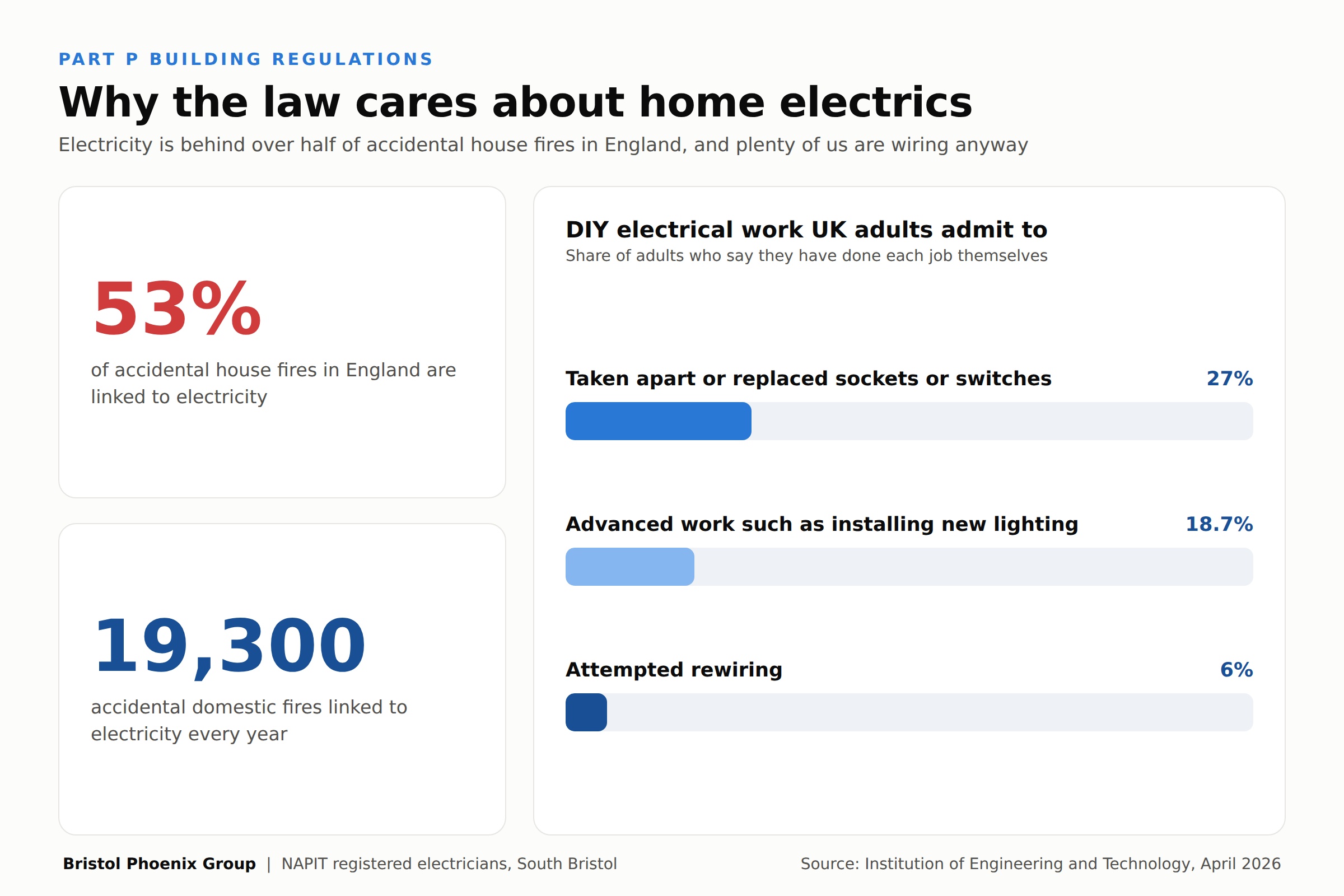
Part P was brought in because electricity is quietly one of the biggest causes of harm in British homes. The scale still surprises people. According to research published by the IET in April 2026, there are around 19,300 accidental domestic fires linked to electricity each year, accounting for about 53% of all accidental house fires in England.
The same research explains why a legal framework for domestic electrical work is not overkill. Some 27% of adults admit they have taken apart or replaced fittings such as plug sockets or light switches themselves, 18.7% have carried out more advanced work like installing new lighting, and 6% have attempted rewiring. We admire the confidence. The statistics suggest the wiring does not always share it.
None of this means a homeowner can never touch their own electrics. It means the law draws a line around the riskiest categories of work and says: this must either be done by someone who can prove competence, or checked by someone who can.
Part P Electrical Work: What Is Notifiable and What Is Not
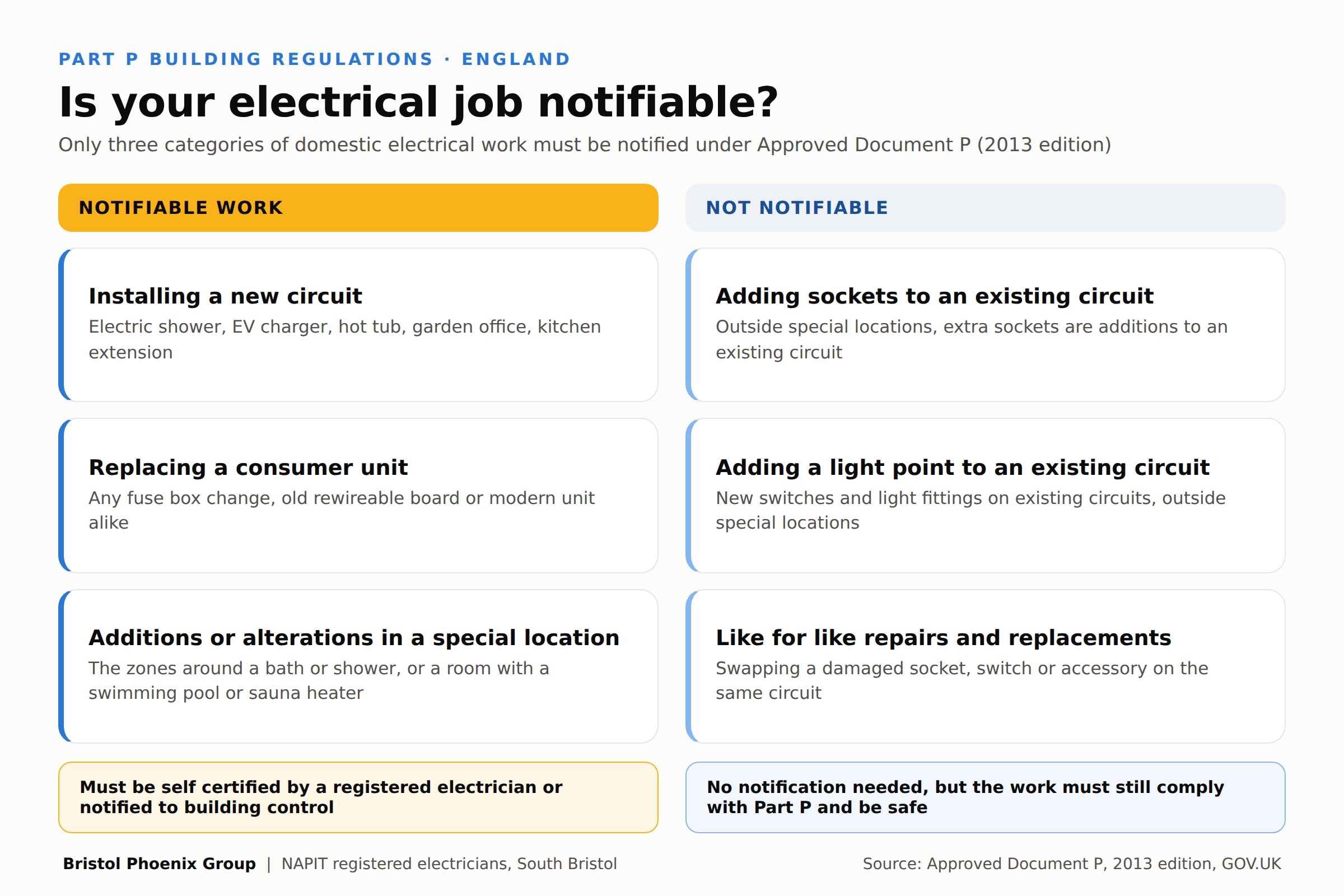
Notifiable work is the category that must be declared to a building control body, or self certified by a registered electrician, before or shortly after it is done. Since the 2013 edition of Approved Document P, the list in England is short. Regulation 12(6A) identifies three types of notifiable work: the installation of a new circuit, the replacement of a consumer unit, and any addition or alteration to existing circuits in a special location.
Anything outside those three categories is not notifiable. It still has to comply with Part P and be safe, but there is no requirement to involve building control or generate a Building Regulations compliance certificate. Here is how that plays out with common jobs:
| Job | Notifiable? | Why |
|---|---|---|
| Replacing a consumer unit (fuse box) | Yes | Consumer unit replacement is one of the three notifiable categories |
| Installing an electric shower on a new circuit | Yes | New circuit, and usually work in a special location too |
| Installing an EV charger | Yes | Needs its own new dedicated circuit |
| Wiring a hot tub or garden office | Yes | New outdoor circuit |
| Adding sockets to an existing circuit in a bedroom | No | Addition to an existing circuit outside a special location |
| Adding a light point to an existing circuit | No | Alteration to an existing circuit outside a special location |
| Like for like swap of a damaged socket or switch | No | Repair or replacement, not a new circuit |
| Moving a shaver socket next to a bath | Yes | Alteration to a circuit within a special location |
A useful rule of thumb: if the job involves the fuse board, a brand new circuit, or the area around a bath or shower, assume it is notifiable. If you are genuinely unsure, ask a registered electrician before the work starts, not after. The before conversation is free. The after conversation can involve a council officer.
Special Locations: Bathrooms, Pools and Saunas
The phrase special location sounds grander than it is. Approved Document P defines it as the space within a room containing a bath or shower, specifically the zone surrounding the bath tap or shower head, extending 2.25 metres vertically and 0.6 metres horizontally from the edge of the bath or shower tray, plus any room containing a swimming pool or sauna heater.
The logic is simple: water and electricity are a poor mix, so alterations to circuits in those wet zones carry a higher risk and therefore need notification even when the same alteration elsewhere in the house would not. Before the 2013 changes the definition also swept up kitchens and gardens, which is why older articles and forum threads still insist that a new kitchen socket must be notified. In England, under the current edition, it does not, unless one of the three notifiable categories applies.
Bristol has no shortage of loft conversions with en suites squeezed under the eaves, and those compact shower rooms are exactly where this rule bites. Shifting a pull cord switch or adding a downlight over a shower is a small job, but it is a notifiable one.
Part P Building Regulations Compliance: The Three Legal Routes
For notifiable work there are three legal ways to stay on the right side of the Part P building regulations, and they differ a lot in cost and hassle.
Route 1: Use a registered competent person
The simplest route. An electrician registered with a government authorised competent person scheme can self certify that their own work complies with the Building Regulations, with no separate building control application and no council fee. NAPIT and NICEIC operate the best known schemes; NAPIT is authorised by the government to run competent person schemes in England and Wales, and it is the scheme we are registered with. The electrician notifies the work through their scheme, and the scheme sends you the compliance certificate.
Route 2: Unregistered installer plus third party certifier
Approved Document P also allows an installer who is not registered to appoint a registered third party certifier to inspect and test the work. This route exists, but in practice it is used far less often, because finding a certifier willing to put their name to someone else’s work can be harder than just hiring a registered electrician in the first place.
Route 3: A building control application
The DIY route. You notify your local authority building control team before starting, pay their fee, and they arrange the inspection and testing needed to satisfy themselves the work complies. It is entirely legal, and for a competent DIYer doing a one off job it may be the honest choice, but it is typically the slowest and most expensive of the three, and the fee usually dwarfs whatever the materials cost.
The Paperwork You Should End Up Holding
Done properly, a notifiable job leaves you holding two separate documents, and it is worth knowing the difference because solicitors will ask for both by name.
| Document | Who issues it | What it proves |
|---|---|---|
| Electrical Installation Certificate (EIC) | The electrician who did the work, to BS 7671 | The installation was designed, built, inspected and tested safely |
| Building Regulations Compliance Certificate | The competent person scheme, within 30 days of completion | The work was notified and complies with the Building Regulations |
| Completion certificate or final certificate | Building control, where Route 3 was used | The council or approved inspector accepts the work complies |
Approved Document P says the compliance certificate should reach the occupier within 30 days of the work being completed, and NAPIT’s own scheme guidance confirms the same 30 day window. If a certificate has not landed a month after a fuse board change, chase it. We cover the certificate side of landlord compliance in more detail in our guide to electrical certificates for landlords.
Keep both documents with your deeds and warranties. They cost nothing to store and a surprising amount to replace, in both money and delay.
What Happens If Part P Is Ignored
The IET’s guidance puts the legal position plainly: failure to comply with the Building Regulations is a criminal offence, and local authorities have the power to require the removal or alteration of work that does not comply with the requirements. In other words, the worst case is not just a telling off. A council can insist that non compliant work is ripped out or redone, at the owner’s expense.
Prosecution for a domestic electrical job is rare in practice. The consequence that actually catches people is quieter and far more common: the house sale. When you sell, the buyer’s solicitor asks about alterations and requests the certificates. A consumer unit change or a new circuit with no paperwork raises a flag, and the usual outcomes are a price renegotiation, an indemnity insurance policy bought at the seller’s cost, or a demand for an electrical inspection before exchange. We have written separately about electrical certificates when selling a house, and Part P gaps are one of the most frequent problems in that process.
If you already have unnotified work in your home, the practical options are worth knowing. Your local building control team can advise on putting the paperwork right retrospectively, and a registered electrician can inspect and test the work, typically through the same process used for an EICR, to establish whether it is actually safe. That does not rewrite history, but it answers the question a buyer really cares about, which is whether the wiring is dangerous.
A Worked Example: The Consumer Unit That Nearly Sank a Sale
Picture a typical South Bristol scenario. A couple in a Victorian terrace accepted an offer on their house. Back in 2019 a friend of a friend replaced their old fuse box with a modern consumer unit. Decent job, tidy wiring, cash price, no paperwork. Nobody thought about it again until the buyer’s solicitor asked for the Building Regulations compliance certificate for the visible alteration.
There was none, because the work was never notified. The buyer’s mortgage lender then wanted reassurance, so the sellers had three unattractive choices: knock money off, buy an indemnity policy and hope the buyer accepted it, or get the installation inspected and tested by a registered electrician and present the report. They chose the inspection. The wiring itself passed, the sale completed a few weeks late, and the sellers paid for a report, a policy and a bruising lesson that would all have been avoided if the original installer had been registered to self certify. The moral is not that the friend of a friend was a cowboy. It is that certificates are part of the job, and a quote that leaves them out is not really cheaper.
Part P in Bristol Homes
South Bristol’s housing stock makes Part P more relevant here than in a town full of new builds. The terraces of Bedminster, Southville, Totterdown and Knowle are largely Victorian and Edwardian, and most have been altered repeatedly over a century of ownership. It is completely normal for us to open a consumer unit in BS3 and find four generations of work, from fabric insulated cable to last year’s kitchen extension. Each new circuit added along the way was notifiable work, and the further back it goes, the thinner the paperwork tends to be.
The city’s current appetite for loft conversions, garden offices and EV chargers means notifiable jobs are being created every week, and homes with unnotified work from previous owners change hands every day. If you are planning anything from a fuse box upgrade to a full rewire, building the certification into the plan from day one is far cheaper than retrofitting it.
How to Check Your Electrician Can Self Certify
Checking takes two minutes and is worth doing before any notifiable job. The official Registered Competent Person Electrical register lets you search by postcode or company name, and every electrician listed has been authorised by the government to self certify that their work complies with the Building Regulations. If a firm is not on the register, they cannot self certify notifiable work, whatever their van says.
Ask two questions when you get a quote: are you registered with a competent person scheme, and will I receive the Building Regulations compliance certificate? A registered firm will answer both without blinking. We are NAPIT registered, so every notifiable job we complete, from our base in South Bristol across the city, is notified through the scheme and certificated as standard. You can read more about how we work on our about us page, or see the full range of what we do on our services page.
Final Thoughts
The Part P building regulations are not there to stop you improving your home. They exist because electrical work is the one trade where a bad job can sit invisibly behind plaster for years before it announces itself, sometimes as a tripping circuit and sometimes as something much worse. The rules boil down to three habits: know which jobs are notifiable, use an electrician who can self certify them, and file the certificates when they arrive.
If you are planning electrical work in Bristol and want it done properly, certificates included, or you have discovered unnotified work and need it inspected before a sale, we are happy to help. Get in touch with Bristol Phoenix Group and we will give you a straight answer on what the job needs, what it does not, and what the paperwork should look like at the end.