Ask ten landlords what an electrical certificate for landlords actually involves and you will get ten slightly different answers, usually delivered with total confidence. Some think it is a yearly thing. Some think it only applies to new tenancies. Some think their letting agent sorted it in 2021 and the matter is closed. Meanwhile fire and rescue services attended 23,795 accidental dwelling fires in England in the year to March 2026, and councils can now fine a non-compliant landlord up to £40,000. The rules are not complicated, but they are specific, and the deadlines are the part that catches people out. Here is the whole thing in plain English, from a NAPIT approved firm in South Bristol that produces these reports week in, week out. Need it done? See our landlord electrical safety certificate service in Bristol.
Table of Contents
- What an Electrical Certificate for Landlords Actually Is
- Landlord Electrical Obligations: The Rules in Plain English
- What Happens If You Get It Wrong
- The 2025 and 2026 Changes: Social Housing Joins the Rules
- Satisfactory or Unsatisfactory: Reading the Result
- What an Electrical Certificate for Landlords Costs
- Landlord Electrical Safety Certificate Bristol: The Local Picture
- A Worked Example: One Bedminster Terrace, Start to Finish
- Common Questions
- Final Thoughts
TL;DR
- The electrical certificate for landlords is, in legal terms, an EICR: an Electrical Installation Condition Report on the fixed wiring, carried out by a qualified person at least every 5 years.
- It has been mandatory for private rented homes in England since 2020, and from 1 November 2025 the same rules were extended to the social rented sector.
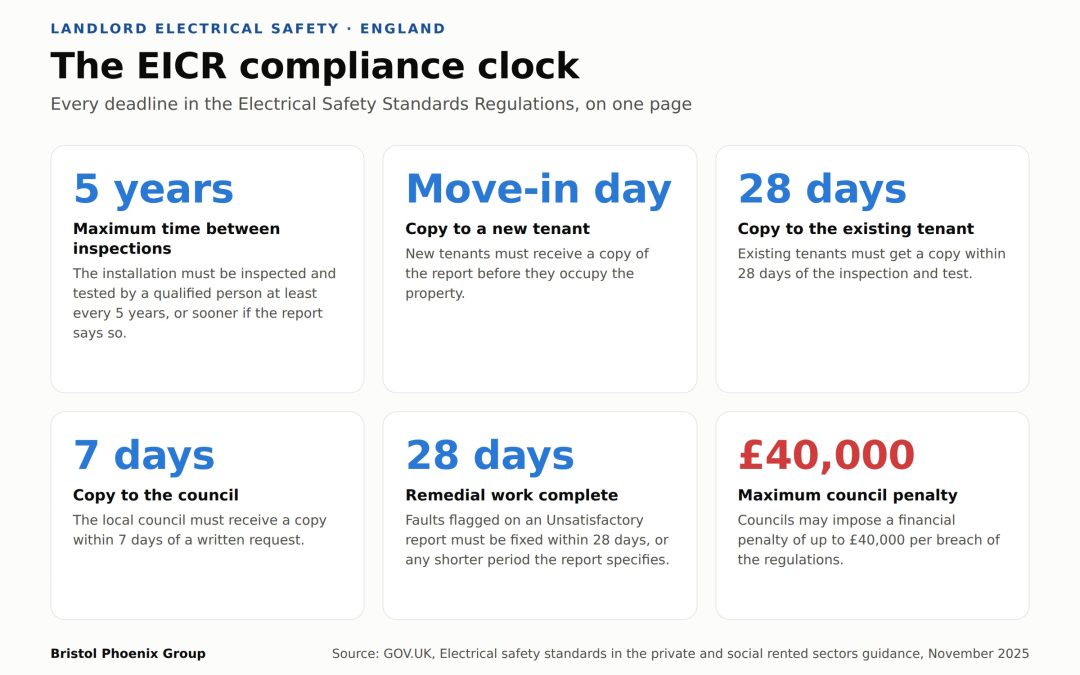
- The deadlines matter: a copy to a new tenant before they move in, to an existing tenant within 28 days of the inspection, to the council within 7 days of a request, and any remedial work finished within 28 days or sooner if the report says so.
- Councils can issue a financial penalty of up to £40,000 per breach.
- Nationally most domestic EICRs cost between £100 and £300. Our own prices are fixed and published: £180 + VAT for a studio, 1 or 2 bed property and £250 + VAT for a typical 3 bed house.
What an Electrical Certificate for Landlords Actually Is
The phrase on everyone’s lips is “landlord electrical safety certificate”, but you will not find that wording in any regulation. The document the law actually asks for is an Electrical Installation Condition Report, or EICR. Same thing, different label. If you want the full anatomy of the report itself, we have a complete guide to what an EICR is, but the short version is this: a qualified electrician inspects and tests the fixed electrical installation in the property and records its condition against the national safety standard, BS 7671.
Fixed installation means the things that are wired in: the consumer unit, the circuits buried in the walls, the sockets, the light fittings, the earthing and bonding. It does not cover the washing machine you left in the kitchen or the lamp the tenant brought with them. The inspection is a proper piece of electrical inspection and testing work with dead tests, live tests and a written schedule of results, not a walk round with a clipboard.
Two details worth pinning down. First, the person doing it must be qualified and competent, which in practice means an electrician registered with a body such as NAPIT or NICEIC who carries the right test equipment and insurance. Second, the output is a report with an overall outcome, Satisfactory or Unsatisfactory, and that single word decides whether you are done for five years or on a 28 day clock. More on that below.
Landlord Electrical Obligations: The Rules in Plain English
The law here is the Electrical Safety Standards in the Private Rented Sector (England) Regulations 2020, and the government’s official guidance was refreshed in November 2025 to cover both private and social landlords. Strip out the legal language and the whole framework fits in five sentences.
The Five Year Cycle
Every rented home in England must have its electrical installation inspected and tested by a qualified person at least every 5 years. The report itself states the date by which the next inspection is due, and that date can be sooner than five years if the installation is older or in poorer condition. Five years is the ceiling, not a guarantee.
Who Gets a Copy, and When
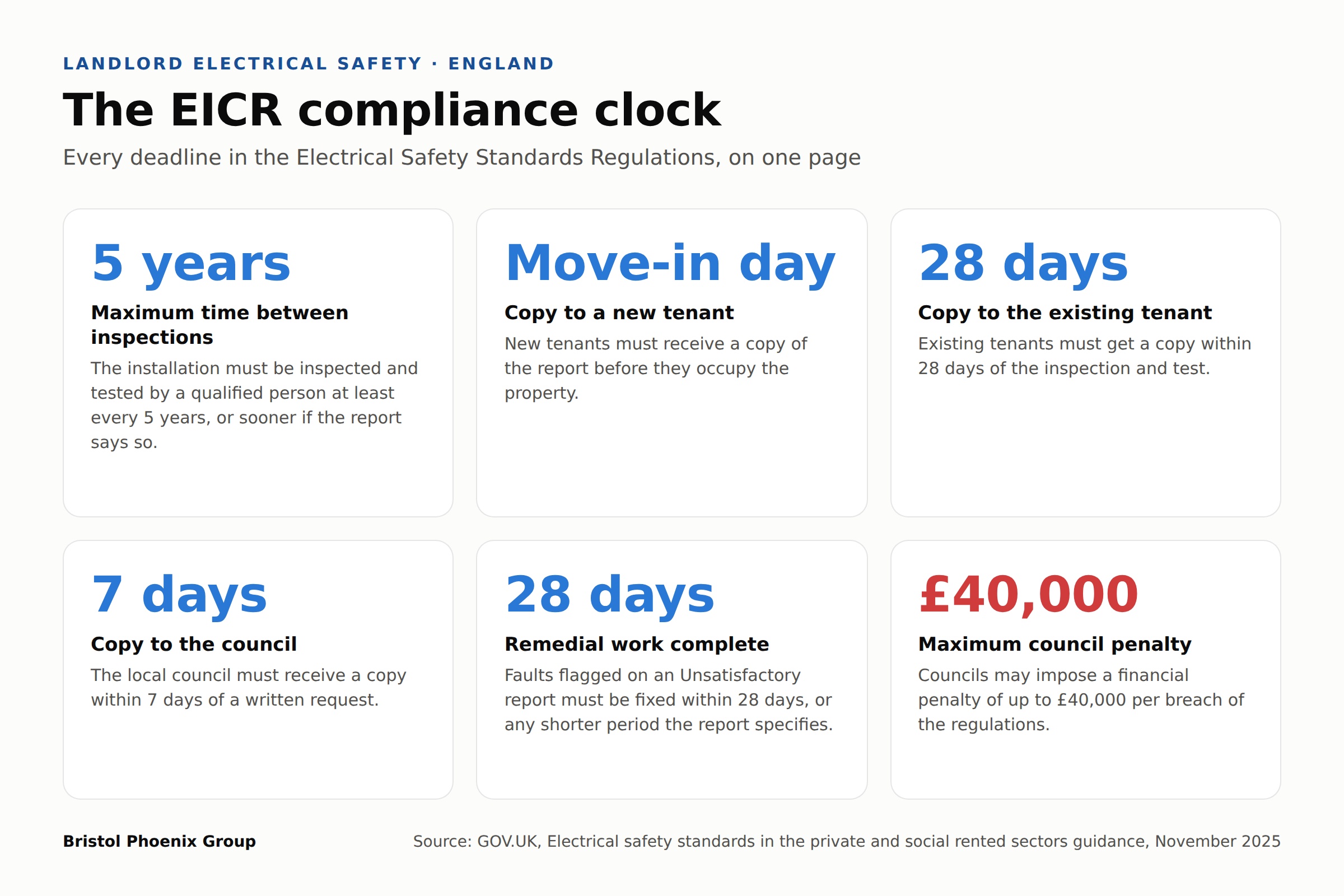
This is where most accidental breaches happen, because the inspection gets done and the paperwork then sits in a drawer. The regulations set out exactly who must receive the report and by when:
| Requirement | Deadline |
|---|---|
| Inspection and test of the installation by a qualified person | At least every 5 years |
| Copy of the report to a new tenant | Before they occupy the property |
| Copy of the report to an existing tenant | Within 28 days of the inspection |
| Copy of the report to the local council | Within 7 days of a written request |
| Copy to any prospective tenant who asks | Within 28 days of the request |
| Remedial work where the report requires it | Within 28 days, or sooner if the report says so |
Keep the report somewhere you can find it. The electrician doing the next inspection will want the previous one, and it makes their job quicker, which tends to make your invoice smaller.
New Tenancies
You do not need a fresh EICR for every change of tenant. A valid report carries across tenancies. What you do need is a valid report in place before a new tenancy starts, with a copy in the new tenant’s hands before they move in. If your report is about to lapse and a new let is about to begin, get the inspection done first. Handing over keys with an expired report is a breach from day one.
What Happens If You Get It Wrong
Enforcement sits with the local council, and the stick is a big one: the guidance confirms councils may impose a financial penalty of up to £40,000 on landlords in breach of their duties. That is per breach, not per property portfolio, so a landlord with no report, no remedial work and no paperwork trail can be looking at more than one penalty on the same house.
The enforcement machinery changed recently too. For offences committed from 1 May 2026, penalties are handled under the civil penalty regime of the Renters’ Rights Act 2025 rather than the older Housing and Planning Act route. The practical effect for landlords is unchanged: the council can fine you a five figure sum for paperwork you could have sorted for less than the cost of a boiler service.
Councils can also arrange urgent remedial action themselves where a landlord fails to act, and recover the cost from the landlord. Ignoring the letter does not make the problem go away, it makes the problem arrive with an invoice attached.
The 2025 and 2026 Changes: Social Housing Joins the Rules
For five years these regulations only applied to private landlords, which produced the odd situation where a housing association tenant had fewer electrical safety rights on paper than the student next door. That gap has now closed. The 2020 regulations were amended to extend the requirements to the social rented sector, and the extension came into force on 1 November 2025.
The rollout works in two stages. The rules apply to social housing tenancies granted after 1 December 2025 straight away. For tenancies that already existed before that date, social landlords have until 1 November 2026 to complete their first inspections. After that first report, the familiar five year cycle applies to everyone.
If you are a private landlord, nothing about your duties changed, but the direction of travel is clear: electrical safety in rented homes is being tightened, not relaxed, and enforcement tends to follow new legislation.
Satisfactory or Unsatisfactory: Reading the Result
Every EICR lands on one of two overall outcomes, driven by the observation codes the electrician records against anything they find:
- C1: danger present, risk of injury. The electrician will make it safe before leaving, and it needs a permanent fix immediately.
- C2: potentially dangerous. Not an emergency at the moment of inspection, but it fails the report.
- FI: further investigation required without delay. Also fails the report until resolved.
- C3: improvement recommended. Does not fail the report. It is advice, not a defect.
Any C1, C2 or FI makes the report Unsatisfactory, and that starts the 28 day clock for remedial work, or a shorter deadline if the report specifies one. Once the work is done, get written confirmation from a qualified person that the installation now meets the standard, and keep that confirmation with the report. A C3 only report is Satisfactory: you are compliant, and the recommendations are yours to take or leave, though taking them is usually cheaper now than in five years.
One thing we say to every landlord: an Unsatisfactory report is not a disaster and it is not a scam. Older rental stock fails first time more often than not, usually on tired consumer units, missing bonding or damaged accessories. The report is doing its job, which is finding the problems while they are still boring.
What an Electrical Certificate for Landlords Costs
Nationally, the price of an electrical certificate for landlords sits in a fairly narrow band. Checkatrade puts most electrical safety checks between £100 and £250 with an average around £200, and MyBuilder’s price guide reports an average of £212 with a typical range of £100 to £300 for domestic properties. Bigger properties with more circuits cost more, because the electrician is testing every circuit, not billing by the hour and hoping.
We have a full breakdown of what an EICR costs and what moves the price, but for our own work in and around Bristol the prices are fixed and published:
| Property | Our fixed price |
|---|---|
| Studio, 1 or 2 bed property | £180 + VAT (£216 inc VAT) |
| 3 bed house | £250 + VAT (£300 inc VAT) |
| 4 bed house | £300 + VAT (£360 inc VAT) |
| 5 bed house | £350 + VAT (£420 inc VAT) |
| HMOs and larger homes | Quoted after a quick chat, from £350 + VAT |
Remedial work is priced separately, quoted before anything is done, and only ever for what the report actually requires. Spread over the life of the certificate, a £216 inspection on a two bed flat works out at just over £43 a year, which is one of the cheaper line items on any landlord’s spreadsheet.
A word of caution on bargain certificates. An EICR priced at £60 for a three bed house is not a bargain, it is a document typed up quickly. If the firm is not on the NAPIT or NICEIC register, the report may not satisfy your council, your insurer or your letting agent, and you will end up paying twice.
Landlord Electrical Safety Certificate Bristol: The Local Picture
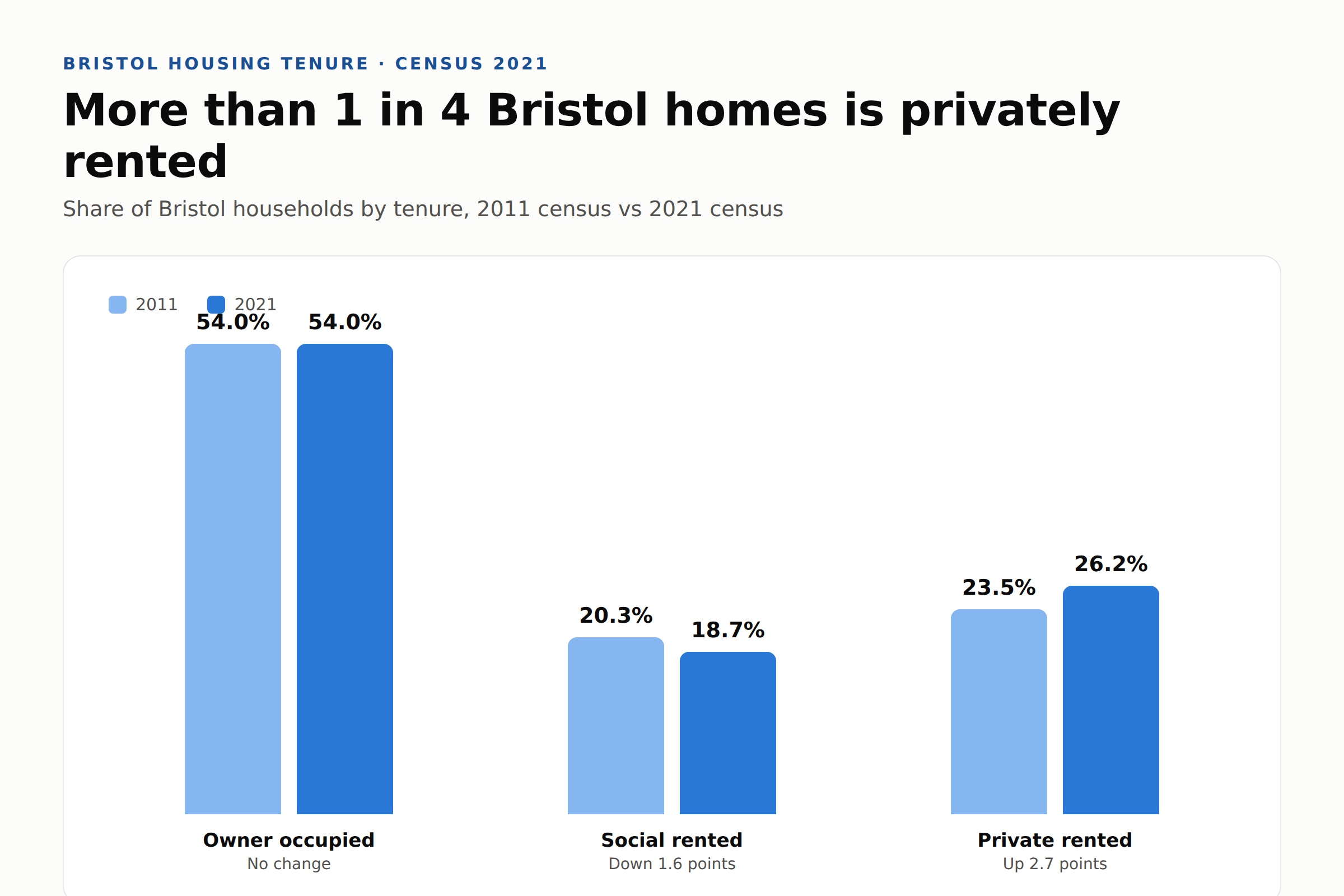
Bristol is a renting city, and it is becoming more of one. At the 2021 census, 26.2% of Bristol households rented privately, up from 23.5% a decade earlier, and the city sits in the top quarter of English local authorities for social renting at 18.7%. That is a lot of EICRs, and the first big wave of reports from the 2020 and 2021 compliance rush is expiring around now, which is why our phone has been busier with landlords this year than ever.
Much of the rental stock on our patch is Victorian and Edwardian terracing, and those houses have their own habits: rewires done in stages over decades, consumer units in odd cupboards, extensions with one circuit too many. None of that is a problem for the inspection, but it is why a local firm that sees the same housing stock every week tends to produce quicker, calmer reports than a certificate mill working from a call centre.
We are a NAPIT approved contractor based in South Bristol, and we carry out landlord electrical safety certificate work across the city: Bedminster, Southville, Totterdown, Windmill Hill, Knowle, Brislington, Bishopsworth, Hartcliffe, Whitchurch, Stockwood and Hengrove, plus Long Ashton and the villages south of the city. If your postcode starts BS3, BS4, BS13, BS14 or BS41, you are in our core patch. Booking is simple: fixed prices, dated report, reminder before the next one is due. Start on our EICR Bristol page and you will see exactly what you will pay before you get in touch.
A Worked Example: One Bedminster Terrace, Start to Finish
Picture a landlord with a two bed Victorian terrace off North Street in Bedminster. The tenancy renews in October, the existing EICR is dated September 2021, and the letting agent has sent one of those cheerful emails pointing out that the report expires before the new tenancy starts.
- Booking. The landlord books an inspection for early September. For a property this size the fixed price is £180 + VAT, and the tenant is given notice of the visit in the usual way.
- Inspection day. Two to three hours on site: consumer unit opened, circuits tested dead and live, sockets and fittings sampled, earthing and bonding checked. The tenant loses power for part of the visit, which is the price of a proper test.
- The result. The report comes back Unsatisfactory. One C2 for a cracked socket faceplate behind the sofa and one C2 for missing bonding to the gas pipework, plus a C3 recommending blanking plates on the old fuse board cupboard. Annoying, but typical for the age of the house.
- Remedial work. The two C2 items are quoted, approved and fixed on a single return visit inside a fortnight, comfortably within the 28 day limit. The landlord receives written confirmation that the installation now meets the standard.
- Paperwork. The tenant gets a copy of everything within 28 days of the inspection, and the incoming tenant gets a copy before they move in. Both go in the same folder as the gas safety record and the deposit paperwork.
Total cost, inspection plus modest remedials, comfortably under £400. Total protection: five years of compliance, a safer installation, and nothing for the council to find. Compare that with the alternative timeline where the expired report is discovered by the council after a tenant complaint, and the £40,000 ceiling stops being a piece of trivia.
Common Questions
Is a landlord electrical safety certificate the same as an EICR?
Yes. Letting agents, councils and insurers use the phrases interchangeably. The legal document is the EICR, and any electrician offering an EICR for landlords is producing the report the regulations require.
Do I need a new certificate every time the tenant changes?
No. A valid report carries across tenancies. Your duties are to have a valid report at all times, to give the new tenant a copy before occupation, and to renew by the date stated on the report, which will be five years at most.
Does the certificate cover appliances I provide?
No. The EICR covers the fixed installation only. Appliances you supply, like a cooker or washing machine, sit outside the report, though you still have a general duty to make sure anything you provide is safe.
What about HMOs?
HMOs are covered by the same regulations, and HMO licensing usually adds its own conditions on top. The inspection itself takes longer because there are more circuits and often fire alarm and emergency lighting circuits to consider, which is why HMO pricing starts higher.
I am a landlord in Wales or Scotland. Does this apply to me?
These regulations apply to England. Scotland and Wales run their own schemes with the same five year rhythm, but the paperwork and enforcement differ.
My report is due soon. How early can I renew?
Any time. There is no penalty for inspecting early, and lining the new report up with a tenancy change often saves a headache later. The five years runs from the new inspection date, so you lose nothing.
Final Thoughts
The electrical certificate for landlords is one of the simpler compliance duties a landlord has: one report, every five years, with clear deadlines for who gets a copy and how fast problems must be fixed. The rules have just been extended to social housing, the maximum penalty now stands at £40,000, and enforcement is only moving in one direction. Sorting it is cheap, quick and, with the right firm, painless.
If you have a rental property in Bristol and the renewal date is approaching, or you have no idea where the current report is, we can help. Fixed prices, NAPIT registered inspectors who know South Bristol’s housing stock street by street, and remedial work quoted fairly before anyone lifts a screwdriver. Have a look at our fixed price EICR service or get in touch and we will take the whole thing off your list.