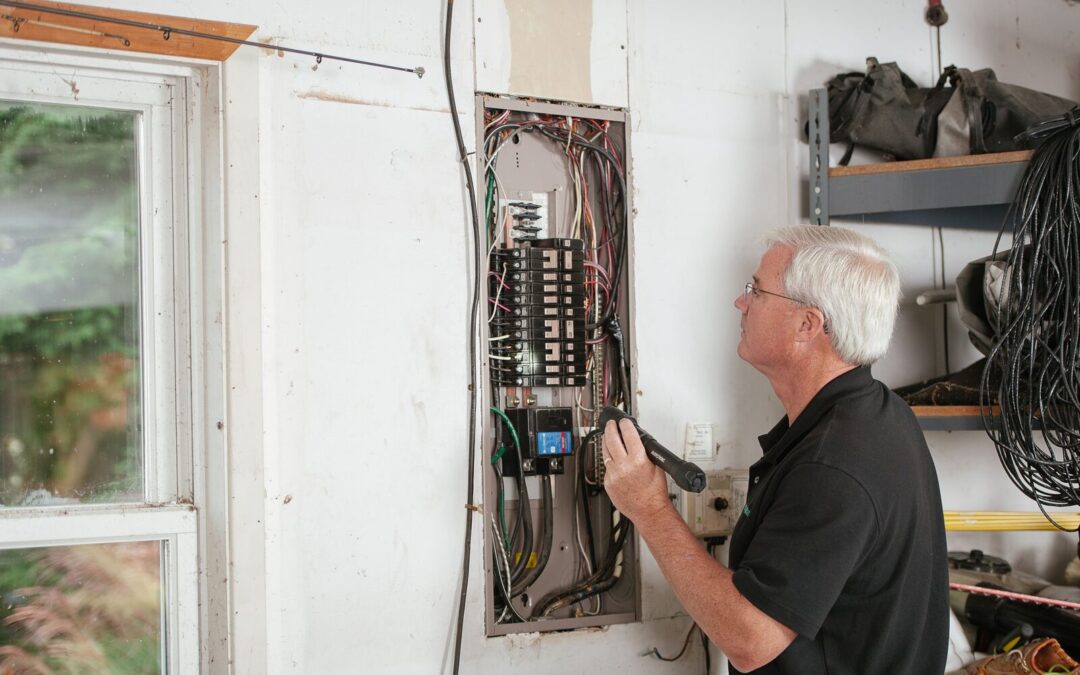
Four letters land in an inbox or a tenancy agreement, and most people nod along without knowing what they mean. An EICR shows up on a mortgage checklist, a landlord compliance email, or a fuse board sticker, and the natural reaction is to Google it rather than ask. It’s a fair reaction too. Almost eight in ten UK adults (79%) say they feel confident their home is electrically safe, yet fewer than a third have actually had their household electrics checked by a qualified electrician within the past decade, according to the Institution of Engineering and Technology. What does EICR stand for, exactly? We’ll break down what those letters mean, what the report checks, and why it carries more weight than most paperwork sitting in a property file.
Table of Contents
- What Does EICR Actually Stand For
- What an EICR Actually Checks
- EICR vs Other Electrical Paperwork
- Who Needs an EICR and When It’s Legally Required
- Understanding EICR Classification Codes
- How Long an EICR Lasts and When to Renew
- What an EICR Costs and What Affects the Price
- Choosing a Qualified Person to Carry Out Your EICR
- What Happens If You Ignore an EICR Requirement
- Final Thoughts
TL;DR
- An EICR certificate stands for an Electrical Installation Condition Report, a formal check of a property’s fixed wiring, consumer unit, sockets, and earthing.
- It’s a legal requirement for private and social landlords in England. If you’re wondering how long does an EICR last, the answer is five years at most before it needs renewing.
- Reports are marked Satisfactory or Unsatisfactory, with C1, C2, C3, and FI codes showing how urgent any faults are.
- Costs typically range from around £100 to £300 depending on property size and circuit count.
- Only a qualified, registered electrician should carry one out, since the certificate needs to hold up with insurers, tenants, and local authorities.
What Does EICR Actually Stand For
So, what does EICR stand for? EICR stands for Electrical Installation Condition Report. Break the phrase into its four parts and the purpose becomes obvious: it’s a report on the condition of an electrical installation. Not appliances, not extension leads, the fixed wiring and equipment built into a property. The term is defined and governed by BS 7671, the IET Wiring Regulations (currently the 18th Edition), and that’s the technical standard every registered electrician tests against, the same standard behind our electrical testing services.
The terminology gets muddled in everyday conversation. People talk about an “electrical safety certificate,” an “EICR test,” or “fixed wire testing,” and whichever version you hear, they’re all answering the same question: what does EICR stand for. The EICR meaning underneath stays identical no matter which label someone reaches for.
Where the Term Comes From
Older homeowners or landlords might still say “periodic inspection report,” which was the phrase used before EICR became standard. The underlying purpose, and the EICR meaning behind it, hasn’t changed. Only the name and the technical detail shifted, alongside updates to BS 7671 itself.
EICR Meaning in Plain English

Strip away the jargon and an EICR is a health check for a building’s electrics, carried out by someone qualified to spot what an untrained eye would miss. The practical output is several pages listing what was tested, what passed, what didn’t, and what needs attention. It’s not a certificate of perfection. It’s a snapshot of condition against a defined safety standard on a specific date, nothing more, nothing less.
What an EICR Actually Checks
What actually happens during an inspection? It covers the consumer unit (fuse board), the fixed wiring running through walls and floors, socket outlets, light switches, and the earthing and bonding that protects against electric shock. The process starts with a visual inspection, then moves into dead testing (power off) and live testing (power on) using calibrated equipment to check insulation resistance, earth continuity, and polarity. Whatever the electrician finds gets written straight into your EICR certificate, which is why it helps to know what’s actually being checked before the report lands in your inbox.
The Fixed Wiring and Consumer Unit
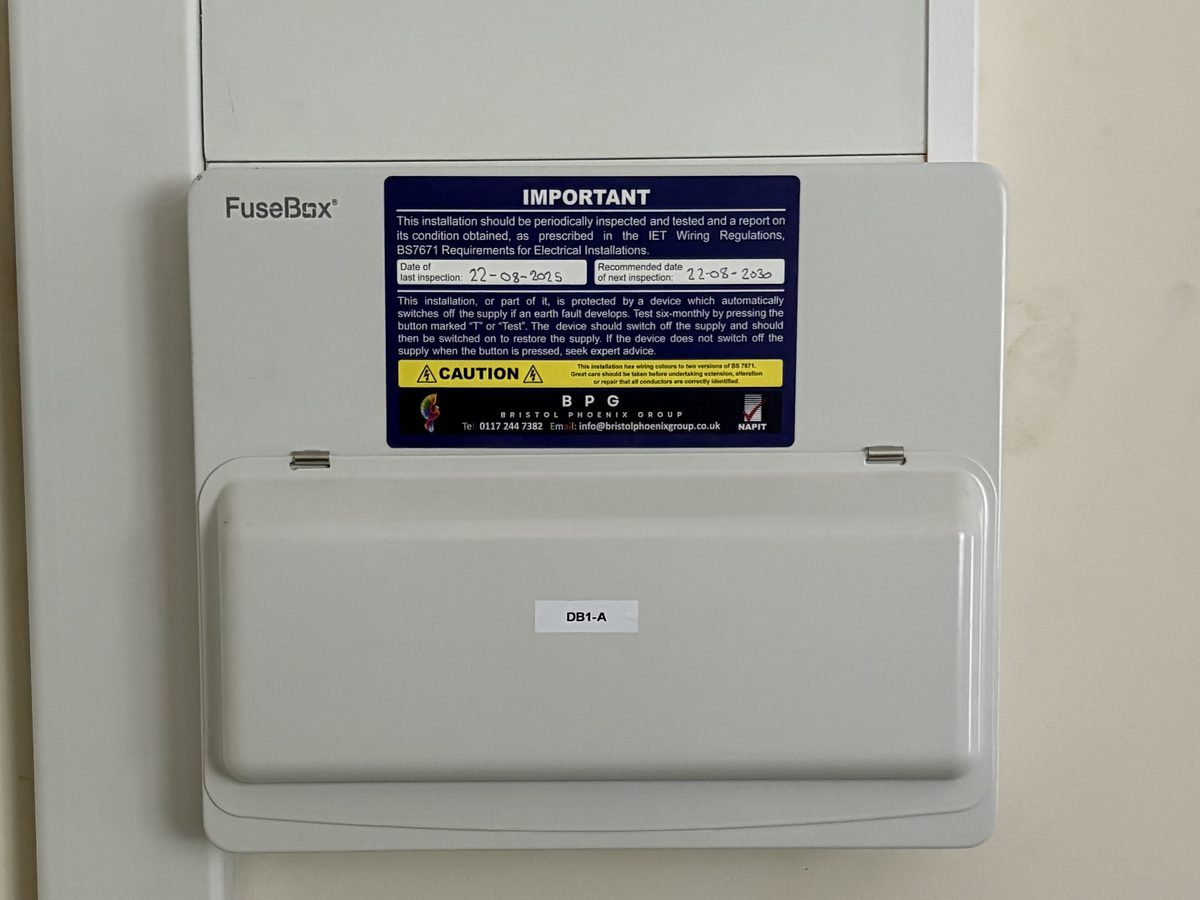
Inspectors look at correct labelling, appropriate circuit breakers, evidence of overheating or scorching, and whether the unit itself meets current standards. A property’s wiring age influences findings more than people expect. Older rewires often show issues that were compliant at the time but no longer meet 18th Edition requirements.
Take a three-bedroom semi last rewired in the late 1990s. It comes through inspection with a consumer unit that was fully compliant when it was fitted. Two decades on, it lacks the RCD protection now required on most circuits under the current edition of BS 7671, an issue that wouldn’t have existed on paper in 1998 but shows up as a C2 today. We see this exact scenario often, a unit that was textbook-compliant the day it was fitted, quietly out of step with the rules a few years later. Twenty years is a long time in wiring regulations. At that point, a consumer unit upgrade is usually the more sensible fix than patching round it circuit by circuit.
Sockets, Switches, and Earthing

At the smaller scale, inspectors check sockets for damage, correct polarity, and signs of overloading (the one someone meant to replace “temporarily” three tenants ago tends to stand out), and switches for wear or incorrect installation. Earthing and bonding matter here too: think of it as the safety net that redirects a fault to ground instead of through a person, which is why its absence or damage gets treated seriously.
What Falls Outside an EICR’s Scope
An EICR doesn’t cover plug-in appliances, extension leads, or portable equipment, since those fall under separate testing (PAT). A common misconception is that an EICR guarantees every appliance in a property is safe. It doesn’t. Conflating the two leaves real gaps in what landlords think they’ve covered, and that gap tends to surface at the worst possible moment.
EICR vs Other Electrical Paperwork
Property paperwork gets confusing fast. Multiple certificates sound similar but serve different purposes, and the table below lays out the difference between an EICR and the documents people most often mix it up with.
| Certificate | Covers | Who Carries It Out | How Often |
|---|---|---|---|
| EICR | Fixed wiring, consumer unit, sockets, earthing | Qualified, registered electrician | At least every 5 years (rented property) |
| PAT Testing | Portable plug-in appliances | Competent person (narrower training than a full electrician) | Typically annual in higher-risk settings |
| Electrical Installation Certificate (EIC) | New electrical work only | The qualified electrician who carried out the work | Once, at completion of new work |
EICR vs PAT Testing

An EICR vs PAT testing comparison comes up constantly, and the line between them is simple once you see it: EICR covers the fixed installation, PAT covers the plug-in items, kettles, extension leads, portable heaters. A qualified electrician carries out an EICR. A competent person with narrower training usually handles PAT. Landlords with furnished lets often need both, not one instead of the other.
This is where it trips people up in practice. A landlord with a fully furnished flat keeps a valid, Satisfactory EICR on file and assumes that covers everything. During a routine council inspection, it turns out none of the appliances supplied with the property, kettle, toaster, microwave, had ever been PAT tested. The EICR alone doesn’t satisfy that obligation, and the gap only surfaces when someone actually checks.
EICR vs a New-Installation Certificate
An EICR assesses existing wiring. An Electrical Installation Certificate gets issued after new work, a rewire, a consumer unit swap, an extension’s first fit. One certifies new work meets standard on day one. The other checks how an installation has held up since. A new-build’s installation certificate from a full rewire or new-build installation doesn’t substitute for an EICR once years pass or the property changes hands. If you’re eyeing up somewhere with recent electrical work done, ask which of the two certificates you’re actually being shown.
Who Needs an EICR and When It’s Legally Required
EICR for landlords is a legal requirement, and the rules differ sharply from what applies to owner-occupied property. Beyond the legal minimum, practical trigger points, a new tenancy, a property sale, a mortgage requirement, an insurance renewal, tend to push an EICR up the priority list even where it isn’t strictly mandated.
Private Landlords in England
The Electrical Safety Standards in the Private Rented Sector (England) Regulations 2020 became mandatory on 1 July 2020 for new tenancies and 1 April 2021 for existing ones. Landlords must have the installation inspected at least every five years, provide tenants with a copy of the report within 28 days, and supply the local authority with a copy within seven days if requested. This is exactly the gap landlord electrical safety certification is built to close, and it’s worth having a simple system for staying on top of it rather than relying on memory (not the same folder as the boiler certificate, ideally, though we’ve seen that happen too).
Landlord EICR Compliance Checklist:
- Book an inspection with a registered, qualified electrician.
- Confirm the inspection date and diarise the five-year renewal.
- Provide a copy of the report to tenants within 28 days of the inspection.
- Provide a copy to the local authority within 7 days if requested.
- Action any C1, C2, or FI codes, then get written confirmation the remedial work is complete.
- Keep the report and any remedial confirmation on file as compliance evidence.
Social Housing and Recent Rule Changes
EICR for landlords rules aren’t staying confined to the private rented sector for much longer. Social housing is catching up fast. In its government response published in June 2025, GOV.UK confirmed that social landlords will face the same five-yearly inspection duty as private landlords, plus mandatory in-service testing of any appliances they supply. The changes take effect for new tenancies from November 2025 and existing tenancies from May 2026. There’s a connection to Awaab’s Law here too, which sets fixed timeframes for social landlords to fix hazards, electrical faults included, so the direction of travel across both sectors is the same.
Homeowners and Property Buyers or Sellers
No legal requirement exists for owner-occupiers, but industry bodies recommend a check every ten years, or sooner after a flood, fire, or visible fault. Buyers frequently request one before completion, and mortgage lenders sometimes ask for evidence of a recent inspection on older properties. When was the last time anyone actually looked behind your sockets?
Understanding EICR Classification Codes
What does EICR stand for in terms of the actual findings you’ll see written down? This is where most confusion sits once someone receives a report. Inspectors use four EICR codes, and each one means something specific.
What Satisfactory and Unsatisfactory Actually Mean

There’s no pass or fail here, only Satisfactory or Unsatisfactory. A report becomes Unsatisfactory if it contains any C1, C2, or FI code among the EICR codes listed. A C3 alone, an improvement recommendation, still results in a Satisfactory outcome, which surprises people expecting any flagged issue to fail the report outright.
| Code | Meaning | What It Requires |
|---|---|---|
| C1 | Danger present | Immediate risk to life; often made safe on the spot during the inspection |
| C2 | Potentially dangerous | Urgent remedial action, typically within 28 days for rented property |
| C3 | Improvement recommended | Not dangerous; advisory only, doesn’t affect a Satisfactory outcome |
| FI | Further investigation required | Additional inspection needed to determine if a dangerous condition exists |
What Happens After a C1 or C2
Of the four EICR codes, C1 and C2 are the two that demand action. C1, danger present, often gets made safe on the spot during the inspection itself, since it poses immediate risk. C2, potentially dangerous, requires urgent remedial work, and under PRS regulations, landlords have 28 days to sort it and supply written confirmation the work is done. FI means exactly that: more digging needed before anyone can say whether it’s dangerous. On site, we’d rather flag a C2 early and have that slightly awkward phone call than watch it drift toward a C1 nobody’s dealt with.
Government figures put this in context. There were 22,877 accidental dwelling fires in England in the year ending March 2025, and misuse of equipment or appliances was a factor in 29% of them, a share that’s stayed virtually unchanged year on year, according to the Home Office’s detailed fire statistics. That’s the backdrop against which a C2 stops being a bureaucratic inconvenience and becomes exactly what it was always meant to flag: a genuine hazard.
Picture a routine five-year renewal on a rented terrace that turns up a C2 on the consumer unit, evidence of overheating around one of the breakers. The tenant stays in the property throughout. The landlord gets a remedial quote within a week, the work’s done inside the 28-day window, and the electrician issues written confirmation that gets filed alongside the original report. Straightforward, once you know the steps.
How Long an EICR Lasts and When to Renew
How long does an EICR last? It’s one of the most common follow-up questions once someone understands what the report actually is, and the timeframes are more specific than people assume. If you want the full picture on timings, we have covered how long an EICR takes in detail.
The Five-Year Rule for Rented Property
Five years is the legal maximum interval for privately rented and, under the new rules, social housing too, though an inspector can specify a shorter interval if the installation’s condition warrants closer monitoring. If you’re still asking how long does an EICR last on your particular property, check the report itself first, since a shorter interval overrides the general five-year default. A change of tenant doesn’t reset the clock. The five years runs from the inspection date regardless of who’s living there at the time.
Why Older EICRs Are Starting to Fail Modern Standards

A pattern’s showing up right now. EICRs issued in 2020 and 2021, right when the PRS regulations first took effect, are reaching their EICR renewal date, and the renewals themselves are increasingly flagging C2 codes under updated BS 7671 requirements. Modern loads like EV chargers and heat pumps strain installations that were compliant a few years ago but haven’t been upgraded since. Often the simplest fix is upgrading an older consumer unit before it becomes a recurring C2 on every future EICR renewal. For the full picture, see our guide to EICR renewal.
Industry commentary from Property118 has flagged this exact renewal wave colliding with the abolition of Section 21 no-fault evictions on 1 May 2026. That matters practically because landlords can no longer simply remove a tenant who’s making access for a renewal inspection difficult, and instead need to document reasonable attempts to gain entry. Two separate compliance headaches, arriving at the same time, for the same landlords.
What an EICR Costs and What Affects the Price
Pricing on this varies more than most comparable trades work, so it’s worth having a realistic EICR cost range in mind before you book anything.
Typical Price Ranges

Smaller flats start around £100. An average three-bedroom house lands between £150 and £250. Larger or older properties run higher, and commercial premises get priced separately, typically costing more due to circuit count and complexity.
A one-bed flat with a modern consumer unit and eight circuits takes under two hours to inspect and lands near the bottom of that range. A five-bedroom Victorian conversion with a mix of original and rewired circuits, split across three consumer units, takes most of a working day and costs considerably more. Not because the electrician’s charging extra for the postcode, but because there’s simply more to test.
What Makes Costs Go Up
Circuit count, property size, wiring age and accessibility (boxed-in period cabling takes longer to inspect), and whether remedial quotes get bundled into the visit all affect your final EICR cost. Unusually cheap quotes sometimes mean a rushed inspection, so check what’s included before booking on price alone. If a quote folds in wider building and renovation work, ask for that broken out separately from the inspection fee so the two quotes are easy to compare side by side.
What Your EICR Quote Should Include:
- Confirmation of registration body (NICEIC, NAPIT, or equivalent)
- Proof of current public liability insurance
- The number of circuits covered by the quoted price
- Whether the written report itself is included or charged separately
- Expected turnaround time for the report
- Whether remedial work quotes, if needed, are itemised separately from the inspection fee
Choosing a Qualified Person to Carry Out Your EICR
The person doing the inspection matters as much as the inspection itself. An EICR certificate only holds legal and insurance weight if it comes from someone properly qualified and registered.
Why Registration Matters
Competent person schemes like NICEIC and NAPIT exist for a reason. A report from a registered electrician carries more credibility with local authorities, insurers, and letting agents than one from an unregistered tradesperson, and it’s the difference between a genuine EICR certificate and a piece of paper that won’t hold up if it’s ever challenged. The risk with an unqualified inspection isn’t abstract either, it’s a landlord relying on an invalid report and only finding out after an incident, which is precisely the moment nobody wants to discover a gap in their paperwork. Our qualified rewiring team holds itself to that exact benchmark on every new installation too.
Questions Worth Asking Before You Book
A few practical questions save headaches later. Which registration body are you with? Are you insured? What’s included in the quoted price? What’s the turnaround time for the written report? None of this is awkward to ask. Any electrician worth booking answers these without blinking.
What Happens If You Ignore an EICR Requirement
Skip or delay a required inspection and the consequences aren’t theoretical, not for EICR for landlords and increasingly not for social landlords either.
Financial Penalties for Landlords

The financial side of EICR for landlords compliance comes down to hard numbers. Local authorities can issue a civil penalty of up to £30,000, increased to up to £40,000 from 1 November 2025, for breaching electrical safety duties. Councils can also arrange remedial work themselves and recover the cost from the landlord directly, which tends to cost considerably more than booking an EICR certificate through a registered electrician in the first place.
The Bigger Risk Behind the Paperwork

Fines aside, this is the underlying reason the rule exists. Around 19,300 accidental domestic fires linked to electricity happen in the UK each year, accounting for roughly 53% of all accidental house fires in England, according to data reported by the Institution of Engineering and Technology. We’d rather have an awkward conversation about a repair bill than have a landlord find out the hard way what an uninsured claim looks like. An EICR isn’t a compliance box-tick dressed up as paperwork. It’s a genuine safety measure, and treating it as anything less misses the point entirely.
Final Thoughts
Knowing what does EICR stand for is one thing. Acting on it is another. For landlords juggling renewal dates or homeowners who’ve never had one done, the sensible next step is booking with someone locally registered rather than guessing at compliance.
That’s where we come in. We know how easy it is to lose track of a five-year renewal date buried in a filing cabinet, and how frustrating it is chasing quotes from strangers who might not even be properly registered. As a NAPIT-approved team based in South Bristol, we handle EICRs for landlords, homeowners, and buyers across the city without the runaround. If you’re not sure when your last inspection was, or you’ve never had one done, the easiest way to stop guessing is to get in touch with our team and get a date in the diary.
An EICR isn’t paperwork for its own sake. It’s an honest read on whether a property’s electrics are safe to live with, regardless of what the calendar says about your next renewal.