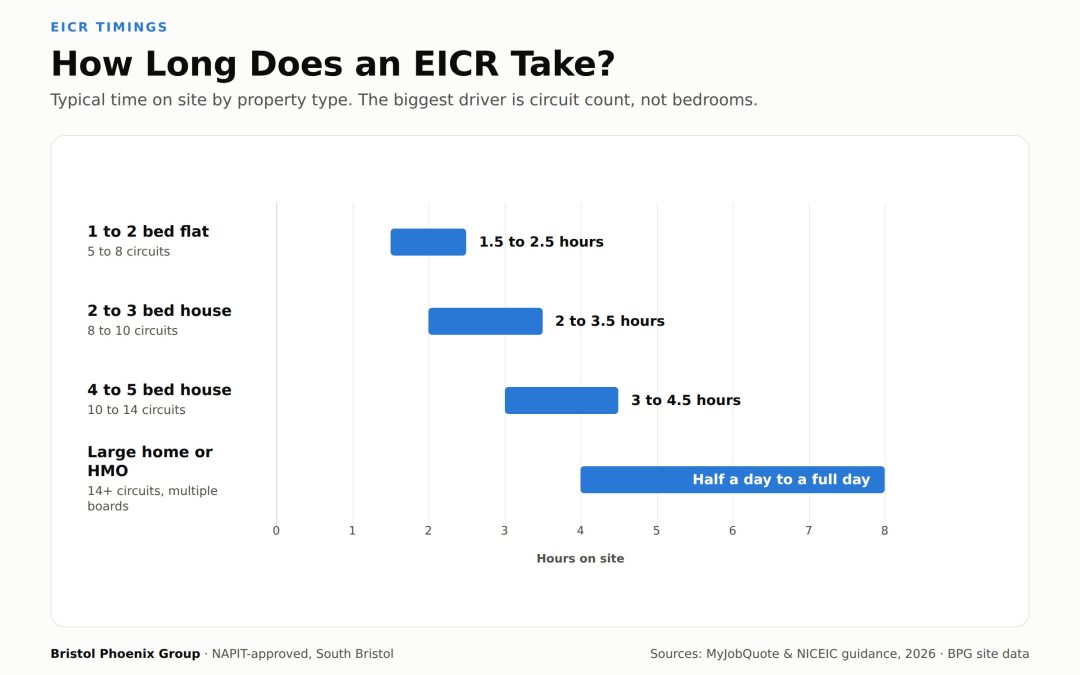
It’s the second question everyone asks when booking an electrical inspection, right after the price. You need to know whether to book a morning off work, warn the tenants, or clear the diary for the whole day. So, how long does an EICR take? For most UK homes, the honest answer is 2 to 4 hours, and current trade data from MyJobQuote backs that up for an average sized property. But averages hide a lot. A one bed flat with a modern board is a very different job from a five bed Victorian conversion with three consumer units, and the gap between those two visits can be a full working day. Here’s how the timings actually break down, property by property, and what makes an inspection run long.
Table of Contents
- How Long Does an EICR Take on Average
- EICR Duration by Property Type
- What Happens on the Day, Hour by Hour
- Will the Power Go Off During an EICR
- What Slows an EICR Down
- Access Tips for Landlords and Tenants
- How Long Until the Report Arrives
- A Worked Example: Timing a Three Bed Terrace
- Final Thoughts
TL;DR
- How long does an EICR take? Most homes sit between 2 and 4 hours, with small flats at the quick end and large or older houses at the slow end.
- The single biggest factor is circuit count, not bedrooms. Every circuit gets tested individually, so ten circuits simply take longer than six.
- Expect the power to go off in stages during dead testing, usually circuit by circuit rather than the whole house at once.
- Unlabelled fuse boards, boxed-in wiring, blocked sockets and missing paperwork are the four things most likely to add an hour or more.
- The written report typically follows within a couple of working days, and for rented property in England the landlord must pass it to tenants within 28 days.
How Long Does an EICR Take on Average
The trade consensus is fairly tight on this. MyJobQuote’s current cost guide puts an EICR at between 2 and 4 hours for an average sized home. NICEIC’s guidance is a touch more cautious, putting it at a few hours for a small domestic property through to a full day, or even several days, for the largest premises. Both are right, they’re just describing different ends of the same spread.
That spread exists because an EICR isn’t a quick glance at the fuse board. As we covered in our guide to what an EICR actually is, the inspection covers the consumer unit, the fixed wiring, sockets, switches, and the earthing and bonding, with every circuit tested individually using calibrated instruments. The EICR duration for your property is really just the sum of those individual circuit tests plus the visual inspection around them. More circuits, more time. It’s arithmetic, not mystery.
One thing worth saying early: a suspiciously fast EICR is a bigger worry than a slow one. If someone claims they can properly inspect and test a three bed house in 45 minutes, most of those circuits were never tested. Speed is only a virtue up to the point where the testing stops being real.
EICR Duration by Property Type
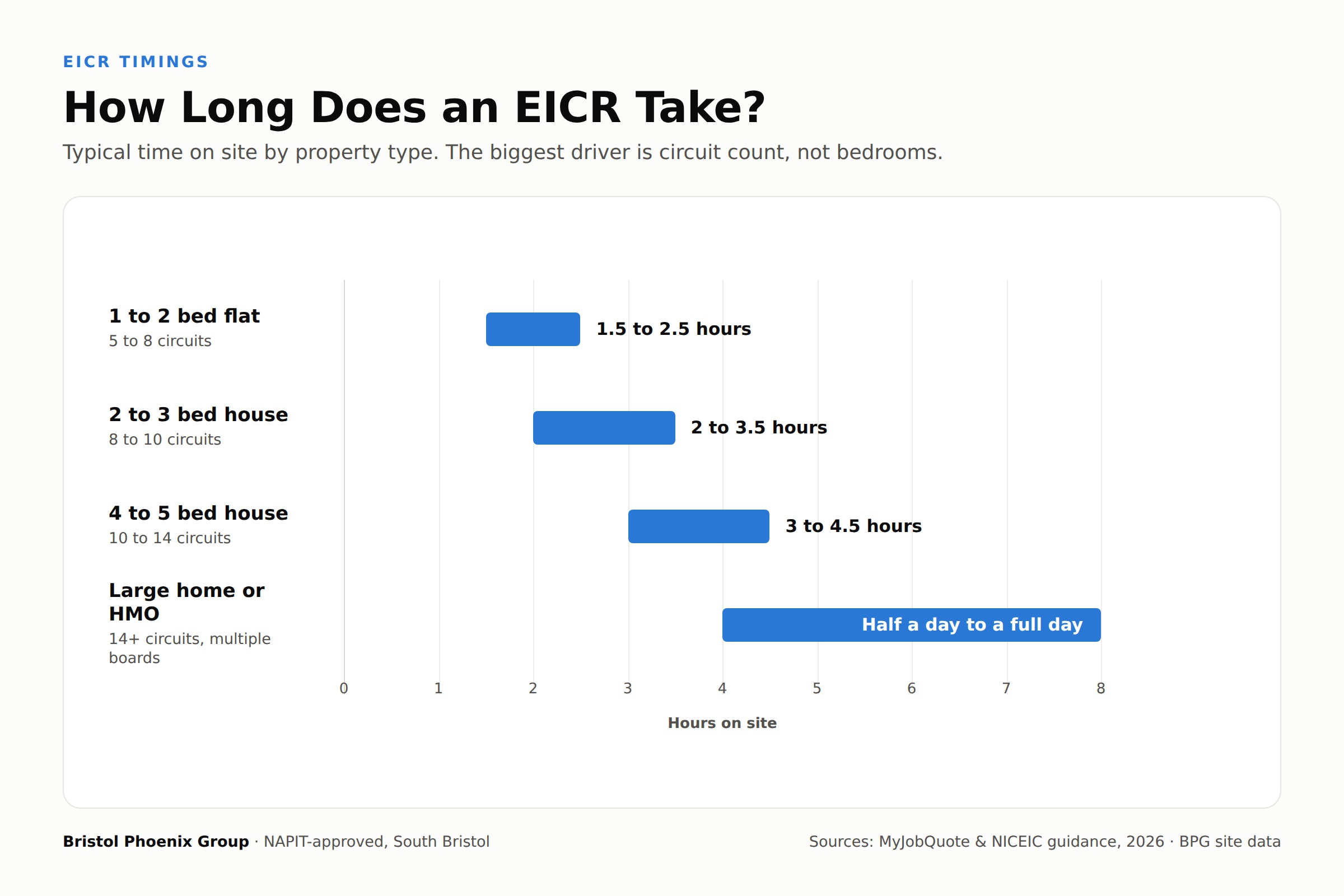
Bedrooms are a rough proxy for circuit count, so they’re a reasonable way to estimate timings, as long as you remember that extensions, loft conversions, garden offices and electric showers all add circuits without adding bedrooms. Here’s what we’d expect on site, which lines up with the ranges in our EICR cost guide.
| Property type | Typical duration | Typical circuit count |
|---|---|---|
| 1 to 2 bedroom flat | 1.5 to 2.5 hours | 5 to 8 |
| 2 to 3 bedroom house | 2 to 3.5 hours | 8 to 10 |
| 4 to 5 bedroom house | 3 to 4.5 hours | 10 to 14 |
| Large home, HMO or multiple boards | Half a day to a full day | 14 plus, often across 2 or 3 boards |
Flats and Smaller Homes
A modern one bed flat is the quickest EICR there is. Five or six circuits, one compact consumer unit, everything within a few metres of everything else. An experienced inspector can be done in well under two hours without cutting a single corner. Older flats in converted buildings are the exception, since conversions often carry odd wiring arrangements and shared supplies that need untangling before testing can even start.
Terraces and Three Bed Semis
This is the bread and butter inspection, and the reason the 2 to 4 hour figure gets quoted so often. A typical three bed terrace or semi carries eight to ten circuits: lighting up and down, a ring or two of sockets, cooker, shower, maybe a garage or garden supply. Around Bristol, where a huge share of the housing stock is Victorian and Edwardian terracing, the age of the installation matters as much as the size. A 1990s rewire tests quickly. Original rubber or early PVC cabling, less so.
How Long Does an EICR Take for Larger Homes and HMOs
Five bedrooms and up, or any house in multiple occupation, and you should plan for half a day at minimum. More circuits, more accessories to open up and check, and often more than one consumer unit in different parts of the building. HMOs add fire alarm circuits and emergency lighting to the list. A large or older property can absorb a full day, which is exactly the spread NICEIC describes, and nobody doing the job properly will apologise for that.
What Happens on the Day, Hour by Hour
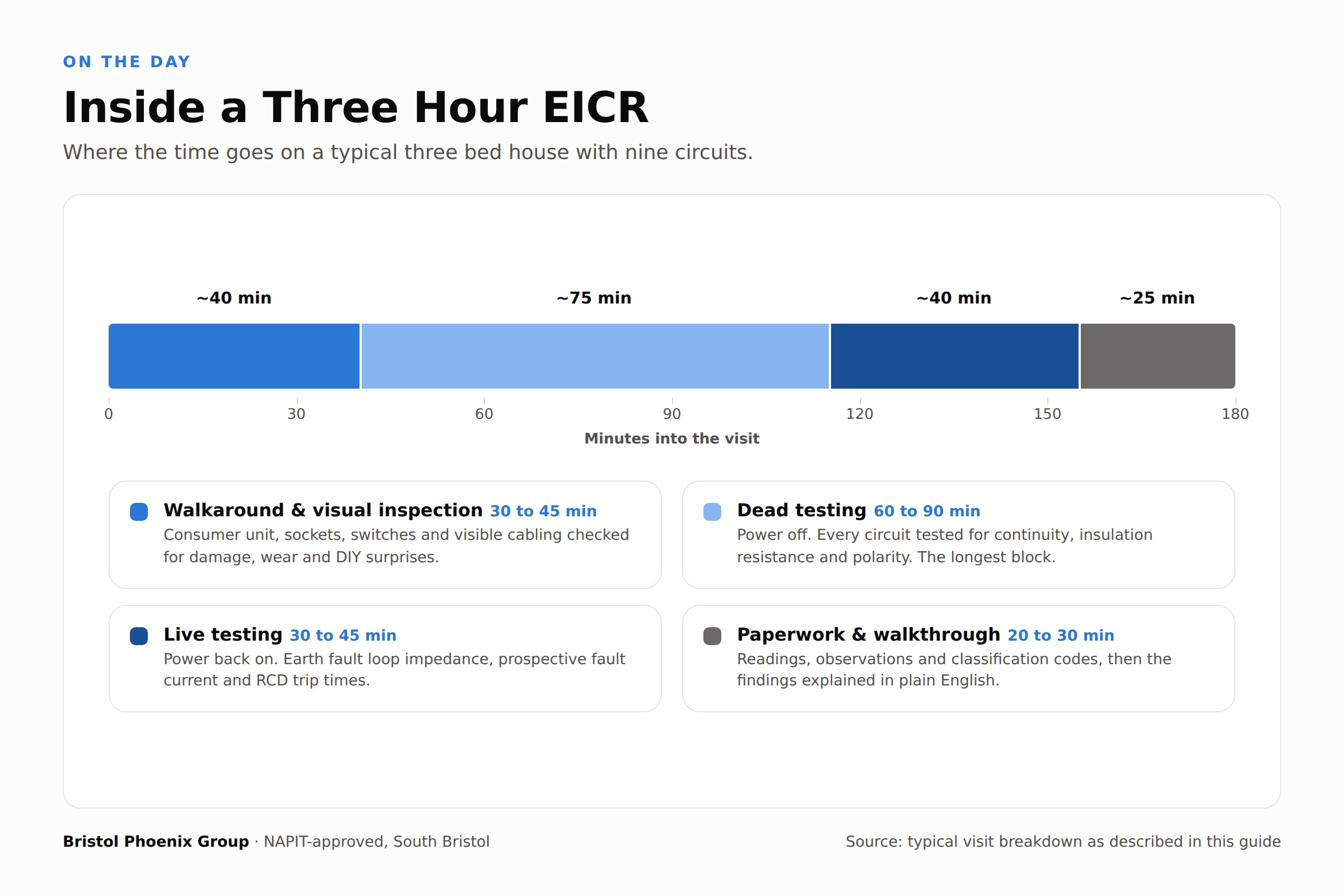
Knowing where the time goes makes the whole thing less mysterious, and it also explains why the quick quotes can’t be doing the full job. On a typical three bed house running to about three hours, this is roughly how the visit breaks down for us.
The Walkaround and Visual Inspection
The first 30 to 45 minutes is looking, not testing. The inspector checks the consumer unit for labelling, scorching and appropriate protective devices, then walks the property checking sockets, switches, light fittings and visible cabling for damage, wear, DIY surprises and signs of overheating. A good visual inspection shapes the rest of the visit, because anything that looks wrong gets extra attention during testing.
Dead Testing
The longest block, usually 60 to 90 minutes on that same three bed house. Power comes off and each circuit is tested with calibrated instruments for continuity, insulation resistance and polarity. This is the part people mean when they ask whether the electrics get switched off, and it’s the part that scales directly with circuit count. There are no shortcuts here that don’t show up in the quality of the report.
Live Testing
Power back on for 30 to 45 minutes of live tests: earth fault loop impedance, prospective fault current, and RCD trip times. RCDs get tested properly, which means they will trip, so anything sensitive plugged in should be saved and shut down beforehand. More on that below.
Paperwork and the Walkthrough
The last 20 to 30 minutes covers schedules, instrument readings, observations and classification codes, plus the conversation that we’d argue matters most: walking the customer through what was found in plain English. If your inspector hands over a report without explaining a single line of it, you’ve bought a document, not an inspection.
Will the Power Go Off During an EICR
Yes, but not for the whole visit, and usually not the whole property at once. Dead testing needs circuits isolated, so expect each circuit to go off in turn while it’s tested. In practice most homes lose power to any given circuit for a matter of minutes, and the total interruption across the visit typically adds up to somewhere between 30 minutes and an hour, spread out rather than in one block.
A few practical points from the sharp end:
- Working from home is fine, but plan calls away from the dead testing window and ask the inspector to do the socket circuits feeding your desk first or last. Laptops on battery sail through; desktop PCs need saving and shutting down.
- Fridges and freezers cope comfortably with the short interruptions involved. Keep the doors shut and there’s nothing to worry about.
- Anything genuinely critical, medical equipment especially, should be flagged when booking so the isolation can be planned around it.
- Wi-Fi routers drop out when their circuit is tested. If the household will riot, tether to a phone for that half hour.
What Slows an EICR Down
Two identical looking houses can produce very different visit lengths. These are the usual suspects, with the sort of time they add on site.
| Hold-up | Typical time added | Why |
|---|---|---|
| Unlabelled or mislabelled consumer unit | 20 to 30 minutes | Every circuit has to be identified by testing before it can be inspected |
| Boxed-in or concealed wiring | 30 to 60 minutes | Period properties often hide cabling behind panelling that takes time to access safely |
| Furniture blocking sockets and accessories | 15 to 45 minutes | A sample of accessories must be opened up, and wardrobes don’t move themselves |
| Multiple consumer units | 45 to 90 minutes per extra board | Each board carries its own set of circuits needing the full test sequence |
| No previous certificates or paperwork | 15 to 30 minutes | The inspector starts from zero on circuit identification and installation history |
| Faults found during testing | Variable | Genuine defects need investigating and documenting properly, not rushing |
The last row deserves a word. An inspection that turns up problems takes longer than one that doesn’t, and that’s the system working as intended. Home Office figures recorded 22,877 accidental dwelling fires in England in the year ending March 2025, with misuse of equipment or appliances a factor in 29% of them, according to the detailed fire statistics. The extra 40 minutes an inspector spends chasing down a warm junction box is exactly the time you’re paying for.
Access Tips for Landlords and Tenants
For rented property in England this isn’t optional scheduling admin. Under the government’s electrical safety standards guidance, landlords must have the installation inspected and tested by a qualified person at least every 5 years, supply the report to tenants within 28 days of the inspection, and get any required remedial work done within 28 days or sooner if the report says so. The same five yearly duty is now extending across the social rented sector too. A visit that fails because nobody could get in still leaves the landlord holding the compliance clock.
What actually makes the day run smoothly:
- Give tenants proper notice and a realistic window. Quote the full expected duration from the table above, not the optimistic end of it. A tenant told “an hour or so” who’s still without a working kettle at lunchtime is not a tenant who’ll grant access readily in five years’ time.
- Confirm who’s holding keys. Agent, tenant or landlord, decided before the morning of the visit, with a phone number that gets answered.
- Ask tenants to clear access to the consumer unit and sockets. The board is usually in a hallway cupboard behind the ironing board and two vacuum cleaners. Ten minutes of clearing beforehand saves half an hour on the clock.
- Pass on any known quirks. The socket that’s never worked, the breaker that trips when the shower and kettle run together. These half-remembered complaints are gold to an inspector and shorten the diagnostic legwork.
- Send any previous reports or certificates ahead. An inspector who knows the installation’s history tests faster and writes a better report.
Owner-occupiers have no legal interval to meet, but Electrical Safety First recommends a periodic inspection at least every 10 years for an owner-occupied home. If you can’t remember your last one, that’s usually the answer to whether you’re due.
How Long Until the Report Arrives
The visit is only half the timeline. The written report, the actual EICR document with its schedules, readings and classification codes, usually follows separately once the inspector has completed the paperwork properly. Same day happens for simple installations. A couple of working days is normal. A week should prompt a polite chase.
If you’ve been searching “EICR how long” with a deadline attached, a property sale, a new tenancy, a mortgage condition, say so when booking. We turn most domestic reports around within two working days, and knowing the deadline means the visit gets scheduled with enough margin to handle anything the testing turns up. What you shouldn’t do is accept a report handed over on the doorstep thirty seconds after the last test. The write-up takes real time, and a report written in the van outside rarely survives scrutiny from a buyer’s solicitor or a letting agent’s compliance team.
Remember the report lands as Satisfactory or Unsatisfactory, with C1, C2, C3 and FI codes flagging any issues. If remedial work is needed, that’s a separate visit with its own timescale, so the true end-to-end time from booking to a clean certificate can stretch across a few weeks even though the inspection itself only took a morning. Our electrical testing services page covers how we handle the inspection and any follow-up work as one job rather than two invoices and a gap.
A Worked Example: Timing a Three Bed Terrace
Take a typical three bed Victorian terrace in South Bristol. Rewired in the 1990s, nine circuits on a single board, kitchen extension added since, furnished and tenanted. Booked as a five yearly landlord renewal with the tenant working from home that day.
The inspector arrives at 9am. Walkaround and visual inspection done by 9:45, including the obligatory archaeology to reach the consumer unit in the understairs cupboard. Dead testing runs from 9:45 to 11:15, taken circuit by circuit so the tenant’s video calls survive with one short planned break. Live testing and RCD trips run to about 11:50. The last half hour covers readings, observations and a walkthrough of the findings with the tenant, who passes them to the landlord. Off site by 12:30, report emailed the next working day.
Total time on site: about three and a half hours. Right in the middle of the range for the property type, and the tenant lost power to their desk for under ten minutes of it. Picture the same terrace with an unlabelled board, no previous paperwork and a wardrobe in front of half the bedroom sockets, and the same inspection drifts past 2pm. The difference isn’t the electrician. It’s the preparation.
Final Thoughts
So, how long does an EICR take? Block out 2 to 4 hours for a typical home, half a day or more for a big one, and treat anyone promising a full inspection in under an hour with the suspicion they’ve earned. The duration isn’t dead time, it’s the testing itself, and the report at the end is only as good as the hours behind it.
If you’re booking one in Bristol, we can usually tell you the expected duration for your specific property before we arrive, because we quote on circuits rather than guesswork. As a NAPIT-approved contractor based in South Bristol, we handle EICRs for landlords, homeowners and buyers across the city, we schedule around tenants and home working rather than through them, and our prices are fixed and published in our EICR cost guide. If you want a straight answer on timing and price for your property, get in touch with the team and we’ll give you both before you commit to anything.
An EICR takes a morning. Living with an electrical fault you didn’t know about takes considerably longer.