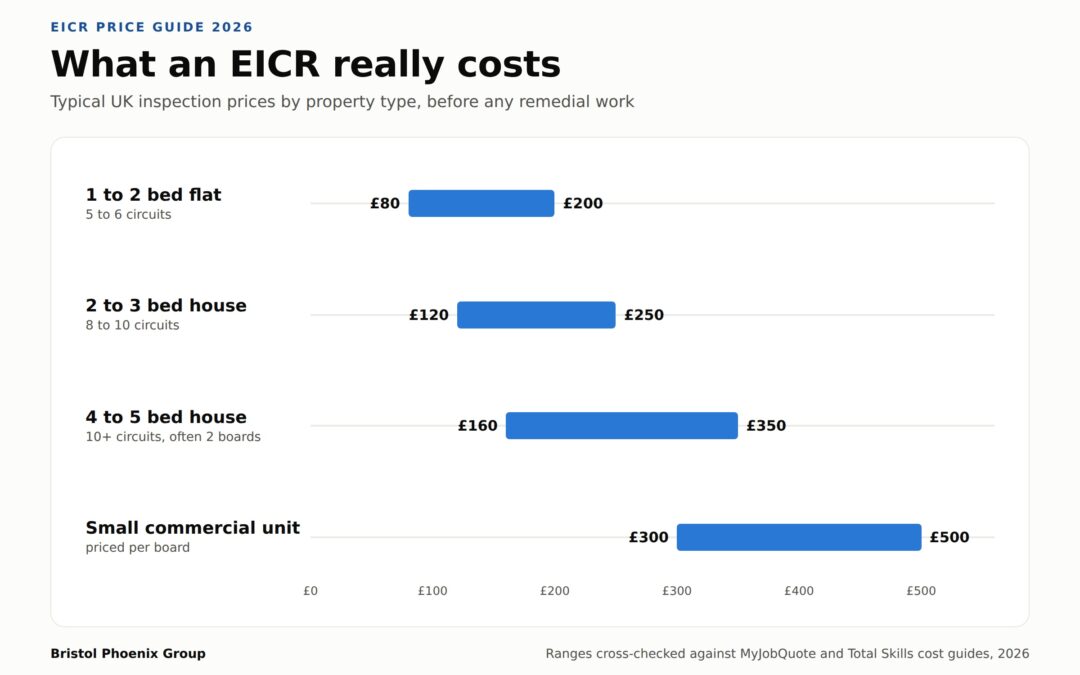
How much does an EICR cost? For most UK homes the inspection alone costs between £120 and £350, and a typical three bedroom house sits in the £150 to £250 band according to the national cost guides. In Bristol our own prices are fixed and published: £200 + VAT for a studio or one bed, £225 + VAT for a two bed and £250 + VAT for a three bed, flat or house, with any remedial work quoted separately so the inspection price never moves on the day.
Ask three electricians how much does an EICR cost and you will get three different numbers, sometimes fifty pounds apart for the same house. That spread is not a scam, but it is confusing, and it leaves plenty of homeowners and landlords either overpaying or, worse, picking the cheapest quote and getting a report that is not worth the PDF it arrives on. In this guide we will set out realistic EICR prices for 2026 by property type and circuit count, explain exactly what pushes a quote up or down, and flag the warning signs that a bargain inspection is anything but.
Table of Contents
- EICR Cost at a Glance
- How Much Does an EICR Cost by Property Type
- What Makes an EICR Price Vary
- EICR Cost for Landlords vs Homeowners
- Cheap EICR Quotes: The Warning Signs
- What Happens After the Report, and What It Might Add
- A Worked Example: Pricing a Three Bed Terrace
- How to Keep the Cost Down Without Cutting Corners
- What We Find in South Bristol Homes, and What It Adds to the Bill
- Our Fixed EICR Prices in Bristol
- Do the 2026 Wiring Regulations Change the Price?
- EICR Cost: Your Questions Answered
- Booking an EICR in Bristol
TL;DR
- Most domestic EICRs in the UK cost between £120 and £350, with a typical three bedroom house landing in the £150 to £250 range depending on region and circuit count.
- Our Bristol prices are fixed and published: £200 + VAT for a studio or 1 bed, £225 + VAT for a 2 bed, £250 + VAT for a 3 bed, £300 + VAT for a 4 bed and £350 + VAT for a 5 bed, the same for a flat or a house.
- The biggest price drivers are the number of circuits, the age and condition of the installation, access, and where in the country you are.
- Landlords in England must have an EICR carried out at least every 5 years by law, and councils can fine up to £40,000 for non-compliance, so the report is cheap insurance by comparison.
- Suspiciously cheap quotes usually mean rushed testing, sampling shortcuts, or a report designed to generate remedial work. Check registration before price.
- The inspection itself typically takes 2 to 4 hours for an average home.
- The inspection fee is the small number. In South Bristol’s older housing the remedial work is what decides the real total, which is why we publish those prices too.
EICR Cost at a Glance
If you only take one thing from this page, take the table below. The national column reflects what UK trade pricing guides currently report, taken from MyJobQuote’s cost data, and it matches what we see quoted around Bristol day to day. The right hand column is what we actually charge, fixed in advance and published on our EICR Bristol page.
| Property type | Typical UK EICR cost | Our fixed price (+ VAT) | Typical duration |
|---|---|---|---|
| 1 to 2 bedroom flat | £120 to £250 | £200 (studio or 1 bed), £225 (2 bed) | 1.5 to 2.5 hours |
| 2 to 3 bedroom house | £150 to £250 | £225 (2 bed), £250 (3 bed) | 2 to 3.5 hours |
| 4 to 5 bedroom house | £250 to £350 | £300 (4 bed), £350 (5 bed) | 3 to 4.5 hours |
| 6 bedrooms or more, and HMOs | £350 to £450 | From £400 (6 bed+), from £350 (HMO), confirmed before booking | 4 hours upwards |
| Small commercial unit | £300 to £500 | Quoted per board | Half a day or more |
| Larger commercial premises | £500 into four figures | Quoted per board | Quoted per distribution board |
Those are inspection prices only. If the report finds problems, remedial work is quoted separately, and we will come to that further down. The ranges are wide because two properties with the same number of bedrooms can have very different electrical installations, which brings us to the details.
How Much Does an EICR Cost by Property Type
Bedrooms are a rough proxy. What an electrician is actually pricing is the number of circuits on your consumer unit, because every circuit gets inspected and tested individually. If you want the full picture of what those tests involve, our guide to what an EICR actually is walks through the whole process. Here is how the property types break down.
Flats and One to Two Bedroom Homes
A modern one bed flat might have five or six circuits: lighting, sockets, cooker, maybe a shower and a heating circuit. That is a compact job, often done in a couple of hours, which is why the national guides put a one bedroom property at £120 to £180, with the big cities at the top of that range. Ours is £200 + VAT for a studio or one bed and £225 + VAT for a two bed, whichever city you are in. If your flat has electric heating with storage heaters on their own circuits, expect the higher end of the range.
Three and Four Bedroom Houses
This is the bread and butter EICR, and the price band most people actually pay: roughly £150 to £250 nationally, and £250 + VAT for a three bed or £300 + VAT for a four bed with us. A typical three bed semi carries eight to ten circuits, and the inspection usually takes 2 to 4 hours according to MyJobQuote’s current cost data. Extensions, loft conversions and garden offices all add circuits, so a heavily extended three bed can quietly price itself like a five bed.
Larger Homes and HMOs
Five bedrooms and up, or any house in multiple occupation, means more circuits, more accessories to inspect, and often more than one consumer unit. Prices from £250 to £450 are normal for large family homes nationally, and an HMO with fire detection and escape route lighting circuits to check can push towards £500. Our HMO price starts at £350 + VAT and a six bed or larger home from £400 + VAT, both confirmed before booking rather than adjusted on the day. For HMO landlords the EICR is not optional paperwork, it is a licensing condition in most council areas.
Commercial Premises
Commercial EICRs are priced on distribution boards and circuits rather than rooms, which is why quotes start around £300 and climb with the size of the installation. Three phase supplies, machinery circuits and testing that has to happen while the premises are closed all move the number. If you run a shop, café or unit in Bristol, our commercial EICR service covers exactly this, priced per board rather than plucked from the air.
What Makes an EICR Price Vary
Two identical looking houses on the same street can come back with quotes £80 apart. Here is what is actually driving the difference.
Circuit Count and the Age of the Installation
Every circuit needs dead testing and live testing with calibrated instruments, so ten circuits simply take longer than six. Age matters just as much. A house last rewired in the 1980s takes longer to inspect than a 2015 build because the inspector has more to check, more to question, and usually more to write up. Old rubber or fabric insulated cable, a fuse board with rewirable fuses, or a mix of wiring from three different decades all add time, and time is what you are paying for.
Access and Property Condition
An empty rental with clear access to every socket is a quick job. A fully furnished family home where the consumer unit hides behind the Christmas decorations in the cupboard under the stairs is not. Loft wiring buried under insulation, sockets behind heavy furniture, and locked outbuildings all slow the inspection down. Some firms quote low then add access charges on the day, which is worth asking about before you book.
Location and Who You Hire
London and the South East carry the highest prices, often £120 to £300 for standard homes. Regional cities like Bristol sit in the middle of the national range. The other variable is the person doing the testing. A registered electrician working under a scheme such as NAPIT or NICEIC has assessment, insurance and calibration costs behind that certificate, and charges accordingly. An unregistered tester with a multimeter and a template does not, and it shows in the price and, unfortunately, in the report.
What the Fee Should Include
Before comparing numbers, check what each quote actually covers. A proper EICR fee includes the visual inspection, dead and live testing of the agreed circuits, the written report with observations and classification codes, and the electrician’s time to talk you through the findings. Watch for quotes that exclude VAT, charge extra for the written report itself, or bill separately for “certificate registration”. None of those should be surprises on the invoice. If a quote is silent on any of them, ask before you book rather than after the report lands.
EICR Cost for Landlords vs Homeowners
The inspection itself is the same either way. The difference is the legal weight behind it, and that changes how you should think about the EICR cost for landlords in particular.
The Legal Position for Landlords

In England, government guidance requires landlords to have the electrical installation in a rented property inspected and tested by a qualified person at least every 5 years. From 2025 the same standards were extended to the social rented sector too. The report has to go to existing tenants within 28 days, to new tenants before they move in, and if it calls for remedial work, that work must be completed within 28 days or sooner if the report says so. Local councils can impose a financial penalty of up to £40,000 for breaches. Set against that, a £250 + VAT inspection every five years works out at £60 a year including VAT, which is less than most landlords spend on a single void day. When the five year clock actually starts, and when a report needs renewing early, is covered in our EICR renewal guide.
Homeowners: No Law, Same Wiring
No statute forces an owner-occupier to have an EICR, but Electrical Safety First recommends one at least every 10 years for an owner-occupied home, and NICEIC gives the same 10 year guidance. The complacency gap here is real. According to research published by the Institution of Engineering and Technology in April 2026, 79% of UK adults feel confident their home is electrically safe, yet fewer than a third have had their electrics checked by a qualified electrician in over a decade, and around 19,300 accidental domestic fires each year are linked to electricity, roughly 53% of all accidental house fires in England. Wiring does not send a reminder when it starts to degrade. The report is how you find out.
For homeowners there are three moments when the money is clearly well spent: when you buy an older property and want to know what you are inheriting, when it has been ten years or more since anyone tested the installation, and when you are about to sell. An EICR is not legally required to sell a home, but a satisfactory report sitting in the paperwork answers a buyer’s survey query before it turns into a renegotiation. We cover that situation in full in our guide to electrical safety certificates when selling a house.
Cheap EICR Quotes: The Warning Signs
Search for an EICR price online and you will find offers that look too good to be true. They usually are, in one of four ways.
- Sampling instead of testing. The regulations allow an agreed level of sampling in some situations, but a £60 “full EICR” on a three bed house in under an hour means most circuits were never properly tested. The certificate might look fine. The wiring behind it is unknown.
- The loss-leader report. Some firms price the inspection below cost, then produce a report heavy with failure codes and a conveniently expensive remedial quote. If an unsatisfactory report lands together with a quote for thousands on the spot, get a second opinion before signing anything.
- No registration to check. If you cannot find the company on the NAPIT or NICEIC register, the report may not satisfy your council, your insurer, or a buyer’s solicitor. Registration is a two minute check that is worth doing before you compare a single price.
- No mention of circuits. A serious quote asks how many circuits or bedrooms you have, whether there are outbuildings, and when the property was last rewired. A price given with none of those questions is a guess, and the day rate will be recovered somewhere.
What Happens After the Report, and What It Might Add
An EICR comes back either satisfactory or unsatisfactory, and any faults are graded with classification codes. As NICEIC explains, C1 means danger present with immediate action required, C2 means potentially dangerous with urgent remedial work needed, C3 is an improvement recommendation that does not cause a fail, and FI means further investigation is required. Only C1, C2 and FI items make a report unsatisfactory. Our separate guide to EICR codes goes through each one with real examples, so we will not repeat that here.
This is where the true cost picture matters. The inspection fee is fixed. The remedial work is not, and it can range from £50 to swap a damaged socket to four figures for a consumer unit upgrade. Two practical tips soften this. First, ask for the observation list with photos, so you can see exactly what was found. Second, ask whether minor fixes can be done during the inspection visit for a small addition, which many firms, ours included, will do rather than booking a second visit.
Because the remedial side is where the uncertainty lives, we publish those prices as well. Fault finding on a circuit that fails testing is £140 + VAT. A straight consumer unit swap is £680 + VAT for a 6 way board and £780 + VAT for 8 to 12 ways, with the full table on our consumer unit replacement page. If the report points to wiring that has reached the end of its life, a full rewire starts from £4,500 + VAT for a one bed flat and from £5,400 + VAT for a three bed house, as set out on our house rewiring page. Knowing those numbers before the inspection takes most of the fear out of an unsatisfactory result.
A Worked Example: Pricing a Three Bed Terrace
Picture a typical three bedroom Victorian terrace in South Bristol. Last rewired somewhere in the 1990s, nine circuits on the board, a kitchen extension added in 2010, loft boarded, furnished and lived in. Here is how that quote builds.
| Element | Effect on price |
|---|---|
| Base inspection, up to 8 circuits | £130 to £170 |
| Ninth circuit (extension kitchen) | £10 to £15 |
| Furnished property, slower access | Allowed for in the base, no extra |
| 1990s board, fuller write-up expected | Included, but rules out the cheapest quotes |
| Likely total from a typical local quote | £140 to £185 |
| Our fixed price for the same house | £250 + VAT (£300 inc VAT), extras only for a second board or an outbuilding |
On the day, the inspection takes around three hours. The report comes back unsatisfactory with one C2, no RCD protection on the socket circuits, plus two C3 observations. The C2 remedial work is quoted separately, the landlord has it done inside the 28 day window, and the certificate of remedial works closes the loop. Total spend: under £600 including the fix, for a property that now will not need another inspection for five years. That is the realistic shape of an EICR cost, inspection plus remedials, and it is why the cheapest inspection fee is rarely the cheapest outcome.
How to Keep the Cost Down Without Cutting Corners
There are legitimate ways to pay less. Book with flexibility on timing, since a firm filling a quiet day will often sharpen the price. Clear access before the visit: consumer unit reachable, sockets accessible, loft hatch unblocked. If you are a landlord with several properties, ask about batch pricing for testing them in one run. And keep your previous report, because an installation with a documented history and no changes since is quicker to inspect than a mystery. What we would not recommend is shopping purely on price, skipping registration checks, or leaving it until the week a tenancy starts, when you have no leverage and no time to fix anything the report finds.
What We Find in South Bristol Homes, and What It Adds to the Bill
National price guides cannot tell you what an inspection tends to turn up in your part of the city, and that is the half of the EICR cost question that matters most. We are based in South Bristol and spend much of our week in Bedminster, Southville, Totterdown, Knowle, Bishopsworth, Hartcliffe and the streets between, so we see the same housing stock again and again.

Victorian and Edwardian Terraces
The two up two down and bay fronted terraces around Bedminster, Southville and Totterdown have usually been rewired at least once, but rarely all at once. A typical board carries wiring from two or three different decades, and the common observations are socket circuits with no RCD protection, lighting circuits with no earth at the switch or ceiling rose, and a kitchen or loft extension wired as an afterthought. None of that changes our inspection price, but it does mean a fuller report and a higher chance of a C2. A consumer unit upgrade is the usual fix for the RCD finding, and that is the £680 to £780 + VAT job rather than a four figure surprise.
1930s Semis and Inter-War Houses
The semis around Knowle, Headley Park, Bishopsworth and Bedminster Down were often rewired in the 1970s or 1980s and then left alone. We regularly find rewirable fuse boards, missing main bonding to the gas and water, and immersion heater or shower circuits that have been added without upgrading the board. Bonding is a quick remedial. A board still on rewirable fuses with no RCD protection is the C2 that costs most, and it is the one that pushes a landlord’s total from the inspection fee towards the £1,000 mark once the consumer unit is replaced.
Post-War Council Housing and Flats
Hartcliffe, Withywood, Knowle West and parts of Bishopsworth have large numbers of post-war council built homes, many now privately rented. Solid concrete floors mean cables run in the ceiling and down the walls, so a rewire is slower and dearer than in a terrace with a void, which is exactly why a thorough inspection pays for itself: catching a degraded lighting circuit on the report is far cheaper than finding it when a fault takes the lights out. Purpose built and converted flats across the area add their own wrinkle, a shared supply or a sub board, which is the £50 + VAT additional board extra on our price list rather than a renegotiated quote.
If you want to see what a real inspection in one of these houses looks like, with the test readings and what they meant, we wrote up an EICR on a three bedroom house in Bedminster where every socket still worked and the report still came back unsatisfactory.
Our Fixed EICR Prices in Bristol
These are the numbers we quote from, published on our EICR Bristol page and the same for a flat or a house. The standard scope is one consumer unit and up to 12 circuits, which covers the large majority of homes in the city.
| Property | Price + VAT | Price inc VAT |
|---|---|---|
| Studio or 1 bed home | £200 | £240 |
| 2 bed home | £225 | £270 |
| 3 bed home | £250 | £300 |
| 4 bed home | £300 | £360 |
| 5 bed home | £350 | £420 |
| 6 bed or larger | From £400, confirmed before booking | From £480 |
| HMO | From £350, confirmed before booking | From £420 |
The extras are published too, and agreed before we start rather than discovered on the invoice: an additional consumer unit such as a garage or flat sub board is £50 + VAT, an outbuilding tested on the same visit is £50 + VAT, circuits beyond the twelfth are £15 + VAT each and a three phase supply is from £75 + VAT. Remedial work is always quoted separately and you are free to use anyone you like for it. That is the whole price list. There is no hourly meter: the price we agree is the price you pay.
Do the 2026 Wiring Regulations Change the Price?
A question we are getting more often this year. The current edition of the wiring regulations is BS 7671:2018+A4:2026, which NICEIC confirms was published on 15 April 2026, with the previous version, A2:2022 plus A3:2024, withdrawn on 15 October 2026. An EICR assesses your installation against the current edition, so from mid October reports are written against Amendment 4.
What that does not do is make your home fail. An installation that was compliant when it was put in is not dangerous because the standard has moved on; the inspector records departures from the current edition as C3 improvement recommendations unless they are actually dangerous, and C3 observations do not make a report unsatisfactory. So the regulation change does not alter our inspection price and should not, on its own, add remedial work. What it does change is the wording on the report, and anyone quoting you a premium “for the new regs” is charging for a line of text.
EICR Cost: Your Questions Answered
Is VAT included in EICR prices?
Often not, which is the single biggest reason two quotes for the same house look different. A sole trader under the VAT threshold can quote a lower headline figure than a VAT registered firm without being cheaper to run. We quote plus VAT and show the inclusive figure alongside it, so a three bed is £250 + VAT, which is £300 on the invoice, with nothing added.
Does the EICR price include fixing anything?
No, and it should not. The inspection is an independent assessment, and bundling repairs into it is how the loss leader model described above works. A fair arrangement is a fixed inspection fee, a report with photos, and a separate written quote for any C1 or C2 items that you are free to take elsewhere.
How much does an EICR cost per circuit?
Most firms do not price per circuit for homes; they price by bedrooms with a circuit allowance, because bedrooms predict the circuit count well enough. Our standard scope covers up to 12 circuits, and each one beyond that is £15 + VAT. Commercial premises are the exception, where quotes are built per distribution board and the number of circuits on each.
Do landlords pay more for an EICR than homeowners?
Not with us, and they should not anywhere. The inspection and the report are identical. What differs is the paperwork around it: a landlord needs the report to go to tenants within 28 days and to the council within 7 days of a request, and remedial work completed inside 28 days. We photograph every observation and explain each code in plain English on the report, which is what letting agents actually need from us.
Booking an EICR in Bristol
We are Bristol Phoenix Group, a NAPIT registered electrical contractor based in South Bristol, and EICRs are a core part of our electrical testing services for homeowners, landlords and letting agents across the city. We quote on circuits, not guesswork, we photograph what we find, and we will talk you through the report in plain English rather than leaving you to decode it alone. If you want a straight answer on how much an EICR would cost for your property, our EICR prices are fixed and published: £200 + VAT for a studio or 1-bed, £225 + VAT for a 2-bed and £250 + VAT for a 3-bed, flat or house. Call us on 0117 2447 382 or get in touch with the address and the number of bedrooms, and we will confirm your price with no surprises on the day.