Ask three people whether you need an electrical safety certificate when selling a house and you will get three confident answers, at least two of them wrong. Estate agents hedge, forums argue, and somewhere in the middle a seller books a test they may not need, or skips paperwork a buyer’s solicitor will certainly ask for. The truth is tidier than the folklore. No law forces you to hand over an electrical certificate to sell your home in England and Wales, but there are three specific documents a conveyancer can request, and knowing which is which can save you weeks of back and forth. We test homes across South Bristol every week, so here is the picture as it actually stands.
Table of Contents
- Is an Electrical Safety Certificate a Legal Requirement When Selling a House?
- EICR, EIC or Building Regulations Certificate: Which Is Which?
- What Your Buyer’s Conveyancer Will Actually Ask For
- Where Mortgage Lenders and Surveyors Come In
- Selling a Rented Property: The One Case With Real Rules
- How an EICR Smooths a Sale
- What an Electrical Safety Certificate Costs When Selling a House
- Missing Paperwork: Your Options as a Seller
- Advice If You Are the Buyer
- Frequently Asked Questions
- Final Thoughts
TL;DR
- No electrical safety certificate is legally required to sell a house in England and Wales. Both Electrical Safety First and the Law Society’s TA6 guidance confirm it.
- Buyers’ solicitors will still ask about electrical work on the TA6 property information form, and certificates for notifiable work done since 2005 are the documents they mean.
- An EICR is voluntary for a sale but often the cheapest way to stop a buyer renegotiating over “the electrics”.
- Selling a tenanted property is different: landlords in England must already hold a valid EICR under the 2020 regulations, and councils can fine a landlord up to £30,000 for non-compliance.
- Expect to pay roughly £100 to £300 for a domestic EICR, with a typical three bed around £150 to £250.
Is an Electrical Safety Certificate a Legal Requirement When Selling a House?
No. For an ordinary owner occupied home in England and Wales, there is no statute that says you must produce an electrical safety certificate before you can sell. Electrical Safety First puts it plainly: you do not need to provide an Electrical Installation Condition Report in order to sell a property, although it will give your buyer peace of mind that the home is electrically safe. The Law Society’s explanatory notes to the TA6 form say the same thing in solicitor language: an EICR is not a legal requirement for the sale of property in England and Wales.
So why does the question keep coming up? Because “no legal requirement” is not the same as “nobody will ask”. A sale involves a buyer, a conveyancer, a surveyor and usually a mortgage lender, and each of them has ways of making the electrics your problem before completion. The rest of this guide is about those people, what they can ask for, and how to keep the sale moving.
One caveat on scope: this article is about ordinary domestic sales. If the property is tenanted, or you are a landlord selling with tenants in place, skip ahead to the rented property section, because that is the one situation where the law does have teeth.
EICR, EIC or Building Regulations Certificate: Which Is Which?
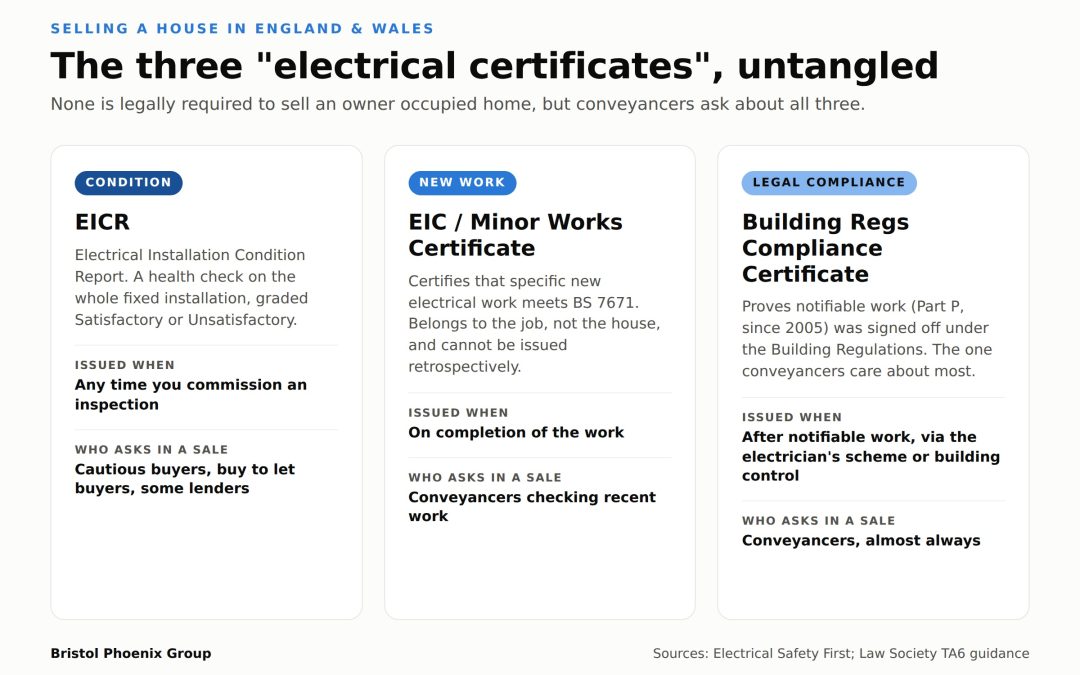
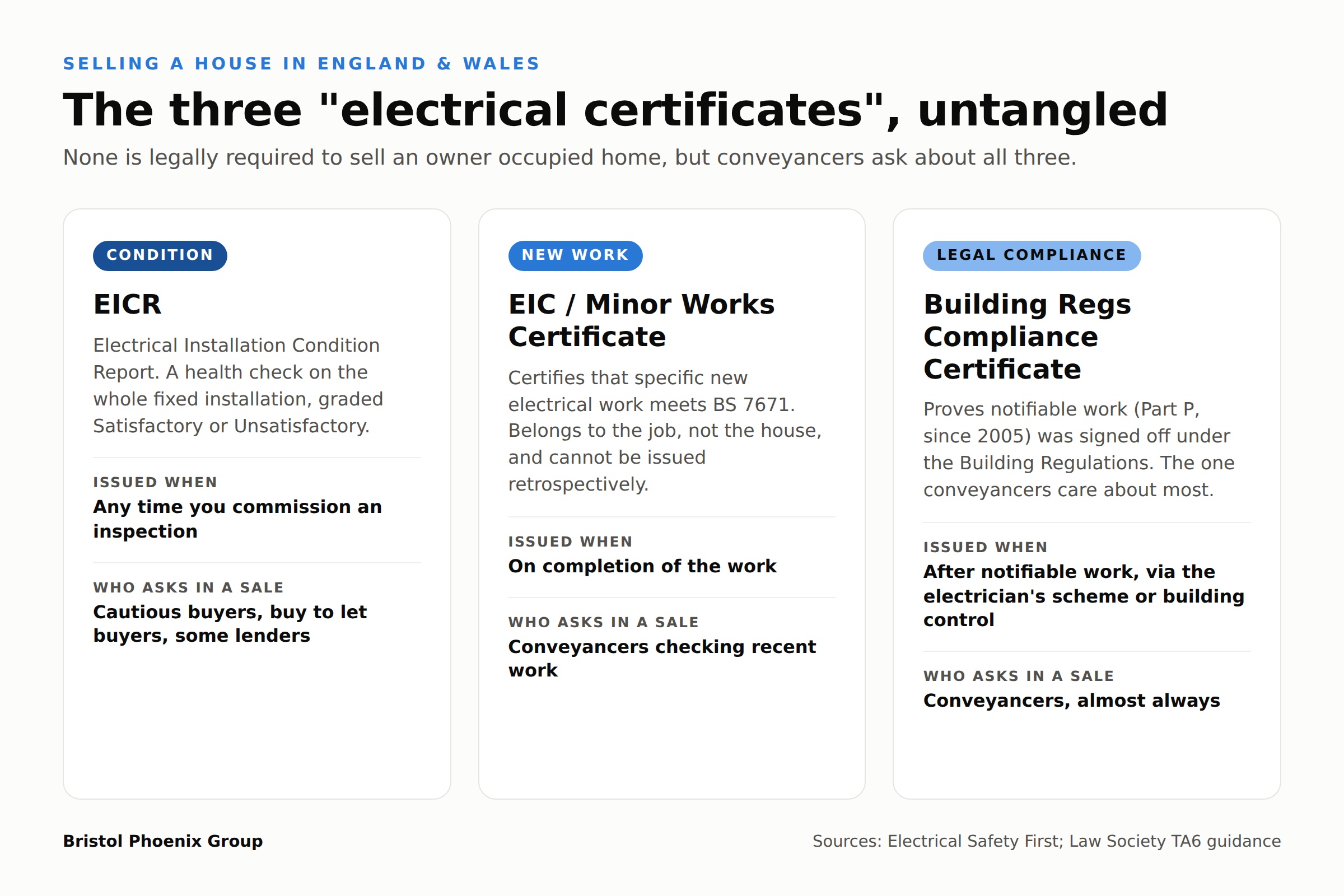
Most of the confusion in this area comes from three different documents being lumped together as “the electrical certificate”. They are not interchangeable, and a conveyancer asking for one will not be satisfied by another. Here is the short version.
EICR: the condition report
An Electrical Installation Condition Report is a health check on the fixed wiring of the whole property: consumer unit, circuits, sockets, earthing and bonding. It is graded Satisfactory or Unsatisfactory, with any faults coded by urgency. It describes the installation as it is today, whoever did the work and however old it is. We cover the full detail in our guide to what an EICR actually is, and it is the report our electrical testing services produce day in, day out.
EIC: the installation certificate
An Electrical Installation Certificate is issued when new electrical work is carried out, confirming that the specific work meets BS 7671, the national wiring standard. Smaller jobs get a Minor Electrical Installation Works Certificate instead. These certificates belong to the work, not the house as a whole, and they cannot be issued retrospectively by a different electrician years later. Our hot tub electrical installation guide picks this up in more depth.
Building Regulations Compliance Certificate: the legal paper trail
Since 2005, certain electrical work in homes in England and Wales has been notifiable under Part P of the Building Regulations. According to Electrical Safety First’s Part P guidance, when notifiable work is done properly you should receive both an Electrical Installation Certificate or Minor Works Certificate confirming the work meets BS 7671, and a Building Regulations Compliance Certificate confirming it meets the Building Regulations. The rules were trimmed in 2013, so some kitchen and outdoor work no longer needs notifying, but new circuits, consumer unit changes and most work in bathrooms still do. This compliance certificate is the one conveyancers care about most, because it proves the work was done legally.
| Document | What it covers | When it is issued | Who asks for it in a sale |
|---|---|---|---|
| EICR | Condition of the whole installation as tested | Whenever you commission an inspection | Cautious buyers, buyers who plan to let, some lenders |
| EIC or Minor Works Certificate | Specific new work meeting BS 7671 | On completion of the work | Conveyancers checking recent work |
| Building Regulations Compliance Certificate | Notifiable work meeting the Building Regulations | After notifiable work, via the electrician’s scheme or building control | Conveyancers, almost always |
What Your Buyer’s Conveyancer Will Actually Ask For
The standard sale process in England and Wales runs on the Law Society’s TA6 property information form, which every seller completes. It has a section on alterations and works, and the official explanatory notes spell out the documents in play: a building control completion certificate, the installer’s Building Regulations Compliance Certificate, or the BS 7671 Electrical Installation Certificate. If electrical work has been done and you hold a certificate, you attach it. If work was done and there is no certificate, you say so, and the buyer’s solicitor takes a view.
Notice what is missing from that list: any requirement for a fresh test. The TA6 asks what work was done and whether it was certified. It does not demand an EICR for an ordinary sale, and the same notes confirm one is not legally required. Where an EICR does enter the conversation is when your buyer intends to let the property. The Law Society notes flag exactly this case: a buyer who plans to rent the home out will want to check there is a current EICR, because they will need one from day one as a landlord.
In practice, here is what crosses our desk in Bristol: sellers of older terraces get asked about that consumer unit change in 2011, the kitchen rewire that came with the extension, or the hot tub circuit put in during lockdown. If those jobs were notifiable and the paperwork is missing, expect an enquiry. Conveyancers rarely block a sale over it, but they slow it down, and slow is expensive when you are in a chain.
Where Mortgage Lenders and Surveyors Come In
Your buyer’s lender does not routinely ask for electrical certificates on a standard purchase. What actually happens is subtler. The lender’s valuer or the buyer’s surveyor walks through the property, and if they see warning signs, an old rewireable fuse box, a mix of wiring colours, scorched sockets, they write a line in the report recommending an electrical inspection. That single line changes the mood of a sale.
From there, one of three things follows. The buyer asks you to commission an EICR. The buyer commissions one themselves and negotiates off the back of it. Or, at the cautious end, a lender makes its offer subject to an electrical report or holds back part of the loan until the electrics are confirmed safe. None of this is a legal requirement on you as the seller. All of it is leverage, and whoever holds the report holds the leverage.
This matters in our patch more than most. South Bristol’s housing stock leans heavily Victorian and Edwardian, and a hundred year old terrace in Bedminster or Totterdown may be on its second or third generation of wiring. Surveyors know that, so they look harder, and the “recommend electrical inspection” line appears often. Sellers who pre-empt it with a recent report take that card off the table before it is played.
Selling a Rented Property: The One Case With Real Rules
Everything above changes if the home is tenanted. Under the Electrical Safety Standards in the Private Rented Sector (England) Regulations 2020, landlords in England must have the electrical installation inspected and tested at intervals of no more than 5 years, by a qualified person, with the rules applying to new tenancies from July 2020 and all existing tenancies shortly after. A valid EICR is not optional here. It is a standing legal duty, and under the regulations as enacted a local council can fine a landlord up to £30,000 for non compliance.
When a tenanted property is sold, the buyer inherits the tenants and the duty on day one. Their solicitor will therefore treat the current EICR as essential paperwork, alongside the gas certificate and deposit protection details. No report, or an expired one, and you can expect the sale to stall until it is produced. If you are a landlord preparing to sell, our guide to the electrical certificate for landlords covers the duty in full, including what happens when a report comes back Unsatisfactory.
The same logic applies in reverse to a buyer purchasing with a sitting tenant: check the EICR date before exchange, because the five year clock does not reset at completion.
How an EICR Smooths a Sale
Since a seller does not have to produce an EICR, why do so many choose to? Because the alternative is letting the buyer’s imagination price the electrics. An unknown installation is worth whatever the most pessimistic person in the chain thinks it is worth, and buyers negotiate hard against uncertainty.
The numbers behind that nervousness are real. According to the Institution of Engineering and Technology, around 19,300 accidental domestic fires each year are linked to electricity, about 53% of all accidental house fires in England, and while 79% of adults feel confident their home is electrically safe, fewer than a third have had their electrics checked by a qualified electrician within the past decade. Buyers may not know the figures, but their surveyors do.
Picture a typical case. Take a three bed Victorian terrace in Knowle, on the market with a dated but working installation. The seller spends a modest sum on an EICR before listing. The report comes back Satisfactory with a couple of C3 improvement recommendations, which mean “worth upgrading” rather than “dangerous”. When the buyer’s survey duly notes the older consumer unit, the seller’s agent simply forwards a dated report from a registered electrician showing the installation is safe. The renegotiation conversation never starts. Now run the same sale without the report: the survey line triggers a quote for remedial work, the buyer opens with a four figure price reduction “for the electrics”, and the seller is negotiating blind against a worst case. Same house, same wiring, very different completion statement.
Two honest caveats. First, an EICR can come back Unsatisfactory, and once you know about a C1 or C2 fault you should fix it rather than sit on it. We have written about exactly what an Unsatisfactory EICR means and what it costs to put right. Second, an EICR is a condition report, not a magic shield: it will not paper over a botched DIY rewire, and nor should it.
What an Electrical Safety Certificate Costs When Selling a House
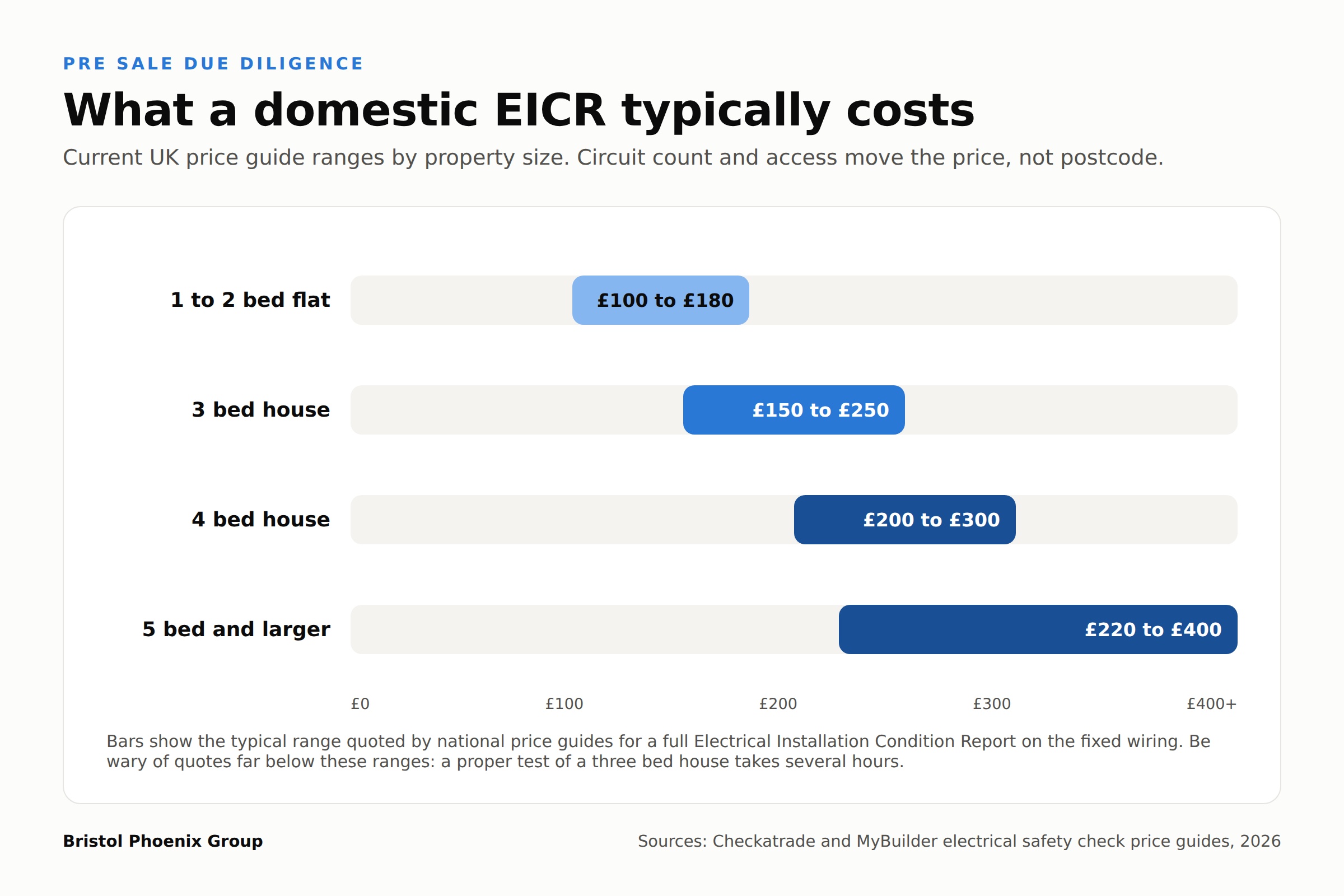
For a domestic EICR, current UK price guides cluster tightly. Checkatrade puts most electrical safety checks between £100 and £250, with flats from around £100 and larger houses more. MyBuilder’s price guide quotes £100 to £300 for domestic properties. Set against the sums moving around in a house sale, it is one of the cheaper pieces of due diligence you can buy. The ranges below are MyBuilder’s current national figures.
| Property type | Typical EICR price range |
|---|---|
| 1 to 2 bed flat | £100 to £180 |
| 3 bed house | £150 to £250 |
| 4 bed house | £200 to £300 |
| 5 bed house or larger | £220 to £400 |
They square with what we see quoted around Bristol, where most domestic EICRs land between £80 and £350, and what moves the price within a band is mostly circuit count and access. An older property with a crowded consumer unit takes longer to test properly than a recently rewired flat. Be wary of quotes far below these ranges: a thorough test of a three bed house is several hours of work, and a £60 “certificate” usually means sampling shortcuts or a report designed to sell you remedial work. We break the pricing down fully in our guide to how much an EICR costs.
Missing Paperwork: Your Options as a Seller
Suppose the buyer’s solicitor asks for the Building Regulations certificate for a consumer unit swap in 2012, and you have nothing. You are far from alone.
- Search first. If a registered electrician did the work, their scheme should have notified it, and the compliance certificate may be retrievable from the scheme operator or the council’s building control records. Ten minutes of digging beats every other option.
- Indemnity insurance. The pragmatic conveyancing fix. A one off premium covers the buyer against the small risk of council enforcement over historic unnotified work. It satisfies solicitors, but note what it does not do: it says nothing about whether the electrics are actually safe.
- Regularisation or fresh certification. The council can retrospectively assess unnotified work, though for electrics this is slow and rarely used. What a new electrician can do is test the installation as it stands and issue an EICR, which answers the question the buyer really cares about: is this wiring safe.
- Price it in. If the work is old, uncertified and visibly tired, sometimes the honest route is a small adjustment and full disclosure. Buyers respond better to candour with evidence than to shrugs.
In our experience, the combination that keeps sales moving is indemnity insurance for the legal gap plus a current EICR for the safety question. Solicitor satisfied, buyer reassured, chain intact.
Advice If You Are the Buyer
Flip everything above around and the playbook writes itself. The seller does not have to give you an electrical safety certificate, so assume nothing about the wiring until you hold evidence.
- Read the TA6 answers closely. Electrical work with no certificate attached is a question, not necessarily a problem, but ask it before exchange, not after.
- If the home is more than 25 years old and there is no recent EICR, commission one during conveyancing. It looks at the one system a standard survey barely touches.
- Buying to let? A current Satisfactory EICR is not a nice to have, it is your legal baseline as a landlord in England from the day the tenancy exists. Check the date and the outcome, not just that a report exists.
- Use findings to inform, not just to haggle. A C3 code is an improvement suggestion, not a crisis. A C2, or any sign of DIY circuit work, deserves a proper quote before you commit.
And whoever carries out the inspection, buyer side or seller side, check they are registered with a recognised competent person scheme. A report is only as credible as the person signing it.
Frequently Asked Questions
Do you need an EICR to sell a house?
No. An Electrical Installation Condition Report is not a legal requirement to sell an ordinary home in England and Wales, a point Electrical Safety First confirms directly. Plenty of sellers commission one anyway, because it heads off exactly the kind of survey query described above.
Do I need an electrical certificate to sell my house?
Only if you already have one to disclose. The TA6 form asks whether electrical work has been carried out and whether it was certified, not whether you can produce a fresh test. If no notifiable work has been done, or the paperwork already exists, there is nothing further to arrange.
What happens if I do not have an electrical safety certificate when selling?
Nothing stops the sale outright. Missing certification for past work usually gets resolved with indemnity insurance, a retrospective search of the electrician’s scheme records, or a fresh EICR to confirm the wiring is safe now, the three routes covered in the missing paperwork section above. What it does add is a round of enquiries, and enquiries cost time in a chain.
Does a landlord selling a tenanted property need an EICR?
Yes, and this is the one place the question has a hard legal answer. Under the Electrical Safety Standards in the Private Rented Sector (England) Regulations 2020, a landlord must hold a valid EICR throughout the tenancy, and a council can fine a landlord up to £30,000 for breaching that duty. A buyer taking on sitting tenants inherits the obligation from completion, so their solicitor will ask for the current report as standard.
Final Thoughts
The law on an electrical safety certificate when selling a house is short: for an ordinary home in England and Wales, you do not need one. The reality of a sale is longer: conveyancers ask about certificates for past work, surveyors flag ageing installations, lenders listen to surveyors, and buyers negotiate against uncertainty. A current EICR from a registered electrician is the cheapest way to replace that uncertainty with a document, whichever side of the sale you are on.
Bristol Phoenix Group is a NAPIT approved electrical contractor based in South Bristol, and pre sale EICRs on the city’s older housing stock are bread and butter work for us. If you are preparing to sell, buying somewhere with question marks over the wiring, or a landlord getting a tenanted property ready for market, get in touch and we will give you a straight answer on what you need, and just as importantly, what you do not.
Call us on 0117 2447 382 or contact us online to book a pre-sale EICR with a NAPIT approved South Bristol electrician.