The report lands, you skim past the pages of test results, and there it is on the front: Unsatisfactory, in a box you cannot miss. An EICR unsatisfactory result feels like a verdict, and for a landlord it comes with a legal clock attached. But unsatisfactory does not mean the house is about to catch fire, or that every cable is coming out of the walls. It means the inspector found at least one thing that needs putting right, and the report says exactly what, how urgently, and where. This guide covers what the result means, what the C1, C2 and FI codes are telling you, the 28 day rule for rented property, and what the common fixes cost, from a NAPIT approved firm in South Bristol that writes these reports every week.
Table of Contents
- What an EICR Unsatisfactory Result Actually Means
- The Four Codes: C1, C2, FI and C3
- EICR Unsatisfactory as a Landlord: The 28 Day Rule
- Unsatisfactory Report as a Homeowner or Seller
- What the Common Fixes Cost
- Turning an EICR Unsatisfactory Into a Satisfactory
- Think the Result Is Wrong?
- A Worked Example: A Three Bed Semi in Bishopsworth
- Common Questions
- Final Thoughts
TL;DR
- An EICR is marked Unsatisfactory if it records even one C1, C2 or FI observation. C3 observations alone still mean a Satisfactory report.
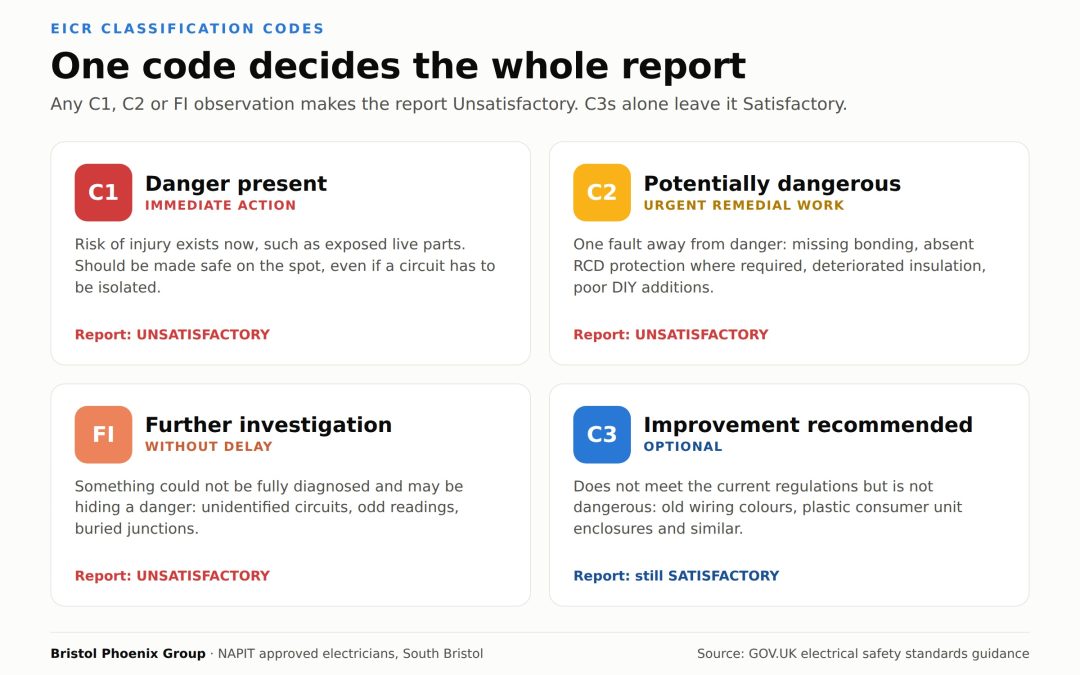
- C1 means danger is present right now. C2 means potentially dangerous. FI means further investigation is needed without delay. C3 is a recommended improvement, not a defect you must fix.
- Landlords in England must complete remedial or investigative work within 28 days, or sooner if the report says so, then give written confirmation to the tenant and council within 28 days of completion. Fines run up to £40,000.
- You do not usually need a full new EICR afterwards; certification covering the fixes normally counts as the written confirmation.
- Common fixes run from small repairs under a hundred pounds to a consumer unit change at several hundred; our fixed prices are listed below.
What an EICR Unsatisfactory Result Actually Means
An Electrical Installation Condition Report only ever ends one of two ways: Satisfactory or Unsatisfactory. No grades in between, no percentage score, and despite what half the internet says, no pass or fail. People talk about a failed EICR all the time, and we know what they mean, but the report never uses the word. For the full background on what the report covers and who needs one, our plain English guide to what an EICR stands for starts from the ground up.
The rule that decides the outcome is simple. If the inspector records even one observation coded C1, C2 or FI, the report is Unsatisfactory. If the worst thing found is a C3, the report is Satisfactory with recommendations. So an EICR unsatisfactory result is not a judgement on the whole installation. One damaged socket makes the report Unsatisfactory exactly as surely as problems on every circuit. The detail lives in the observations list, and that list is the first thing worth reading properly.
If you have just typed unsatisfactory EICR what happens into a search bar, the short answer is: a specific list of repairs, a deadline if the property is rented, and rarely anything close to a rewire. The report is a to do list, not a condemnation.
The Four Codes: C1, C2, FI and C3
Every observation on the report carries a classification code, and the codes carry all the meaning. Here is what each one is telling you, with examples we actually find in Bristol homes.

C1: Danger Present
Risk of injury exists right now. Exposed live parts are the classic example: a broken socket faceplate with live terminals within reach of fingers, or a light fitting hanging off with bare conductors showing. C1s are rare, and whoever finds one should make it safe on the spot where possible, even if that means isolating the circuit, and confirm in writing that danger was present.
C2: Potentially Dangerous
Not an immediate risk at the moment of inspection, but one fault or one wrong set of circumstances away from becoming dangerous. Common examples: missing main protective bonding to gas or water pipework, no RCD protection where current standards demand it, badly deteriorated insulation, and DIY additions with connections that were never made properly. Most unsatisfactory reports we produce are driven by C2 observations.
FI: Further Investigation Required
The inspector found something that could not be fully diagnosed within the scope of the inspection, and it needs investigating without delay because it may be hiding a danger: a circuit that cannot be identified, readings that make no sense, signs of a buried junction nobody can locate. An FI makes the report Unsatisfactory on its own, which surprises people, but the logic is sound: an unknown is not a pass.
C3: Improvement Recommended
The installation does not meet the current edition of the wiring regulations, but nothing about it is dangerous. Old wiring colours, a consumer unit in a plastic enclosure, or absent RCD protection in lower risk situations often land here. C3 items never make a report Unsatisfactory and nobody can force you to fix them, though some are cheap enough to do while an electrician is there.
| Code | Meaning | Effect on the report | Action needed |
|---|---|---|---|
| C1 | Danger present, risk of injury | Unsatisfactory | Immediate action, made safe on the day where possible |
| C2 | Potentially dangerous | Unsatisfactory | Urgent remedial work |
| FI | Further investigation required without delay | Unsatisfactory | Investigation, then any work it reveals |
| C3 | Improvement recommended | Still Satisfactory | Optional improvement |
EICR Unsatisfactory as a Landlord: The 28 Day Rule
For rented property in England the response to an unsatisfactory report is not optional, and the deadlines are set out in the Electrical Safety Standards Regulations. The government guidance is blunt about the sequence. Where the report shows C1, C2 or FI observations, the landlord must ensure the remedial work or further investigation is completed within 28 days, or within any shorter period the report itself specifies. A C1 usually comes with immediate action specified; 28 days does not apply to danger present today.
Then comes the part many landlords miss. Within 28 days of the remedial or investigative work being completed, you must obtain written confirmation from a qualified person that the work is done and the standards are met, and supply it, together with the original report, to the tenant and to the local council where required. Written confirmation normally means a satisfactory EICR, an Electrical Installation Certificate, or a Minor Electrical Installation Works Certificate covering the work. The paperwork is the specific thing the regulations require, and the first thing a council asks for.
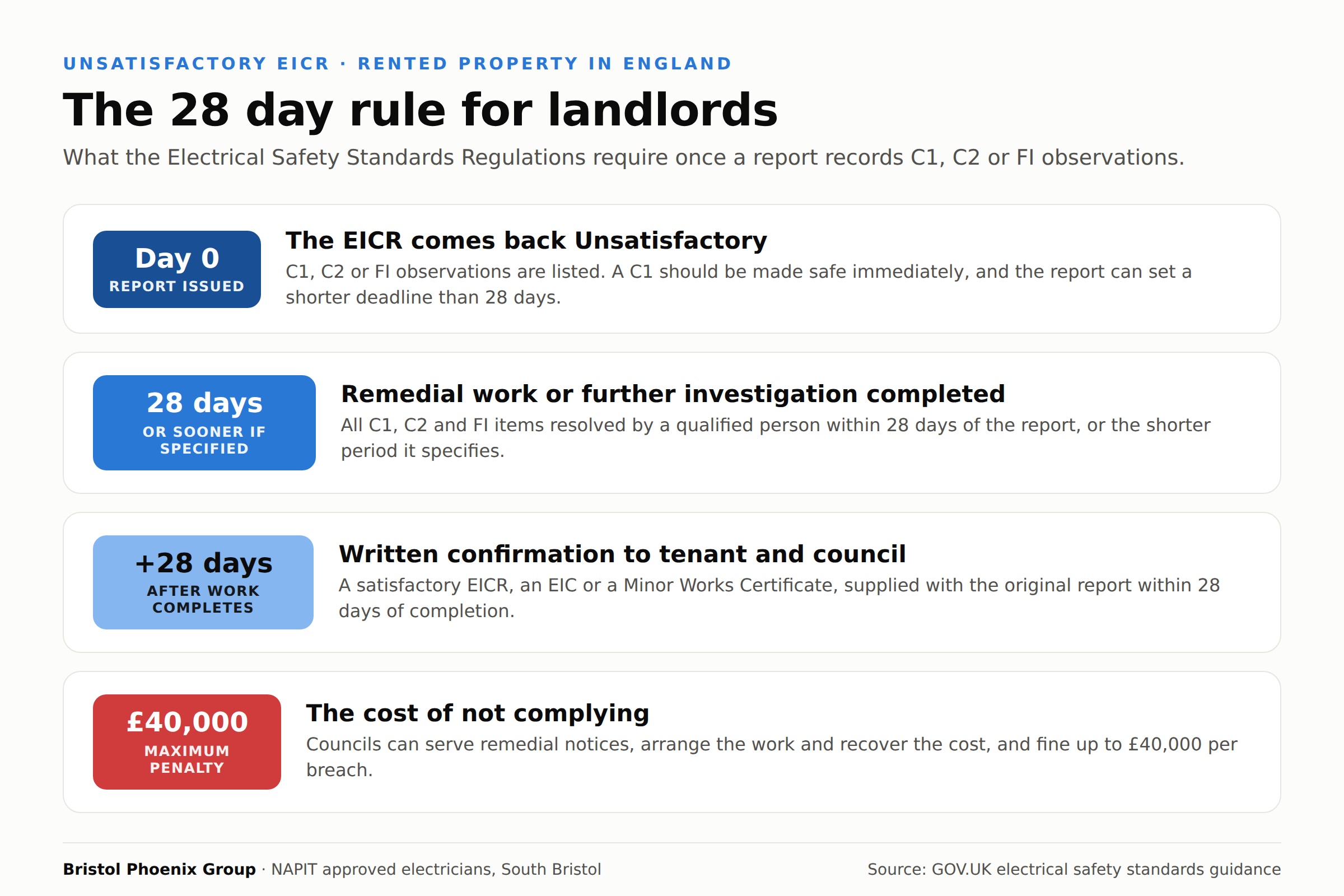
The enforcement teeth are real. Local councils can serve remedial notices, arrange the work themselves and recover the cost from the landlord, and impose a financial penalty of up to £40,000 for a breach. Since 1 November 2025 the same standards have applied to the social rented sector, so housing associations and council landlords now work to the same rulebook. The requirement to inspect at least every five years has not changed. Our guide to the electrical certificate for landlords covers the full set of duties and dates.
One practical note from the coalface: 28 days disappears quickly. A report sits in an inbox for a week, two quotes take another week, and half the window is gone. The landlords who handle this well book the work the day the report lands and file the paperwork the day the job finishes.
Unsatisfactory Report as a Homeowner or Seller
If you own and occupy your home, an unsatisfactory EICR carries no legal deadline. Nobody fines an owner occupier, and no council officer is checking. What you have is a professional written record that the installation contains something dangerous or potentially dangerous, and it does not disappear because the report goes in a drawer.
It tends to resurface at the worst moments. Home insurers commonly expect the electrical installation to be kept in safe condition, and a documented, ignored C1 or C2 makes for an awkward conversation after a claim. House sales are the other pressure point. Bristol buyers increasingly commission an EICR alongside the survey, particularly on the Victorian terraces in Bedminster, Southville and Totterdown and the 1930s semis further south, where original or part upgraded wiring is common. An unsatisfactory report surfacing mid sale becomes a renegotiation tool, and the price knocked off usually beats the repair bill. Fixing C1 and C2 items on your own timetable, before anyone else holds the report, is almost always the cheaper route.
Around 23,795 accidental dwelling fires were attended by fire and rescue services in England in the year to March 2026, according to Home Office fire statistics. Not all of those started in the wiring, but C1 and C2 items are exactly the category of defect a condition report exists to catch while they are still observations rather than incidents.
What the Common Fixes Cost
The costs below reflect what unsatisfactory reports typically lead to. National figures are ranges because every installation differs; our own prices are fixed and published, because guessing games help nobody. Every price we quote leads with the ex VAT figure, with the VAT inclusive amount alongside.
| Typical remedial job | Usual code behind it | Typical national range | Our fixed price |
|---|---|---|---|
| Small repairs: damaged accessories, bonding upgrades, replacing a broken faceplate | C1 or C2 | Under £100 to a few hundred pounds depending on count | Small jobs from £95 + VAT (£114 inc VAT) |
| Consumer unit replacement with RCD or RCBO protection | C2 observations around protection, or several faults concentrated at the board | Roughly £350 to £750 installed | £680 to £920 + VAT (£816 to £1,104 inc VAT) depending on circuits |
| Partial or full rewire | Widespread C2 findings on aged cabling | Several thousand pounds, size dependent | Typically £4,500 to £6,500 + VAT for a full domestic rewire |
| The EICR itself, if you need a fresh one | n/a | Around £100 to £300 | From £180 + VAT (£216 inc VAT) for 1 to 2 bedrooms |
The national consumer unit figures line up with the major trade directories: Checkatrade puts a typical populated RCBO board at around £485 installed, and MyJobQuote lands on about £525, within a £350 to £750 spread. Our fixed prices sit toward the upper part of those ranges because they include a full RCBO board and the certification that makes the job count for the regulations. The full breakdown is on our consumer unit replacement page, and EICR pricing by bedroom count is on our EICR Bristol page.
One honest caveat: nobody can price remedial work from the word Unsatisfactory alone. Two reports with the same verdict can need £95 of work or £5,000 of work. The observations list, not the front page, is what a quote is built from, so send the full report, not just the verdict.
Turning an EICR Unsatisfactory Into a Satisfactory
The route back to a clean sheet is shorter than most people expect, and rarely involves paying for a second full inspection. The sequence looks like this.
- Read the observations list. Each C1, C2 and FI item is numbered, located and described. This list is the entire job. C3 items can be done or politely ignored.
- Get the remedial work quoted. Any competent electrician can quote from the report. It does not have to be the firm that inspected, although using one firm for both halves usually saves a visit.
- Have the work done by a qualified person. FI items get investigated first, because what the investigation finds decides what work follows.
- Collect the written confirmation. Depending on the scale of the work, that means an Electrical Installation Certificate, a Minor Electrical Installation Works Certificate, or a fresh satisfactory EICR. For landlords, this document plus the original report is what goes to the tenant and the council.
- File everything. The report, the certificates, the dates. Five years is a long time to remember where a PDF went.
A full re inspection is worth it mainly when the remedial work was extensive, or when a sale or new tenancy makes a clean report dated this month worth having. For a couple of C2 repairs, certification of the work itself is the standard and accepted route. This is bread and butter for our electrical testing service: we inspect, we quote the remedials from our own observations, and the certification lands in your inbox when the work is done.
Think the Result Is Wrong?
Coding involves judgement, and electricians are human. The industry publishes guidance so that a C2 in Bristol means the same as a C2 in Carlisle, but borderline items exist, and occasionally a report crosses our desk with C2s that read more like C3s.
If a result smells wrong, do three things. Ask the inspector to talk you through each coded item; a competent one will explain the reasoning without bristling. Check that the codes and the observation descriptions obviously belong together. If doubt remains, get a second opinion from a registered firm before paying for remedial work: a couple of hundred pounds confirming a diagnosis beats thousands treating the wrong one. What we would not recommend is shopping around for an electrician willing to code generously. The report protects the people living behind the meter, and that only works if the codes mean what the guidance says they mean.
A Worked Example: A Three Bed Semi in Bishopsworth
Picture a typical 1930s three bed semi in Bishopsworth, let to a young family. The five yearly EICR comes back Unsatisfactory with four observations: a C2 for missing main bonding to the water pipe, a C2 for no RCD protection on the bathroom lighting circuit, an FI for a lighting junction that could not be traced, and a C3 noting old colours on two circuits, still sound.
Day one, the landlord sends us the report. Day three, we confirm a fixed quote: bonding run and clamped, the lighting circuits brought under RCD protection at the board, an hour allowed to chase the FI. Day nine, the work happens. The FI turns out to be a forgotten junction box above the bathroom ceiling: opened, inspected, properly terminated, closed. The C3 stays where it is, on paper, costing nothing. Day ten, the certificates go to the landlord, who forwards them with the original report to the tenants that afternoon. Total spend: a few hundred pounds. Days used of the 28 available: ten. No drama, no rewire, and the property file is clean until 2031.
Common Questions
Is an unsatisfactory EICR illegal?
No. The report is a finding, not an offence. For landlords in England the offence is failing to act on it within the deadlines; for homeowners there is no legal duty at all, only the practical risks of leaving dangerous items in place.
What happens if I ignore an unsatisfactory EICR?
As a landlord, you are in breach of the regulations once the 28 day window passes. The council can demand the paperwork, serve a remedial notice, arrange the work itself and bill you, and fine up to £40,000. As a homeowner, nothing formal happens, but the defects stay live, and the report resurfaces at insurance or sale time.
Can a tenant stay in the property after a failed EICR?
Usually yes. Most unsatisfactory reports involve C2 or FI items that need urgent attention but do not make the property unliveable. A C1 is different: the danger is present now, and should be made safe immediately, which occasionally means isolating a circuit until repairs happen.
Do I need a whole new EICR after the fixes?
Usually not. Certification covering the remedial work, an EIC or a Minor Works Certificate, is normally sufficient written confirmation. A fresh EICR makes sense after major works or when you want a single clean document for a sale or new tenancy.
Final Thoughts
An EICR unsatisfactory result is a list of specific problems with a well trodden path out: read the codes, fix the C1s and C2s, chase down the FIs, keep the certificates, and if the property is rented, respect the 28 day rule because the council certainly will. The worst response is the drawer. The best one usually costs less than a month of worrying about it.
If a report has just landed on you, satisfactory or otherwise, send it over and we will tell you plainly what it means and what it would cost to put right. We are Bristol Phoenix Group, a NAPIT approved contractor based in South Bristol, testing and certifying homes across the city every week, and we quote from the observations list, not from thin air. Get in touch here or call 0117 244 7382, and turn that Unsatisfactory into last month’s problem.