
Every summer the same thing happens across Bristol: a hot tub arrives on a pallet, the delivery driver leaves, and the new owner stands in the garden holding a cable that has nowhere to go. Hot tub electrical installation is the part of the purchase that gets the least thought and carries the most consequence, because a tub is a large electrical appliance full of water, sitting outdoors, with people in it. Get the electrics right and it is one of the safest things in the garden. Get them wrong and it is a heater, a pump and a family, all sharing the same puddle. We are Bristol Phoenix Group, a NAPIT registered electrical contractor based in South Bristol, and this guide covers what the wiring actually involves, what the regulations require, and what it realistically costs.
Table of Contents
- A Hot Tub Is an Electrical Job First
- Plug-and-Play or Hardwired: 13A vs 32A
- Hot Tub Wiring Requirements UK: The Rules That Apply
- Outdoor Cabling: Armoured Cable, Trenches and Doing It Once
- Earthing, PME and Why Your Electrician Might Say TT
- Part P: The Paperwork That Comes With the Trench
- Hot Tub Electrics Cost in 2026
- A Worked Example: A Tub in a Totterdown Garden
- The Mistakes We Keep Seeing
- Final Thoughts
TL;DR
- Hot tubs come in two electrical flavours: 13A plug-and-play models that run from a suitable RCD protected outdoor socket, and hardwired models needing a dedicated 32A or 40A circuit from the consumer unit.
- Every outdoor supply needs 30mA RCD protection, and the isolator or socket should sit at least 2 metres from the water’s edge, per BS 7671 guidance.
- A hardwired installation is a new circuit, which makes it notifiable under Part P. A registered electrician can self-certify; a DIY job cannot.
- Realistic hot tub electrics cost: roughly £150 to £450 for a proper outdoor socket for a plug-and-play tub, and around £450 to £1,000 for a dedicated 32A circuit, depending on cable run, trenching and the state of your consumer unit.
- Long Bristol terrace gardens push the price up more than the tub’s spec does, because cable length and digging are where the money goes.
A Hot Tub Is an Electrical Job First
A typical hardwired hot tub runs a 3kW heater, one or two pumps, a control pack and lighting, for hours at a time, outdoors, in Bristol weather. Sustained load, water and open air: exactly the situation the wiring regulations treat most seriously.
The IET, who publish the wiring regulations every UK electrician works to, put it plainly in their Wiring Matters guidance on hot tubs: in these locations the risk of electric shock is increased by a reduction in body resistance and contact of the body with earth potential. In plain English, warm wet skin conducts far better than dry skin, and a person sitting in water is about as well earthed as it gets.
None of this makes a hot tub dangerous. It makes a properly installed one a small engineering exercise, which is a different thing entirely.
Plug-and-Play or Hardwired: 13A vs 32A
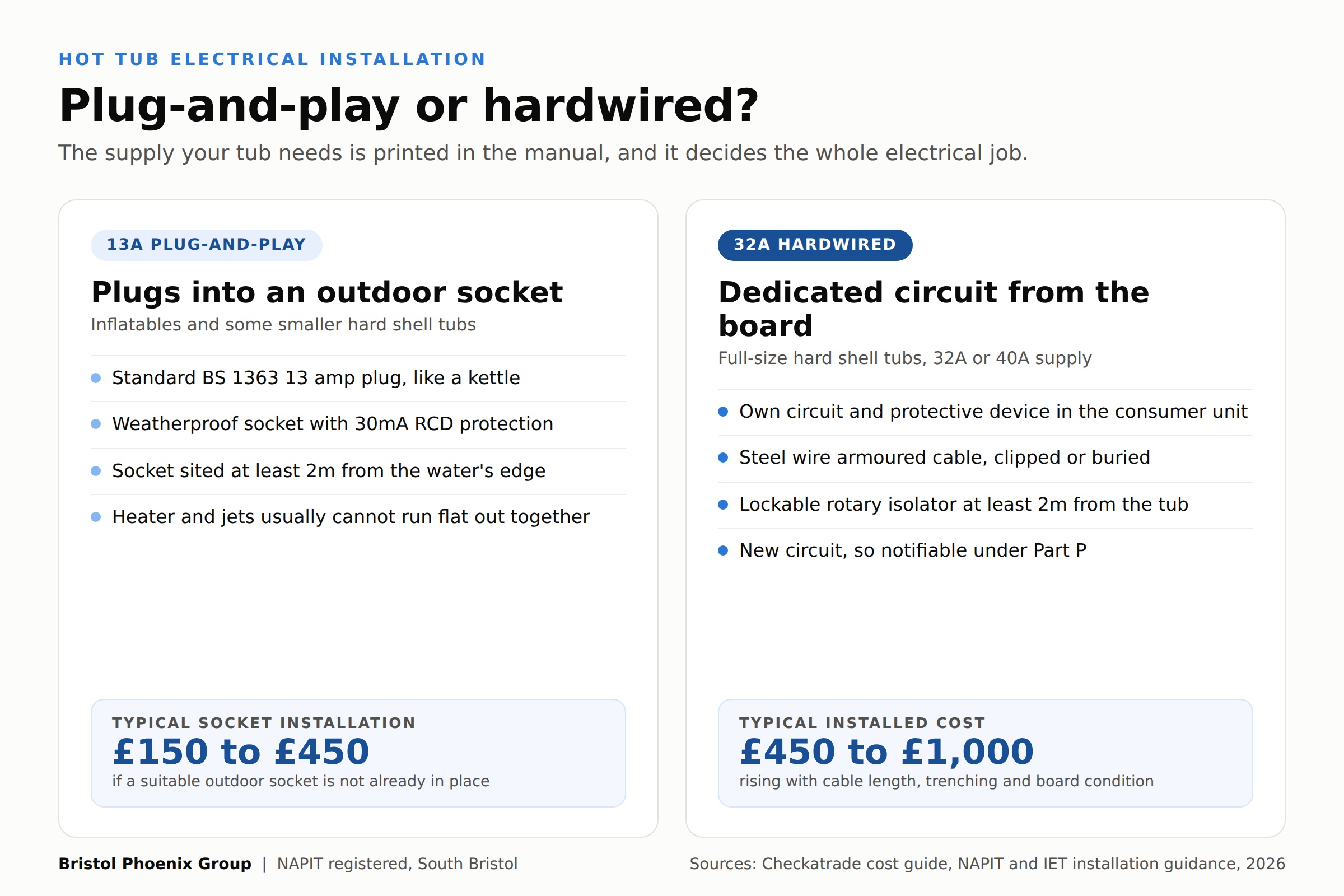
Almost every question about hot tub electrical installation splits at the same fork: what kind of supply does the tub need? The answer is printed in the manual, and it puts the tub in one of two camps, as NAPIT’s installation guidance sets out.
13A plug-and-play tubs
These come fitted with a standard BS 1363 13 amp plug, the same as a kettle. Most inflatable tubs and some smaller hard shell models take this route. The plug needs a socket, and this is where corners get cut: it is designed for a proper outdoor socket on a suitable supply, not an extension lead trailed through the kitchen window.
The socket should be a weatherproof outdoor unit with 30mA RCD protection, positioned at least 2 metres from the tub. If you already have a decent outdoor socket, you may be most of the way there. If not, our guide to outdoor socket installation cost covers that job in detail.
The trade-off is performance. A 13 amp supply caps what the tub can draw, so plug-and-play models usually cannot run the heater and both pumps flat out at the same time. The water heats slower and cools while the jets are on. Fine for many, worth knowing before you buy.
32A hardwired tubs
Full-size hard shell tubs typically need a 32A or 40A supply, which means a dedicated circuit run from your consumer unit to the tub: its own protective device in the board, armoured cable out to the garden, and a rotary isolator switch near the tub. NAPIT’s guidance notes that a socket-outlet or rotary isolator adjacent to the tub satisfies the regulation requiring an effective means of isolation, and the IET goes further, recommending fixed wiring over a socket connection so the supply cannot be misused.
Hardwired means the tub runs everything at once, heats faster and holds temperature. It also means the installation is a proper electrical project, which is where the rest of this guide comes in.
| Aspect | 13A plug-and-play | 32A hardwired |
|---|---|---|
| Connection | BS 1363 plug into RCD protected outdoor socket | Dedicated circuit from the consumer unit |
| Typical tubs | Inflatables, smaller hard shells | Full-size hard shell tubs |
| Heater and jets together | Usually limited | Yes |
| Electrical work needed | Suitable outdoor socket, if not already present | New circuit, armoured cable, rotary isolator |
| Part P notification | Not usually, if adding to an existing circuit outside special locations | Yes, a new circuit is notifiable |
| Typical electrics cost | £150 to £450 for the socket | £450 to £1,000 for the circuit |
Hot Tub Wiring Requirements UK: The Rules That Apply
The technical standard behind all of this is BS 7671, the IET Wiring Regulations. For an outdoor tub, Section 702, which covers swimming pools and other basins, is the part your electrician will be working to, alongside the manufacturer’s instructions.
30mA RCD protection, always
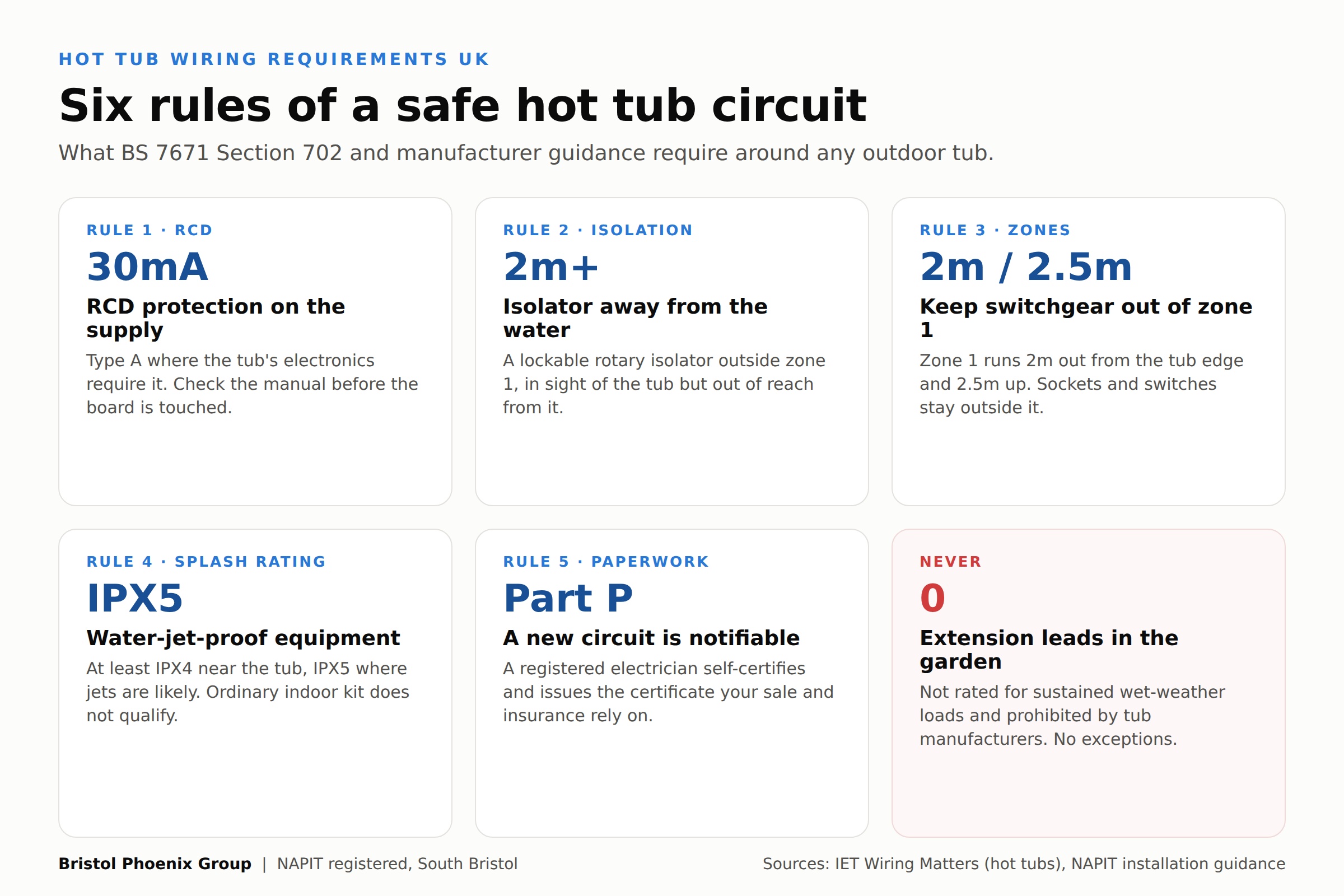
An RCD is the device that disconnects the supply in a fraction of a second when current leaks somewhere it should not, such as through a person. The IET guidance is explicit that the hot tub supply needs an RCD with a rated residual operating current of 30mA, and Electrical Safety First’s garden advice is blunter still: use a residual current device with all outdoor electrical equipment.
There is a detail here that separates a careful installation from a casual one. Modern tub control packs contain electronics that can leak small DC currents, and a standard RCD can be blinded by them. The IET notes that some equipment needs a Type A RCD for exactly this reason, so the manufacturer’s manual gets read before the protective device gets chosen. If your consumer unit is an older board with no spare ways or no RCD protection at all, it may need attention first; our consumer unit page explains what a modern board does differently.
The rotary isolator
Every hardwired tub gets a rotary isolator: a weatherproof switch mounted within sight of the tub that kills the supply completely for maintenance and emergencies. It needs to be close enough to be useful and far enough away that nobody can reach it from the water. The IET guidance places it outside zone 1, which extends 2 metres horizontally from the edge of the tub, so in practice the isolator lives at least 2 metres from the water’s edge, out of reach of anyone in the tub.
Zones, distances and IP ratings
BS 7671 draws imaginary boxes around any basin of water and restricts what electrical equipment can live in each one. Zone 1 covers the tub itself and the area 2 metres out from its edge, up to a height of 2.5 metres. Switches and sockets stay out of that box. Any equipment that does sit near the tub needs to be built for splashing: NAPIT’s guidance calls for at least IPX4 rated equipment in zone 2, and IPX5 where water jets are likely, which around a tub full of teenagers they are.
Outdoor Cabling: Armoured Cable, Trenches and Doing It Once
The cable between your consumer unit and the tub is doing a hard job: carrying a sustained 32A load, outdoors, for years. The standard answer is steel wire armoured cable, SWA to the trade, either clipped along a wall or fence line or buried in a trench across the garden.
Buried cable needs to go deep enough that a garden fork can never find it, with marker tape above it as a warning to whoever digs there in ten years. Where a flexible final connection into the tub is needed, NAPIT points to heavy duty H07RN-F rubber cable, which shrugs off UV and weather in a way ordinary flex does not.
Cable gets thicker as runs get longer, because voltage drop is real. A tub at the far end of a 30 metre Bristol terrace garden may need a larger cable than one sat by the back door. This is why two identical tubs in different gardens get two honestly different quotes.
One piece of advice from the trenches, literally: while the ground is open, think about what else the garden will ever need. An outdoor socket, garden lighting, power for a shed. The digging is the expensive part and it only needs doing once.
Earthing, PME and Why Your Electrician Might Say TT
Here is the part most guides skip, and often the most important conversation on the survey. Most Bristol homes have what is called a PME earthing arrangement, where the earth connection is provided by the electricity network. Indoors it is fine. Outdoors, with a person sitting in water in direct contact with the ground, a rare network fault could make every earthed metal part live at a dangerous voltage, and an RCD would not help because an RCD cannot see that kind of fault.
The IET’s hot tub guidance works through this in detail and the practical upshot is that many hot tub circuits are converted to what is called a TT arrangement: an earth rod driven into your own garden, so the tub’s earth is independent of the network. It is a modest piece of work with an unglamorous name, and the kind of detail that tells you whether the person quoting has actually read Section 702.
Part P: The Paperwork That Comes With the Trench
In England, electrical work in homes and gardens falls under Part P of the Building Regulations. The IET’s Part P FAQ confirms the rule that matters here: the installation of a new circuit is notifiable to building control. A dedicated hot tub circuit is a new circuit, full stop, so it is notifiable, every time.
An electrician registered with a competent person scheme, such as NAPIT, self-certifies the work and the notification happens for you, with the certificate and paperwork landing in your inbox. The alternative is notifying Bristol City Council building control yourself before the work starts and paying them to inspect it, which costs more and takes longer. The registered electrician route is cheaper, faster and how virtually all of these jobs are done.
The certificate is not bureaucratic decoration. When you sell the house, your conveyancer will ask for it. When you claim on insurance after any electrical incident, the insurer will ask for it. A tub wired without one is a problem saved up for the worst moment.
Hot Tub Electrics Cost in 2026
Now the number everyone scrolled here for. Hot tub electrics cost depends on which fork you took above, then on how far the cable travels.
For a 13A plug-and-play tub, the electrical work is an outdoor socket on a suitable supply. Checkatrade’s hot tub cost guide puts a 13 amp socket installation at £150 to £450. That sits above the £75 to £200 of a basic outdoor socket because a tub socket is rarely the cheap back-to-back case: it usually means a decent run down the garden and heavier duty kit.
For a hardwired tub, the same Checkatrade guide quotes around £750 for a 32 amp installation, and Hamuch’s tradespeople data lands on a similar £750 estimate. Regional electricians’ own published pricing, such as this Somerset guide, starts a straightforward short-run installation from around £450, rising from £600 or so once the cable run stretches past 15 metres, with trenching priced on top by the metre. Put together, a realistic 2026 range for a dedicated 32A hot tub circuit is £450 to £1,000, with long runs, extensive digging or awkward access pushing past that.
| Job | Typical 2026 range | What moves it |
|---|---|---|
| Outdoor socket for a 13A plug-and-play tub | £150 to £450 | Distance from an existing circuit, wall construction |
| Dedicated 32A circuit, short run | £450 to £750 | Spare way in the board, clipped rather than buried cable |
| Dedicated 32A circuit, long run with trenching | £600 to £1,000+ | Cable length, digging and reinstatement, TT earthing |
| Consumer unit replacement first, if needed | £350 to £750 | Age and condition of the existing board |
That last row matters more often than people expect. A tub adds a large continuous load, and an older board with no spare ways or no RCD protection needs sorting before the garden work starts. We have covered what that involves in our new fuse box cost guide, and the figures there hold: £350 to £750 for a typical home.
Worth budgeting alongside the installation: the running cost. Checkatrade’s guide puts a hard shell tub at £30 to £60 a month in electricity, and inflatable tubs at roughly £150 a month, because thin walls lose heat and a 13A supply reheats slowly. The cheaper tub is often the dearer one by Christmas.
A Worked Example: A Tub in a Totterdown Garden
Picture a typical job for us. A Victorian terrace in Totterdown, consumer unit under the stairs at the front of the house, and a new hard shell tub arriving in three weeks that wants a 32A supply at the end of a 22 metre garden.
The survey finds a modern board with one spare way, so no board replacement, but like most of the street the house is on a PME supply, so the circuit will be converted to TT with an earth rod by the tub. The route runs SWA cable clipped discreetly along the boundary wall for 12 metres, then through a 10 metre trench across the lawn to the tub base. A Type A RCBO goes in the board, a lockable IP rated rotary isolator goes on the fence post 2.5 metres from the water’s edge, and the tub’s control pack is connected per the manufacturer’s manual.
The bill lands around £850: the circuit and isolator at short-run money, plus the trench, the earth rod and the longer cable. Paperwork follows: an Electrical Installation Certificate and the Part P notification through NAPIT, no council visit needed. Total electrical time on site, about a day, most of it digging. The tub owner’s only real job was choosing where the isolator went and putting the kettle on.
The Mistakes We Keep Seeing
The extension lead. Every year, tubs running off a reel through the kitchen window. Leads are not rated for sustained loads in wet gardens, they defeat every protection measure above, and manufacturers’ manuals prohibit them. If a tub is worth £4,000, it is worth a socket.
The indoor socket through the wall. A close cousin: a hole through the kitchen wall, the tub plugged in behind the washing machine. No RCD designed for the job, no isolation outside, no certificate, and a cable route that would make an insurance assessor reach for the exclusions page.
The quote with no mention of earthing. If a quote for a hardwired tub says nothing about earthing, the question has not been considered. Ask. The answer tells you a lot.
The missing paperwork. A new circuit with no certificate and no building control notification is not a bargain, it is a liability with jets. It resurfaces at sale time, every time.
Final Thoughts
A hot tub is a lovely thing, and the electrics are a solved problem: a suitable supply, 30mA RCD protection of the right type, an isolator you can reach and the tub cannot, armoured cable that will outlive the fence it runs along, earthing chosen deliberately, and a certificate at the end. None of it is exotic. All of it needs doing properly, once.
We are Bristol Phoenix Group, NAPIT registered and based in South Bristol, and hot tub circuits sit squarely within our services, from the first survey through trenching coordination to the final certificate. If a tub is on its way to your garden, or already sitting on its pallet looking hopeful, get in touch and we will talk through the supply it needs before the water goes in.