An outside socket is one of those jobs that sits on the to-do list for months. The pressure washer runs off an extension lead through the kitchen window, the lawnmower cable does a lap of the utility room, and everyone quietly accepts the arrangement until something trips or gets rained on. Then the question finally gets asked: what does outdoor socket installation cost, and why do quotes for such a small job vary so much? The short answer is that it costs less than most people expect, and the variation comes down to two or three decisions we can explain in plain English. As a NAPIT registered firm based in South Bristol, we fit a lot of these, so here is the honest version.
- Outdoor Socket Installation Cost: The Numbers
- What Makes the Price Move
- Spur or New Circuit: The Decision That Matters Most
- IP Ratings Explained Without the Jargon
- RCD Protection: The Non-Negotiable Part
- The Garden Office Effect
- A Worked Example
- Cheap Quote Warning Signs
- Outdoor Socket Installation Cost FAQs
- Final Thoughts
TL;DR
- A straightforward outside socket fitted as a spur from an existing circuit typically costs somewhere between £75 and £200 in the UK, with the socket itself only £10 to £60 of that. Double sockets and awkward cable runs push past £200.
- Most jobs take between one and four hours including testing and certification.
- Every outdoor socket must be RCD protected, either built into the socket or at the consumer unit. This is not optional.
- Buy weatherproof kit: IP66 is the standard most outdoor sockets are sold at, and it is the sensible minimum for anything living on an outside wall.
- A simple spur added to an existing circuit is usually not notifiable under Part P. A brand new circuit, which is what a garden office or hot tub needs, is notifiable, so use a registered electrician who can self-certify.
- If a quote seems suspiciously cheap, it usually means no RCD, no certificate, or an indoor socket doing an outdoor job. All three cost you more later.
Outdoor Socket Installation Cost: The Numbers
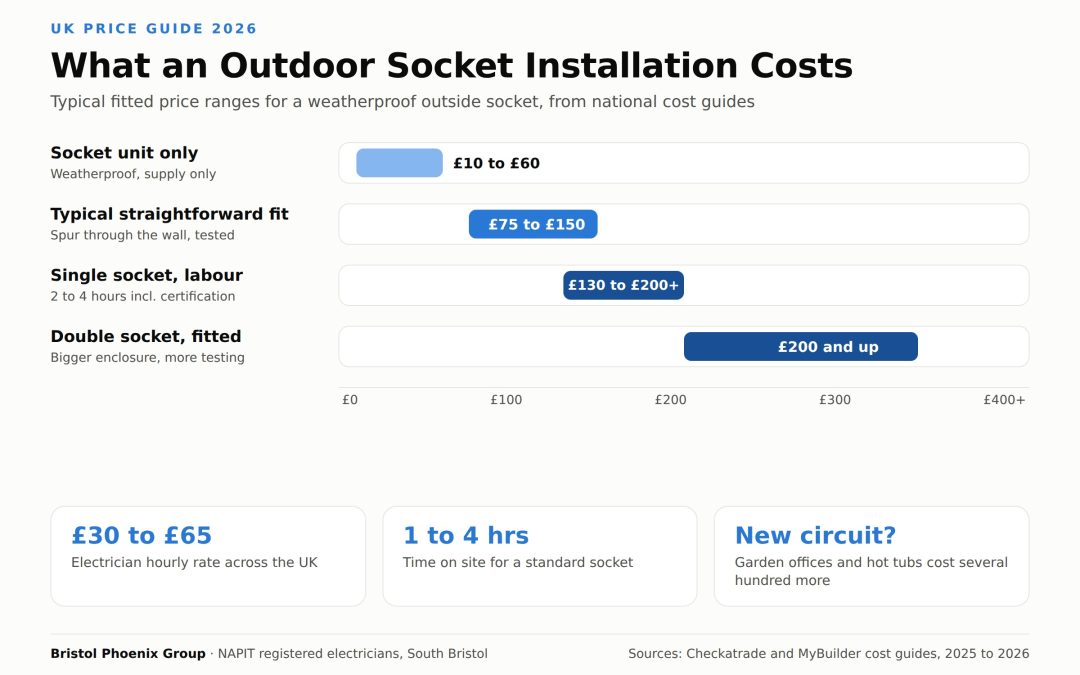
Let us start with what the national trade directories say, because they publish the averages that most customers will have already seen before ringing us. Checkatrade’s cost guide, updated in June 2026, puts the socket itself at £10 to £60, labour for a single outdoor socket at £130 to £200 or more, and labour for a double at upwards of £200, with the whole job typically taking two to four hours including testing.
MyBuilder’s price guide is a touch more optimistic, quoting £75 to £150 for a typical installation, electrician labour at £30 to £65 per hour, and one to three hours on site. The difference between the two guides is mostly about what counts as typical. A socket mounted directly on the other side of the wall from an existing indoor socket sits at the bottom of both ranges. Anything involving a long cable run, conduit, or a tired consumer unit climbs quickly.
Here is the picture in one table, using both guides as the spread:
| Item | Typical UK range | Notes |
|---|---|---|
| Outdoor socket unit only | £10 to £60 | Weatherproof double sockets sit at the top end |
| Single socket, fitted as a simple spur | £75 to £200 | Straight through the wall from an indoor socket |
| Double socket, fitted | £200 and up | More testing, more terminations, bigger enclosure |
| Electrician labour | £30 to £65 per hour | Regional variation applies, Bristol sits mid-pack |
| Time on site | 1 to 4 hours | Including testing and the certificate |
Treat those figures as the sensible middle of the market. The outside socket fitting cost for your actual house depends on where the socket needs to go and what your existing installation looks like, which brings us to the interesting part.
What Makes the Price Move
Distance from the nearest circuit
The cheapest outdoor socket in Britain is the one fitted back-to-back with an indoor one. Drill through the wall, seal the penetration, mount the enclosure, connect, test, done. Every metre the socket moves away from that ideal adds cable, clips, possibly conduit, and time. A socket at the far end of a garden is a different job entirely, and usually a different circuit too.
The state of your consumer unit
If your fuse board is modern and has RCD protection with spare capacity, the job is simple. If it is an older board with no RCD, the socket will need one built in, or the board needs attention first. We would rather tell you that upfront than have you find out as a surprise line on an invoice.
The socket specification
A basic weatherproof single is cheap. A double IP66 socket with a lockable cover, or a smart version you can switch from your phone, costs more to buy but the labour barely changes. Spending an extra £20 on the socket is usually the best value upgrade on the whole job.
Access and wall construction
Drilling through a 250mm stone wall in an older property takes longer than a modern cavity wall, and render repairs or awkward access add time. Nothing dramatic, but hourly rates make time the main ingredient in any quote.
Spur or New Circuit: The Decision That Matters Most
Almost every outdoor socket quote splits into one of two shapes, and this is the fork in the road that moves the price more than anything else.
The first shape is a spur: a short branch taken from an existing socket circuit, through the wall, into a weatherproof enclosure. It is quick, it is tidy, and for a socket powering a mower, a pressure washer, or garden tools, it is usually the right call. Under the Building Regulations in England, alterations and additions to existing circuits outside special locations are generally not notifiable, as the Planning Portal’s guidance confirms. You still need the work tested and certificated, but there is no building control paperwork for a standard spur.
The second shape is a new circuit run from the consumer unit. This is what you need when the load is serious or the distance is long: a garden office, a workshop, a hot tub, an EV charger, or several sockets down the garden. The same Planning Portal guidance lists the installation of a complete new circuit as notifiable work. NICEIC’s garden electrics guidance makes the same point about garden installations: some of this work must be notified to local authority building control, unless your electrician is registered with a competent person scheme and can self-certify it. That is exactly what our NAPIT registration lets us do, so the paperwork happens quietly in the background and you receive the certificate without ever speaking to the council.
Price-wise, a new garden circuit with armoured cable, proper burial or clipping, a new protective device in the board and the notification sits well above the simple spur figures in the table. It is several hundred pounds rather than around a hundred, with the exact number driven by cable length and groundworks. If someone quotes spur money for new-circuit work, one of you has misunderstood the job, and it is worth finding out who before anyone starts drilling.
IP Ratings Explained Without the Jargon
Every piece of outdoor electrical kit carries an IP rating, and the code is simpler than it looks. IP stands for ingress protection, and the two digits answer two questions: how well does it keep solid stuff out, and how well does it keep water out. First digit, dust and fingers. Second digit, water. Higher is better in both cases.
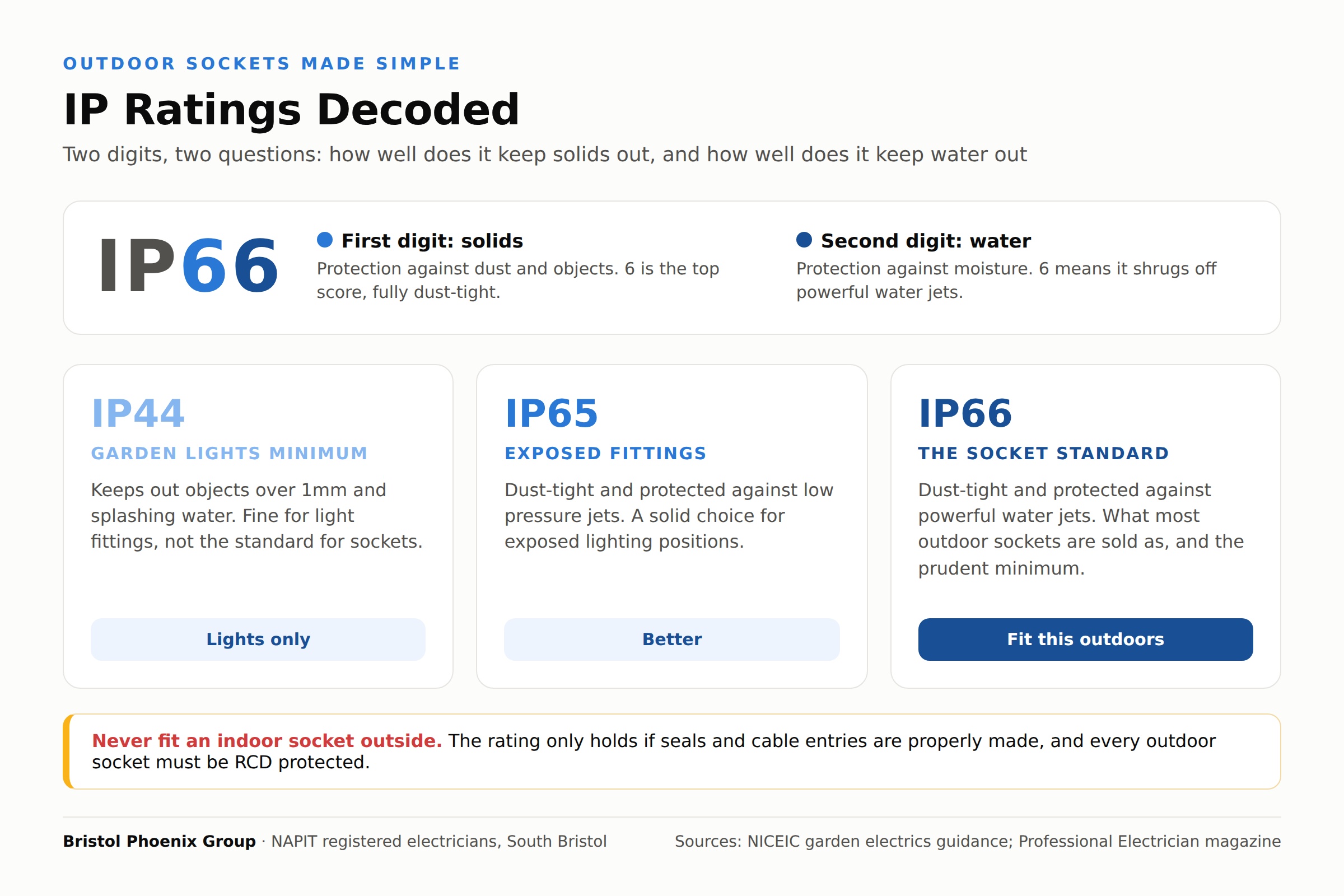
For fixed outdoor sockets, the market has largely settled the question for you. As NICEIC notes, most outdoor socket-outlets on sale have an IP66 rating, which means dust-tight and protected against powerful water jets. Trade guidance published by Professional Electrician magazine calls IP66 a prudent minimum for outdoor sockets and switches, and we agree. For garden lights, NICEIC suggests IP44 or higher, which covers splashing water rather than direct jets.
| Rating | What it means in practice | Sensible use outdoors |
|---|---|---|
| IP44 | Protected against objects over 1mm and splashing water | Minimum for garden light fittings |
| IP65 | Dust-tight, protected against low pressure water jets | Exposed lighting, covered sockets |
| IP66 | Dust-tight, protected against powerful water jets | The standard for fixed outdoor sockets |
One practical note from the tools-down side of the trade: the rating only holds if the enclosure is installed properly. An IP66 socket with an unsealed cable entry or a cracked cover is an IP-nothing socket. Fitting is as important as the number on the box.
RCD Protection: The Non-Negotiable Part
An RCD, or residual current device, watches the current flowing out and back on a circuit and disconnects in a fraction of a second if some of it goes missing, which is precisely what happens when electricity travels through a person. Outdoors, where damp, bare feet and severed cables are all part of normal life, this protection matters more than anywhere else in the house.
The guidance here is blunt. Electrical Safety First says to use an RCD with all outdoor electrical equipment, and puts the reason plainly: without it, cutting through a lead while mowing the lawn could kill you. NICEIC’s position is that all outdoor socket-outlets should be RCD protected. Current trade practice, reflected in the Professional Electrician guidance above, is 30mA RCD protection either built into the socket itself or provided by the circuit’s RCD or RCBO at the board, in line with BS 7671, the IET Wiring Regulations.
In cost terms this is a rounding error. A socket with a built-in RCD costs a little more than a standard one, and if your consumer unit already provides RCD protection, it may cost nothing at all. There is no version of this job where skipping the RCD is a saving worth having. And if you fit one and find it trips more often than seems reasonable, that is usually the RCD doing its job of telling you something, not a faulty device. We wrote a full guide on that in our post on why an RCD keeps tripping, and our fault finding service exists for the stubborn cases.
The Garden Office Effect
Ten years ago the typical garden socket installation powered a lawnmower and a radio. Now it powers a desk, a monitor, a heater and a router, because the shed has quietly become an office. The numbers behind this are real: according to the Office for National Statistics, 28% of working adults in Great Britain were hybrid working between January and March 2025. A meaningful slice of those people are working from the bottom of the garden, and their pods and cabins all need power.
This matters for cost because a garden office is firmly in new-circuit territory. A heater and a computer running all day through a spur designed for hedge trimmers is how nuisance tripping and warm cables happen. The proper job is armoured cable on its own circuit, sized for the load and the distance, with its own protection at the board. While the trench is open it is also the cheap moment to think ahead: many customers add an outdoor socket, garden lighting, or provision for a future EV charger at the same time, because the digging is the expensive part and it only needs doing once.

A Worked Example
Picture a typical 1930s semi on the south side of Bristol. The owner wants one double socket on the rear wall of the house for a pressure washer and the mower. There is a ring main socket in the kitchen, back-to-back with the spot they have in mind. The consumer unit is a modern one with RCD protection. This is the friendly version of the job: a spur through the wall, an IP66 double socket, sealed entries, an hour or two on site including dead and live testing, and a minor works certificate at the end. It lands near the lower middle of the national ranges above, and nobody needs to notify anybody. Wondering how much more that kitchen ring could take before a spur becomes a bad idea? Our guide to how many sockets you can have on a ring main answers exactly that.
Now take the same house, but the owner has just put an office pod fifteen metres down the garden. Different job. Armoured cable buried in a trench along the fence line, a new circuit from the consumer unit with its own RCBO, a small consumer unit in the pod, an outside socket added while the trench is open, then notification handled through self-certification. More materials, most of a day’s labour, and a price several times the simple spur. Neither quote is wrong. They are simply different jobs that happen to share the phrase outside socket.
Cheap Quote Warning Signs
Some quotes are cheap because the electrician is efficient and local. Some are cheap because something is missing. Questions worth asking before you accept the lowest number:
- Is RCD protection included and where does it live, in the socket or at the board? A shrug here ends the conversation.
- What IP rating is the socket being fitted? If the answer is an indoor socket under a porch roof, keep looking.
- Will you receive a certificate? Every addition to a circuit should come with a minor works certificate, and a new circuit with an installation certificate plus building control notification.
- Is the installer registered with a competent person scheme such as NAPIT or NICEIC? Registration is what makes self-certification legal, and it is checkable online in about a minute.
- Does the quote say spur or new circuit? If it does not say, the price is a guess, and guesses get revised on the day.
None of this is about spending more for the sake of it. It is about making sure the £150 job is actually the £150 job, rather than the first instalment of a £400 one.
Outdoor Socket Installation Cost FAQs
Can I just use an extension lead through the window instead?
People do, and for a one-off task with an RCD adaptor it is survivable. As a permanent arrangement it is a poor idea: leads get trapped, pulled and soaked. Electrical Safety First advises that any leads used outdoors should be weather-resistant with moulded connections, and the honest advice is that if the lead lives outside more than it lives in the drawer, you need a socket.
Is fitting an outside socket notifiable under Part P?
A simple spur from an existing circuit, outside special locations, is generally not notifiable in England. A new circuit is. Either way the work must meet BS 7671 and be properly tested and certificated, which is why this is not a DIY-and-hope job.
How long does the work take?
The national guides say one to four hours for a standard socket, and that matches our experience. Garden circuits with trenching are most of a day, sometimes more, with the digging usually taking longer than the electrics.
What about hot tubs?
A hot tub is a new dedicated circuit, full stop. It combines water, high load and bare skin, which is the complete set of reasons the regulations exist. Budget for new-circuit money, not spur money.
Final Thoughts
Outdoor socket installation cost is one of the friendlier numbers in domestic electrical work: for most homes it is a £75 to £200 job that takes a morning, ends the extension-lead-through-the-window era, and comes with a certificate. The price only climbs when the job genuinely changes shape, from a spur to a new circuit, and now you know how to spot which one you are being quoted for.
If you are in Bristol or the surrounding area and want a straight answer on your own outside socket, garden office supply, or anything else on the list of things we do, send us a photo of the wall and the fuse board and we will tell you which kind of job you have. No call-out fee for an honest opinion. You can reach us through our contact page and we will come back to you quickly, usually with a fixed price rather than a shrug.