A wallbox is a small grey or white box that does one job, yet ask three installers what it costs to fit one and you can get three answers hundreds of pounds apart. If you have been searching for EV charger installation cost UK wide and getting numbers that range from £500 to £2,000, you are not going mad, and nobody is necessarily trying to fleece you. The honest answer is that the price depends on your house far more than it depends on the charger. In this guide we will break down what the box costs, what the installation costs, what quietly pushes quotes up, and the grant that some households can still claim towards the whole thing.
Table of Contents
- EV Charger Installation Cost UK: The Headline Numbers
- What the Charger Itself Costs
- What Installation Involves and Why It Costs What It Does
- What Pushes EV Charging Point Installation Cost Up
- Tethered or Untethered: Does It Change the Price
- The £500 Chargepoint Grant: Who Can Still Claim
- The Smart Charging Rules Your New Charger Must Meet
- A Worked Example: Home EV Charger Cost for a Bristol Semi
- Cheap Quote Warning Signs
- Final Thoughts and Getting a Firm Price
TL;DR
- A typical 7kW home charger, fully installed, costs around £800 to £1,200 in the UK in 2026, with the national average sitting near £1,000.
- The unit itself is usually £450 to £900 depending on spec. Labour for a straightforward install is 2 to 4 hours.
- Long cable runs, an old or full consumer unit, earthing upgrades and groundworks are the four things that push quotes up.
- Flat owners, renters and households with only on-street parking can claim 75% off, up to £500, through the government chargepoint grant until 31 March 2027. Homeowners in houses with driveways cannot.
- Every new home charger sold must be a smart charger by law, and the installation should always be done by a registered electrician.
EV Charger Installation Cost UK: The Headline Numbers
Start with the figure most people actually want. For a standard 7kW smart charger on a single phase domestic supply, the typical fully installed price in the UK is £800 to £1,200, with the 2026 average around £1,110 according to The Electric Car Scheme’s cost guide. BookaBuilderUK’s 2026 guide lands in the same territory, putting a standard 7kW installation at £900 to £1,400.
That is the whole job: the charger, the dedicated circuit back to your fuse board, the protective devices, the testing and the certification. If a quote is dramatically under that range, something on that list is usually missing. If a quote is dramatically over it, there is usually a genuine reason hiding in your driveway, your fuse board or your earthing arrangement, and a good installer will tell you exactly which one.
What the Charger Itself Costs
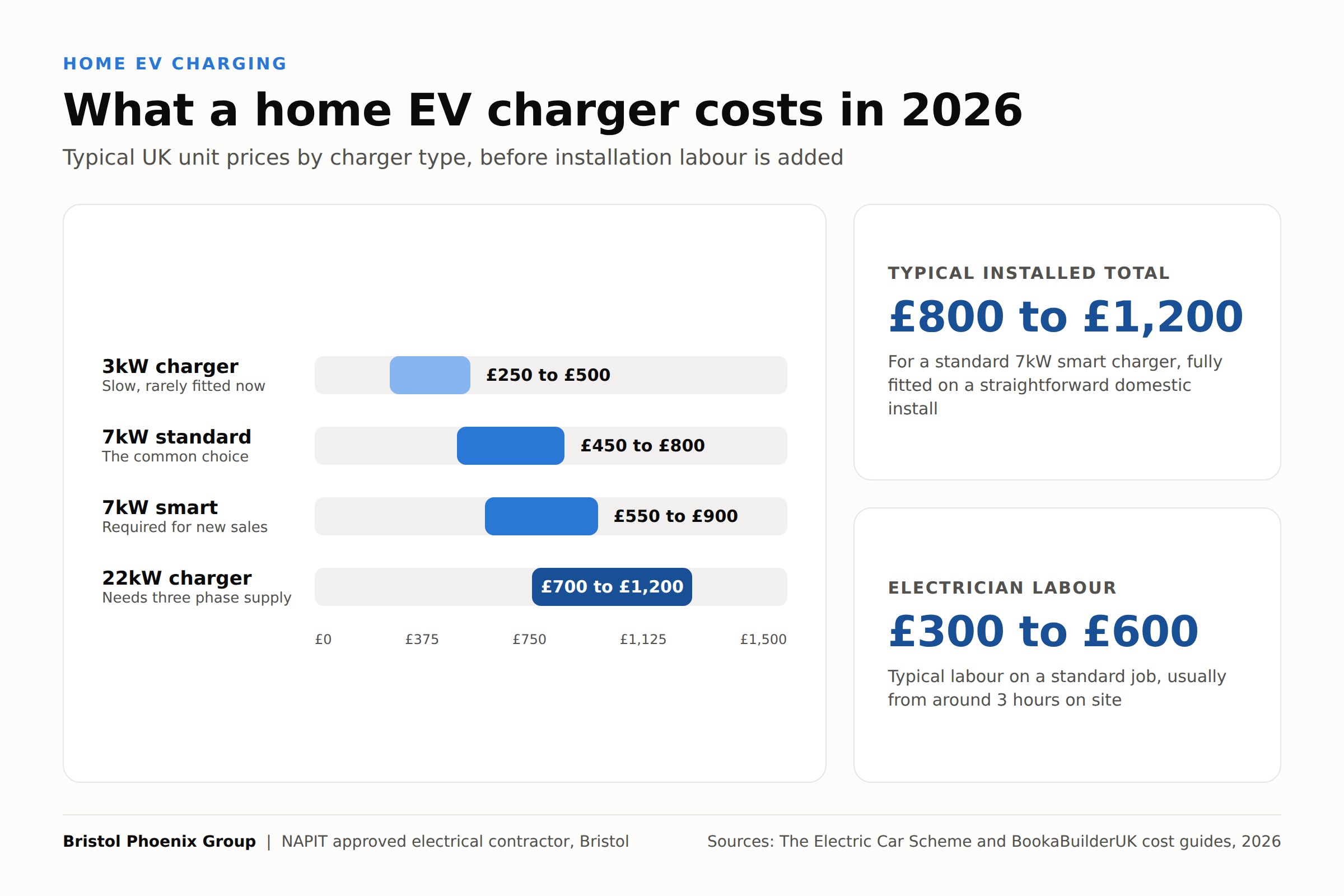
The box on the wall is roughly half the bill. Prices vary by charging speed and by how clever the unit is, and the ranges below come from The Electric Car Scheme’s 2026 figures.
| Charger type | Typical unit price | Worth knowing |
|---|---|---|
| 3kW charger | £250 to £500 | Slow. Rarely fitted now, since a full charge can take all night and then some. |
| 7kW standard | £450 to £800 | The workhorse of UK driveways. Suits almost every single phase home. |
| 7kW smart | £550 to £900 | App control, scheduling and off-peak tariff support. New chargers sold must be smart anyway. |
| 22kW charger | £700 to £1,200 | Needs a three phase supply, which most UK homes do not have. Usually not worth the upgrade cost. |
On top of the unit, BookaBuilderUK puts the labour at £300 to £600 on a standard job, with an installation typically taking from around three hours on site. Popular units we see requested around Bristol include the Ohme Home Pro, Zappi and Wallbox, and the differences between them matter less than the quality of the installation behind them.
What Installation Involves and Why It Costs What It Does
A home charger is not a plug-in appliance. It is a new dedicated circuit, and on a 7kW unit that circuit will happily carry over 30 amps for six or eight hours at a stretch. Very little else in your house works that hard for that long, which is why the electrical side has to be right.
A proper installation includes a survey of your supply and fuse board, a new circuit run in appropriately sized cable, protective devices to guard against faults, checks on your earthing arrangement, then testing and certification at the end. As a NAPIT approved contractor based in South Bristol, we notify the work and issue the paperwork as part of the job, and that certificate matters when you come to sell the house or claim on insurance. Our EV charger installation service covers all of this as standard.
Electrical Safety First is blunt on two points here, and we agree with both. First, “the safest way to charge at home is with a dedicated EVCP”, not a standard socket, because “the extended load and duration of charging an EV are likely to exceed what a standard socket-outlet and standard wiring is designed for”. Second, “a home charging point must be installed by a registered and competent electrician, trained and qualified to install electric vehicle charge points”. Granny cables and extension leads trailing out of a kitchen window are for emergencies, not for every night.
What Pushes EV Charging Point Installation Cost Up
Two identical chargers on two different houses can produce very different bills. When an EV charging point installation cost comes in above the typical range, it is almost always one of these four things.
The cable run
Most installers include around 10 metres of cable in the standard price. Your fuse board is under the stairs, the charger goes on the front wall, everyone is happy. If your board is at the back of the house and the parking is at the front, every extra metre adds cost. The Electric Car Scheme puts this at £10 to £20 per extra metre, and a long, awkward route through a finished interior takes time as well as cable.
Your consumer unit
The charger needs a spare way on your fuse board and a board that is safe to add to. Plenty of older Bristol homes have neither. If your board is full, or it is an older type without the protection a new circuit needs, the honest fix is a board change. Budget £350 to £750 for a typical replacement, as we set out in our new fuse box cost guide, and see our consumer unit service for what the job involves. It is annoying to discover this on a survey, but a charger hung off an inadequate board is a corner nobody should cut.
Earthing arrangements
EV chargers have specific earthing requirements because a car on charge is effectively a large metal appliance sitting outdoors. Many modern chargers include built-in protection that avoids the need for an earth rod, but where your supply arrangement needs extra work, that adds parts and labour. This is exactly the sort of thing a pre-install survey catches, and one reason we always look before we quote.
Groundworks and three phase
Charger going on a detached garage? The cable has to get there, and trenching across a garden or driveway typically adds £200 to £500. And if you have set your heart on a 22kW unit, be aware that upgrading a typical home to a three phase supply runs to £2,000 to £5,000 or more, which is why we almost never recommend it for a domestic driveway. A 7kW charger fills the battery overnight, and overnight is when most cars are parked anyway.
Tethered or Untethered: Does It Change the Price
A tethered charger has its own cable permanently attached, usually 5 to 7.5 metres of it, coiled on the wall ready to go. An untethered charger is just a socket, and you use the cable that came with the car. The price difference between the two is modest, typically well under £100 either way, so choose on convenience rather than cost.
Tethered wins for day-to-day ease: walk out, uncoil, plug in. Untethered looks tidier, copes if you change car and the connector standard ever changes, and leaves nothing dangling for a passer-by to fiddle with. We fit both. If pressed, most of our customers with one car and one driveway end up happier with tethered, and most people who share a charger between two cars prefer the socket.
The £500 Chargepoint Grant: Who Can Still Claim
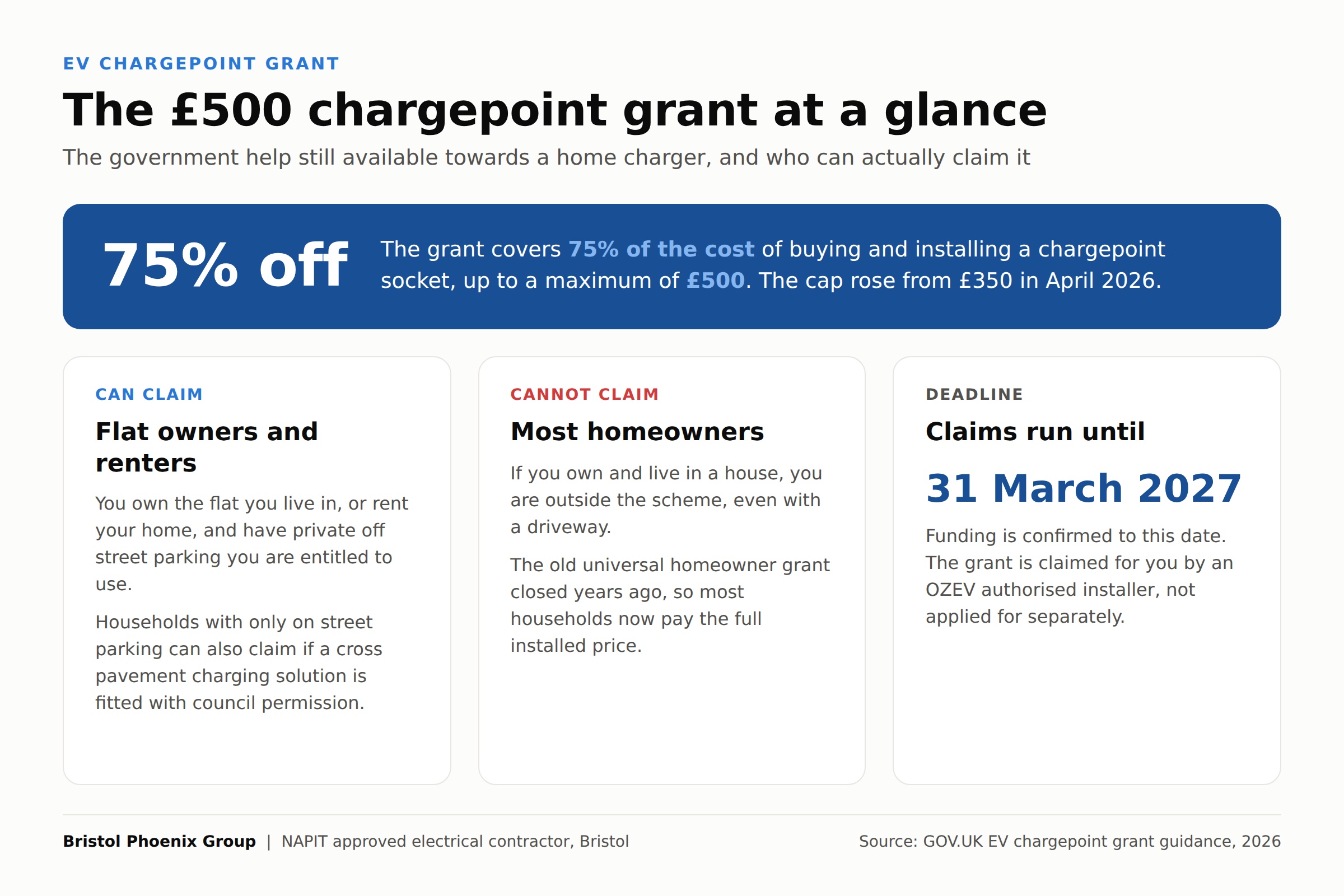
The days of every homeowner getting a grant towards a wallbox are gone, but targeted help still exists and it got more generous this year. The EV chargepoint grant gives eligible households “75% off the cost of buying and installing a socket, up to a maximum of £500”. The cap rose from £350 to £500 per socket in April 2026, and the government’s installer guidance confirms the schemes run until 31 March 2027.
Who qualifies? Two main groups. First, you rent your home, or you own a flat you live in, and you have private off-street parking you are entitled to use. Second, under a separate strand of the same grant, households with no off-street parking at all can claim if a cross-pavement charging solution is installed alongside the chargepoint with permission from the local highways authority. That second route is worth knowing about in Bristol, where whole streets of terraces park at the kerb.
Who misses out? If you own and live in a house, even one with a driveway, there is currently no grant for you. One practical note: the grant is claimed through an OZEV authorised installer as part of the job, not something you apply for separately afterwards, so mention it when you first get in touch.
The Smart Charging Rules Your New Charger Must Meet
Since 30 June 2022, the Electric Vehicles (Smart Charge Points) Regulations 2021 have required most home and workplace chargers sold in Great Britain to have smart functionality. In plain English, your charger must be able to talk to the internet, respond to tariff signals and schedule itself.
Two of the built-in behaviours surprise people. Out of the box, chargers default to avoiding peak hours, which the regulations set as 8am to 11am and 4pm to 10pm on weekdays. They also apply a randomised delay of up to 600 seconds before starting a charge, so a million cars do not all hit the grid at the same second when cheap rate begins. You can override both settings, and your installer should show you how, but do not be alarmed when a brand new charger sits there thinking for a few minutes before it starts. It is behaving, not broken.
The practical upside of smart charging is money. Paired with an off-peak EV tariff, scheduled overnight charging is the difference between motoring on cheap-rate electricity and paying daytime prices, and it is the main reason we would not fit a dumb charger even if you could still buy one.
A Worked Example: Home EV Charger Cost for a Bristol Semi
Take a typical three bed semi in South Bristol: driveway at the side, fuse board in the hallway, supply and earthing in good order. The owner wants a 7kW untethered smart charger on the wall nearest the parking. The cable run is about 8 metres, inside the standard allowance.
The maths on a job like that is pleasingly dull. Call it £600 for a decent 7kW smart unit, plus half a day of labour, sundries, testing and certification. The all-in home EV charger cost lands somewhere around £950 to £1,050, sitting exactly where the national £800 to £1,200 range says it should. No grant applies, because the owner lives in a house they own.
Now picture the same house with a full 1980s fuse board and parking behind a garage at the end of the garden. Add a board change at £350 to £750, a 20 metre cable run with some trenching, and the same charger can push £1,800 to £2,000. Same box, same street, different house. That is the entire story of EV charger pricing in one paragraph, and it is why any firm quote you get without anyone looking at your fuse board is really a guess with a logo on it.
Cheap Quote Warning Signs
Some quotes are cheap because the installer is efficient. Some are cheap because something is missing. Watch for these.
A price given without a survey, or without even a photo of your fuse board, means the awkward extras have not been priced and will appear later as “unforeseen works”. No mention of testing or certification is a bigger red flag: a new circuit should always end with proper test results and paperwork from a registered electrician, the same standard behind our electrical testing services. Vague talk about “sorting the earthing if needed” for an unspecified sum deserves a follow-up question, because that phrase can mean anything from nothing to several hundred pounds.
And if someone offers to wire a charger into an existing socket circuit to save money, thank them politely and close the door. Electrical Safety First’s warning about the sustained load of EV charging exists because that shortcut has burned real houses down.
Final Thoughts and Getting a Firm Price
The realistic budget for a 7kW home charger in the UK in 2026 is £800 to £1,200 fully installed, with the charger itself taking roughly half of that. Long cable runs, tired consumer units, earthing work and groundworks are what move the number, and a proper survey turns all four from surprises into line items. If you rent, own a flat, or park on the street, check the £500 grant before you do anything else, because three quarters off up to the cap is not to be sniffed at.
If you are in Bristol or the surrounding area and want a real number rather than a range, send us a photo of your fuse board and the spot where the charger would go, and we will give you an honest price either way. We are a NAPIT approved contractor, we fit and certify chargers across the city from our South Bristol base, and we are happy to talk through tethered versus untethered, tariffs and grants before any money changes hands. Get in touch here and we will take it from there.