The new fuse box cost question usually arrives at an awkward moment. An electrician has just finished an inspection, pointed at a plastic board under the stairs, and said the words “this needs upgrading”. Suddenly you are being quoted anything from £350 to well over £1,000 for a grey metal box you had never thought about until this morning. The spread in those quotes is not random, and it is not necessarily anyone trying it on. We fit consumer units across South Bristol every week, and in this guide we will break down what a replacement genuinely costs in 2026, what should be included in the price, why RCBO boards cost more than dual RCD boards, and why so many older fuse boxes get flagged on an EICR.
Table of Contents
- What a New Fuse Box Costs in 2026
- What Should Be Included in the Price
- RCBO vs Dual RCD Boards: Where the Money Goes
- What Drives a New Fuse Box Cost Up
- Why Old Fuse Boxes Get Flagged on an EICR
- Building Regulations: Yes, a New Fuse Box Is Notifiable
- A Worked Example: Three Bed Semi, 1990s Board
- Cheap Quote Warning Signs
- Final Thoughts
TL;DR
- A typical consumer unit replacement cost in the UK sits between £350 and £750 including parts and labour, with around £485 a fair national benchmark for a fully populated 10 way RCBO board.
- Expect the South West to run slightly above the national midpoint, and complex jobs with remedial work to push into four figures.
- The price should always include tightness checks, testing of every circuit, an Electrical Installation Certificate, and Building Regulations notification. A board swap with no certificate is not a bargain, it is a liability.
- RCBO boards cost more than dual RCD boards up front but save money and hassle every time a single circuit faults.
- Replacing a consumer unit is notifiable work under Part P, so use a registered electrician who can self certify.
- Old plastic and rewireable boards are the main reason consumer units get coded C2 on an EICR: no RCD protection, combustible enclosures, or both.
What a New Fuse Box Costs in 2026
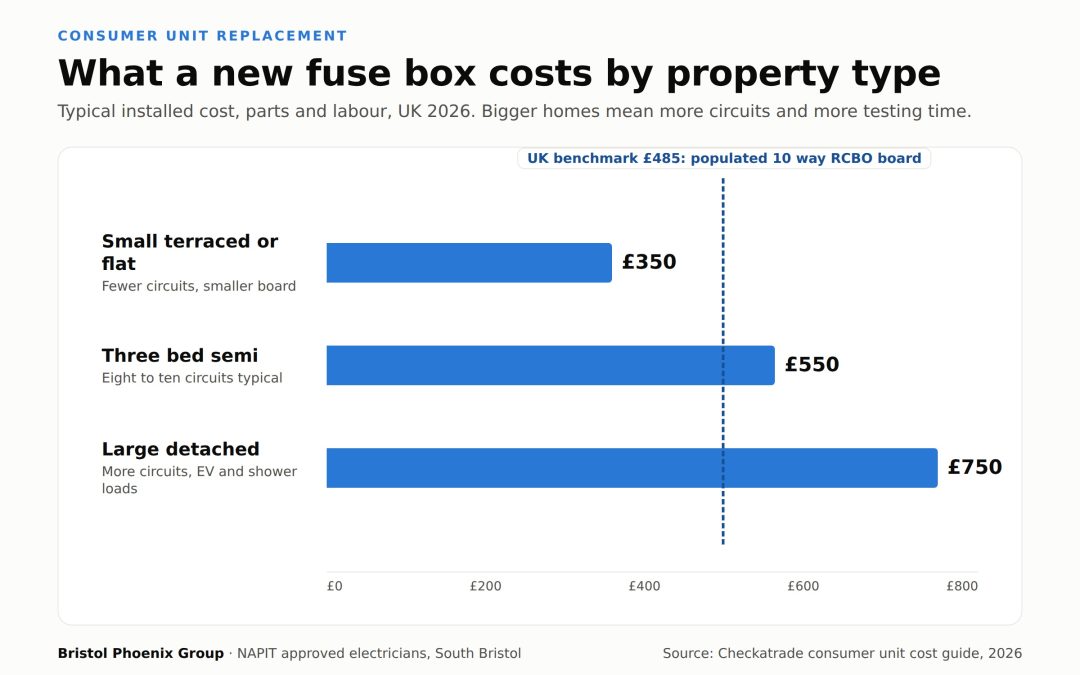
Start with the honest headline: the average consumer unit replacement cost in the UK is around £350 to £750 including materials and labour, according to MyJobQuote’s 2026 cost guide. Checkatrade’s guide lands in the same territory, quoting around £485 for a populated 10 way RCBO consumer unit including installation.
Property size moves the number more than anything else, because bigger houses have more circuits, and more circuits mean a bigger board, more protective devices, and more testing time at the end.
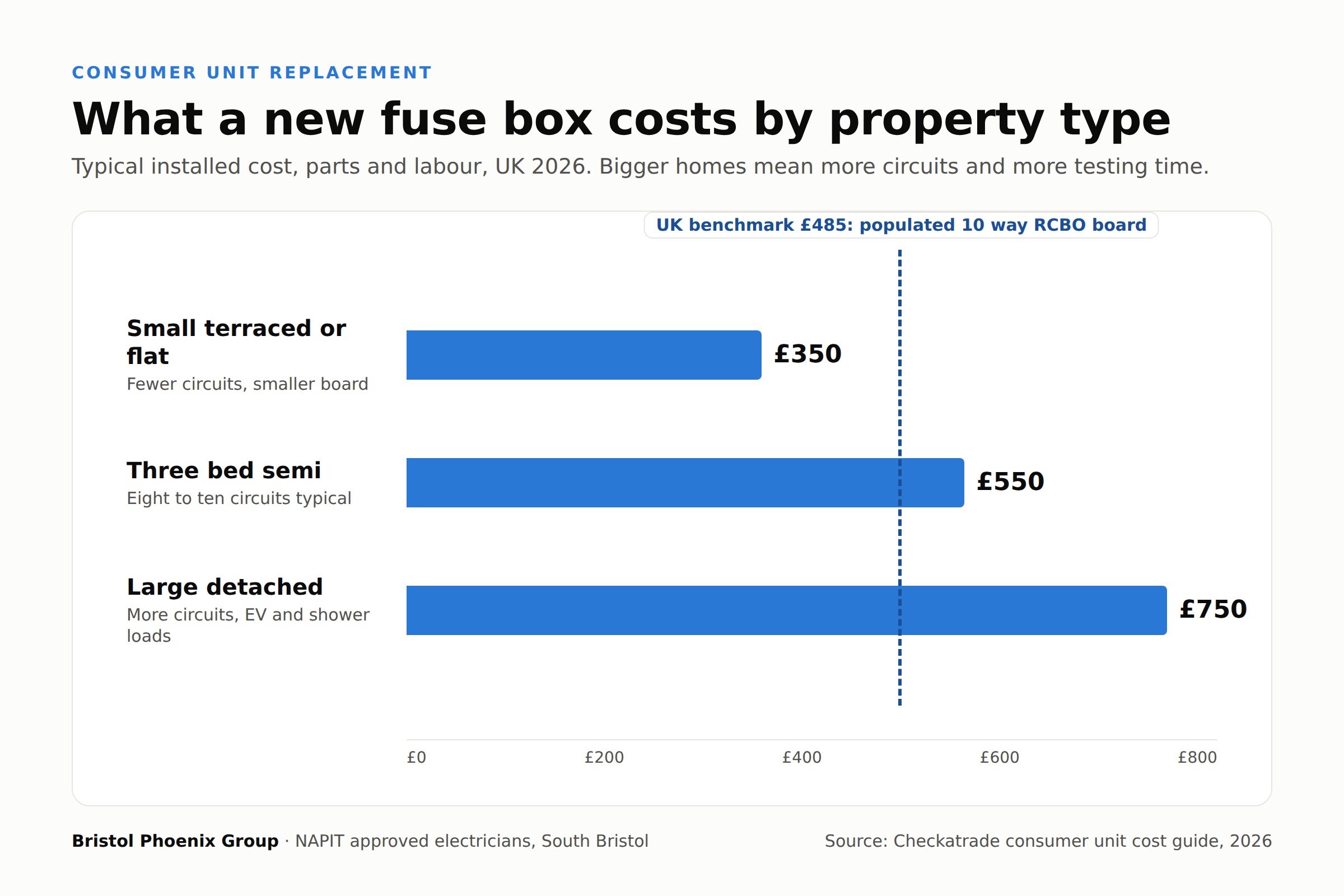
| Property type | Typical installed cost | Why it lands there |
|---|---|---|
| Small terraced house or flat | Around £350 | Fewer circuits, smaller board, shorter testing time |
| Three bed semi detached | Around £550 | Eight to ten circuits is typical, mid size board |
| Large detached house | Around £750 | More circuits, often outbuildings, EV charger or shower circuits on top |
Those property figures come from Checkatrade’s current guide. Two caveats worth knowing before you compare quotes. First, region matters: MyJobQuote’s regional data puts the South West around 9 percent above the national midpoint, so Bristol quotes tend to sit slightly higher than a like for like job in the North East. Second, these figures assume the rest of the installation is in reasonable health. If the earthing and bonding need upgrading, or an old circuit will not pass testing, the price climbs, and we cover that below.
On time, both sources agree a straightforward swap takes roughly 4 to 8 hours. Plan for the power being off for most of a working day, and for a large or awkward installation to stretch to a full day.
What Should Be Included in the Price
A fuse board replacement cost quote should never just be “take old box off wall, put new box on wall”. A proper job has three distinct parts, and the third one is where cheap quotes quietly cut corners.
The pre-checks
Before the old board comes off, a competent electrician confirms the earthing arrangement, checks the main bonding to gas and water, and looks at the condition of the meter tails. Any of these can need upgrading before a new consumer unit can legally be energised, which is why a five minute survey before quoting beats a number plucked from the air over the phone.
The board and the fitting
The unit itself, the protective devices that populate it, glands and tails, and the labour to transfer every circuit across, label everything, and torque every connection to specification. That last detail matters more than it sounds: loose connections are precisely what caused the consumer unit fires that changed the regulations, which we come to shortly.
Testing, certification and notification
Every circuit gets dead tested and live tested before the job is signed off, essentially the same discipline as our electrical testing services apply during an inspection. You should receive an Electrical Installation Certificate, and the work must be notified to Building Control, which a registered electrician handles for you. If a quote does not include certification and notification, it is not a like for like comparison with one that does.
RCBO vs Dual RCD Boards: Where the Money Goes
This is the fork in the road on every consumer unit upgrade cost conversation, so here is the plain version.
Dual RCD boards
Two RCDs each protect a bank of circuits. Cheaper to buy, and perfectly compliant when designed properly. The catch is shared protection: when one appliance leaks current, the RCD covering that whole bank trips, and half the house goes dark while you hunt for the culprit. Fine to live with, mildly infuriating on a dark December evening with a freezer full of food on the affected side.
RCBO boards
Every circuit gets its own combined RCD and circuit breaker. A fault on the kitchen sockets takes out the kitchen sockets and nothing else, and fault finding becomes dramatically simpler. The premium is real but modest: MyJobQuote puts a dual RCD board at £460 to £600 installed and a high integrity board at £470 to £650, and full RCBO boards typically land in the same band as high integrity units. We fit RCBO boards on most consumer unit upgrades in Bristol for exactly this reason: the extra spend buys you circuit by circuit protection for the life of the board.
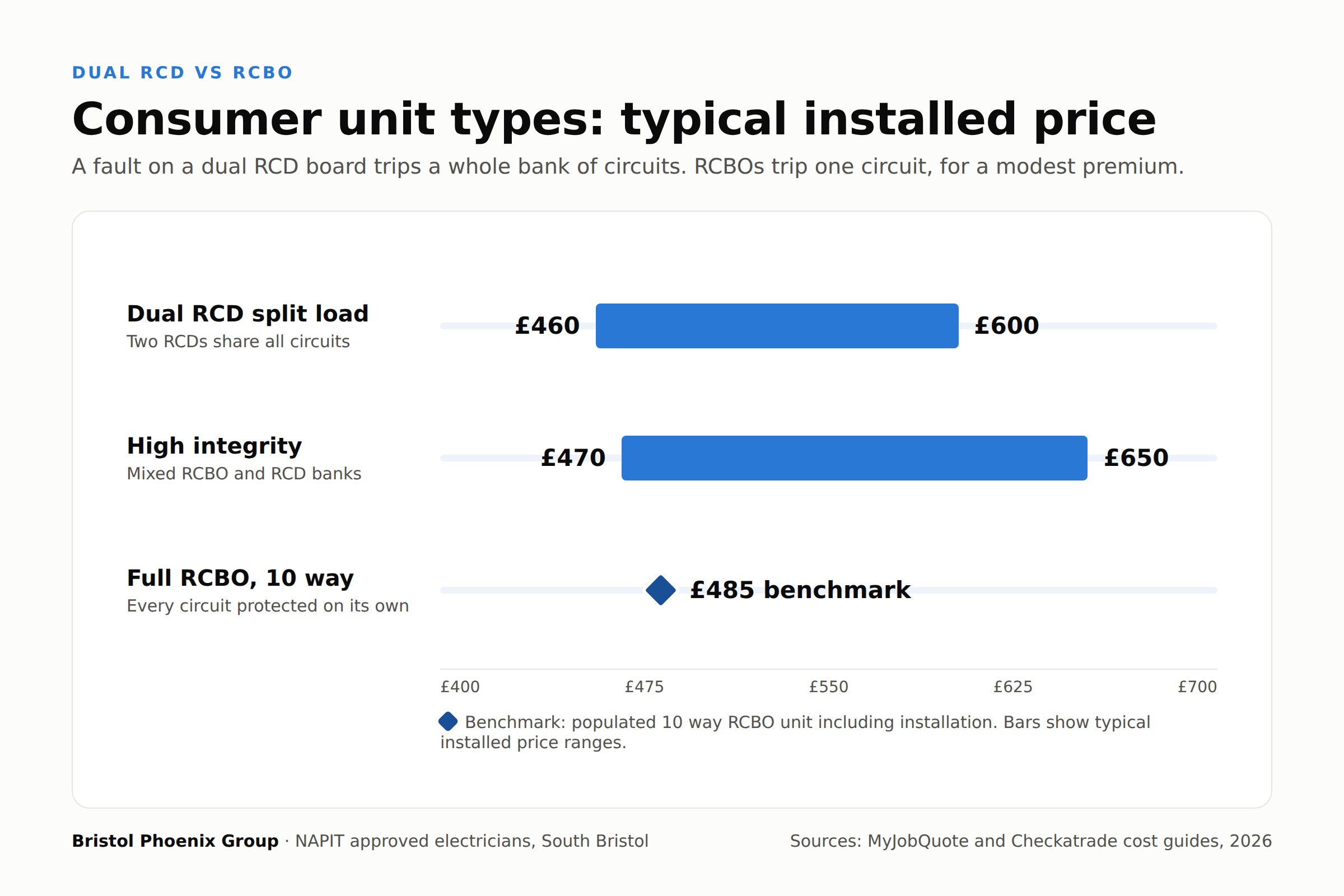
| Board type | Typical installed price | Nuisance tripping behaviour |
|---|---|---|
| Dual RCD split load | £460 to £600 | A fault trips a whole bank of circuits |
| High integrity (mixed RCBO and RCD) | £470 to £650 | Critical circuits isolated, some banks shared |
| Full RCBO | Similar band to high integrity, around £485 benchmark for a populated 10 way board | A fault trips only its own circuit |
Surge protection and arc fault devices
Since Amendment 2 of the Wiring Regulations in 2022, surge protective devices are effectively standard on new domestic boards. Regulation 443.4.1 requires protection against transient overvoltages wherever the consequences could affect human life or safety services, and as NAPIT’s technical guidance puts it, SPDs “are a part of our installation culture and they should almost always be installed”. Most quality boards now arrive with an SPD built in, so treat a quote without one with suspicion rather than gratitude. Arc fault detection devices remain optional for ordinary homes, so do not let anyone sell them to you as a legal must have.
What Drives a New Fuse Box Cost Up
When a new fuse box cost quote comes in well above the typical bracket, one of these is usually the reason.
- Earthing and bonding upgrades. Older properties often lack main bonding to gas and water, or have an earthing arrangement that needs bringing up to standard before the new board goes live. This is the single most common addition to a quote.
- Meter tails and isolator. Undersized tails need replacing, and if there is no isolator switch, fitting one (or coordinating with the supplier) adds cost.
- Circuits that fail testing. A new board will not mask a faulty circuit. Low insulation resistance readings or borderline faults discovered during changeover need investigating, and occasionally a circuit needs remedial work before it can be reconnected.
- Moving the board. Relocating a consumer unit rather than replacing it in place is a much bigger job, since every cable has to reach the new position.
- More ways. EV chargers, electric showers, garden offices: modern life keeps adding circuits, and each one needs a protective device and testing time.
None of this is padding. It is the difference between a fuse board swap and a safe installation, and it is why a fixed price given after a proper look at your board beats a guess over the phone every time. It is also why some 2026 guides quote a wider bracket of £550 to £1,500 for a straightforward replacement once remedial work enters the picture, with BookaBuilderUK putting a compliant replacement in a typical 1970s three bed semi at £700 to £1,200 where the surrounding installation needs attention.
Why Old Fuse Boxes Get Flagged on an EICR
A huge share of consumer unit replacements start with an EICR, usually a landlord’s five yearly inspection or a pre purchase check. Two features of older boards attract codes.
First, missing RCD protection. A rewireable fuse board or an old breaker board with no RCDs offers no additional protection against electric shock on socket circuits, and inspectors will typically code that C2, potentially dangerous, which makes the whole report Unsatisfactory. If you have read our guide to what an EICR actually checks, this is the classification system doing its job.
Second, combustible enclosures. Fire investigators traced a persistent pattern of consumer unit fires to overheating connections inside thermoplastic boards, and the regulations responded. Since January 2016, Regulation 421.1.201 has required consumer units in homes to have an enclosure made of non combustible material, or to be housed in one, as set out in the IET’s guidance on the change. In practice that means metal boards. An existing plastic board is not automatically dangerous and is usually coded C3, improvement recommended, on that point alone, but combined with missing RCDs the case for replacement builds quickly.
The wider context is sobering: fire and rescue services attended 22,877 accidental dwelling fires in England in the year to March 2025, according to Home Office fire statistics. A modern board with RCD protection on every circuit, solid connections and a metal enclosure is one of the more effective single upgrades a home can get.
Building Regulations: Yes, a New Fuse Box Is Notifiable
Replacing a consumer unit is notifiable work in England. Approved Document P lists notifiable work as the installation of a new circuit, any addition or alteration to existing circuits in a special location, and, in exactly these words, “the replacement of a consumer unit”.
That gives you two routes. A registered competent person self certifies the work and you receive your certificates within 30 days of completion, or an unregistered installer involves Building Control directly, which adds fees and delay. As a NAPIT approved contractor based in South Bristol, we self certify consumer unit replacements as a matter of routine: the notification happens behind the scenes and the paperwork simply arrives. If someone offers to fit a board “without the bother of the paperwork”, what they are actually offering is an unnotified installation that will surface as a problem the next time the house is sold or inspected.
A Worked Example: Three Bed Semi, 1990s Board
Take a typical three bed semi in south Bristol. Plastic split load board from the 1990s in the hallway cupboard, nine circuits, one RCD covering the socket circuits and nothing protecting the lights. An EICR has just coded the missing RCD coverage C2 and the report has come back Unsatisfactory.
The quote might break down like this. A metal 12 way board populated with nine RCBOs and an SPD. Pre checks confirm the bonding is present and the tails are adequately sized, so no extras there. A day on site: power off mid morning, circuits transferred and tested one by one, energised and live tested by late afternoon. Full Electrical Installation Certificate issued, Building Regulations notification lodged through NAPIT. All in, somewhere in the £550 to £700 bracket, sitting exactly where the national figures say a job this size should.
Now add one complication. Testing reveals the bonding to the water main is missing. That is a length of earth cable, some labour, and a modest addition to the bill, and it is non negotiable, because the new board cannot be signed off without it. This is the gap between the tidy number in a cost guide and a real quote: the board is the fixed part, the condition of everything around it is the variable.
Cheap Quote Warning Signs
A suspiciously low consumer unit replacement cost usually has a reason, and it is rarely generosity. Watch for these.
- No survey before the price. Anyone quoting a firm figure without seeing the board, the earthing or the tails is guessing, and the gap gets closed later with extras.
- No certificate mentioned. The Electrical Installation Certificate and Building Regulations notification are part of the job, not optional add ons. Ask explicitly.
- No registration. If the installer is not registered with a competent person scheme such as NAPIT or NICEIC, they legally cannot self certify, and someone has to pay Building Control instead.
- A dual RCD board priced as a premium product. Nothing wrong with dual RCD boards honestly sold, but paying RCBO money for one is poor value.
- No mention of testing time. Transferring circuits takes a couple of hours. Testing them properly takes the rest of the day. A “two hour board swap” tells you which part is being skipped.
Final Thoughts
A new fuse box is one of those jobs where the cheapest quote and the best value quote are rarely the same document. Budget £350 to £750 for a typical home, nudge that upward for the South West, insist on an RCBO board if the budget allows, and treat certification and notification as the point of the exercise rather than the small print. Done properly, it is a day of disruption for a board that will quietly protect the house for decades.
If your board is elderly, your EICR has come back Unsatisfactory, or you simply want a fixed price from people who will look before they quote, get in touch and we will give you a straight answer. We are NAPIT approved, we work across Bristol and the surrounding areas, and we quote for the whole job, testing, certificate, notification and all, so the number you agree is the number you pay.