Ask three electricians how many sockets on a ring main is acceptable and you may get three different answers: ten, twelve, or a shrug. The confusion is understandable, because the honest answer is that the current UK wiring regulations put no fixed number on it at all. The real limit is the floor area the circuit serves, not a count of the sockets on it. In this guide we will explain where the mythical socket limit came from, what BS 7671 actually expects, how spurs fit in, and the warning signs that a ring is being asked to do too much.
Table of Contents
- How Many Sockets on a Ring Main? The Short Answer
- What a Ring Main Actually Is
- The Real Limit: Floor Area, Not Socket Count
- Spurs and the Ring Main Sockets Limit
- How Many Sockets on One Circuit UK: Ring vs Radial
- How Many Sockets on a Ring Main Before It Overloads?
- A Worked Example: One Kitchen, One Ring
- When Extra Sockets Need a New Circuit
- Frequently Asked Questions
- Final Thoughts
TL;DR
- There is no fixed maximum number of sockets on a ring main under the current edition of BS 7671, the IET Wiring Regulations.
- The working limit is floor area: long-standing guidance is that one ring final circuit should serve no more than around 100 square metres.
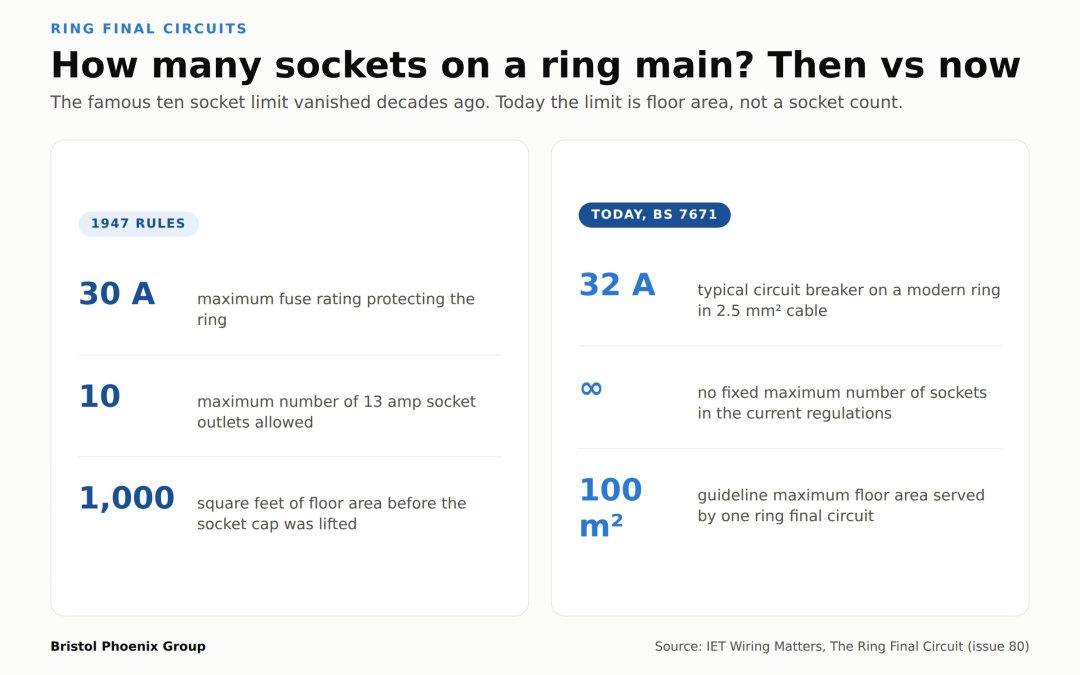
- The famous “ten socket” figure is history. It comes from the 1947 regulations, which allowed up to ten 13 amp socket outlets on a ring protected by a 30 amp fuse.
- Spurs have their own limits: an unfused spur should feed only one single or one twin socket, while a fused spur can feed more because the fuse protects the smaller cable.
- What actually matters is load. A ring protected at 30 or 32 amps can only deliver so much at once, however many sockets it has.
- Warning signs of an overloaded ring include warm sockets or plugs, a breaker that trips when the kitchen is busy, and a house that runs on extension leads.
- Heavily loaded rooms, kitchens above all, often justify their own circuit rather than more sockets on the existing ring. That is a job for a registered electrician.
- BS 7671 Amendment 4:2026, published in April 2026 and due to become the definitive standard from October 2026, does not add a socket limit. The floor area principle below still applies.
How Many Sockets on a Ring Main? The Short Answer
There is no maximum. That surprises a lot of people, including some who have been quoted a hard limit by a builder or a well-meaning relative, but the current wiring regulations do not cap the number of socket outlets on a ring final circuit. A ring serving a floor of a typical house might have eight sockets or eighteen, and both can be perfectly compliant.
What the rules do care about is how much of the property one ring is expected to cover, and how much current the circuit is likely to carry in practice. A socket sitting unused draws nothing. Twenty sockets with lamps and phone chargers plugged in ask far less of a circuit than four sockets running a kettle, a washing machine, a tumble dryer, and a dishwasher at the same time.
So the useful question is not how many sockets on a ring main you are allowed, but how much load the ring will actually see, and whether the areas it serves are sensible. The rest of this guide unpacks exactly that.
What a Ring Main Actually Is
A ring main, properly called a ring final circuit, is a loop of cable that starts at the consumer unit, visits a chain of socket outlets, and returns to the same protective device. Because the circuit forms a complete ring, current can reach every socket from two directions at once. That clever arrangement lets a relatively modest 2.5 mm² cable safely serve a circuit protected at 30 or 32 amps, which is why the ring became the standard way to wire sockets in British homes.
Most UK houses have at least two: one ring for the upstairs sockets and one for the downstairs, often with a third dedicated to the kitchen in newer or rewired properties. If you have ever wondered why your electrician talks about the “downstairs ring” while your consumer unit just shows a row of switches, that is the wiring behind the labels.
A quick bit of history
The ring circuit is a post-war British invention, born out of a copper shortage and a housebuilding boom. When it first appeared in the 1947 regulations, there genuinely was a socket limit. Regulation 201 of the day said a ring protected by a fuse of not more than 30 amps could serve no more than ten 13 amp socket outlets, as the IET’s Wiring Matters review of the ring final circuit records. That ten socket rule is almost certainly where the persistent myth of a modern limit comes from.
The numeric cap was dropped decades ago in favour of something more sensible: limiting the area a single ring serves, and trusting the physics of diversity, which we will come to shortly.
The Real Limit: Floor Area, Not Socket Count
The measure that replaced the socket count is floor area. The long-standing rule of thumb, which the IET notes is still used in guidance today and appears in IET Guidance Note 1, is that a single ring final circuit should serve a floor area of no more than about 100 square metres.
To put that in perspective, 100 square metres is roughly the entire footprint of an average UK three-bed semi. One ring per floor of a normal house sits comfortably inside the guidance, which is exactly how most homes are wired. The floor area approach works because it indirectly controls load: a bigger area means more rooms, more appliances, and more chance of everything running at once.
Here is the modern ring final circuit at a glance, alongside the 1947 original that started the whole “ten sockets” idea:
| Feature | 1947 ring circuit | Modern ring final circuit |
|---|---|---|
| Protective device | Fuse rated up to 30 amps | Typically a 32 amp circuit breaker or RCBO |
| Cable | Imperial sizing, close to 2.5 mm² in metric terms | 2.5 mm² twin and earth as standard |
| Socket limit | Maximum of ten 13 amp socket outlets | No fixed maximum number of sockets |
| Area limit | Floor area up to about 1,000 square feet | Guidance of up to around 100 square metres per ring |
Notice how little has really changed. The 100 square metre guidance is essentially the metric descendant of the original 1,000 square feet, and the cable is the same size it has effectively been since the beginning. What changed is the recognition that counting sockets was never the point.

Spurs and the Ring Main Sockets Limit
A spur is a branch off the ring: a single cable that leaves the loop at a socket or junction box and feeds an extra point. Spurs are how most extra sockets get added to existing houses, because running one short branch is far less disruptive than extending the ring itself. They are also where a genuine ring main sockets limit does still exist, so this is the part worth reading twice.
Unfused spurs
An unfused spur is a plain branch cable with no fuse of its own, relying on the ring’s 32 amp protection. Because that branch is a single 2.5 mm² cable rather than a loop fed from both ends, it cannot carry what the ring can. Accepted practice under BS 7671 keeps unfused spurs on a tight leash: one unfused spur should feed only one single or one twin socket outlet, and good practice is to avoid having more spurs on a ring than there are sockets on the ring itself. Daisy-chaining socket after socket off one spur is one of the most common DIY wiring mistakes we find during inspections.
Fused spurs
A fused spur runs through a fused connection unit, usually holding a 13 amp fuse. Because that fuse now protects the branch cable, a fused spur can legitimately feed more than one point. This is how things like kitchen appliance outlets, boilers, and heated towel rails are often wired. The fuse is the safeguard, which is exactly why removing or bypassing one is such a bad idea.
If your house has grown a collection of mystery spurs over the years, an inspection and test will map out what is actually connected where. Our electrical testing services exist for precisely this kind of detective work, and a proper test will tell you whether the ring is still a ring at all. Broken rings that have quietly become two overloaded radials are a regular find in older Bristol housing stock.
How Many Sockets on One Circuit UK: Ring vs Radial
Rings are not the only way to wire sockets, and the answer to how many sockets on one circuit UK regulations allow depends on which type of circuit you mean. A radial circuit is a simple one-way run: cable leaves the consumer unit, visits each socket in turn, and stops at the last one. No loop, no return leg.
Radials follow the same philosophy as rings: no fixed socket count, with floor area guidance scaled to the cable and breaker size. A 20 amp radial in 2.5 mm² cable suits a smaller area than a 32 amp ring, while a 32 amp radial needs heavier 4 mm² cable to compensate for being fed from one end only.
Radials have quietly come back into fashion, especially for kitchens and for new work where the simplicity pays off. There is less cable to test, no risk of a broken ring going unnoticed, and fault-finding is quicker. When we carry out rewiring and new build wiring installations, the design usually ends up as a sensible mix: rings or radials for general sockets, and dedicated circuits for the heavy hitters like ovens, showers, and EV chargers.
How Many Sockets on a Ring Main Before It Overloads?
Here is the part that matters more than any rule of thumb. A ring protected at 32 amps can deliver roughly 7,360 watts at UK mains voltage. It does not matter whether that demand arrives through four sockets or fourteen: once the sustained load heads past what the protective device allows, the breaker will trip, and if the protection is inadequate or has been tampered with, the cable will overheat instead.
The regulations lean on a concept called diversity: the sensible assumption that not everything is on at once. Across a whole house that assumption holds up well. Where it collapses is the modern kitchen. Run the numbers for a busy Sunday morning: a 3 kW kettle draws about 13 amps on its own, a washing machine heating water pulls around 10, a tumble dryer similar, and a dishwasher not far behind. Two or three of those together and one ring is already working hard before anyone plugs in an air fryer.
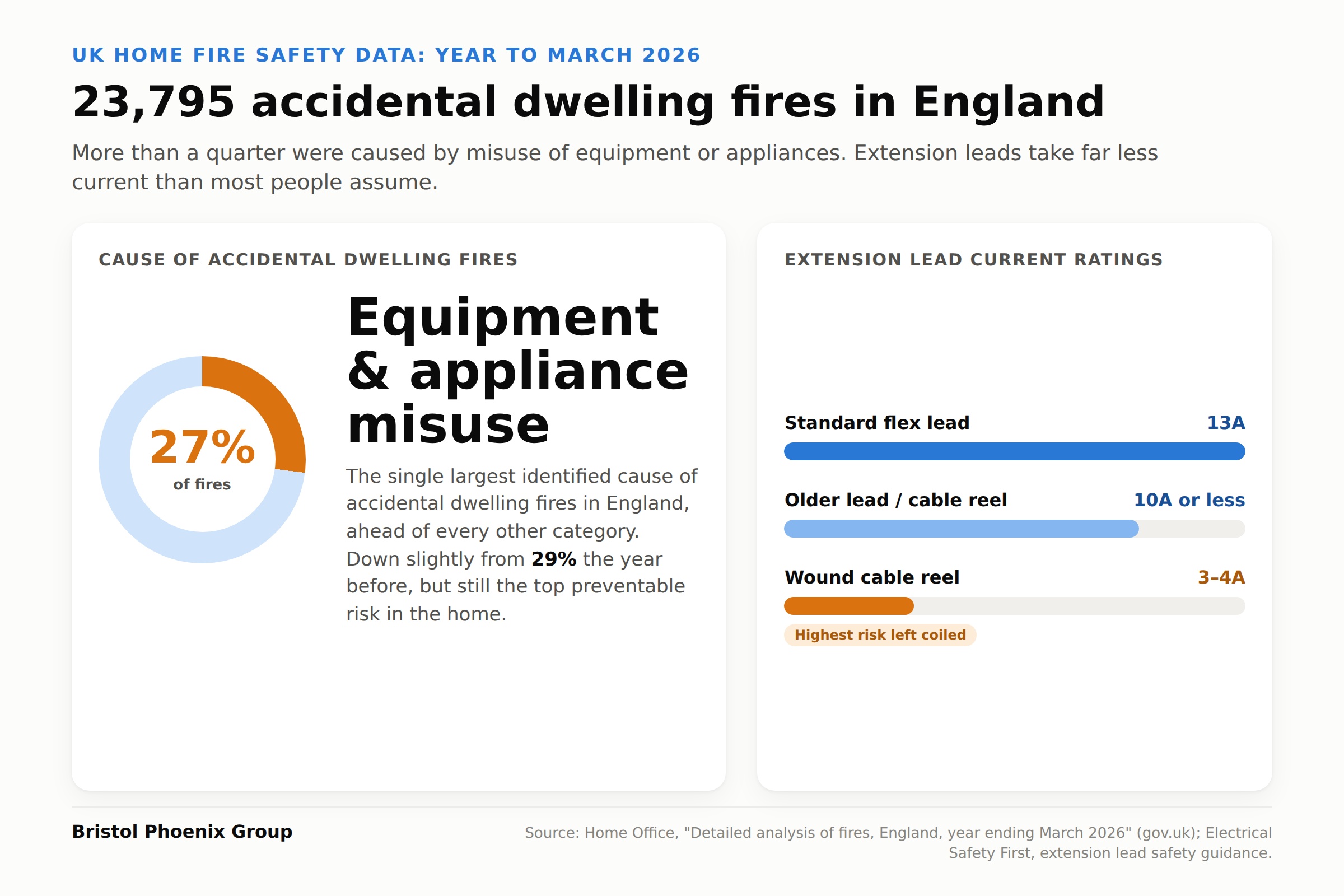
Extension leads make this worse, not better, because they add load without adding capacity. As Electrical Safety First points out, most extension leads are rated at 13 amps, some older ones and many cable reels at only 10 amps or less, and a wound cable reel may safely carry as little as 3 or 4 amps. A four-way strip does not turn one socket into four sockets’ worth of capacity. It turns one socket into one socket with more things attached.
The stakes are not theoretical. Home Office figures for England record 23,795 accidental dwelling fires in the year to March 2026, with 27 percent caused by misuse of equipment or appliances, the category that includes overloaded and misused electrics. Warm socket faceplates, scorch marks around plugs, a lingering fishy or burning smell, and a breaker that trips whenever the kitchen is busy are all signs a circuit is telling you something. Our guide to a fuse box that keeps tripping covers how to read those signals properly.
A Worked Example: One Kitchen, One Ring
Picture a typical Victorian terrace in Totterdown. The whole ground floor runs on a single ring: living room, hallway, and kitchen, perhaps fourteen sockets in total. On paper it complies. The floor area is well under 100 square metres and every socket is on the ring or a properly wired spur.
Now walk through a weekday evening. The kettle goes on at 13 amps while the washing machine is mid-cycle at around 10. The tumble dryer joins at another 10 or so, and someone slides dinner into a plug-in countertop oven drawing 9 more. That is roughly 42 amps of demand chasing a 32 amp breaker. Nothing about the number of sockets caused this, and removing half the sockets would change nothing. The circuit simply serves a kitchen that has outgrown it.
The fix is not a bigger breaker, which would just let the cable overheat. The fix is redistributing the load: typically a dedicated kitchen circuit, sometimes two, leaving the original ring to handle the light work in the living room and hallway. It is a modest, planned job, and it transforms how the house copes.
When Extra Sockets Need a New Circuit
Adding a socket or two to a healthy, lightly loaded ring is routine work. A spur here, a ring extension there, and a minor works certificate to document it. But there are situations where more sockets on the existing ring is the wrong answer, and a new circuit is the honest recommendation:
- Kitchens being refitted. Modern appliance counts justify a dedicated circuit, and a refit is the cheapest moment to add one.
- Home offices and garden buildings. Heaters and equipment running all day deserve their own supply, as we cover in our outdoor socket installation cost guide.
- Rings already showing overload symptoms. Extending a struggling circuit adds load precisely where it is least wanted.
- Old or damaged wiring. If testing shows a broken ring, perished insulation, or an undersized consumer unit, the priority is putting that right first. Our new fuse box cost guide explains what that side of the job involves.
A new circuit means work at the consumer unit, which is notifiable under the Building Regulations in England and Wales, so it needs a registered electrician who can self-certify the work rather than a handy friend with a reel of cable. Any competent installer will start by testing the existing ring before adding anything to it. If most of the house needs the same treatment, it may be worth reading our house rewire cost guide before committing to piecemeal fixes.
Frequently Asked Questions
Does the new BS 7671 Amendment 4:2026 change how many sockets I can have on a ring main?
No. Amendment 4:2026 to BS 7671, published by the IET and BSI in April 2026 and becoming the definitive standard from October 2026, focuses on areas such as battery storage systems, functional earthing for IT equipment, Power over Ethernet circuits and medical locations. It does not introduce a socket limit for ring final circuits, so the floor area principle explained above still stands.
Can I add an extra socket to my ring main myself?
Often, yes, on the legal side. Adding a socket to an existing ring by way of a spur is generally not notifiable work in England, unless it falls within the special location around a bath or shower, or the job strays into a new circuit or work at the consumer unit. Our guide to Part P building regulations sets out the three categories that do need notifying. Even where DIY is legally permitted, a badly wired spur is one of the most common faults we find on inspection, so we would always recommend a registered electrician for anything beyond a straightforward like-for-like swap.
How do I know if my ring main is already overloaded?
Watch for warm socket faceplates or plugs, a breaker that trips whenever the kitchen gets busy, a faint burning or fishy smell near an outlet, or a household that leans on extension leads to cope. Any one of those is worth a proper test rather than a guess.
Is a ring main safer than a radial circuit?
Neither is inherently safer. Both are fully compliant ways to wire sockets under BS 7671 when they are designed, installed and protected correctly. The right choice comes down to the layout of the property and the load the circuit needs to carry, not which one sounds more robust.
Final Thoughts
So, how many sockets on a ring main? As many as the design sensibly allows, which in a normal house is a question of floor area and realistic load rather than an arbitrary number. The ten socket limit died with the post-war regulations that invented it, and anyone still quoting it is working from a very old rulebook.
The better questions are the practical ones. Is the ring intact? Is one circuit being asked to run a modern kitchen designed around a 1970s idea of demand? Are extension leads quietly doing the job that fixed sockets should? Those are the questions we answer every week. As a NAPIT-approved contractor based in South Bristol, we test, extend, and redesign socket circuits across the city, and we would always rather specify a new circuit honestly than pile more sockets onto a ring that cannot take them.
If your sockets are warm, your breaker is temperamental, or you are planning a kitchen and want the wiring done properly first time, get in touch with our team or call us on 0117 2447 382. A quick test now is considerably cheaper than a fire investigation later, and rather more pleasant to schedule.