It always picks its moment. The oven is halfway through a roast, or someone is mid-shower, and the house clicks into silence. If your fuse box keeps tripping, you are dealing with one of the most common electrical complaints in the UK, and one of the most misunderstood. The good news: a tripping board is not your electrics failing. It is your electrics working, cutting the power the instant something looks wrong. We are Bristol Phoenix Group, a NAPIT-approved electrical contractor based in South Bristol, and tracing these faults is a large part of our week. This guide covers what a trip actually means, how to narrow down the culprit safely at home, and the point where you should put the kettle down (assuming it is not the kettle causing it) and call a professional.
Table of Contents
- Why a Fuse Box Keeps Tripping: The Short Answer
- First Question: What Actually Tripped?
- The Six Usual Suspects When a Fuse Box Keeps Tripping
- How to Find the Culprit Safely, Step by Step
- A Worked Example: The Sunday Roast Mystery
- When a Tripping Board Is Telling You to Stop
- What Professional Fault Finding Costs
- How to Stop It Happening Again
- Final Thoughts
TL;DR
- A trip is a protective device doing its job. Something asked for too much current or leaked current where it should not go.
- Which switch dropped matters. An MCB trip points to overload or a short on one circuit. An RCD trip points to current leaking to earth, often through a faulty appliance, moisture, or damaged wiring.
- Most repeat tripping is caused by a single faulty appliance, findable with a safe process of elimination: unplug everything, reset, and reintroduce items one at a time.
- Burning smells, scorch marks, buzzing, or a switch that will not reset with everything unplugged are stop signs. Leave the power off and call an electrician.
- Straightforward professional fault finding typically costs £50 to £200 at standard rates. Emergency rates run higher, so a daytime diagnosis is the cheaper route when it is safe to wait.
Why a Fuse Box Keeps Tripping: The Short Answer
Your fuse box, properly called a consumer unit, is a row of automatic switches standing between your wiring and trouble. When a trip switch keeps tripping, it is reacting to one of three things: a circuit carrying more current than it is rated for, a live conductor touching where it should not, or current leaking to earth through a fault, damp, or a person. None of those should happen quietly, so the board makes the decision for you.
Repeat tripping is a symptom, not the disease. Resetting the switch again and again without asking why is like silencing a smoke alarm without checking for smoke. The pattern, which switch drops, when, and how often, is the evidence that leads to the cause.
Government figures for England recorded 22,877 accidental dwelling fires in the year to March 2025, with 29% caused by misuse of equipment or appliances and cooking appliances the largest ignition category at 44%, according to the Home Office fire statistics. A board that trips before a fault becomes a fire is the cheapest safety device you will ever own.
First Question: What Actually Tripped?
Before touching anything, look at which switch has dropped. Modern boards have two types of protective device, and they trip for different reasons. Which one moved tells you half the story.
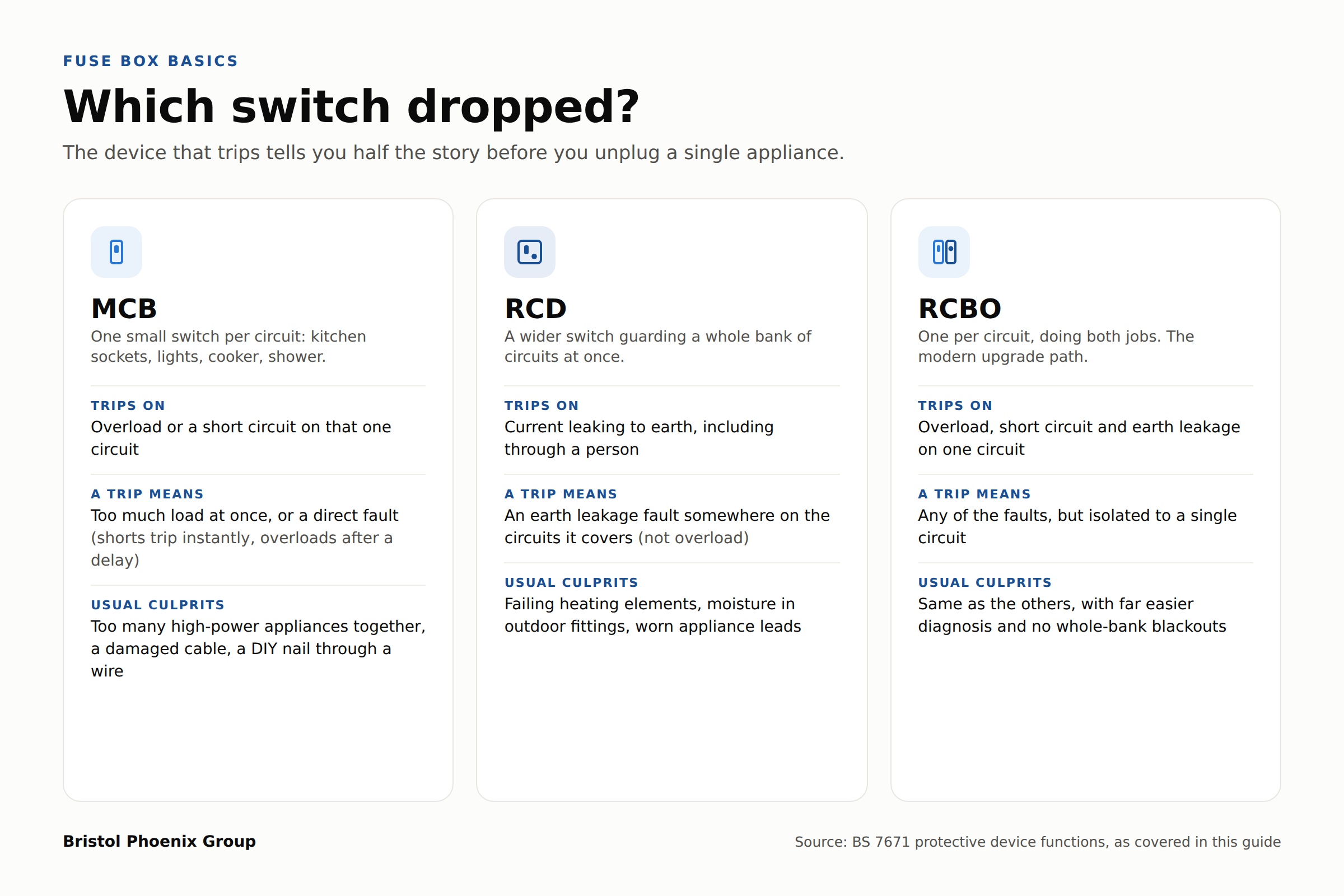
If a single small switch dropped: an MCB trip
MCBs (miniature circuit breakers) are the row of small switches, each labelled for one circuit: kitchen sockets, upstairs lights, cooker, shower. When one MCB drops and the rest stay up, the problem lives on that circuit alone. An MCB trips for two reasons: overload, too many amps drawn at once, or a short circuit. Overloads trip after a delay, once the circuit has been working hard for a while. Shorts trip instantly, often the moment something switches on.
If a larger switch dropped and half the house went dark: an RCD trip
An RCD (residual current device) is the wider switch guarding a bank of several MCBs. It does not care about overload. It watches the balance of current flowing out on live and back on neutral, and if any goes missing, leaking to earth through a faulty element, damp connection, or a person, it cuts the power in a fraction of a second. When a circuit breaker keeps tripping and it is the RCD rather than an MCB, you are hunting an earth leakage fault, and the culprit is usually a single appliance rather than the wiring.
If your board has neither
Some older boards have rewirable fuses and no RCD protection anywhere. That still interrupts big faults, but offers nothing like modern shock protection, and the current wiring regulations, BS 7671:2018 as amended by Amendment 4, which came into effect on 15 April 2026, expect far more of a modern installation. We cover the upgrade path in our consumer unit replacement service: one of the most worthwhile safety upgrades an older home can get.
| Device | What it protects against | A trip usually means | Typical culprits |
|---|---|---|---|
| MCB (one small switch per circuit) | Overload and short circuits on a single circuit | Too much load on that circuit, or a direct short | Too many high-power appliances at once, a damaged cable, a DIY nail through a wire |
| RCD (wider switch covering several circuits) | Current leaking to earth, including through a person | An earth leakage fault somewhere on the circuits it covers | Failing heating elements, moisture in outdoor fittings, worn appliance leads |
| RCBO (one per circuit, does both jobs) | Overload, short circuit and earth leakage on one circuit | Any of the above, but isolated to a single circuit | Same as above, with easier diagnosis and no whole-bank blackouts |
The Six Usual Suspects When a Fuse Box Keeps Tripping
1. A single faulty appliance
The most common cause by a comfortable margin. Anything with a heating element is a suspect: kettles, ovens, washing machines, dishwashers, immersion heaters and electric showers. Elements crack with age, and a cracked element leaks current to earth, which is exactly what an RCD is built to notice. The giveaway is timing. If the trip switch keeps tripping when one appliance runs, or at one point in its cycle, such as when a washing machine starts heating water, you have your suspect.
2. An overloaded circuit
Kitchens are the classic case: one circuit feeding a kettle, microwave, air fryer and washing machine can be asked for more current than its breaker allows, and the MCB eventually lets go. Extension leads make it worse by concentrating several appliances onto one socket. Most extension leads are rated at 13A, but some older ones and many cable reels are only 10A or less, and plugging one extension lead into another can cause the plug in the wall socket to overheat, as Electrical Safety First warns. If the tripping happens at busy moments, laundry mornings, dinner prep, cold evenings with portable heaters running, overload is the likely story.
3. Moisture where it should not be
Water and electricity resolve their differences through your RCD. Outdoor sockets, garden lighting, shed feeds and security lights all face the weather, and a perished seal lets rain creep into connections. The pattern is meteorological: if the fuse box trips during or after heavy rain and resets fine in dry spells, start looking outside. Bathroom extractor fans and leaking pipes above light fittings do the same indoors.
4. Worn or damaged wiring
Cables age, insulation cracks, and connections loosen with decades of thermal cycling. A nail through a hidden cable during DIY produces an instant short or an intermittent fault that surfaces months later. Rodents in lofts do their bit too. Wiring faults tend to trip the board at random, with no pattern tied to any appliance, and they do not fix themselves. This is where professional electrical fault finding earns its keep, because the fault hides inside walls, floors or ceilings.
5. Nuisance tripping from accumulated leakage
Every appliance leaks a tiny, harmless amount of current to earth. A house full of electronics can accumulate enough background leakage that the RCD sits close to its threshold, and one small push tips it over. The fix for this nuisance tripping is usually rebalancing circuits or moving to RCBOs, so each circuit carries its own protection rather than sharing one twitchy RCD.
6. Fuse Box Keeps Tripping With Nothing Plugged In?
If you have unplugged everything and the board still will not hold, the remaining candidates are wired-in equipment (the oven, hob, shower, immersion heater, heating system, smoke alarms), a fault in the fixed wiring, or a failing breaker in the unit itself. Breakers do wear out, though the wiring is guilty far more often than the switchgear. This is not a scenario to keep resetting. It needs test equipment and someone qualified to use it.
How to Find the Culprit Safely, Step by Step
You do not need a screwdriver, a multimeter, or bravery for this. Everything below happens at the socket face and the consumer unit switches, which is where a homeowner should stop. Never remove the unit’s cover, never hold a tripping switch on, and keep your hands dry throughout.
- Note which switch dropped. Take a photo of the board. One MCB down: note its circuit label. The RCD down: note which MCBs sit under it. This single observation halves the search.
- Switch off every MCB under the tripped device, then reset it. If it now holds with all its circuits off, the fault is downstream on one of those circuits, not in the board.
- Turn the MCBs back on one at a time. Pause between each. When the trip happens again, the last circuit you switched on is carrying the fault. Leave it off.
- Unplug everything on the guilty circuit. Every socket, adaptor and extension lead, including the hidden residents: the fridge behind its housing, TV equipment, chargers, the tumble dryer in the garage.
- Reset and reintroduce one appliance at a time. Plug each item in and, where relevant, run it. A faulty kettle may trip the board the moment it heats; a washing machine may only trip mid-cycle, so give suspects time. When the board drops, the last appliance connected is your culprit. Retire it, and the problem usually retires with it.
- If the circuit trips with nothing plugged in, stop. The fault is in the fixed wiring or wired-in equipment, and the safe options have run out. Leave that circuit off and book a professional. If the circuit feeds a freezer, keep its door shut and plan around it rather than gambling on a reset marathon.
One warning deserves repeating. If a switch will not reset, or trips the instant your finger leaves it, stop: you are repeatedly energising a live fault that may be heating up. Two or three attempts is information. Ten is a risk.
A Worked Example: The Sunday Roast Mystery
Picture a typical Victorian terrace in south Bristol. Every Sunday around one o’clock, half the sockets in the house go dead. Never on a weekday, never in the evening. The homeowner has reset the RCD so many times it has become part of the cooking routine, somewhere between basting and gravy.
Run it through the method. The device dropping is the RCD, so this is earth leakage, not overload. The timing is the second clue: Sunday lunchtime is when the oven has been working hard for hours, and heat is what exposes a cracked element. Cold, the element measures fine. At roasting temperature the crack opens, current leaks to earth, and the RCD does its job. The confirmation is simple: cook with the oven off at the wall one weekend and the board holds all day. The fix is a new oven element, and the drama ends.
The lesson from this hypothetical is the shape of the diagnosis: which device, what pattern, what was running. Intermittent faults feel random until you log them, so note the date, time and what was on whenever the board drops. Three entries usually reveal the pattern.
When a Tripping Board Is Telling You to Stop
Most tripping faults are patient: they will still be there on Tuesday morning, findable at standard rates in daylight. A minority are not. Leave the power off and call an emergency electrician straight away if any of the following turn up:
- A burning smell, or the fishy smell of overheating plastic, near the board, a socket or a switch. Smell is often the first warning of a connection running hot.
- Scorch marks, browning or melting around sockets, plugs or the board itself.
- Buzzing, crackling or fizzing from the board or any accessory. Healthy electrics are silent.
- A main switch or RCD that will not reset even with every circuit switched off and everything unplugged.
- Any tingling sensation from an appliance, tap or pipework. Stop touching it and make the call.
- Water getting into the consumer unit or any accessory, from a leak or flood.
None of those are keep-an-eye-on-it situations: the extra signals mean the fault is producing heat or putting people at risk. The fire statistics quoted earlier are drawn from exactly these beginnings.
What Professional Fault Finding Costs
Reassuringly little in most cases. Electricians typically charge £45 to £60 an hour at standard rates, with day rates commonly £200 to £400, and straightforward domestic fault finding tends to land between £50 and £200, according to price guides from Checkatrade and MyBuilder. Out-of-hours emergency work runs higher, typically £80 to £110 an hour: one more reason a patient daytime diagnosis beats a midnight callout when it is safe to wait.
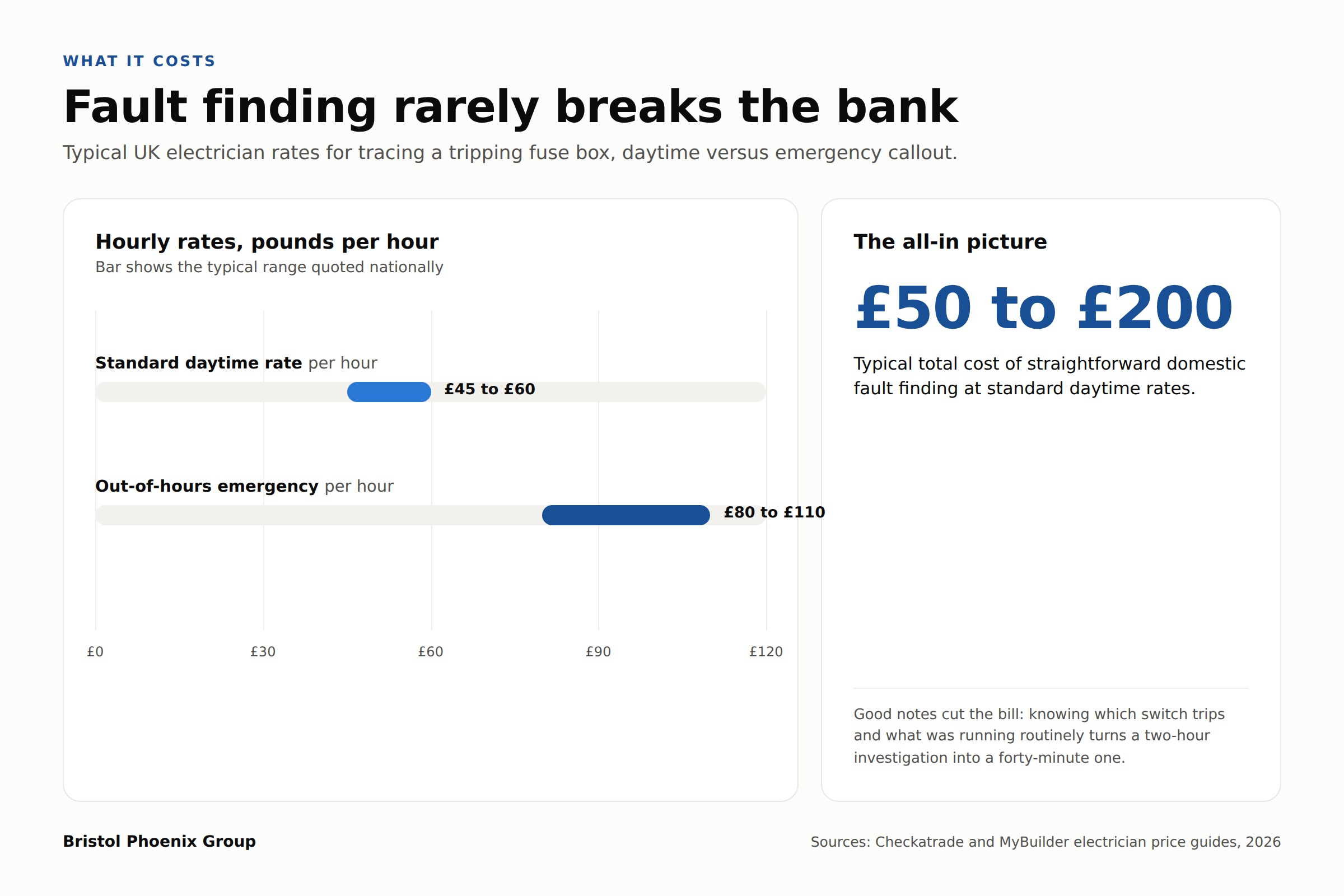
The homework above feeds directly into that bill. An electrician who arrives to “the board keeps tripping” starts from zero. One who arrives to “the kitchen MCB trips five minutes into the dishwasher cycle” starts three steps from the finish line. Good notes routinely turn a two-hour investigation into a forty-minute one.
What you are paying for is test instrumentation and the judgement to use it. Repeat tripping with no obvious appliance cause is one of the strongest signals that an installation deserves a closer look, not a bigger fuse and a shrug.
How to Stop It Happening Again
Once the fault is fixed, four things make the biggest difference:
- Spread the load. Keep high-power appliances off shared extension leads and, where possible, off the same circuit at once. The kettle and toaster will survive being run in sequence rather than in chorus.
- Retire suspect appliances properly. An appliance that has tripped the board more than once has earned repair or replacement, not a different socket. Moving a leaky washing machine to another circuit just moves the problem.
- Upgrade a tired consumer unit. If your board runs rewirable fuses, has no RCD protection, or one RCD guarding half the house, a modern RCBO board gives every circuit its own combined protection. One fault then takes out one circuit, not six rooms, and diagnosis becomes almost self-service. Our consumer unit upgrade service covers exactly this, including full testing and certification.
- Test and inspect on schedule. Press the RCD test button now and then to confirm it still trips cleanly, and have the installation inspected periodically. For rentals this is not optional: landlords in England must have the electrics in their rented properties checked at least every 5 years by a properly qualified person, under the government’s electrical safety standards guidance. For homeowners, the same inspection, an EICR, is the definitive answer to whether recurring trips are a quirk or a warning.
Boards that trip often were usually marginal to begin with. Tripping is how that history introduces itself, and taken early, the introduction is cheap.
Final Thoughts
A fuse box that keeps tripping is annoying, but it is annoying in your favour. Every trip is the installation catching a fault faster than any human could, and the pattern of those trips is a message you can read with patience. Find the device, find the pattern, find the appliance. Most of the time, that is the whole story.
And when it is not, when the board drops with everything unplugged, or the trips have no pattern, or any stop sign appears, that is where we come in. As a NAPIT-approved contractor in South Bristol, we handle fault finding across the city with proper test equipment and a straight answer at the end: what failed, why, and what it costs to put right. If your board has been making a habit of this, get in touch with our team and we will get it traced. Resetting a trip switch twelve times a week is not a maintenance routine. It is a fault, and finding it is the job.