It is one of the more baffling household faults. The RCD keeps tripping, you reset it, and twenty minutes later the house clicks into darkness again. Sometimes it goes the moment the kettle boils. Sometimes it waits until 2am for no reason you can see. We spend a good part of our working week in South Bristol homes chasing exactly this fault, and the honest news is encouraging: an RCD that keeps tripping is nearly always protecting you from something real, that something is usually a single appliance, and with a careful process you can often narrow it down yourself before you ever pick up the phone.
This guide explains what your RCD is doing when it trips, why “tripping for no reason” is almost never accurate, and how to run the elimination process we use on a first visit. We will also be clear about where DIY detective work should stop.
Table of Contents
- What an RCD Actually Does
- Why Your RCD Keeps Tripping: The Usual Suspects
- RCD Tripping for No Reason? There Is Always a Reason
- How to Find the Fault: The Appliance Elimination Method
- Reading the Pattern: A Quick Reference Table
- When an RCD Keeps Tripping With Everything Unplugged
- When to Stop and Call an Electrician
- Look After Your RCD: The Three Month Test
- Final Thoughts
TL;DR
- An RCD trips when current leaks to earth, often through a faulty appliance, moisture, or damaged wiring. It is doing its job, not malfunctioning.
- The most common culprit by far is a single appliance with a failing heating element: washing machines, dishwashers, kettles, immersion heaters and electric showers lead the list.
- “Tripping for no reason” usually means cumulative earth leakage from many devices, an intermittent appliance fault, or moisture that comes and goes with the weather.
- The appliance elimination method finds most culprits: unplug everything, reset, then reconnect one device at a time and wait.
- If the RCD still trips with everything unplugged, the fault is in the fixed wiring or a wired-in circuit, and that is a job for a qualified electrician.
- Press the test button every three months. A trip that will not reset, or any burning smell, means stop and call for help.
What an RCD Actually Does
An RCD, short for residual current device, is the wide switch in your consumer unit that guards a bank of circuits. It works on a simple principle: the current flowing out on the live conductor should exactly match the current coming back on the neutral. If some of it goes missing, it must be leaking somewhere it should not, possibly through water, possibly through damaged insulation, possibly through a person. The RCD notices the imbalance and cuts the power in a fraction of a second.
The sensitivity involved is remarkable. Under BS 7671, the IET Wiring Regulations, Regulation 411.3.3 requires additional protection by an RCD rated at no more than 30 milliamps for socket outlets rated up to 32 amps. Thirty milliamps is a tiny current, around what a small LED lamp draws. Your RCD is watching for a leak that small, constantly, on every circuit it covers.
It is worth being clear about what an RCD is not. It is not an MCB, one of the smaller switches that each guard a single circuit against overload and short circuits. If a small switch is dropping, you are dealing with a different class of problem, and our guide to a fuse box that keeps tripping covers that in detail. This article is about the wider switch, the one that takes out half the house at once and watches for leakage rather than overload.
Why Your RCD Keeps Tripping: The Usual Suspects
After enough fault-finding visits, the same handful of causes come up again and again. Here they are, in roughly the order we find them.
1. A failing heating element
This is the big one. Washing machines, dishwashers, tumble dryers, kettles, immersion heaters, ovens and electric showers all contain heating elements, and elements crack as they age. A cracked element lets current leak through the mineral insulation to the earthed metal casing, which is precisely the kind of leak an RCD exists to catch. The giveaway is timing: the trip happens when the appliance heats, not when it starts. A washing machine that runs its drum happily but drops the RCD ten minutes into a cycle, just as the water heats, is practically signing a confession.
Kitchen appliances deserve extra respect here. In the year to March 2025, cooking appliances were the largest specified ignition category for accidental dwelling fires in England, accounting for 44% of these fires according to official fire statistics. An RCD that objects to a kitchen appliance is not being dramatic. It is intervening early in a story that sometimes ends with a fire engine.
2. Moisture where it should not be
Water and electricity settle their differences through your RCD. Outdoor sockets, garden lighting, pond pumps, shed feeds and security lights all live in the weather, and a perished seal or cracked fitting lets rain creep into terminals. The pattern here is meteorological: if the RCD trips during or after heavy rain and behaves itself in a dry week, start your suspicions outside. Indoors, steam-heavy bathrooms and condensation in rarely used sockets can do the same on a smaller scale.
3. Too many small leaks adding up
Every modern electronic device leaks a tiny, harmless current to earth through its filters: computers, TVs, chargers, induction hobs, anything with a switch-mode power supply. Individually these leaks are trivial. Add enough of them on one RCD and you can sit at 20-plus milliamps of standing leakage, leaving so little headroom that one damp morning or one marginal appliance tips the balance. This is the classic profile of a household where the RCD trips randomly and no single device ever looks guilty.
4. Cheap or damaged plug-in equipment
Frayed flexes, crushed extension leads, and bargain electronics of uncertain origin all feature regularly in our fault-finding notes. Electrical Safety First reports that one in ten UK consumers has experienced an electrical fire or shock from a product bought online. If the tripping started shortly after a new gadget arrived, the new arrival goes to the top of the suspect list, whatever it cost.
5. Damaged fixed wiring, or the RCD itself
Less common, but real: a nail or screw through a cable, rodent damage, aged rubber insulation crumbling in a loft, or water in a junction box will all leak current to earth. Occasionally the RCD itself has worn out and trips at well below its rated threshold. Both of these need proper instruments to diagnose, which brings us to the boundary between DIY and professional work later on.
RCD Tripping for No Reason? There Is Always a Reason
We hear the phrase “RCD tripping for no reason” on the phone most weeks, and we understand why. From the hallway, staring at a tripped switch at 11pm, it looks random. But an RCD is a comparison device. It trips because the sums stopped balancing, full stop. “No reason” really means “no reason visible from the hallway”, and the job is to make the reason visible.
Three patterns explain most so-called random tripping. The first is the cumulative leakage problem described above: the household sits close to the trip threshold all the time, so the final straw is different each day. The second is an intermittent appliance fault, a fridge compressor that only leaks when hot, a heating element that only leaks at full temperature, a cable that only touches when the washing machine hits spin. The third is environmental: moisture cycles with weather and season, so the fault appears in October and vanishes in May.
Genuine nuisance tripping, where the RCD reacts to harmless transient events rather than a true fault, does exist. Motors starting, freezers cycling and surge events can nudge a sensitive or ageing device. But in our experience it is claimed far more often than it occurs. Assume the RCD is telling the truth until proven otherwise. It is the one component in the house with no imagination.
How to Find the Fault: The Appliance Elimination Method
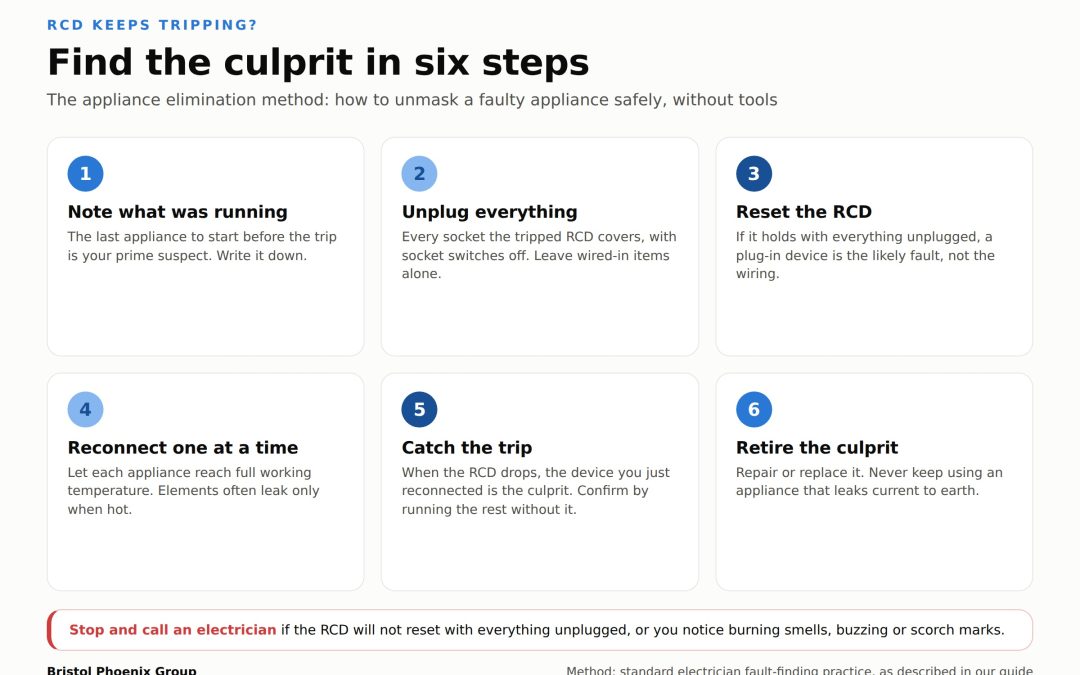
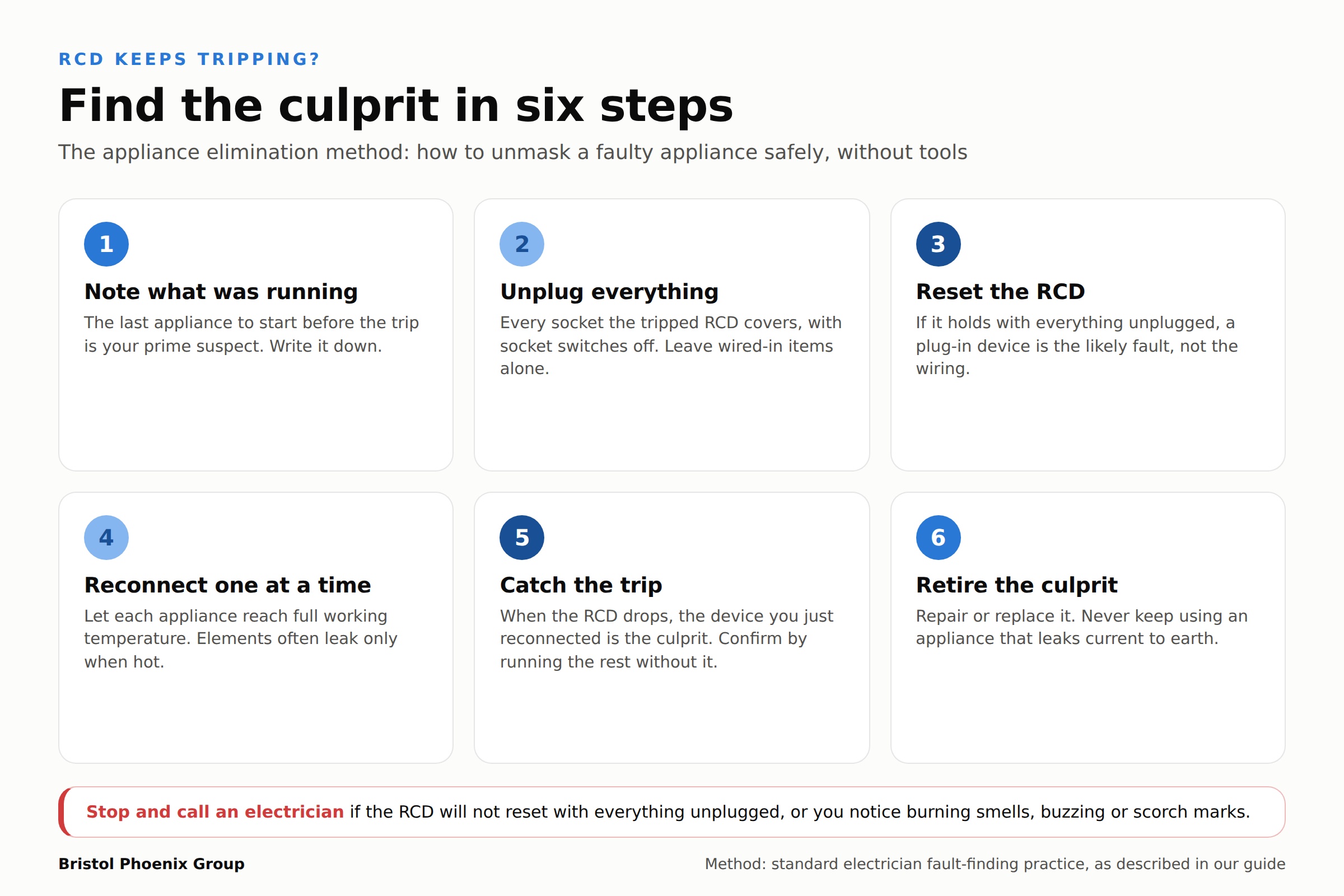
This is the same logic we apply on a first visit, minus the test instruments. It costs nothing, it is safe if you follow it as written, and it identifies the culprit in most cases where a plug-in appliance is to blame.
- Note what was running. Before touching anything, think about what was on when it tripped. The last appliance to start is your prime suspect.
- Unplug everything on the affected circuits. Every socket the tripped RCD covers: kitchen counter, washing machine, TV corner, garage, the lot. Switch off socket switches too. Leave wired-in items alone for now.
- Reset the RCD. Push the switch firmly back up. If it holds with everything unplugged, the fixed wiring is probably healthy and a plug-in device is your culprit.
- Reconnect one appliance at a time. Plug in one device, switch it on, and give it time to reach normal working temperature. Elements often leak only when hot, so a quick flick on and off proves nothing. Then move to the next.
- When the RCD drops, you have your answer. The device you just reconnected is the likely fault. Unplug it, reset, and run everything else normally to confirm the house stays on without it.
- Retire the culprit. Have it repaired by someone qualified or replace it. Do not keep using an appliance that leaks current to earth because it “only trips sometimes”. That is a safety device overruling you, repeatedly.
Picture a typical scenario: a Victorian terrace where the RCD keeps tripping on wash days, never in the evening. Everything gets unplugged, the RCD resets sweetly and holds. The kettle comes back: fine. Fridge freezer: fine. Washing machine: starts fine, fills fine, then trips the board eight minutes in, right as the heater engages. Unplug it, reset, run the rest of the kitchen all afternoon without a flicker. That is a cracked heater element identified with nothing more than patience and a notepad, and the only bill is for the repair or the replacement machine.
Two safety notes. Work with dry hands, use the plugs and switches only, and never open an appliance or remove a socket faceplate. And if at any point the RCD refuses to reset with everything unplugged, or you smell burning, stop and skip ahead to the section on calling for help.
Reading the Pattern: A Quick Reference Table
The pattern of tripping is diagnostic gold. Match your symptoms to the table below before you start unplugging, and you may save yourself half the process.
| When the RCD trips | Most likely cause | Sensible next step |
|---|---|---|
| When one appliance runs, especially mid-cycle as it heats | Failing heating element in that appliance | Run the elimination method to confirm, then repair or replace it |
| During or after heavy rain | Moisture in outdoor sockets, lights or garden wiring | Isolate outdoor circuits if you can, and have the fittings inspected |
| Randomly, different times, no obvious trigger | Cumulative earth leakage or an intermittent fault | Elimination method, then professional leakage testing if inconclusive |
| Instantly on reset, everything unplugged | Fixed wiring fault, wired-in appliance, or the RCD itself | Stop resetting and book a fault-finding visit |
| Only at night or in cold months | Heating loads: immersion, storage or panel heaters, frost protection | Isolate heating circuits one at a time and note which stops the trips |
| When the shower runs | Shower heater element leaking to earth | Stop using the shower and have the unit tested |
When an RCD Keeps Tripping With Everything Unplugged
If you have unplugged every portable appliance, the sockets are all off, and the RCD keeps tripping anyway, the search moves into territory that needs instruments. The remaining suspects are wired-in equipment and the installation itself: electric showers, immersion heaters, ovens and hobs, integrated appliances on fused spurs, outdoor circuits, and the cables buried in walls, floors and lofts.
You can sometimes narrow it further by switching off the MCBs the RCD covers, resetting, then bringing circuits back one at a time. If the RCD drops the moment one particular MCB goes on, that circuit carries the fault. That is genuinely useful information to hand to your electrician, and it shortens the paid part of the hunt. What comes next, though, is insulation resistance testing and leakage measurement with calibrated instruments, which is exactly what our electrical fault finding service exists for. A methodical test sequence pinpoints whether the leak is in a cable run, an accessory, a wired-in appliance, or a tired RCD that needs replacing, without exploratory holes in your walls.
One scenario deserves its own warning. An RCD that will not reset at all, with everything off, is not being stubborn. It is holding the line against a live fault that has not gone away. Repeatedly forcing a reset against a genuine earth fault achieves nothing except stressing the device that is protecting you.
When to Stop and Call an Electrician
Most RCD detective work is safe, but there are hard stop signals. Call a professional immediately if the RCD will not reset with everything unplugged, if any switch, socket or the consumer unit itself smells of burning or shows scorch marks, if you hear buzzing or crackling from the board, if a trip coincides with a bang or a flash, or if anyone has felt a tingle or shock from an appliance or fitting. A shock report plus a tripping RCD is the device telling you it has already intervened once on someone’s behalf.
Out of hours, that is what an emergency electrician is for, and a genuine fault with burning smells or shocks is precisely the situation where waiting until Monday is a false economy. For the non-urgent version, where the house runs fine with one appliance banished and you simply want the underlying fault confirmed, a scheduled fault-finding visit is cheaper and entirely adequate.
A tripping RCD is also a fair prompt to look at the board it lives in. If your consumer unit is an older model with a single RCD covering everything, one damp outdoor socket can black out the whole house, fridge and freezer included. Modern boards with RCBOs give each circuit its own combined protection, so a fault takes out one circuit rather than half your home. If your board predates that approach, it is worth reading up on consumer unit replacement when planning electrical work.
Look After Your RCD: The Three Month Test
An RCD is a mechanical device, and mechanisms stick if never exercised. That little button marked T or Test is there for you, not for electricians. Electrical Safety First has long advised that the test button should be operated every three months. When the charity had 607 installed RCDs independently tested, over 96% were fully functional, but the overwhelming majority of householders admitted they had never tested the device at all. The button takes five seconds: press it, the power should cut, reset it, done. If pressing it does nothing, your safety net may not be there when it matters, and that is worth a professional inspection this week rather than this year.
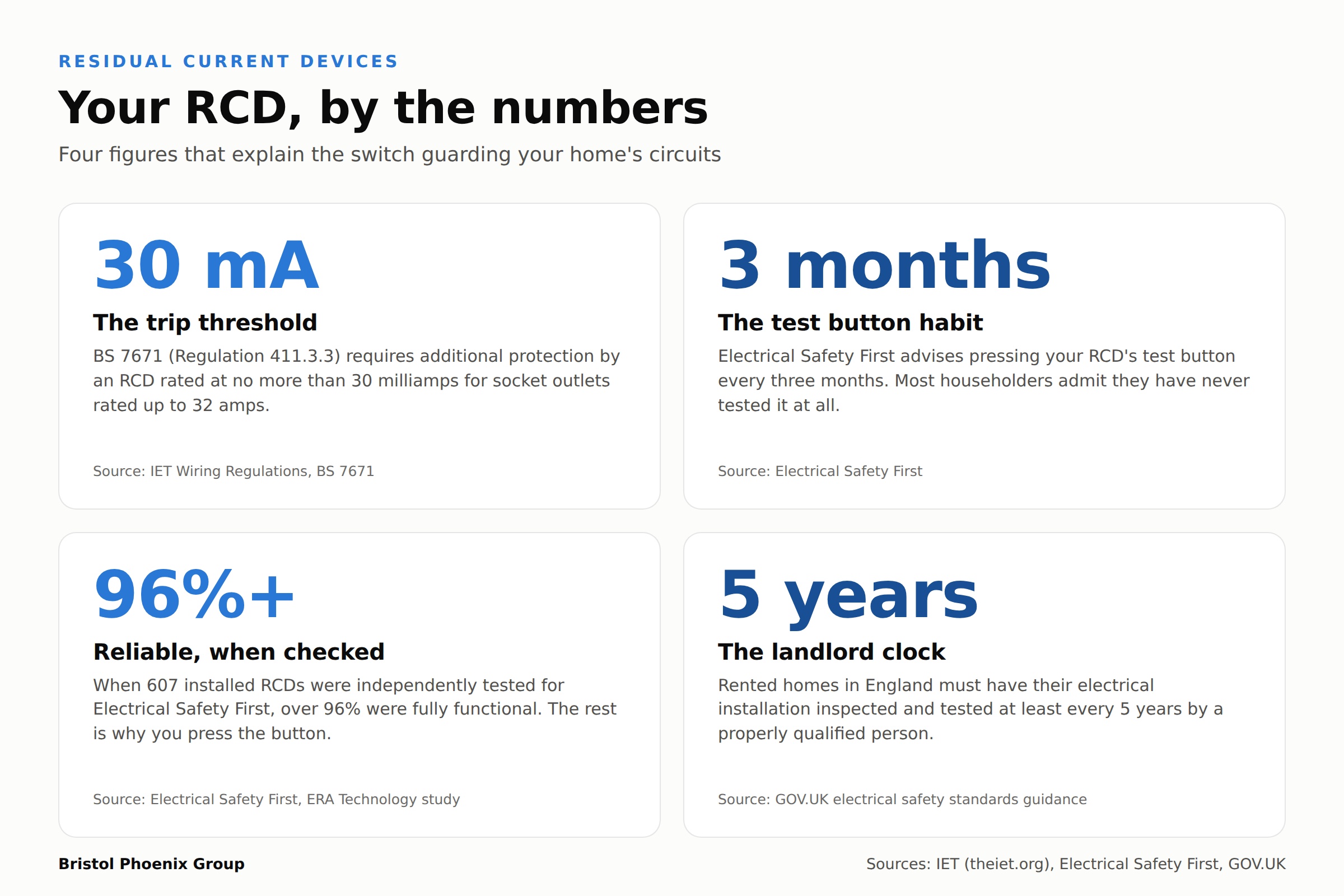
Landlords have a firmer obligation. Under government electrical safety standards, rented properties in England must have their electrical installations inspected and tested at least every 5 years by a properly qualified person, a regime that now extends to the social rented sector too. That inspection is the EICR we have written about elsewhere, and it will pick up tired RCDs, high standing leakage and deteriorating insulation before they become 2am phone calls. If your rental’s RCD keeps tripping between inspections, treat it as a maintenance issue to investigate now, not something to note for the next certificate. Our electrical testing services cover both the periodic inspections and the in-between investigations.
Final Thoughts
An RCD that keeps tripping is annoying, but it is annoyance with a purpose. Somewhere in your home, current is going where it should not, and a thirty-milliamp watchdog is refusing to let that slide. Read the pattern, run the elimination method, and in most cases you will unmask a single guilty appliance without spending a penny. When the fault sits deeper, in the shower, the wiring or the board itself, that is where we come in.
Bristol Phoenix Group is a NAPIT-registered electrical contractor based in South Bristol, and RCD fault finding is bread-and-butter work for us: methodical testing, a clear explanation of what we found, and a fix that lasts. If your RCD keeps tripping and you have run out of patience or suspects, get in touch and we will get your power staying on.