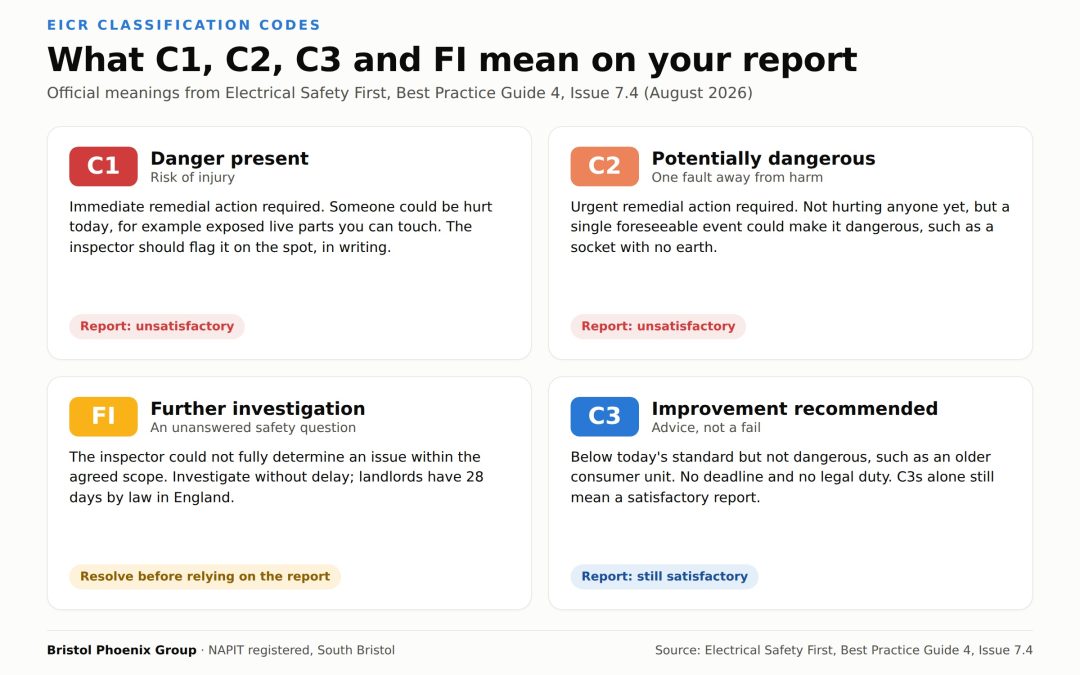
Quick answer: EICR codes grade each defect an inspector finds. C1 means danger present and C2 means potentially dangerous: either one makes the report unsatisfactory and, in a rented home in England, must be put right within 28 days. C3 means improvement recommended and is not a fail, while FI means the inspector needs to investigate further before a definite code can be given. If you need the inspection itself, our EICRs across Bristol are fixed price from £200 plus VAT.
EICR codes are the shorthand an electrician uses to tell you how safe, or unsafe, your electrics really are. If a report has just landed in your inbox with C1, C2, C3 or FI scattered down the observations page, you’re probably wondering which ones matter, which ones can wait, and whether the property has passed at all. This guide explains every code in plain English, with real examples from the current industry guidance, what each one means for the overall result, and exactly what landlords in England are legally required to do about them. We write these reports every week across South Bristol, so none of this is theory.
Table of Contents
- What EICR Codes Are and Where You Find Them
- The Four EICR Codes Explained
- EICR Codes at a Glance: The Table
- Satisfactory or Unsatisfactory: How the Codes Decide the Result
- Real Examples of C1, C2 and C3 Codes
- The Readings Behind the Codes
- Why an Older Home Can Still Pass
- The Codes We Record Most Often in South Bristol Homes
- What Landlords in England Must Do About Each Code
- A Worked Example: Reading a Report on a Knowle Semi
- What To Do Next
- EICR Codes: Your Questions Answered
- Related EICR Guides
TL;DR
- C1 means danger present with a risk of injury. It needs immediate remedial action, usually before the inspector leaves.
- C2 means potentially dangerous. It needs urgent remedial action, and it’s the most common reason a report comes back unsatisfactory.
- C3 means improvement recommended. It is not a fail. A report with only C3s is still satisfactory.
- FI means further investigation is needed because the inspector couldn’t fully determine an issue within the agreed scope of the inspection.
- Landlords in England must fix C1s, C2s and FIs within 28 days, or sooner if the report says so, with fines of up to £40,000 for those who don’t.
- Old wiring colours, rewireable fuses that still protect the circuit properly, and most plastic consumer units do not automatically fail a report.
- Reports are now written to BS 7671:2018+A4:2026. Between 15 April and 15 October 2026 either it or the previous Brown Book could be used; from 15 October 2026 only A4:2026 is current. The codes mean the same under both.
- Most C2s and C3s in South Bristol homes are cleared by a consumer unit change, from £680 plus VAT at our published prices. A house full of them is often a rewire job, from £5,400 plus VAT for a three bed house.
What EICR Codes Are and Where You Find Them
An Electrical Installation Condition Report is the formal record of a periodic inspection of a property’s fixed wiring. If you want the full background on what the document is and who needs one, we’ve covered that in what does EICR stand for. This post is about the codes inside it.
Every concern the inspector finds gets written up as an observation, and every observation about safety gets one classification code. The codes are set by BS 7671, the national wiring regulations, and the way inspectors apply them is standardised by Electrical Safety First’s Best Practice Guide 4, which is written with NAPIT, NICEIC, the IET and the other main industry bodies. The current edition is Issue 7.4, published in August 2026, and it’s the reference we use on every inspection.
One rule worth knowing up front: each observation gets one code only, and if a defect could arguably take two, the inspector must use the more serious one. You’ll find the codes in the observations section, each against a specific defect, with the overall result on the front page: satisfactory or unsatisfactory. The codes drive that result, which is why they’re worth understanding properly.
The Four EICR Codes Explained
Here are the eicr classification codes as the current guidance defines them, in descending order of severity.
C1: Danger Present
The official wording is danger present, risk of injury, immediate remedial action required. A C1 means someone using the installation is at immediate risk, right now, today. The classic example is exposed live parts that anyone could touch: a missing blanking piece on the fuse board, a smashed socket with live terminals showing, or cable insulation that has come away completely.
A C1 is the one code where the inspector won’t wait for the paperwork. The guidance requires them to tell whoever ordered the report immediately, and in writing, that urgent action is needed. In practice, a competent inspector will make the danger safe on the spot where possible, even if that means isolating part of the installation until a proper repair is done.
C2: Potentially Dangerous
The official wording is potentially dangerous, urgent remedial action required. A c2 eicr observation means the defect isn’t hurting anyone at this precise moment, but a foreseeable event, a fault, a bit of wear, a wet floor, could make it dangerous. Missing earthing at a socket, no RCD protection on sockets likely to power garden tools, and loose connections showing signs of overheating all sit in this category.
C2 is the code that catches most landlords and sellers out, because a single C2 makes the whole report unsatisfactory. It’s also the most common serious code we record, simply because earthing, bonding and RCD provision have moved on a long way over the last few decades.
C3: Improvement Recommended
The official wording is simply improvement recommended. A c3 eicr observation means the installation doesn’t meet today’s standard in some respect, but the inspector doesn’t consider it dangerous or potentially dangerous. Upgrading would improve safety; leaving it alone is legal and, for the report, perfectly acceptable.
This is the most misunderstood code of the four. A C3 is not a fail, not a legal instruction, and nobody can force you to act on one. That said, some C3s are cheap wins worth doing while an electrician is already on site.
FI: Further Investigation
FI is used when inspection and testing has revealed a potential safety issue that the inspector couldn’t fully pin down within the agreed extent and limitations of the job. The current Best Practice Guide is notably strict about this code: in a domestic property it should almost always be possible to reach a proper classification, and the guide now lists no domestic examples of FI at all. In other words, if your home EICR is peppered with FIs, that’s a question to put to the inspector, not a normal state of affairs.
Where an FI is genuinely warranted, the issue should be investigated as soon as possible, because an unresolved FI is an unresolved safety question. For rented property in England the law treats it like remedial work, with the same 28 day clock, which we cover below. The investigation itself is a fault finding visit in all but name, priced from £140 plus VAT on our published list, and it usually ends with the FI replaced by a definite code and a quote for whatever it found.
EICR Codes at a Glance: The Table
| Code | Official meaning | Urgency | Effect on the report |
|---|---|---|---|
| C1 | Danger present, risk of injury | Immediate remedial action required | Unsatisfactory |
| C2 | Potentially dangerous | Urgent remedial action required | Unsatisfactory |
| FI | Further investigation needed | Investigate without delay, then act on what it finds | Treated as unsatisfactory until resolved |
| C3 | Improvement recommended | No deadline, owner’s choice | Still satisfactory |
Satisfactory or Unsatisfactory: How the Codes Decide the Result
The overall assessment on the front of the report can only be one of two words. Here’s how the codes map onto it.
Any C1 or C2 makes the report unsatisfactory. No exceptions. The current Best Practice Guide 4 puts it plainly: where any observation has been given a C1 or C2, the overall condition must be reported as unsatisfactory, and where only C3 observations have been recorded, the outcome can be stated as satisfactory.
FI sits in slightly more nuanced territory in 2026. Reports have traditionally shown FI as making the outcome unsatisfactory, and the government’s guidance for landlords still describes FI as further investigation required without delay and treats it exactly like remedial work. The latest Best Practice Guide 4, updated in August 2026, steers inspectors towards reaching a definite code in domestic work rather than leaning on FI. Whichever form your report was written on, the practical advice is identical: an FI is an open safety question, so get it answered quickly. For landlords it carries a legal deadline either way.
The wiring regulations themselves moved this year too. BS 7671:2018+A4:2026 was issued on 15 April 2026, and for six months either it or the outgoing Amendment 3 (the Brown Book) could be used. The IET confirms the Brown Book stayed valid until 15 October 2026, so a report dated before then can legitimately reference either edition, and one dated after it should cite A4:2026. The codes and their meanings are the same under both, so nothing on an older report needs re-coding.
One more thing the guidance is clear about: satisfactory doesn’t mean perfect, and it doesn’t last forever. It means the installation is safe for continued use up to the recommended date of the next inspection, and no further.
Real Examples of C1, C2 and C3 Codes
These eicr observation codes come straight from the examples in Best Practice Guide 4 Issue 7.4, so they’re the codings a competent inspector should reach for, not our house interpretation.
Typical C1 codings, all variations on accessible live parts: a protective device missing from the consumer unit with no blanking piece fitted, a badly damaged accessory with live parts you can touch, live conductors with missing or damaged insulation, and incorrect polarity at the origin of the installation.
Typical C2 codings: no reliable means of earthing for the installation, a gas or water pipe being used as the earth, no earth at a socket outlet, missing main protective bonding, sockets without RCD protection where they could reasonably power equipment outdoors, a borrowed neutral shared between two circuits, a loose connection showing signs of overheating, insulation resistance under 1 megohm, and unenclosed connections at light fittings, which the guide notes can contribute to a fire.
Typical C3 codings: a Type AC RCD fitted where a Type A is now required, no RCD protection on lighting circuits, cables buried less than 50mm deep in a wall without RCD protection or mechanical protection, unsheathed flex on pendant lights, and a plastic consumer unit under a wooden staircase or on the only escape route.
Notice the pattern. C1 is touchable danger, C2 is danger waiting on one more thing going wrong, C3 is yesterday’s standard rather than today’s danger.
The Readings Behind the Codes
Plenty of codes come from what the inspector can see: a missing blank, a cracked socket, a bare earth. Just as many come from what the test instruments say, and those are the ones homeowners find hardest to argue with or understand, because the sockets all work. Insulation resistance under 1 megohm is a C2 in the guide even though nothing has tripped yet. A ring circuit whose end to end readings don’t match the cable it’s wired in points to a loose or damaged conductor somewhere in a wall, and that is where a genuine FI can come from in a home.
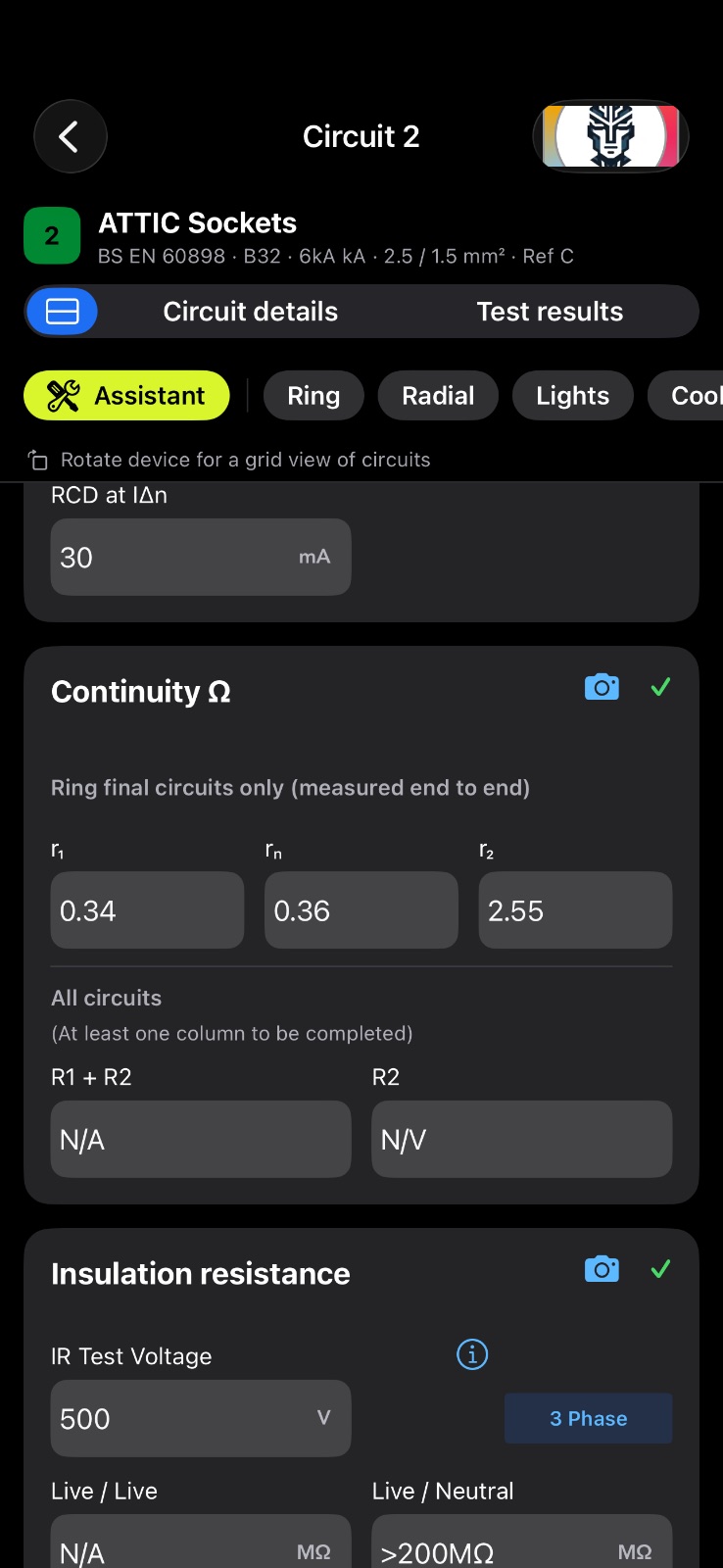
That screenshot is from one of our recent inspections, written up in full in our EICR on a three bed house in Bedminster. The line and neutral agreed with each other, as they should, but the earth was roughly four and a half times what that cable ought to read. Nothing in the house gave any hint of it. It’s a good illustration of why the result of an EICR can’t be guessed from whether the lights come on, and why the observations page is worth reading line by line rather than skipping to the front.
Why an Older Home Can Still Pass
An installation is inspected against the current standard, but the guidance is explicit that older doesn’t mean dangerous. Best Practice Guide 4 keeps a list of items that are non-compliances needing no code at all, and even a list of outright myths that shouldn’t appear on a report.
Old wiring colours from a previous edition of the regulations are a non-compliance only, no code. Rewireable fuses that still provide adequate circuit protection are listed as a myth, not a defect. So are circuit breakers to the old BS 3871 standard, missing bonding to a sink that isn’t an extraneous conductive part, and the absence of switches on socket outlets. A plastic consumer unit that isn’t under a wooden staircase or on a sole escape route doesn’t even earn a C3.
This is why a well maintained 1930s semi in Whitchurch or a Victorian terrace in Bedminster can come back satisfactory with a handful of C3s, while a carelessly extended newer property can fail outright. Age raises the odds of problems; it isn’t a problem in itself.
The Codes We Record Most Often in South Bristol Homes
National guides list every coding that exists. What they can’t tell you is which ones actually turn up in your street. Our EICR work runs from the Victorian terraces of BS3 out to the inter-war estates of BS13 and BS14, and the same handful of observations account for most of what we write. Here they are by code, with what it usually takes to clear them at our published prices.
The C3s almost every pre-2008 home collects
If your home was last rewired or had its fuse board changed before the 17th Edition arrived in 2008, expect C3s for no RCD protection on the lighting circuits and, on boards changed between then and the early 2020s, a Type AC RCD where a Type A is now required. A plastic consumer unit in a hallway cupboard is usually no code at all. None of these fail the report. All of them vanish at once when the board is changed, which is why we tend to suggest living with them until a C2 or a planned job makes a consumer unit replacement worthwhile: £680 plus VAT for a 6-way board in a flat or small house, £780 plus VAT for the 8 to 12-way boards most houses need, with RCBO protection on every circuit so the C3s don’t come back on the next report.
The C2s the Victorian terraces give us
Bedminster, Southville, Totterdown and Windmill Hill are full of terraces that have been extended, split and reinstated many times over. The C2s we record there are the ones the guide predicts: main protective bonding missing or undersized to the water and gas services, socket circuits with no RCD protection, and borrowed neutrals on landing lighting where two circuits were tied together during some past alteration. Bonding is a modest fix we price before we start. The RCD gap is a consumer unit change. A borrowed neutral needs tracing first, then separating, which is fault finding work from £140 plus VAT and sometimes a short run of new cable. Our electricians in Bedminster see this pattern most weeks.
The C2s and FIs the 1930s semis give us
Knowle, Bishopsworth, Headley Park, Hengrove and Whitchurch were largely built between the wars, and their wiring is often three or four generations deep: original rubber or early PVC in the walls, a 1970s ring added for the kitchen, a 1990s extension, a modern shower circuit. That mix is where the test readings start to disagree with the cable, and where unenclosed connections turn up in lofts and under floors. Individually each is a C2 or an FI with its own fix. When a report carries half a dozen of them across different circuits, the honest advice is usually that piecemeal repairs cost more than they’re worth and a house rewire makes more sense: from £4,500 plus VAT for a one bed flat and from £5,400 plus VAT for a three bed house on our published list, with a new consumer unit and certification included so the next EICR is a formality.
The C1s, which are rare
We record very few C1s, and almost all of them trace back to a previous DIY job or an abandoned alteration: a blank missing from the board after a circuit was removed, a cracked socket behind a sofa, a junction box left open in a loft with the lid lost. They’re cheap to put right, usually inside our small jobs pricing from £95 plus VAT, and the inspector makes them safe before leaving regardless. What they tell you about the rest of the installation is the more useful part, because a home with one bodge tends to have others.
What Landlords in England Must Do About Each Code
The Electrical Safety Standards in the Private Rented Sector (England) Regulations 2020 turned the codes from advice into deadlines. The official guidance on gov.uk sets out the duties, and we’ve summarised the workflow on our landlord electrical safety page.
The core duties: have the installation inspected and tested at least every five years by a qualified person, give the report to your tenant within 28 days of the inspection, to a new tenant before they move in, to a prospective tenant within 28 days of a request, and to the council within 7 days if they ask.
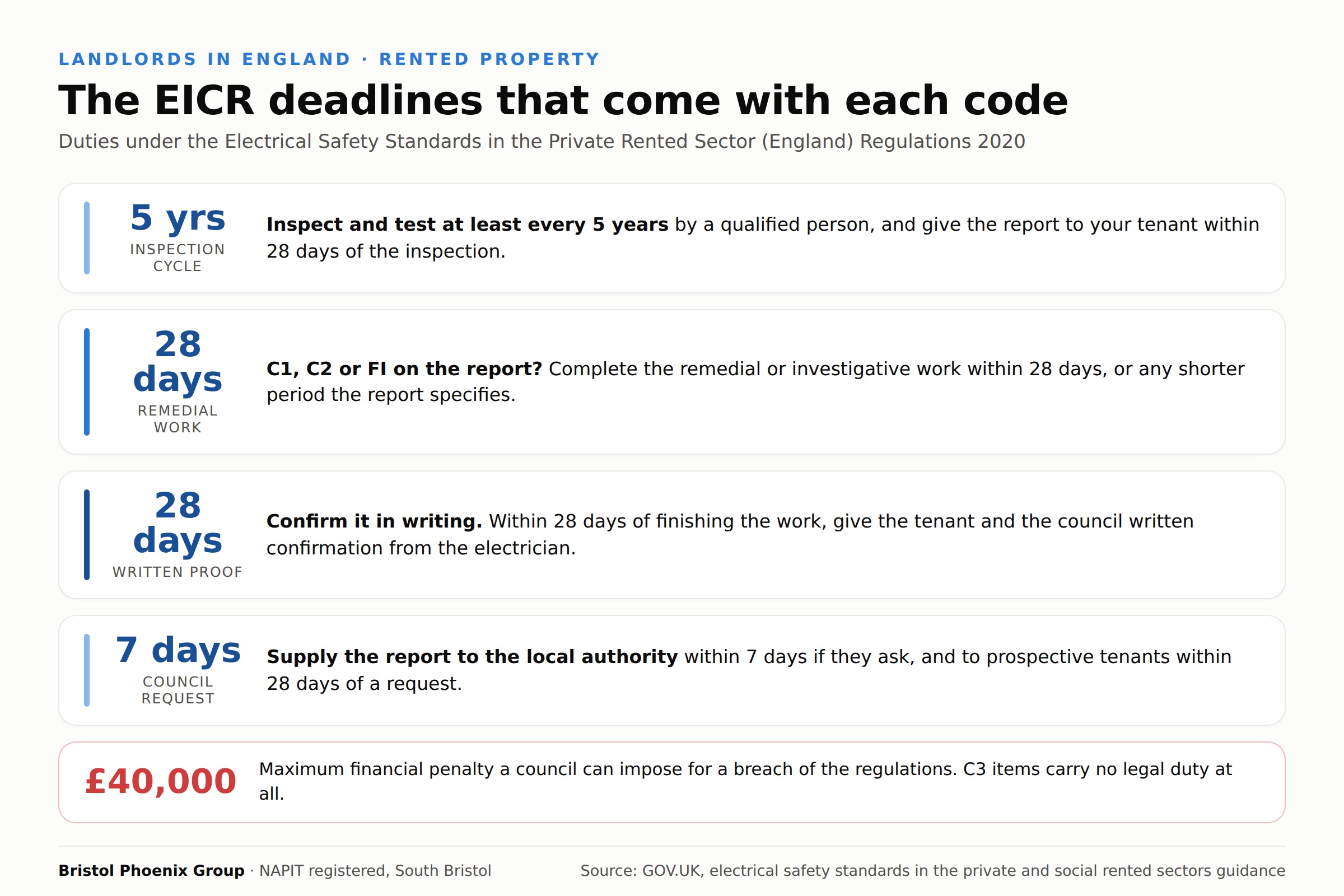
If the report shows a C1, C2 or FI, you must complete the remedial or investigative work within 28 days, or any shorter period if the report specifies one. Then, within 28 days of finishing the work, you must give the tenant and the local authority written confirmation from the electrician that it’s done, which is normally the certification covering the fixes rather than a whole new EICR. Councils can issue a financial penalty of up to £40,000 for landlords in breach, so the 28 day clock is not a suggestion.
C3s carry no legal obligation at all. You can act on them or not; a rental with only C3s on its report is compliant.
One 2025 change worth knowing: the same rules were extended to the social rented sector. The extension took effect on 1 November 2025 for new tenancies, and existing social tenancies need an inspection by 1 November 2026. If you hold private stock in Bristol, nothing about your own duties changed, but the direction of travel is obvious: electrical safety reporting keeps getting less optional.
A Worked Example: Reading a Report on a Knowle Semi
Picture a typical 1930s three bed semi in Knowle, bought by a landlord who’s just had a first EICR done before letting it. The report comes back unsatisfactory with five observations: one C2 for no RCD protection on the socket circuits, one C2 for missing main bonding to the incoming water pipe, and three C3s covering old cable colours noted for information, a plastic consumer unit in the hallway cupboard, and no RCD on the lighting circuits.
Reading it with the table above, the story is simple. The two C2s made the report unsatisfactory and started the 28 day clock. The fix is a consumer unit upgrade with RCD protection plus a length of 10mm bonding conductor to the water main, quoted as a single visit, which at our prices starts at £780 plus VAT for the board a three bed house normally needs. The three C3s need nothing, and two of them are dealt with anyway as a side effect of the new consumer unit. Work done, the electrician issues the certification for the fixes, the landlord sends written confirmation to the tenant and the council inside 28 days, and the property is compliant for up to five years. That’s how most unsatisfactory reports resolve when the codes are read calmly. If you’re anywhere from Knowle to Bishopsworth, our electricians cover Knowle and the surrounding BS4 streets weekly.
What To Do Next
If your report has come back unsatisfactory and you want the full playbook, deadlines, typical remedial costs and all, we’ve written a dedicated guide to an unsatisfactory EICR result so we won’t repeat it here.
If you need an inspection, our EICR service in Bristol runs on fixed published prices, from £200 plus VAT for a studio or one bed home, £250 plus VAT for a three bed, up to £350 plus VAT for a five bed, with the scope and any extras agreed before we book. Every report is written to Best Practice Guide 4, with each code explained in plain English rather than left for you to decode. If the report then needs work, the same published prices apply to the fixes: house rewires from £4,500 plus VAT, consumer units from £680 plus VAT and small remedials from £95 plus VAT, so you can read a quote against this page and know it’s fair.
EICR Codes: Your Questions Answered
Is a C3 on an EICR a fail?
No. C3 means improvement recommended, and a report with only C3 observations is still satisfactory. It’s advice, not an instruction, and there’s no legal duty to act on it, even for landlords.
What does a C2 mean on my EICR, and how urgent is it?
C2 means potentially dangerous: not causing harm at this moment, but liable to become dangerous. It makes the report unsatisfactory, and in a rented property in England it must be fixed within 28 days, or sooner if the report says so.
Does an FI code make my report unsatisfactory?
On most report forms, yes, and government guidance treats an FI like remedial work with the same 28 day deadline for landlords. The 2026 industry guidance also pushes inspectors to avoid FI in domestic work where a definite code can be reached, so expect to see it rarely and question it if it appears without a clear reason.
Do old fuse boxes or old wiring colours fail an EICR?
Not by themselves. Old cable colours are recorded as a non-compliance with no code, and rewireable fuses that still protect their circuits properly are listed in the guidance as a myth rather than a defect. What fails a report is danger, present or potential, not age.
Who decides which code each observation gets?
The inspector who signs the report, exercising their own judgement as a competent person against BS 7671 and Best Practice Guide 4. The guidance is explicit that the client shouldn’t influence the coding, and if an inspector departs from the published examples they should be able to justify why.
How long do I have to fix a C1 as a landlord?
The legal backstop is 28 days, but a C1 means danger present with risk of injury, so the report will almost always specify immediate action, and the inspector should make the danger safe, or isolate that part of the installation, before leaving. Treat a C1 as a same week problem, not a day 27 one.
What does a non-compliance with no code mean on my report?
It means the inspector has noted something that doesn’t match the current edition of BS 7671 but isn’t dangerous or potentially dangerous, so it doesn’t earn a classification. Old cable colours are the usual example. It has no effect on the result, carries no deadline for landlords, and is there for information so the next inspector knows the history.
Is a plastic consumer unit a C2 or a C3?
Usually neither. Best Practice Guide 4 gives a plastic consumer unit a C3 only when it sits under a wooden staircase or on the sole escape route from the property, because of the fire risk in that one location. Anywhere else it is a non-compliance with no code. If a report has coded your hallway cupboard board as a C2 purely for being plastic, ask the inspector to point to the guidance that supports it.
What is the difference between a C2 and an FI?
A C2 is a defect the inspector has identified and judged potentially dangerous. An FI is a safety question the inspector couldn’t answer within the agreed scope of the inspection, often because it needs a wall opened, a floor lifted or a circuit traced. Both make the report unsatisfactory and both carry the 28 day duty for landlords in England, but an FI needs investigating first, after which it becomes a C1, C2, C3 or nothing at all.
Have the EICR codes changed under BS 7671 A4:2026?
No. Amendment 4 was published on 15 April 2026 and became the only current edition on 15 October 2026, but C1, C2, C3 and FI mean exactly what they did before. What changed is the model forms and some of the detail inspectors check against, which Best Practice Guide 4 Issue 7.4 updated for in August 2026. A report written to the previous edition before the changeover date is still a valid report.
Related EICR Guides
- EICR in Bristol: our fixed published prices by property size and what the inspection covers.
- EICR unsatisfactory: the full playbook once the report has failed, with remedial costs.
- EICR renewal: how often you actually need a new one.
- Electrical safety certificate when selling a house: what buyers and solicitors ask for.
- EICR on a three bed house in Bedminster: the real job behind the test record above.
- High R2 reading on a ring: why 1970s cable tests differently, for the technically curious.
Reports Written by People Who Do This Every Week
We’re Bristol Phoenix Group, a NAPIT registered electrical contractor based in South Bristol. EICRs, house rewires and consumer unit replacements for homeowners, landlords and small commercial clients are the core of what we do, from Bedminster and Knowle out to Bishopsworth and Whitchurch, plus North Bristol. If a report has left you with more questions than answers, or you need one booked with prices agreed up front, call us on 0117 2447 382 or get in touch and we’ll talk you through it, codes and all. Our South Bristol electrician page shows the postcodes we cover.