Type “can I install my own EV charger” into a search bar and you will find two camps shouting past each other. One says it is illegal, full stop. The other says a wallbox is just a fancy socket on a big fuse, have at it. Neither is right. Fitting your own charger is legal in England, but only through a route that costs you money, time and paperwork, and at the end of it you own every risk personally. We fit and certify chargers for a living, so you might expect us to say call an electrician. We will, but we will also show our working, because the reasons are more persuasive than the instruction.
Table of Contents
- The Short Answer, Before the Detail
- Can I Install My Own EV Charger Legally? What Part P Actually Says
- Why a Charger Circuit Is Not Like Changing a Light Switch
- What DIY EV Charger Installation Really Costs You
- DIY vs Registered Installer: The Numbers Side by Side
- A Worked Example: Two Neighbours, One Street
- The Jobs You Can Safely Do Yourself
- The Bristol Picture
- So, Can I Install My Own EV Charger? Final Thoughts
TL;DR
- DIY EV charger installation is not banned in England, but a new charger circuit is notifiable work under Part P of the Building Regulations. Either a registered electrician self-certifies it, or you must tell building control before you start and pay them to inspect it.
- Install it yourself and the £500 chargepoint grant is off the table. The grant only pays out through an OZEV authorised installer, and the scheme runs until 31 March 2027.
- A 7kW charger pulls roughly 30 amps for hours at a stretch, and outdoor charging on a standard UK supply comes with specific earthing rules in BS 7671 Section 722 that catch out professionals, never mind first-timers.
- The realistic DIY saving is the labour, around £300 to £600. Set against that: lost grant money, building control fees, no certificates, awkward insurance questions and a slower house sale.
- A typical professional install costs £800 to £1,200 fully fitted in the UK, with the 2026 average around £1,110. The gap between that and a compliant DIY job is thinner than most people expect.
The Short Answer, Before the Detail
Here it is without the hedging. You can legally install your own EV charger in England if you are competent to do the electrical work and you notify your local authority building control before you begin. Almost nobody who asks the question sits in that overlap. The people capable of doing the job to BS 7671 standard tend to be electricians, who would simply certify it themselves, and the people asking tend to be capable DIYers who have wired a garage socket and reason that a wallbox cannot be much harder.
It is harder, in ways that are not obvious from the outside. The rest of this guide covers the legal position, the technical traps, the money you give up by doing it yourself, and the parts of the job you can happily take on without us. If you want the price side in full, our guide to EV charger installation cost in the UK breaks down every line of a typical quote.
Can I Install My Own EV Charger Legally? What Part P Actually Says
Part P of the Building Regulations covers electrical safety in dwellings in England and Wales. It does not say that only electricians may do electrical work. What it says is that certain jobs are notifiable, meaning building control has to know about them and someone has to certify they meet the standard.
Why a charger circuit is notifiable work
The government’s Planning Portal guidance lists “the installation of a complete new circuit” as notifiable work, alongside the installation of a new consumer unit. A home EV charger is almost always a new dedicated circuit run from the consumer unit to the wallbox, so it lands squarely in that category. This is not a grey area. A charger install is notifiable in the same way a new shower circuit or a consumer unit replacement is notifiable.
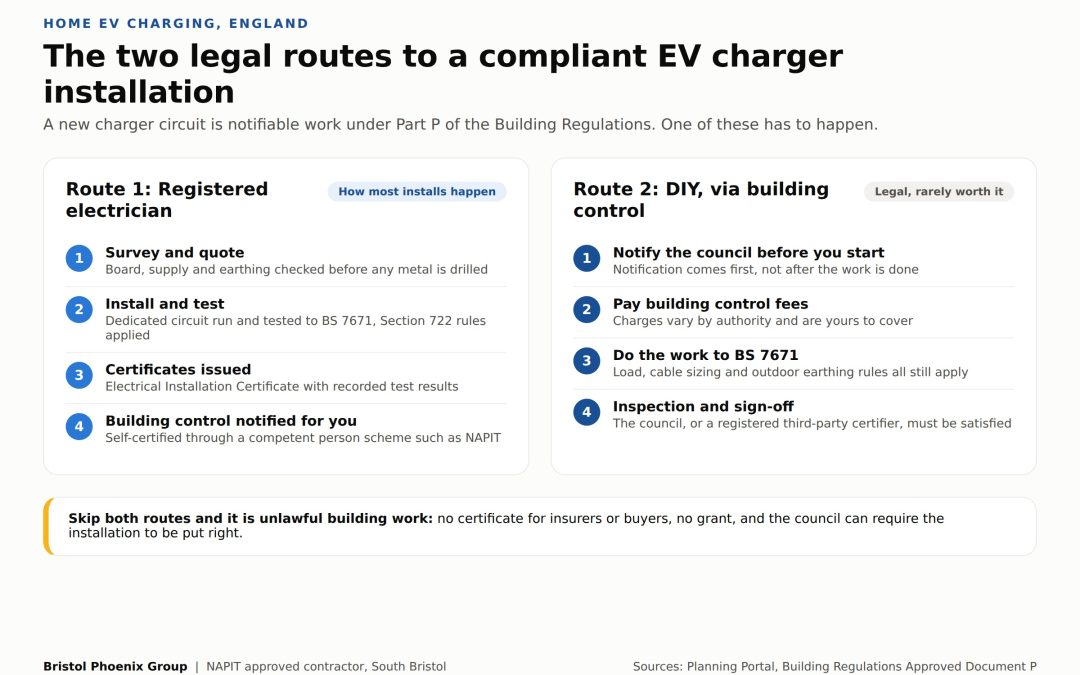
The two legal routes, and what each one asks of you
Route one is the familiar one: use an electrician registered with a competent person scheme such as NAPIT or NICEIC. They do the work, test it, certify it and notify building control on your behalf. You receive an Electrical Installation Certificate and a Building Regulations compliance certificate without lifting a finger. We are a NAPIT approved contractor based in South Bristol, and this self-certification is exactly what the scheme membership exists to do.
Route two is the DIY route. You notify building control before any work starts, pay their application fee, do the work, and the council arranges inspection and testing to satisfy themselves it complies. In England there is also a variant where a registered third-party electrician inspects and certifies your work instead. Either way the point stands: notification comes first, the fee is yours to pay, and if the inspector is not satisfied, the remedial work is yours too. Skip the process entirely and you have unlawful building work on your hands, no certificate to show an insurer or a buyer, and a council that can require it to be put right.
Why a Charger Circuit Is Not Like Changing a Light Switch
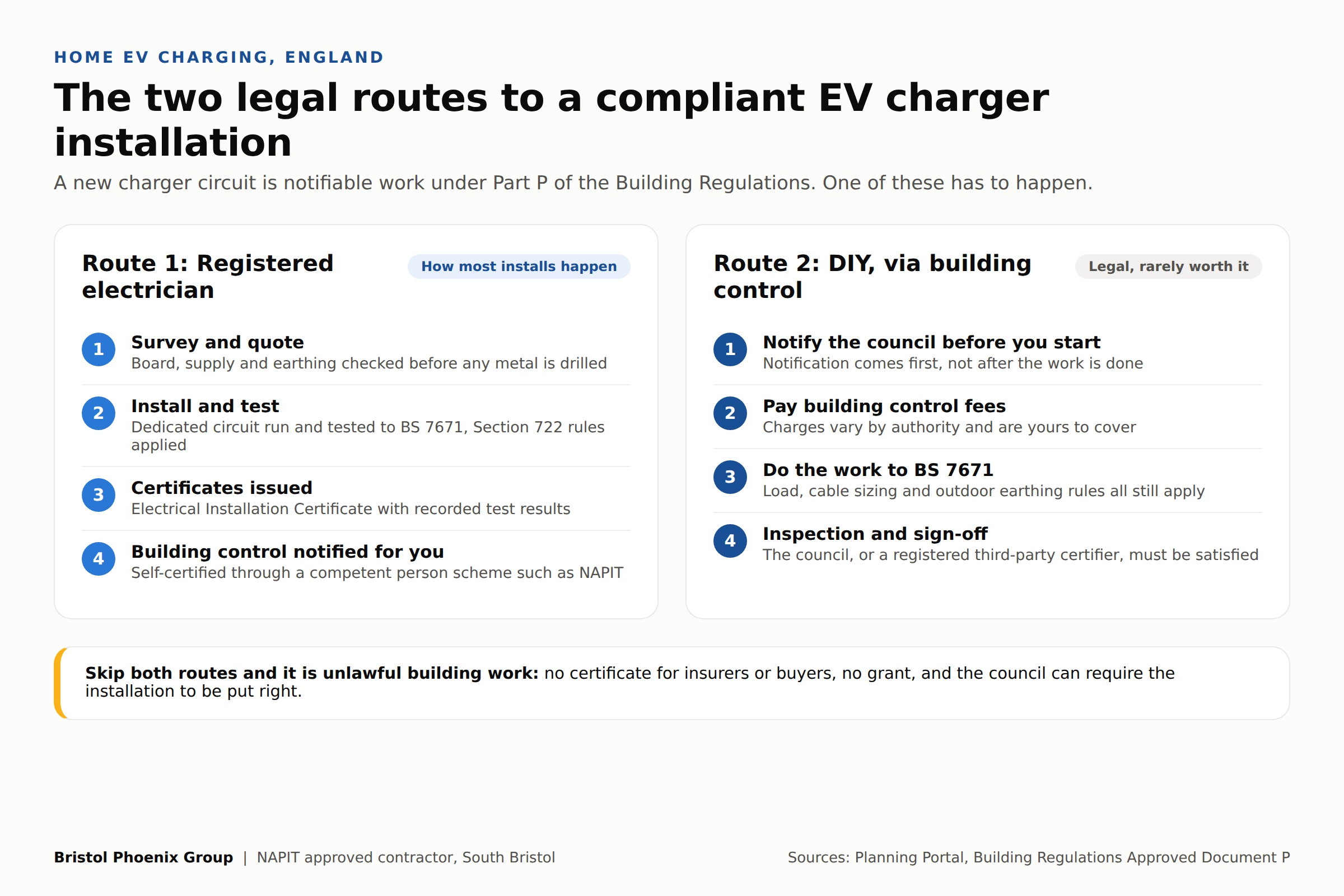
Plenty of UK adults do their own electrical work. The Institution of Engineering and Technology reported in April 2026 that 27% of people have taken apart or replaced fittings such as sockets or light switches, and 6% have attempted rewiring. The same research puts the backdrop in plain numbers: around 19,300 accidental domestic fires in England each year are linked to electricity, about 53% of all accidental house fires. A charger circuit concentrates more sustained load than almost anything else you could bolt to your house, which is why it deserves more respect than a light switch swap.
The load is relentless
A 7kW wallbox draws roughly 30 amps, continuously, often for six or eight hours overnight. A shower pulls more for ten minutes; an oven cycles on and off. A charger just sits there at full chat. Undersized cable, a loose termination or a tired old fuse board that was marginal to begin with will cook slowly rather than fail loudly. Part of a professional install is checking whether your existing board and main supply can actually carry the new load, and fitting the right protective devices if not. Our electrical testing services exist for exactly this kind of question.
Earthing is where DIY jobs quietly become dangerous
Most UK homes have a PME earthing arrangement. It works fine indoors, but it has a known weakness: if the combined neutral and earth conductor out in the street fails, metalwork connected to your earth can rise to a dangerous voltage. Indoors that risk is managed. Outdoors, holding a charging cable connected to a car standing on wet ground, it is not. That is why BS 7671 Section 722 says a PME earthing facility shall not be used for outdoor charging unless one of a short list of specific protective measures is in place, such as an earth electrode or a device that detects the fault and disconnects everything, including the earth. Modern chargers often build this protection in; older and cheaper ones do not. Knowing which situation you are in, and proving it with test results, is precisely the sort of judgement the regulations expect a competent person to make.
The charger itself is regulated too
Since 30 June 2022, The Electric Vehicles (Smart Charge Points) Regulations 2021 have made it illegal to sell a home charge point that does not meet the smart requirements set out in the regulations. Any reputable unit you buy new in the UK should comply, but it is one more reason to be wary of the suspiciously cheap imported wallbox on an online marketplace. If the price looks too good against the £450 to £900 that decent units cost, there is usually a reason.
What DIY EV Charger Installation Really Costs You
The appeal of self-installation is the labour saving, and the labour on a standard job is real money: £300 to £600 according to BookaBuilderUK’s 2026 guide, for three to six hours on site. But the saving shrinks quickly once you count what walks out of the door with it.
The £500 grant walks away first
If you rent your home, or own a flat, and you have private off-street parking, the EV chargepoint grant gives you 75% off the cost to buy and install a socket, up to a maximum of £500, and the scheme runs until 31 March 2027. The catch for the DIYer is structural: the grant is claimed by an OZEV authorised installer on your behalf as part of the job. There is no route for a self-installer to claim it. For eligible households, doing it yourself means paying more for the privilege, before a single technical risk is counted.
Insurance, warranty and the paper trail
A professional install ends with an Electrical Installation Certificate recording the test results, plus the building regulations notification. Home insurers expect notifiable electrical work to have that paper trail, and an uncertified charger circuit gives an insurer an easy question to ask after any electrical incident, whether or not the charger caused it. Manufacturers commonly make installation by a qualified electrician a condition of the wallbox warranty as well, so a unit that develops a fault after a self-install can become an expensive ornament. None of this appears on the DIY spreadsheet, and all of it matters.
Selling or remortgaging later
Conveyancing enquiries routinely ask whether electrical work has been carried out and whether certificates exist. A charger on the wall with no paperwork behind it invites a retention, an indemnity policy, or a demand to have the work inspected and certified retrospectively, which costs more than doing it properly would have. Buyers’ solicitors have seen enough uncertified work to be suspicious by default. We wrote about the same dynamic with fuse boards in our new fuse box cost guide: paperwork you did not get around to has a habit of resurfacing at the worst moment.
DIY vs Registered Installer: The Numbers Side by Side
Here is the comparison laid out plainly, using the national figures from The Electric Car Scheme’s cost guide and BookaBuilderUK, the same sources we used in our full cost guide.
| What you end up with | DIY route | Registered installer |
|---|---|---|
| Charger unit | £450 to £900, you source it | £450 to £900, supplied and matched to your supply |
| Labour | Your weekend, plus materials | £300 to £600, typically 3 to 6 hours on site |
| Building control | Notify before starting, pay the council’s fees, wait for inspection | Handled by the installer through their scheme |
| Chargepoint grant (renters and flat owners) | Not available to self-installers | 75% off up to £500 through an OZEV authorised installer |
| Certificates | Only if the council or a third-party certifier signs it off | Electrical Installation Certificate plus compliance certificate, as standard |
| Warranty and insurance position | Warranty likely void, insurer questions possible | Intact |
| Typical all-in cost | Unit plus fees plus your time, minus nothing | £800 to £1,200 fully fitted, 2026 average around £1,110 |
A Worked Example: Two Neighbours, One Street
Picture a pair of neighbours on the same South Bristol street, both renting, both with a parking space at the back, both wanting a 7kW smart charger on the rear wall near the meter.
The first is a confident DIYer. He buys a decent smart unit for £600, spends £80 on cable, clips and a protective device, and notifies building control before starting, which adds the council’s application fees on top. He does a tidy job over a weekend, then waits for the inspection to be arranged. Because he installed it himself, the £500 grant never enters the picture. His realistic outlay is £680 plus fees plus two days of his time, and his warranty position is shaky.
His neighbour books an OZEV authorised installer. The quoted job is £1,000 all in for a comparable unit, sitting exactly where the national £800 to £1,200 range says it should. As a renter with off-street parking she qualifies for the grant, the installer claims the £500 on her behalf, and she pays £500. She is at work while it happens, and the certificates arrive by email.
She paid less, risked nothing and owns the paperwork. He saved almost nothing and owns every problem. The maths only tilts towards DIY for households that do not qualify for the grant, and even then the gap is a few hundred pounds against everything this guide has covered.
The Jobs You Can Safely Do Yourself
None of this means you are helpless in the process. The homeowner who does the thinking before the electrician arrives usually gets a better job at a better price. All of the following is fair game:
- Choose the charger. Tethered or untethered, app features, tariff integration. You know your car and your habits better than any installer does.
- Pick the position. The closer the wallbox sits to the consumer unit, and the simpler the cable route, the less you pay. Long or awkward runs add £10 to £20 per extra metre.
- Photograph your fuse board and meter cupboard for the quote. It saves a survey visit and flags problems early, especially on older boards.
- Sort the EV tariff. An off-peak overnight rate does more for your running costs than any hardware choice.
- Clear the route. Moving the bikes, the compost bags and the trampoline before the install morning is worth more than you would think.
That split, you do the thinking and the buying decisions, a registered electrician does the circuit and the certification, is the version of DIY that actually saves money.
The Bristol Picture
Bristol’s housing stock makes the question sharper than the national average. Much of South Bristol is Victorian and Edwardian terracing, which means older consumer units, longer cable routes to a rear parking space or garage, and earthing arrangements that need checking before anyone talks about mounting a wallbox. Terraced streets also mean plenty of households with rear lanes, shared access and rented homes, which is exactly the group the £500 renters and flat owners grant was extended for. If your charger dream involves a cable draped across a pavement from a front window, stop there: that is a hazard, not an installation, and the city’s enforcement teams take the same view.
The honest local advice is to start with the state of your board and supply, not the charger brochure. A house that needs its consumer unit upgraded first is common in our part of the world, and finding that out mid-install is the expensive way to learn it.
So, Can I Install My Own EV Charger? Final Thoughts
Legally, yes, through building control, with your own money and your own risk. Practically, for almost everyone, no. The labour saving is £300 to £600 on a typical job. Against it sit the £500 grant you cannot claim, the fees you must pay, the certificates you will not hold, the warranty you will probably void and an earthing question that BS 7671 devotes an entire section to because getting it wrong can kill. That is not a trade we would take, and we make part of our living from electrical work.
If you are in Bristol or anywhere south of the river, our EV charger installation service covers the survey, the earthing checks, the install, the certification and the building control notification in one job, and we will tell you plainly if your board needs attention first. As a NAPIT approved contractor we certify our own work, so the paperwork lands in your inbox rather than on your to-do list. Get in touch for a straight answer and a written quote, and keep your weekend for something with a lower fault current.