A buzzing light switch has a talent for announcing itself at the worst possible moment. The house has gone quiet, you reach for the landing light, and there it is: a faint electrical fizz from somewhere behind the plate. Most people decide it is probably fine and go to bed. Sometimes it is fine. Sometimes it is a switch quietly arcing its way towards a scorched backbox. We are Bristol Phoenix Group, a NAPIT registered electrical contractor based in South Bristol, and buzzing switches sit near the top of the list of small faults people ask us about. This guide explains what the noise actually is, which buzzes are harmless, which ones deserve a prompt phone call, and what a fix costs.
What is in this guide
- Why a light switch buzzes at all
- What causes a buzzing light switch?
- Harmless hum or warning sign? When to worry
- The dimmer and LED problem
- What a buzzing light switch costs to fix
- Can you fix it yourself?
- Why older Bristol homes buzz more
- Getting it sorted
TL;DR
- Nearly all light switch buzzing comes down to one of three things: a loose terminal connection, a worn switch mechanism starting to arc internally, or a dimmer struggling with LED bulbs it was never designed for.
- A soft, steady hum from a dimmer, especially at half brightness, is usually a compatibility issue rather than a danger. Annoying, yes. An emergency, no.
- Crackling, popping, an intermittent fizz, a warm faceplate, scorch marks or a fishy burning smell are different: switch the circuit off at the consumer unit and get a qualified electrician to look at it.
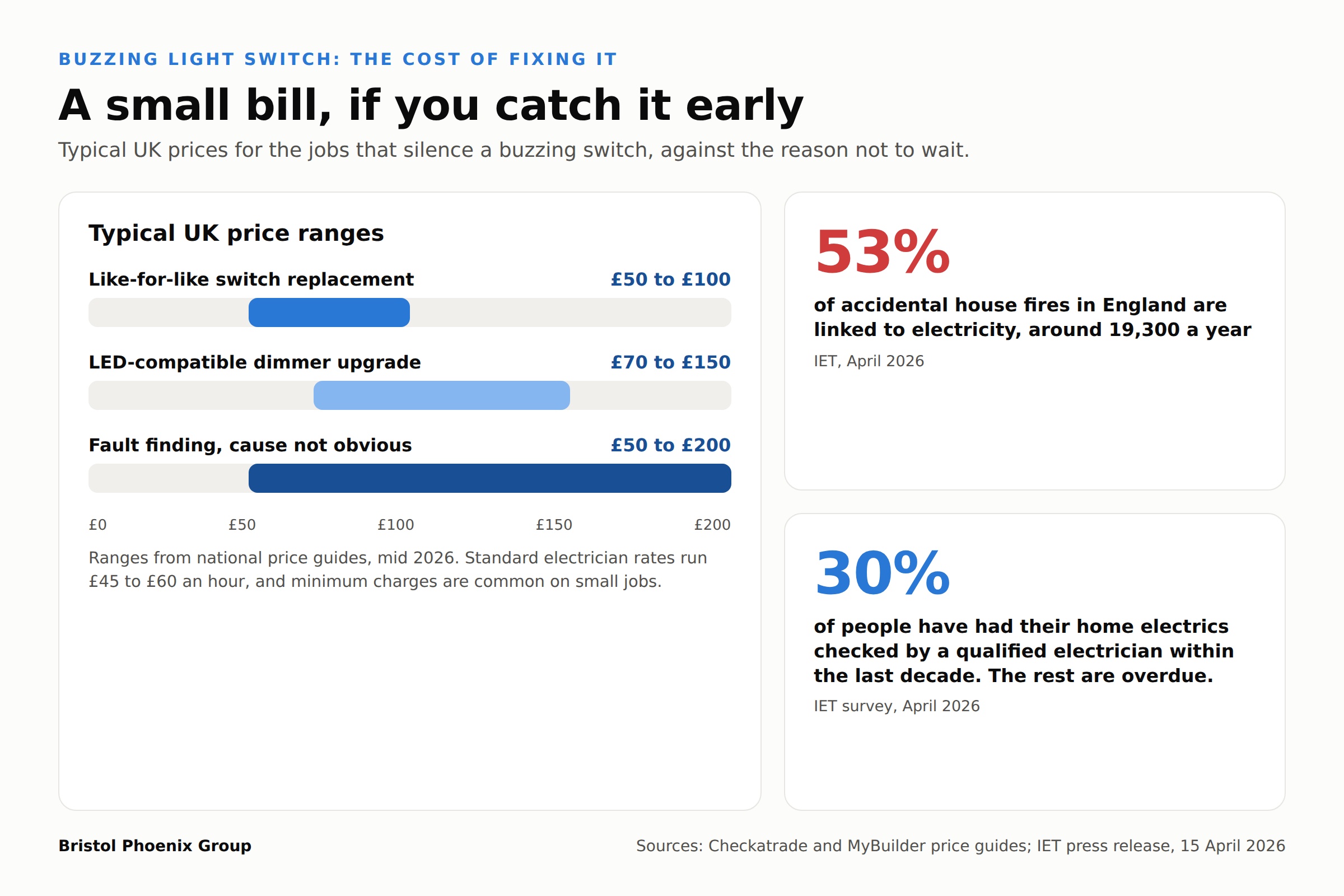
- The fix is one of the cheaper jobs in electrics: a like-for-like switch replacement typically runs £50 to £100, and a dimmer swap £70 to £150 at standard UK rates.
- The context is worth knowing: electricity is linked to around 19,300 accidental domestic fires a year in England, about 53% of the total, so small electrical warning signs earn their attention.
Why a light switch buzzes at all
Electricity in a healthy circuit is silent. As a rule of thumb, the national grid should not have a voice in your hallway. When you can hear a switch, something inside it is physically vibrating or, more seriously, current is jumping a gap it should not be jumping.
UK mains alternates at 50 cycles a second, and that 50Hz rhythm is what gives electrical hums and buzzes their signature drone. Loose parts vibrate at that frequency. Dimmer components chop the waveform and can make cheap LED drivers sing along. And where a connection is loose enough for current to arc across a small air gap, you get the sharper, more erratic sound people describe as a crackling light switch. Each of those three noises points to a different problem, which is why the sound itself is such a useful diagnostic clue.
The habit worth building is simple: treat a new noise from any electrical accessory as information. In an IET survey published in 2026, 5.9% of people admitted to ignoring warning signs like burning smells, buzzing or flickering lights. That is a small percentage doing a genuinely risky thing, because those are precisely the symptoms that cost pennies to investigate early and a great deal more to ignore.
What causes a buzzing light switch?
Loose terminal connections
The most common culprit by a distance. Inside every switch, the live conductors are clamped under small brass terminal screws. Screws that were not fully tightened at installation, or that have relaxed over years of thermal cycling as current warms and cools the metal, leave the conductor fractionally loose. Current crossing a loose joint generates heat and vibration, and the switch starts to hum or fizz.
A loose connection is a progressive fault. It gets hotter, which oxidises the contact surfaces, which increases resistance, which makes it hotter still. Left long enough, that cycle chars the insulation and the backbox. It is the same disease that kills sockets, which is why a socket that has stopped working so often turns out to have a cooked terminal behind it.
A worn switch mechanism and internal arcing
A light switch is a mechanical device with a spring-loaded contact, and mechanisms wear out. Tens of thousands of operations round off the contact faces, weaken the spring, and slow the snap action that is designed to make and break the circuit cleanly. A slow, worn contact lets current arc across the closing gap, and arcing is the sound you hear as crackling or popping.
Arcing is the one to take seriously. It produces temperatures far beyond what the plastic around it is rated for, and it is a recognised ignition source. Persistent arcing faults can also leak enough current to trip protective devices, so a switch that crackles on a circuit where the fuse box keeps tripping is telling you a fairly complete story.
Dimmers and LED compatibility
The most common harmless buzz. Older leading-edge dimmers were designed around 60W and 100W incandescent bulbs, and they chop the mains waveform to reduce brightness. Ask one to control a handful of 5W LEDs and it is operating below the minimum load it was built for, while the LED drivers try to make sense of a mangled waveform. The result is a hum or buzz from the switch, the bulbs, or both, often worst at mid brightness.
This is a compatibility problem, not a fault, and the fix is matching the parts: a trailing-edge dimmer rated for LED loads, dimmable bulbs from a manufacturer the dimmer maker actually lists, and ideally the same bulb across the whole fitting. We cover this in more detail below because it deserves its own section.
Overload and high-load switching
Rarer in modern homes, but a switch controlling more load than it is rated for will grumble about it audibly. We still find grid switches feeding immersion heaters or banks of halogen downlights where the accessory is working at the top of its rating. The buzz here is the sound of a component with no margin left, and the answer is either reducing the load, which LED conversion usually achieves at a stroke, or fitting an accessory rated for the job.
Harmless hum or warning sign? When to worry
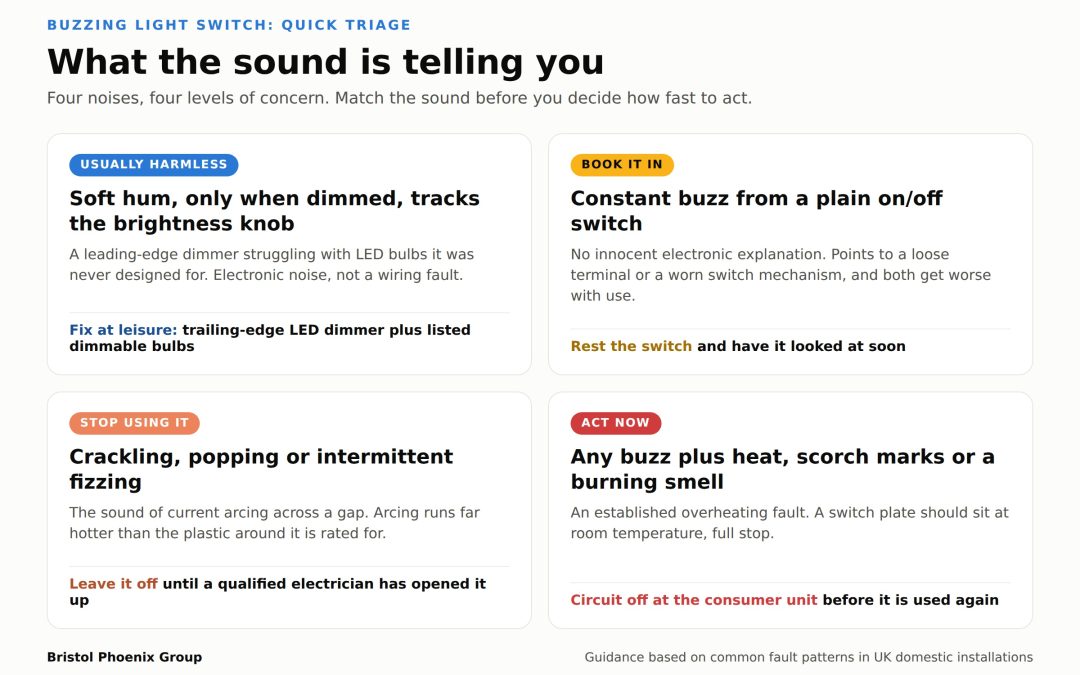
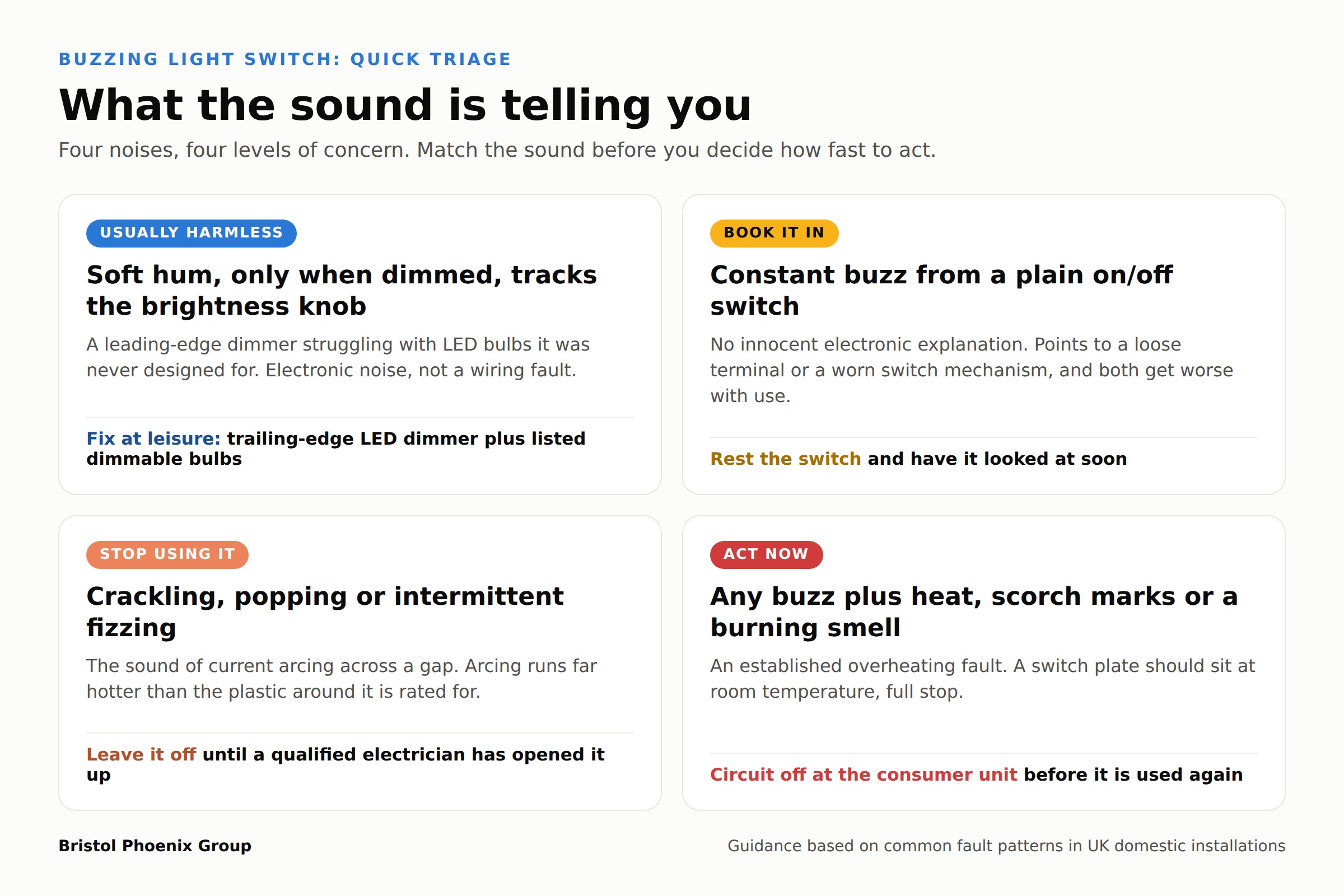
The honest answer is that sound alone does not give a certain diagnosis, but it narrows things down well. The table below is how we triage light switch buzzing on the phone before anyone has opened anything up.
| What you hear | Most likely cause | Risk level | Sensible action |
|---|---|---|---|
| Soft steady hum, only when dimmed, changes with brightness | Dimmer and LED compatibility | Low | Swap to a trailing-edge LED dimmer and listed dimmable bulbs |
| Hum that changes when you add or remove bulbs | Dimmer running below minimum load | Low | Match dimmer and lamps; no urgency, but fix it |
| Buzz from a standard on/off switch, constant when on | Loose terminal or ageing mechanism | Medium | Stop using the switch; book an electrician soon |
| Crackling, popping or intermittent fizzing | Arcing at a contact or terminal | High | Switch the circuit off at the consumer unit; do not keep using it |
| Any buzz plus heat, discolouration or a burning smell | Established overheating fault | Urgent | Circuit off at the consumer unit; qualified electrician before it is used again |
The pattern behind the table: noise that only exists in dimmed circuits and tracks the brightness knob is almost always electronic, and electronic buzz is irritating rather than dangerous. Noise from a plain on/off switch has no innocent electronic explanation, so it moves up a category. And anything you can feel or smell as well as hear means the fault has been generating real heat for a while.
The two red flags we want every reader to remember: a crackling light switch, and a warm faceplate. A switch plate should be at room temperature, full stop. If either symptom appears, stop using the switch, turn the affected circuit off at the consumer unit, and get a qualified electrician in front of it before it goes back into service.
The wider numbers explain why we bang this drum. England recorded 22,877 accidental dwelling fires in the year to March 2025, and the IET puts around 19,300 accidental domestic fires a year down to electricity, about 53% of all accidental house fires in England. A buzzing switch is a small thing. The category of problem it belongs to is not.
The dimmer and LED problem
If your buzz lives on a dimmed circuit, this section is probably your whole answer, so it is worth understanding properly.
Dimmers reduce brightness by switching the mains waveform off for part of every cycle. The older, cheaper method is leading-edge dimming, which cuts the front of the waveform and was perfectly happy driving the resistive filament of an incandescent bulb. LEDs are not resistive: each lamp carries a small electronic driver, and leading-edge chopping hits those drivers with abrupt voltage steps that make components physically vibrate. That vibration is the buzz, and it can come from the switch, the lamps, or both at once.
There is also a minimum load problem. A dimmer built for a 60W to 250W range might now be controlling three 5W LEDs, a total of 15W, well below its design floor. Underloaded dimmers behave badly: buzzing, flickering, and lamps that glow dimly when switched off are the classic trio. If your lights misbehave in ways that defy pattern, an old dimmer on new lamps is one of the first things worth ruling out.
The fix is unglamorous and reliable: a trailing-edge dimmer rated for LED loads, dimmable lamps that appear on the dimmer manufacturer’s tested compatibility list, and matching lamps across the fitting rather than a mixed bag of brands. Done properly, dimmed LED circuits are silent. We fit them week in, week out, and the before-and-after difference still pleases customers more than almost any other small job.
What a buzzing light switch costs to fix
Here is the good news: of all the faults that produce alarming noises, a buzzing light switch has one of the cheapest fixes in the trade. Nationally, price guides from Checkatrade and MyBuilder put the common jobs in these ranges.
| Job | Typical UK range | Notes |
|---|---|---|
| Like-for-like switch replacement | £50 to £100 | Standard plastic accessory, easy access |
| Dimmer replaced with LED-compatible trailing-edge dimmer | £70 to £150 | Quality of the dimmer module drives the spread |
| Electrician standard hourly rate | £45 to £60 | Minimum charges are common on small jobs |
| Fault finding where the cause is not obvious | £50 to £200 | Depends how quickly the fault shows itself |
For our part, we keep it simple: diagnostic attendance in Bristol is a fixed £168 including VAT for up to around an hour on site, which is usually ample time to open up a buzzing switch, find the loose terminal or worn mechanism, and in most cases fix it there and then with the price of the accessory on top. You will know the cost before we start, not after.
One buying tip: switch accessories are a place where the difference between the cheapest fitting and a decent one is about £5, and the decent one has better terminals, a cleaner action and a longer life. We fit the better one. Over a twenty year service life it is the best £5 in the house.
Can you fix it yourself?
Some of it, legally and sensibly. The boundary matters, so here it is drawn clearly.
What any householder can safely do: identify which switch is making the noise, note when it happens, check whether the bulbs on a dimmed circuit are actually marked dimmable, swap a suspect bulb for a known good one, and turn the circuit off at the consumer unit if any red flag from our table appears. All of that is diagnosis by observation, none of it involves a screwdriver near a live part, and it will make any electrician’s visit shorter and cheaper.
What we would rather you did not do is open up the switch and start re-tightening terminals. Not because it is forbidden, replacing a like-for-like accessory is one of the few jobs outside the scope of Part P notification, but because the failure modes are unforgiving. The IET’s 2026 survey found 27% of people have taken apart or replaced fittings such as plug sockets or light switches, and a share of the scorched backboxes we open up are the legacy of exactly that confidence. An over-tightened terminal strips and loosens. An under-tightened one arcs. A conductor nicked while being re-dressed fails years later, inside a wall, where nobody can see it.
There is also the question of what the buzz was trying to tell you. A worn switch is sometimes just a worn switch. On older installations it is often the most audible symptom of tired wiring, and swapping the faceplate silences the messenger without reading the message. A qualified electrician replacing that switch will also notice heat-damaged conductors, crumbling insulation and absent earths, which is the inspection you are really paying for.
Why older Bristol homes buzz more
Our patch of South Bristol, Bedminster, Southville, Knowle, Totterdown, Brislington and out to the edges, is dense with Victorian and Edwardian terraces, and those houses carry their electrical history in layers. A single property can hold 1950s rubber-insulated cable, 1970s PVC, an 80s extension wired by the previous owner’s brother-in-law, and switch drops running through walls that predate the national grid itself. If you have ever opened a switch and found wire colours you did not recognise, our guide to old UK wiring colours will date what you are looking at.
Age matters for buzzing specifically because every one of the causes above is progressive. Terminals loosen over decades of thermal cycling. Switch mechanisms wear with use. And the national habit of leaving electrics alone until they complain is well documented: the IET found fewer than a third of people (30%) have had their household electrics checked by a qualified electrician in over a decade. In housing stock as old as Bristol’s, that is a long time for small faults to compound. A buzzing switch in a 1960s installation is worth reading alongside the other signs a house needs rewiring: if it keeps company with warm plates, frequent tripping and a fuse board with no RCD protection, the switch is the least of it.
Picture a typical two-bed terrace in Bedminster. The hallway switch has hummed faintly for a year, and it gets used forty times a day because the hall light doubles as the stair light. Inside, the line conductor sits under a terminal screw last touched in 1988. The joint has loosened a fraction, oxidised, and now runs warm every evening. Nothing dramatic happens for months, which is the trap: the fault is doing its slow work against ageing insulation the whole time. That switch costs somewhere between £70 and £150 to diagnose and put right as a planned visit at typical national rates. The same fault, discovered after it has cooked the switch drop inside the wall, means chasing out and rewiring a leg of the lighting circuit and redecorating the hallway. Buzzing is cheap to fix precisely because it is an early symptom. The economics only get worse from there.
Getting it sorted
A buzzing light switch is one of those faults where the gap between doing something and doing nothing is enormous relative to the cost. An hour of a qualified electrician’s time settles the question, and in most cases fixes it on the spot, for less than most people expect an electrician’s visit to cost.
If a switch in your home is humming, crackling or running warm, we are happy to help. Bristol Phoenix Group is NAPIT registered, based in South Bristol, and small diagnostic jobs are bread and butter work for us, never a nuisance call. Tell us what you can hear and when, and we will tell you honestly whether it sounds like a £5 dimmer mismatch or something that needs opening up. You can reach us through our contact page and we will take it from there.