Houses rarely announce an electrical problem with a bang. They drop hints instead. A light that flickers when the kettle goes on. A switch that buzzes quietly to itself. A socket that smells faintly of hot plastic, and a fuse board that trips more weeks than it does not. The signs your house needs rewiring are usually small, easy to explain away, and tempting to ignore, which is exactly why so many people do. Research published by the Institution of Engineering and Technology in April 2026 found that 79% of UK adults feel confident their home is electrically safe, yet fewer than a third (30%) have had their electrics checked by a qualified electrician in over a decade. That gap between confidence and evidence is where trouble lives. In this guide we will walk through the seven signs we look for on real jobs around Bristol, what each one actually tells you, and the one test that settles the question properly.
Table of Contents
- The 7 Signs Your House Needs Rewiring
- What the National Numbers Say
- Does My House Need Rewiring? Let an EICR Answer It
- When Does a House Need Rewiring on Age Alone?
- What a Rewire Involves, and What It Costs in 2026
- A Worked Example: A Bedminster Terrace That Dropped Every Hint
- What to Do When You Spot the Signs Your House Needs Rewiring
TL;DR
- The seven warning signs: flickering or dimming lights, buzzing switches or sockets, scorch marks or burning smells, old wiring colours, fuses and trips that keep going, round-pin sockets, and the sheer age of the installation.
- Scorch marks, heat around a socket, or a fishy burning smell are the act-now signs. Stop using the affected circuit and get a qualified electrician in.
- Red and black cables date a circuit to before 2006 at the latest. Plain green earth sleeving, rubber insulation or lead sheathing points to wiring that is fifty or more years old.
- Electricity is linked to around 19,300 accidental domestic fires each year, about 53% of all accidental house fires in England, according to the IET.
- The definitive answer to “does my house need rewiring” is an EICR, typically £80 to £350. Plenty of older installations pass with minor remedial work rather than a full rewire.
- If a rewire is needed, a typical three-bedroom house costs £4,500 to £8,000 in 2026.
The 7 Signs Your House Needs Rewiring
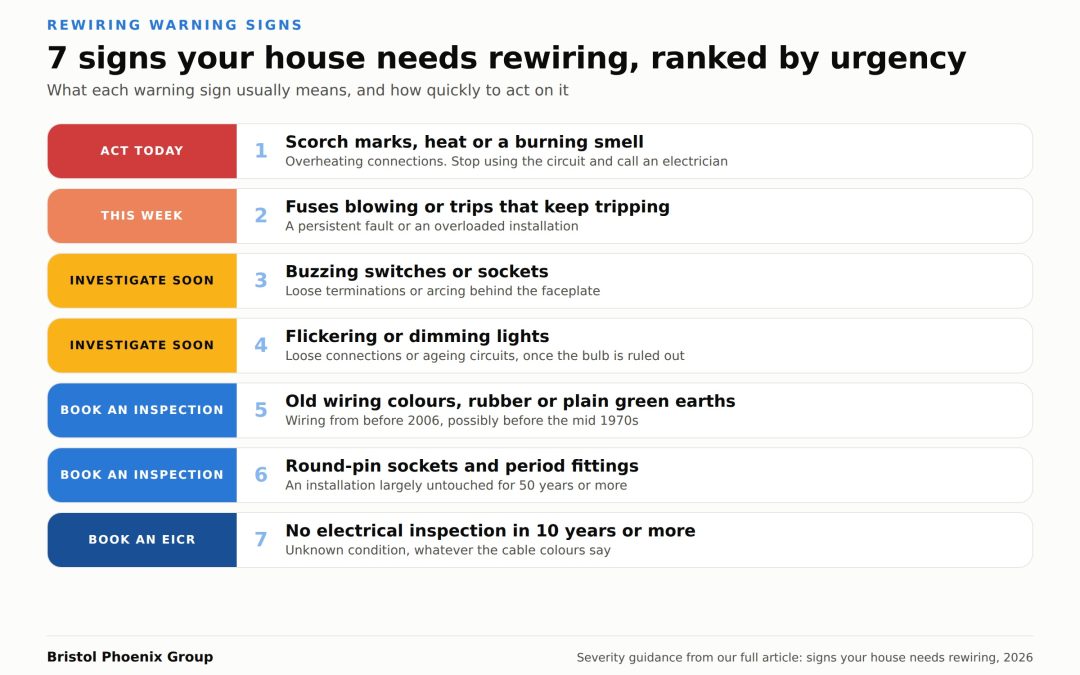
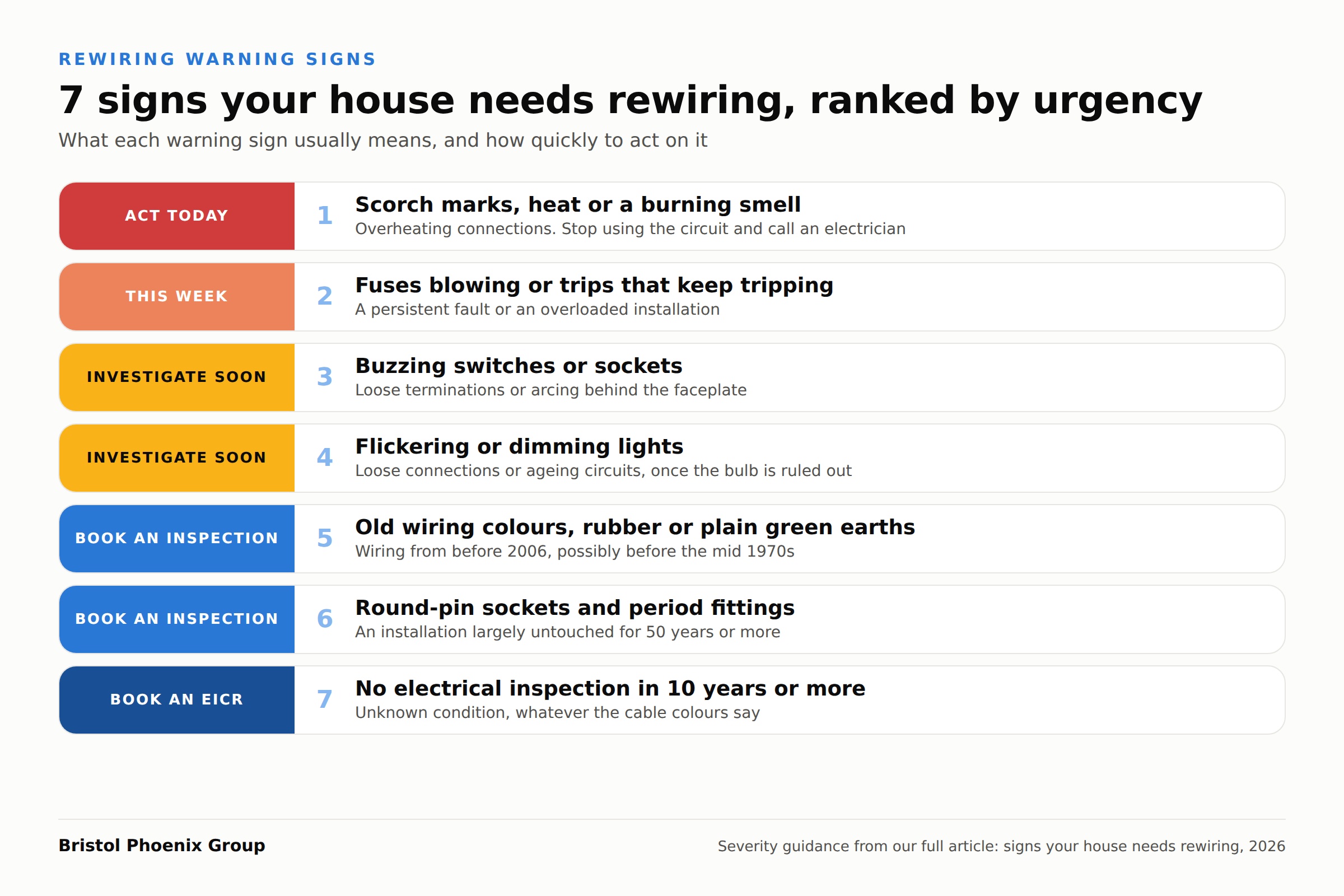
No single sign below proves your wiring has failed. Each one is a clue, and clues stack. One flickering lamp is probably a lamp. Flickering lights plus red and black cables plus a fuse board with a wooden back is a house asking, politely, for an inspection. Here is how we would rank the seven, from drop-everything to diary-note.
| Sign | What it usually points to | How urgent |
|---|---|---|
| Scorch marks, heat or a burning smell | Overheating connections or overloaded circuits | Act today. Stop using the circuit |
| Fuses blowing or trips that keep tripping | A persistent fault or an overloaded installation | Investigate within days, not months |
| Buzzing switches or sockets | Loose terminations or arcing behind the faceplate | Investigate soon |
| Flickering or dimming lights | Loose connections or ageing circuits, once the bulb is ruled out | Investigate soon |
| Old wiring colours, rubber or plain green earths | Wiring from before 2006, possibly before the mid 1970s | Book an inspection |
| Round-pin sockets and period fittings | An installation largely untouched for 50 years or more | Book an inspection |
| Age: no inspection in 10 years or more | Unknown condition, whatever the colours say | Book an EICR and know for certain |
1. Flickering or Dimming Lights
Start with the obvious suspects. A cheap bulb, a worn lamp holder or a dimmer that never liked LEDs will all cause flicker, and none of them means a rewire. The pattern that interests us is different: lights that dim when a heavy appliance starts, flicker that affects a whole room or circuit rather than one fitting, or flicker that comes and goes with no pattern you can pin down.
That behaviour usually traces back to a loose connection somewhere on the circuit, and loose connections generate heat. In an older installation with brittle insulation, that is not a quirk to live with. It is the first and gentlest of the warnings on this list.
2. Buzzing Switches or Sockets
Electricity should be silent. A switch that buzzes, crackles or fizzes when you use it is telling you something inside is arcing, which means current jumping a gap it should not be jumping. The same goes for a socket that hums under load or a faceplate that feels warm without a good reason.
Arcing chews through contacts, builds heat, and in the worst cases ignites whatever dust and timber sits behind the faceplate. A single buzzing accessory might only need that accessory replaced. Buzzing in several places, in a house with older wiring, points at the installation rather than the parts.
3. Scorch Marks, Heat or a Burning Smell
This is the one that jumps the queue. Brown or black marks around sockets and plugs, heat you can feel on a faceplate, melted or discoloured plastic, or that distinctive acrid smell, sometimes described as fishy, of hot insulation. Any of these means a connection is overheating right now, not gradually, not theoretically.
Stop using the affected socket or circuit, unplug what you safely can, and get a qualified electrician to look at it before you go back to normal service. Fire statistics make the point better than we can. Fire services attended 22,877 accidental dwelling fires in England in the year ending March 2025, according to the Home Office detailed fire statistics. A scorched socket is precisely the sort of small warning that sits upstream of those numbers.
4. Old Wiring Colours Behind the Faceplates
Unscrew a faceplate, or lift the flap on the fuse board, and the colours tell you the era. Brown and blue cores mean the circuit was wired in 2004 or later. Red and black means it predates 2006 at the latest, and could be decades older. Plain green earth sleeving, rather than green and yellow stripes, points to the mid 1970s or earlier. Black rubber insulation that cracks or crumbles when flexed, or cable sheathed in lead or woven fabric, means the wiring predates the late 1950s and has outlived its design life by a comfortable margin.
Colour alone is not a verdict. Sound PVC cable from the 1980s in red and black can test perfectly well. We have covered the full dating guide, era by era, in our post on old wiring colours in UK homes, including the three-phase traps. The short version: red and black earns a place on the inspection list, plain green earths and rubber insulation earn a place near the top of it.
5. Fuses That Blow and Trips That Keep Tripping
A breaker that trips once in a blue moon is doing its job. A fuse board that trips weekly, or rewirable fuses that keep blowing, is a symptom, and the cause is rarely the breaker itself. Persistent tripping usually means a deteriorating circuit, moisture getting somewhere it should not, or an installation carrying far more load than it was designed for.
Houses wired in the 1970s were planned around a kettle, a telly and a twin-tub, not an induction hob, a tumble dryer, two showers and a home office. When demand outgrows the design, the electrics protest, and constant tripping is how they do it.
6. Round-Pin Sockets and Other Period Features
Some clues are hiding in plain sight. Round-pin sockets, brown Bakelite switches, twisted fabric flex hanging from a ceiling rose, sockets mounted on skirting boards, or a single socket per room that has sprouted a permanent extension lead farm. Each of these says the installation, or at least part of it, has not been touched in half a century.
Bristol has plenty of housing stock where this applies, from Victorian terraces in Bedminster and Southville to 1930s semis in Knowle and Brislington. Beautiful houses, hardworking electrics, and in the ones that have dodged every renovation since decimalisation, wiring that deserves a proper look rather than another coat of paint over the faceplates.
7. The Age of the Installation
The quietest sign is the calendar. Wiring does not last forever. Insulation degrades, connections work loose with thermal cycling, and regulations move on around the installation. A house rewired in the 1990s is now more than thirty years into service, still probably serviceable, and almost certainly short of current standards on RCD protection. A house untouched since the 1960s is running on borrowed time whatever it looks like from the hallway.
Industry guidance recommends a full inspection at least every ten years for owner-occupied homes, and at least every five years for rentals, where it is a legal requirement in England. If you cannot remember the last time anyone tested your installation, and the paperwork is not in the drawer where compliance certificates go to hide, that alone qualifies as a sign.
What the National Numbers Say
It is fair to ask whether any of this actually matters, or whether electricians simply enjoy frightening people. The national data suggests the concern is earned. According to research published by the IET in April 2026, around 19,300 accidental domestic fires are linked to electricity each year, about 53% of all accidental house fires in England.
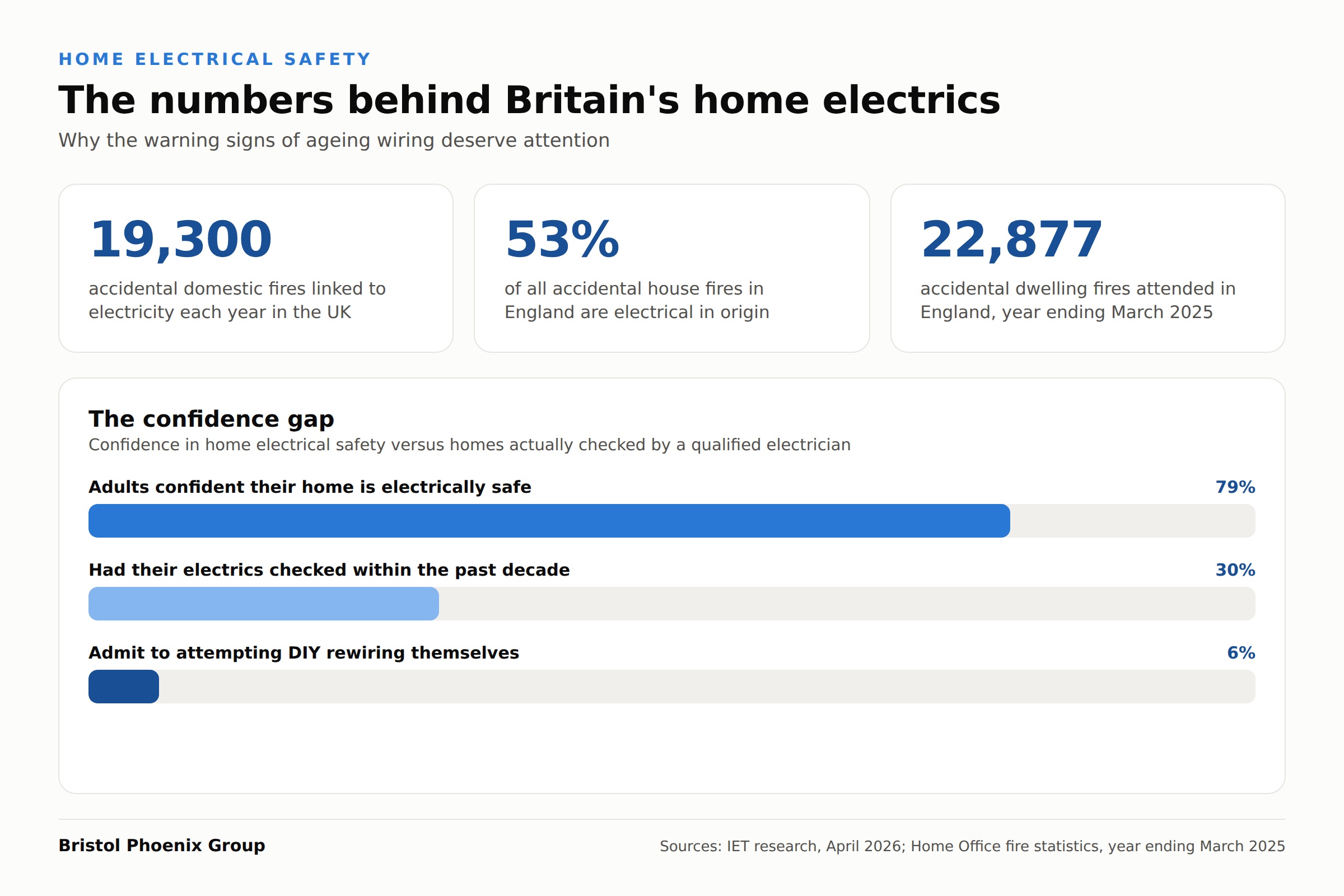
The same research found the confidence gap we mentioned at the top: 79% of adults feel confident about their home’s electrical safety, while only 30% have had the electrics checked by a qualified electrician within the past decade. And 6% admit to having attempted rewiring themselves, which the IET describes as one of the most dangerous electrical jobs in the home.
For scale, the Home Office figures put accidental dwelling fires in England at 22,877 for the year ending March 2025, with misuse of equipment or appliances a factor in 29% of them. Old, tired wiring sits underneath plenty of the rest. The signs in this article are the visible edge of that picture.
Does My House Need Rewiring? Let an EICR Answer It
Here is the part where we talk ourselves out of work. If you have recognised two or three of the signs above, the next step is not booking a rewire. It is booking an Electrical Installation Condition Report, the formal inspection we explain in our guide to what an EICR is. A domestic EICR typically costs £80 to £350 depending on property size, and it tests the things no visual check can reach: insulation resistance, earth continuity, polarity, and the condition of every circuit from the board outwards.
The report grades what it finds. C1 means danger present, dealt with on the spot wherever possible. C2 means potentially dangerous, fix it promptly. C3 is an improvement recommendation, and FI means further investigation. The outcome is Satisfactory or Unsatisfactory, and that verdict, not the colour of your cables, is the honest answer to whether you need to rewire.
The result surprises people in both directions. We test red and black installations from the 1980s that come back Satisfactory with a couple of C3s, and we occasionally open a fuse board in a house that looks freshly decorated and find a C1 by lunchtime. Testing beats guessing, every time. Our electrical testing services cover exactly this, for homeowners, landlords and anyone buying a house with question marks over the electrics.
When Does a House Need Rewiring on Age Alone?
The follow-up question we hear most often: is there simply an age where rewiring becomes automatic? There is no fixed legal age limit, but the practical thresholds look like this.
Wiring from before the late 1950s, the rubber and lead era, should be treated as due for replacement, full stop. The insulation of that period breaks down with age and heat, and by now it has had seventy years of both. Wiring from the 1960s and 1970s, early PVC with plain green earths, has exceeded its expected service life and needs a professional inspection before anyone declares it fine. Wiring from the 1980s and 1990s is often sound in itself but usually lives behind a fuse board without modern RCD protection, so an inspection tends to recommend upgrades even where the cable tests well.
The pattern is simple: the older the installation, the more the question shifts from whether the copper still conducts to whether the whole system still protects you the way current standards expect. When a house needs rewiring, it is usually the protection, the earthing and the capacity that make the case, not just the cable.
What a Rewire Involves, and What It Costs in 2026
If the EICR does make the case for rewiring, it helps to know what you are budgeting for. A full rewire replaces every circuit in the property: new cabling to every socket, switch and light, a modern consumer unit with RCD protection, then testing and certification at the end. It is disruptive, worth doing once and properly, and exactly what our rewiring and new-build wiring service handles week in, week out across Bristol.
On price, our detailed house rewire cost guide puts a full rewire of a three-bedroom house at £4,500 to £8,000 in 2026, and the national guides agree: Checkatrade quotes £4,450 to £8,000 for a three-bedroom house, while MyJobQuote puts the typical three-bedroom job at around £6,500. Smaller flats sit lower, large five-bed houses run to £12,500 or so, and every quote moves with circuit count, construction and whether the house is occupied during the work.
| Step | What it tells you | Typical cost |
|---|---|---|
| EICR inspection | Whether you need a rewire at all, with every fault graded | £80 to £350 |
| Targeted remedial work | Fixes specific C1 and C2 faults on an otherwise sound installation | Often hundreds, not thousands |
| Full rewire, three-bed house | A new installation to current standards, certified | £4,500 to £8,000 |
Note the order. The £80 to £350 line at the top is what stops you spending the bottom line unnecessarily.
A Worked Example: A Bedminster Terrace That Dropped Every Hint
Take a typical Victorian terrace in Bedminster, bought by a couple as their first house. Nothing dramatic on the survey, just the classic phrase “electrics appear dated, further investigation recommended”. Within a month of moving in, the hints start stacking up. The landing light flickers when the shower is on. One kitchen socket buzzes faintly under the toaster. Behind the hallway faceplate, the cores are red and black, and the earth sleeve on one circuit is plain green.
That is three signs from our list, plus a fuse board old enough to remember the Severn Bridge opening. They book an EICR rather than panicking. The report comes back Unsatisfactory, but usefully so: the socket circuits, rewired in the late 1980s, test soundly and pick up C3 improvement notes. The lighting circuits and the board are another story, with degraded insulation on the upstairs lighting and no RCD protection anywhere, graded C2.
The fix is a partial rewire of the lighting circuits and a new consumer unit, done as one planned job with the floors up once, rather than a full rewire the house did not need. The flicker and the buzzing disappear with the loose terminations that caused them. Total cost, comfortably under half of a full rewire, and a house that went from mystery to documented in a fortnight. The signs did their job. The testing did the rest.
What to Do When You Spot the Signs Your House Needs Rewiring
Keep the sequence simple. First, deal with anything from the act-now category: scorching, heat, burning smells, and anything rubbery or crumbling, by taking the affected circuit out of use and getting a professional in. Second, note what you have found, which rooms, which circuits, which colours. Third, book an EICR and let the test results decide what happens next, whether that is a clean bill of health, a short list of repairs, or a properly planned rewire.
We are Bristol Phoenix Group, a NAPIT-approved electrical contractor based in South Bristol, and older installations are a large part of our week: testing them, upgrading them, and rewiring the ones that have earned it. If your house has been dropping hints and you would like a straight answer rather than a sales pitch, get in touch and we will start with the test, not the invoice.
Most houses that show one or two of these signs do not need a full rewire this year. But every house that eventually does need one showed the signs first. The difference between the two is usually whether anyone looked.