Lift a floorboard in an older house and you will often find cables that look nothing like the ones sold today. This complete guide to old wiring colours UK homes have used over the decades will help you identify exactly what you are looking at, roughly when it was installed, and what it means for safety. Red and black cores, plain green earths, rubber that crumbles when you touch it: each one tells a story about your home’s electrical history, and some of those stories end with a rewire.
We are Bristol Phoenix Group, a NAPIT-approved electrical contractor based in South Bristol, and we spend a lot of time with our heads in fuse boards and floor voids. Here is everything we wish every homeowner knew about wiring colours, old and new.
Table of Contents
- Why UK wiring colours changed
- Old wiring colours UK: the quick reference table
- Three-phase colours, and why black and blue are the dangerous ones
- UK wiring colours old and new, era by era
- What old wiring colours tell you about your home’s age
- The safety picture: what the numbers say
- When old colours mean it is time to rewire
- A worked example
- What to do next
TL;DR
- New colours: brown is live, blue is neutral, green-and-yellow is earth. Mandatory for installations started after 31 March 2006.
- Old colours: red was live, black was neutral. Earth was plain green before the late 1970s, green-and-yellow after.
- Red and black is not automatically dangerous. It just means the circuit predates 2006. Condition matters more than colour.
- Plain green earths, rubber insulation or lead sheathing are a different matter. Those point to wiring that is fifty or more years old and overdue professional inspection.
- Never trust colour alone in three-phase installations. Black and blue swapped meanings in 2006, and that catches people out.
- The definitive answer on any older installation is an EICR inspection, not a guess based on colour.
Why UK Wiring Colours Changed
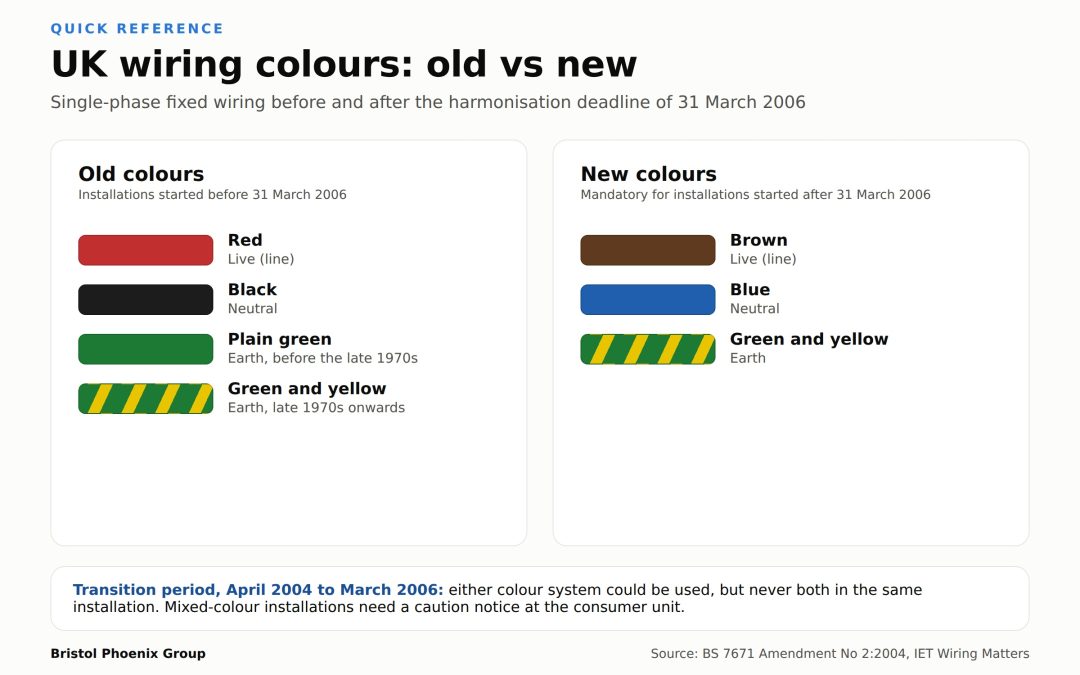
For most of the twentieth century, British fixed wiring used red for live and black for neutral. The rest of Europe used different colours, which made life interesting for anyone working across borders, so the colours were harmonised across the continent.
The change arrived through Amendment No 2 to BS 7671:2001, formally published on 31 March 2004. The IET’s guidance at the time set out a two-year transition: installations started between 31 March 2004 and 31 March 2006 could use either the old colours or the new ones, but not both, and any installation commencing on site after 31 March 2006 had to use the new harmonised colours.
That is why 2006 is the magic date. Wiring in the new brown and blue colours was installed in 2004 at the earliest. Wiring in red and black was installed in early 2006 at the latest, and usually much earlier.
One more detail from the same amendment that surprises people: where new-colour work is added to an old-colour installation, a caution notice should be fixed on or near the consumer unit warning that two colour systems are present. If your fuse board carries one of these little labels, someone has extended or altered your old wiring since 2006. If it has mixed colours and no label, that tells you something about the standard of the work too.
Old Wiring Colours UK: The Quick Reference Table
Here is the single-phase mapping, which covers the vast majority of homes.
| Conductor | Old colour (pre-2006) | New colour (post-2006) |
|---|---|---|
| Live (line) | Red | Brown |
| Neutral | Black | Blue |
| Earth | Green (pre-late 1970s), then green-and-yellow | Green-and-yellow |
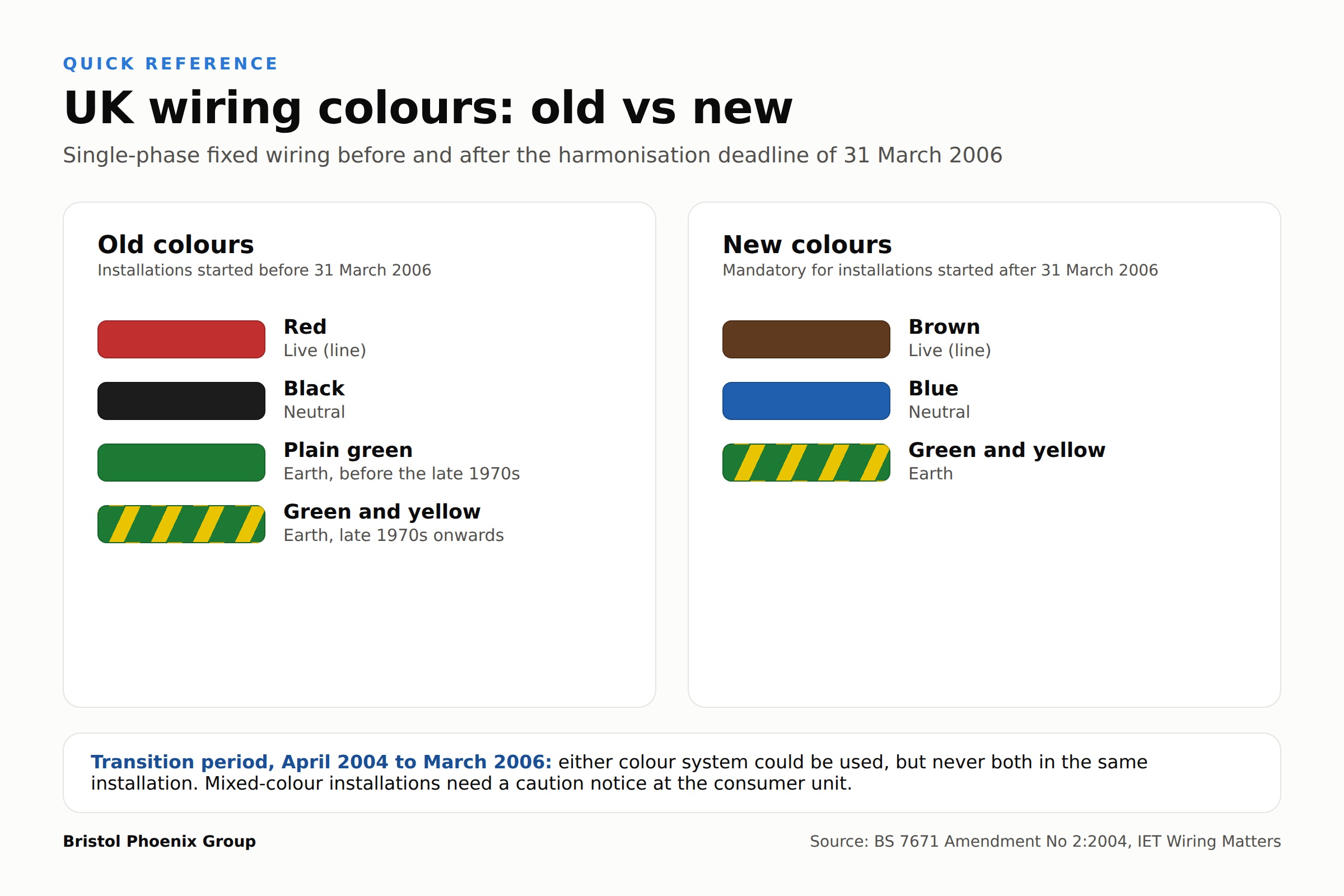
A note on the earth: the earth conductor in twin-and-earth cable is usually bare copper inside the cable, and it is the sleeving fitted at terminations that carries the colour. According to cable manufacturer Prysmian, the earth was identified with plain green until 1976, when the 14th edition amendments brought in the green-and-yellow stripe we still use today. Plain green sleeving is therefore one of the most useful dating clues in the whole guide: wiring carrying it is now around fifty years old.
Three-Phase Colours: Why Black and Blue Are the Dangerous Ones
Most houses have a single-phase supply, but plenty of commercial premises, larger homes, and properties with big loads such as workshops run three-phase. Here the colour change was more than a straight swap, and it created two genuine traps.
| Function | Old colour | New colour |
|---|---|---|
| Phase 1 (L1) | Red | Brown |
| Phase 2 (L2) | Yellow | Black |
| Phase 3 (L3) | Blue | Grey |
| Neutral | Black | Blue |
| Earth | Green-and-yellow | Green-and-yellow |
Read that table twice and you will spot the problem. Black used to mean neutral; in a modern three-phase installation it is a live phase. Blue used to be a live phase; it is now neutral. In a building where old and new wiring meet, the same colour can mean a safe conductor on one side of a junction and 230 volts on the other.
This is exactly why the regulations require marking at the interface between old and new three-phase wiring, with phases identified L1, L2, L3 and neutrals marked N. It is also why we treat every conductor as live until proven dead, whatever colour it is wearing. We recommend everyone else adopts the same policy, ideally without learning it the hard way.
UK Wiring Colours Old and New, Era by Era
Colour is one clue. Cable construction is the other. Put the two together and you can date most wiring to within a decade or so.
| Era | Live | Neutral | Earth identification | Typical cable construction |
|---|---|---|---|---|
| Up to the late 1950s | Red | Black | Plain green, sometimes no earth on lighting | Rubber-insulated cores, often in lead or fabric-braided sheathing |
| Late 1950s to mid 1970s | Red | Black | Plain green | Early PVC insulation and sheathing, grey or white |
| Late 1970s to March 2004 | Red | Black | Green-and-yellow | Modern PVC twin-and-earth |
| April 2004 to March 2006 | Red or brown | Black or blue | Green-and-yellow | Transition period: either colour system allowed, never both in one installation |
| April 2006 onwards | Brown | Blue | Green-and-yellow | Modern PVC twin-and-earth |
Dates are for when wiring was typically installed, and the boundaries are soft. Electricians used up old stock, and a house wired in 1978 may still have plain green sleeving from the back of someone’s van. Treat the table as a guide to era, not a certificate of birth.
What Old Wiring Colours Tell You About Your Home’s Age
Red and black with green-and-yellow earth
This is the most common finding in Bristol’s housing stock, and the least alarming. It dates the circuit to somewhere between the late 1970s and the mid 2000s. PVC cable of this era, installed properly and not overloaded, is often still in serviceable condition. It does not need replacing because of its colour. What it does deserve is periodic inspection, because installations of this age are usually protected by older fuse boards without modern RCD protection.
Red and black with plain green earth
Now you are looking at wiring from before the late 1970s. It has been in service for around half a century, which is beyond the design life of most of the accessories and probably the cable too. Even where the copper is sound, the original fuse board, sockets and switches rarely are. We would want an EICR on this installation before anyone tells you it is fine.
Rubber insulation, lead sheathing or fabric braid
Rubber-insulated cable was standard before PVC took over in the late 1950s. The rubber hardens with age and heat, then cracks and falls away, leaving bare live conductors sitting in your ceiling voids. If you see black rubbery insulation that crumbles when flexed, or cables sheathed in lead or woven fabric, stop poking at it and close the hatch. This wiring is not a candidate for monitoring. It is a candidate for replacement.
Mixed colours in one installation
A red-and-black house with brown-and-blue additions is completely normal and perfectly legal, provided the work was done properly and the caution notice mentioned earlier is fitted at the fuse board. What mixed colours do tell you is that the installation has been altered over time, and alterations are where we find a high proportion of the faults: junction boxes buried under insulation, borrowed neutrals, spurs running off spurs. A history of DIY alteration is a better predictor of trouble than the age of the original wiring.
Supporting clues beyond colour
Colour is easiest to check, but the rest of the installation usually corroborates the date. A wooden-backed fuse board or cast rewirable fuses point to wiring that predates the 1980s. Round-pin sockets, brown Bakelite switches, or twisted flex hanging from ceiling roses push the estimate back further still. At the other end of the scale, a metal consumer unit full of RCBOs suggests significant work since 2016, whatever colour the cables feeding it happen to be.
Check more than one spot before drawing conclusions. It is common for the ground floor sockets to have been rewired in the 1990s while the lighting upstairs is untouched since the house was built. Circuits age individually, which is why we test them individually.
The Safety Picture: What the Numbers Say
It is worth being clear about why any of this matters, because the national statistics are not comforting.
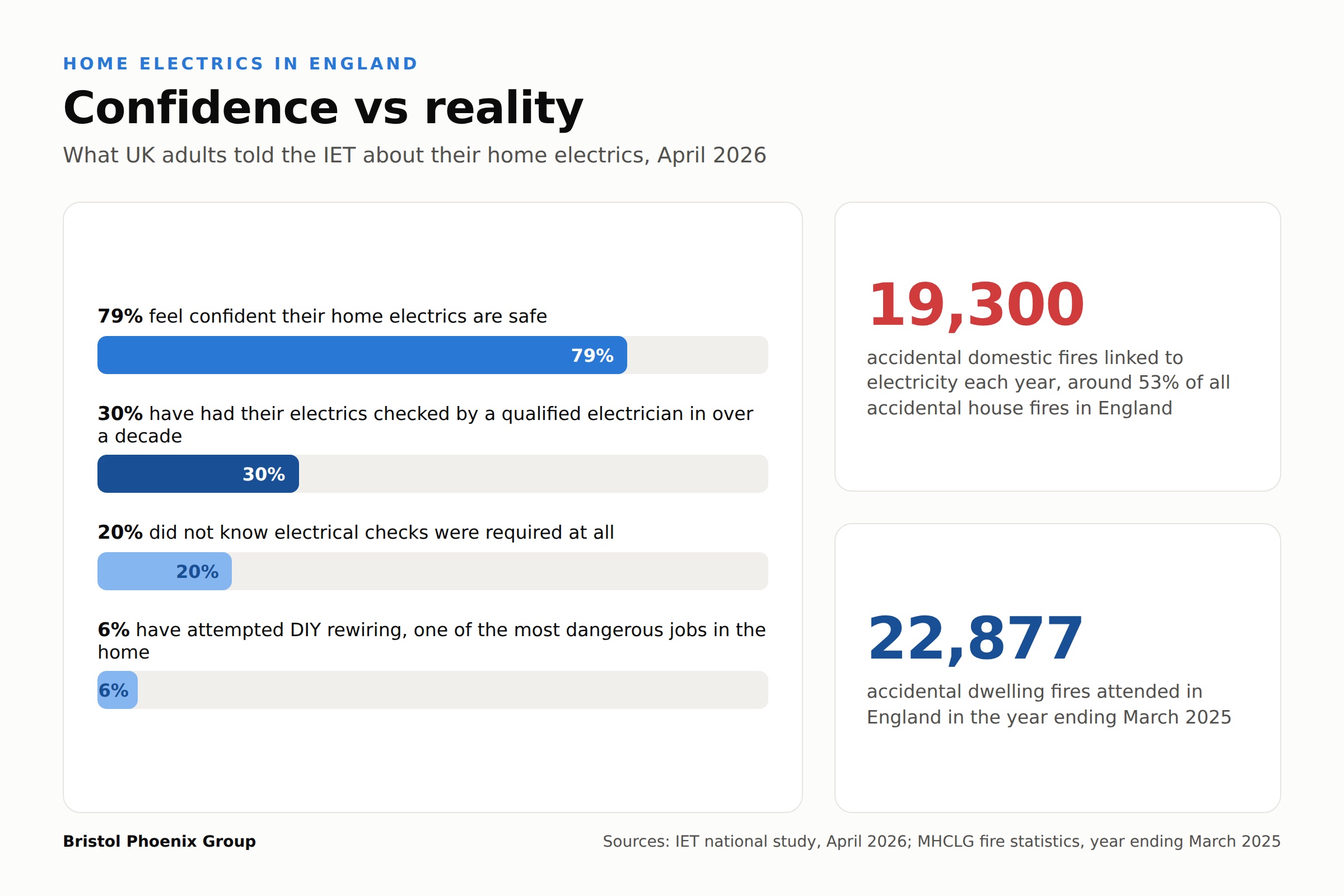
According to research published by the IET in April 2026, there are around 19,300 accidental domestic fires linked to electricity each year, accounting for about 53 percent of all accidental house fires in England. For scale, official fire statistics recorded 22,877 accidental dwelling fires in England in the year ending March 2025.
The same IET study found a gap between confidence and evidence that we recognise from a decade of call-outs: 79 percent of adults say they feel confident about the electrical safety of their homes, yet fewer than a third, 30 percent, have had their household electrics checked by a qualified electrician in over a decade. And 6 percent admit to having attempted rewiring themselves, which the IET describes as one of the most dangerous electrical jobs in the home. We would describe it the same way, with feeling.
Old wiring colours sit right in the middle of this picture. They are the most visible sign that an installation predates modern protective devices, modern earthing arrangements and, in some cases, modern insulation materials. Colour does not start fires. But the age it reveals is a fair proxy for the things that do.
When Old Colours Mean It Is Time to Rewire
Not every red and black installation needs ripping out, and anyone who tells you otherwise on the strength of colour alone is selling something. Here is the honest decision path.
- Get an EICR first. A periodic inspection tests the things colour cannot show you: insulation resistance, earth continuity, polarity, the condition of connections. It typically costs £80 to £350 depending on property size, which is a small price for knowing rather than guessing. Our electrical testing service covers exactly this.
- Act on the codes, not the colours. A satisfactory report on a red-and-black installation means you can plan improvements at leisure. C2 and C1 observations mean remedial work now.
- Rewire when the evidence says so. Plain green earths, rubber insulation, failed insulation resistance readings, no earth on lighting circuits, signs of overheating: any of these makes a rewire the sensible conversation.
On cost, our detailed house rewire cost guide puts a full rewire of a three-bedroom house at £4,500 to £8,000, and national 2026 guides sit in the same territory: Best Builders quotes £5,500 to £8,500 for an occupied three-bedroom semi, while MyJobQuote puts the typical three-bedroom job at around £6,500. Smaller properties cost less, larger ones more, and the price moves with circuit count and finish more than floor area. Our rewiring service page explains how we run the job, and why a rewire is also the moment to plan sockets and lighting for the next thirty years rather than replicating 1975.
A Worked Example
Picture a typical 1930s semi in south Bristol, bought by a young family. The survey said “electrics appear dated, further investigation recommended”, which is surveyor for “not my department”.
Under the stairs sits a fuse board with rewirable fuses. The sockets are wired in red and black PVC with green-and-yellow sleeving: 1980s work, tired but testable. The lighting is another story. At the first ceiling rose, the cable is red and black with plain green sleeving, and the insulation on the last few centimetres is dark, hardened rubber that sheds flakes when the rose cover turns.
An EICR confirms the picture: sockets serviceable with improvements recommended, lighting circuits unsatisfactory with insulation breaking down. The family opts for a rewire of the lighting circuits, a new metal consumer unit with RCBO protection, and new circuits for a planned kitchen. Done as one planned job with floors up once, it costs a fraction of what the same work would cost as three emergencies, and the house goes from 1930s protection to current standards in a week.
The colours did not tell the whole story. They told the family where to look, and the testing did the rest. That is exactly how the two should work together.
What to Do Next
If you have found old colours in your home, the sequence is simple. Do not disturb anything that looks rubbery, crumbly or lead-sheathed. Note which rooms and circuits are affected. Then book a periodic inspection with a registered electrician and let the test results, not the colours, decide what happens next.
We are a NAPIT-approved contractor covering Bristol and the surrounding area from our South Bristol base, and identifying and upgrading older installations is a large part of what we do, from single-circuit repairs to full rewires. If you would like an EICR, a second opinion on a quote, or an honest answer about whether those red and black cables owe you anything yet, get in touch and we will take a look.