Two minutes in, hair full of shampoo, there is a click from the hallway and the water turns cold. If that scene feels familiar, you are in the right place. An electric shower tripping the fuse box is one of the most common faults we are asked to trace across Bristol, and it is almost never random. Something in that circuit is leaking current or pulling too much of it, and your consumer unit is doing exactly the job it was built for. In this guide we rank the causes from most to least likely, show you what is safe to check yourself, explain where the rules say to stop, and put realistic numbers on the fix.
Table of Contents
- Why Your Shower Is the Biggest Load in the House
- Which Switch Tripped? MCB, RCD or RCBO
- Electric Shower Tripping: The Usual Causes, Ranked
- Shower Keeps Tripping the Fuse Box? Safe Checks First
- Where DIY Ends, and Why the Line Sits There
- What a Fix Costs
- A Worked Example: The Shower That Lasted Ten Minutes
- Straight Answers for South Bristol Bathrooms
TL;DR
- A shower that keeps tripping the fuse box is usually a failing heater element leaking current to earth, and the fault typically shows up a few minutes in, once the element is hot.
- Which switch drops tells you a lot. An RCD or RCBO tripping points to earth leakage from the element or moisture. An MCB tripping points to overload or a wiring fault.
- Safe checks are limited: note which switch tripped, reset it once, test hot against cold, and isolate the shower to confirm the culprit. That is the full list.
- Never open the shower unit, never bypass the RCD and never fit a bigger breaker to stop the tripping. Every circuit in a bathroom must have 30mA RCD protection under BS 7671, and the rules exist because water and electricity share a small room here.
- Expect a diagnostic visit at £140 + VAT with us, a like-for-like shower swap at roughly £250 to £450 supplied and fitted, and £500 to £900 where a new circuit is needed.
Why Your Shower Is the Biggest Load in the House
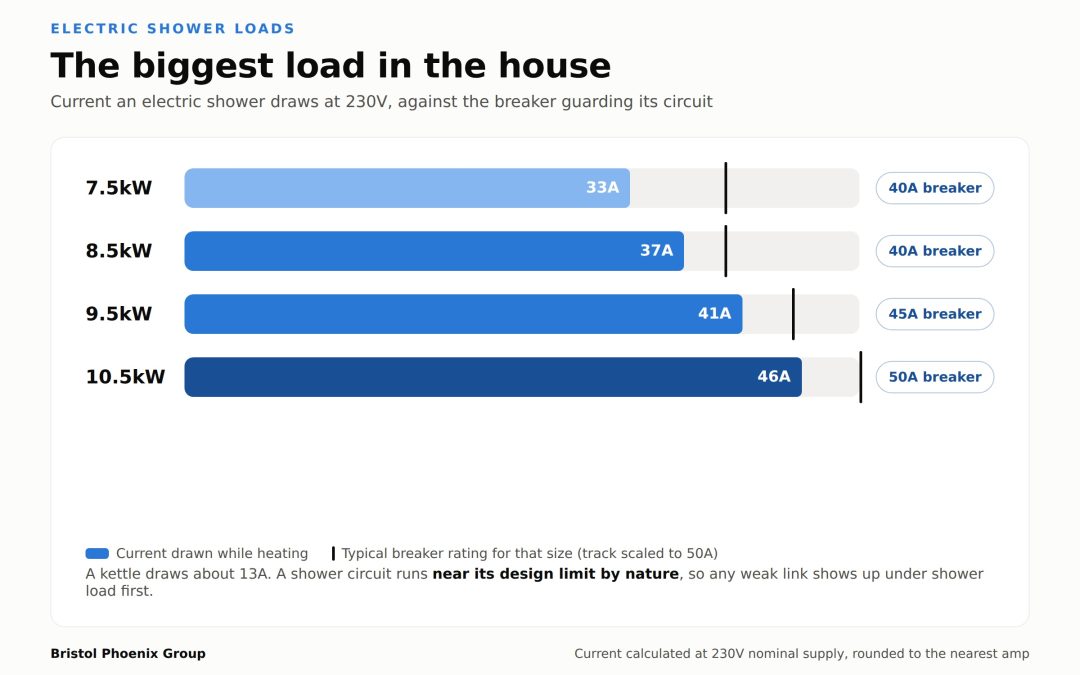
Nothing else in a normal home works as hard as an electric shower. It takes cold mains water and heats it to comfortable in the second or so it spends passing through the unit, and brute electrical force is the only way to do that. A typical kettle draws about 13 amps. A 9.5kW shower draws more than three kettles’ worth, continuously, through one cable, every time someone washes.
The arithmetic is worth seeing, because it explains why shower circuits have so little slack in them.
| Shower rating | Current draw at 230V | Typical protective device |
|---|---|---|
| 7.5kW | About 33 amps | 40A |
| 8.5kW | About 37 amps | 40A |
| 9.5kW | About 41 amps | 45A or 50A |
| 10.5kW | About 46 amps | 50A |
Notice how close the draw sits to the breaker rating. A shower circuit runs near its design limit by nature, so any weakness in the chain shows itself under shower load first. That is why the shower is so often the appliance that exposes a tired consumer unit, a marginal cable or a connection that has been quietly loosening for years. It is the canary in the airing cupboard.
Which Switch Tripped? MCB, RCD or RCBO
Before anything else, open the consumer unit door and look at which switch has dropped, because the answer does half your diagnosis for you.
If a single small switch labelled 40, 45 or 50 has gone down, that is the MCB, the circuit breaker guarding just the shower circuit. MCBs trip on overload or short circuit, so the fault is about too much current: an undersized circuit, a short in the unit or switch, or a genuine wiring fault. Our guide to a fuse box that keeps tripping covers how these devices decide when to let go.
If a wider switch has dropped and taken half the house with it, that is the RCD. An electric shower trips RCD protection for one reason: current is escaping the circuit, usually to earth, and the device cuts power the moment the imbalance passes its threshold. Earth leakage in a shower almost always means the element or moisture, which we will come to. If your board is a newer type with RCBOs, one device does both jobs per circuit, so only the shower way will drop, but the same logic applies. We have written up the whole subject in our guide to an RCD that keeps tripping, including the appliance elimination method that applies when the culprit is less obvious than a shower.
So before you reset anything, take a photo of the board as you found it. Ten seconds of evidence saves half an hour of head scratching later, ours or yours.
Electric Shower Tripping: The Usual Causes, Ranked
Years of fault finding in Bristol bathrooms produces a fairly stable league table. Here it is, most likely first.
1. A failing heater element
The runaway winner. Inside the shower is a compact heating can whose element cracks with age, exactly as kettle and washing machine elements do. Once the casing of the element develops a hairline fault, water contacts parts of the element it was never meant to touch, current leaks to earth and the RCD does its job. The classic signature is a shower that starts fine and trips a few minutes in, once the element is properly hot and the crack has expanded, or one that only trips on the hotter setting. Limescale shortens element life, and years of daily use finish the job. An element failing this way is not repairable in any practical sense; on most domestic units the economic answer is a like-for-like replacement of the shower.
2. Moisture where it should not be
Steam is persistent stuff. If the unit’s case seal, cable entry or an internal hose connection lets water or heavy condensation reach the terminals, you get intermittent earth leakage that trips the RCD, often immediately at switch-on or in damp weather. A shower that trips the moment you pull the cord, before any heating has happened, points this way rather than at the element. Moisture faults also wander: fine for a week, then three trips in a day. They do not fix themselves, because the water always finds the route again.
3. A tired pull cord switch
That ceiling switch carries the full 40-plus amps every time the shower runs, through a small set of contacts operated by a piece of string. When the contacts wear, they arc. Arcing makes heat, heat melts the terminal housing, and somewhere along that road the circuit starts tripping, or the switch starts crackling, or you catch a hot plastic smell in the bathroom. A browned or crackling pull cord switch is a genuine fire risk in miniature and one of the most common finds when we open things up. The good news: it is also one of the cheapest fixes on this whole page.
4. An undersized circuit or the wrong breaker
This one usually follows a bathroom refit. A 10.5kW shower goes in where an 8.5kW unit used to live, nobody checks the cable, and now 46 amps is being asked of a circuit sized for 37. The MCB trips minutes into every shower, reliably, because it is being overloaded, reliably. The fix is not a bigger breaker. The breaker protects the cable, and the cable has not grown. The fix is a circuit built for the load, which is precisely the kind of job that sends people to our page on Part P building regulations, since a new shower circuit is notifiable work.
5. Loose connections and the board itself
A shower circuit heats and cools with every use, and that thermal cycling gradually loosens terminal screws at the unit, the isolator and the consumer unit. A loose connection under 40 amps arcs and cooks, and the tripping it causes can masquerade as any of the faults above. Sometimes the weak link is the board: old consumer units with worn devices or shared RCDs can nuisance-trip under a heavy, spiky load even when the shower itself is healthy. If your board is a dated one, our consumer unit page explains what an upgrade involves and when an EICR flags one.
Shower Keeps Tripping the Fuse Box? Safe Checks First
There is a short list of things a homeowner can do without touching a screwdriver, and it genuinely helps. Work through it in order.
- Record which device tripped. MCB, RCD or RCBO, as above. Photograph the board before you reset anything.
- Reset once. One reset is diagnosis. Repeated resetting is not: a protective device that keeps tripping is reporting a live fault, and forcing it back on simply reapplies power to that fault. Of the 22,877 accidental dwelling fires in England in the year ending March 2025, 29% were caused by misuse of equipment or appliances, according to Home Office fire statistics, and leaning on a tripping switch until it stays put is a textbook way to join that column.
- Test cold against hot. If the shower runs happily cold but trips on hot, suspect the element. If it trips instantly regardless of setting, suspect moisture or the switch.
- Isolate and observe. Turn the shower’s isolator or pull cord off and leave it off for a day of normal living. If the board holds, you have confirmed the shower circuit as the culprit. If tripping continues with the shower isolated, the fault lies elsewhere, and our RCD tripping guide is your next read.
- Use your nose and ears. Brown marks around the pull cord, a crackle when it operates, a hot or fishy plastic smell: any of these means stop using the shower now and keep the circuit off at the board.
That is the whole list. Everything beyond it involves removing covers from equipment that connects a wet room to the busiest circuit in the house, and that is not homeowner territory.
Where DIY Ends, and Why the Line Sits There
We are direct about this with every customer: the shower circuit is the one piece of your electrics where we would rather you did nothing at all beyond the checks above. The reasons are written into the regulations rather than into our diary.
A bathroom is what BS 7671 calls a special location. Under Section 701 of the IET Wiring Regulations, every low voltage circuit serving a room containing a bath or shower must have RCD protection rated at no more than 30mA, precisely because a wet, earthed human is a far better conductor than a dry one. Disabling or bypassing a tripping RCD to keep the water hot removes the one device standing between a cracked element and a serious shock. On top of that, building work on shower circuits is regulated: installing a new circuit, replacing a consumer unit, or altering circuits within the bathroom zones is notifiable under Part P, which is one more reason the work belongs with a registered electrician. Our Part P guide sets out the detail without the jargon.
The stakes are not theoretical. Fire and rescue services attended 25,334 dwelling fires in England in the year ending March 2025, and heat, current and worn contacts are exactly the ingredients a neglected shower fault keeps in stock. If you ever smell burning at the pull cord or the shower unit, switch the circuit off at the board, leave it off, and treat it as an urgent electrical fault rather than a job for some future weekend.
What a Fix Costs
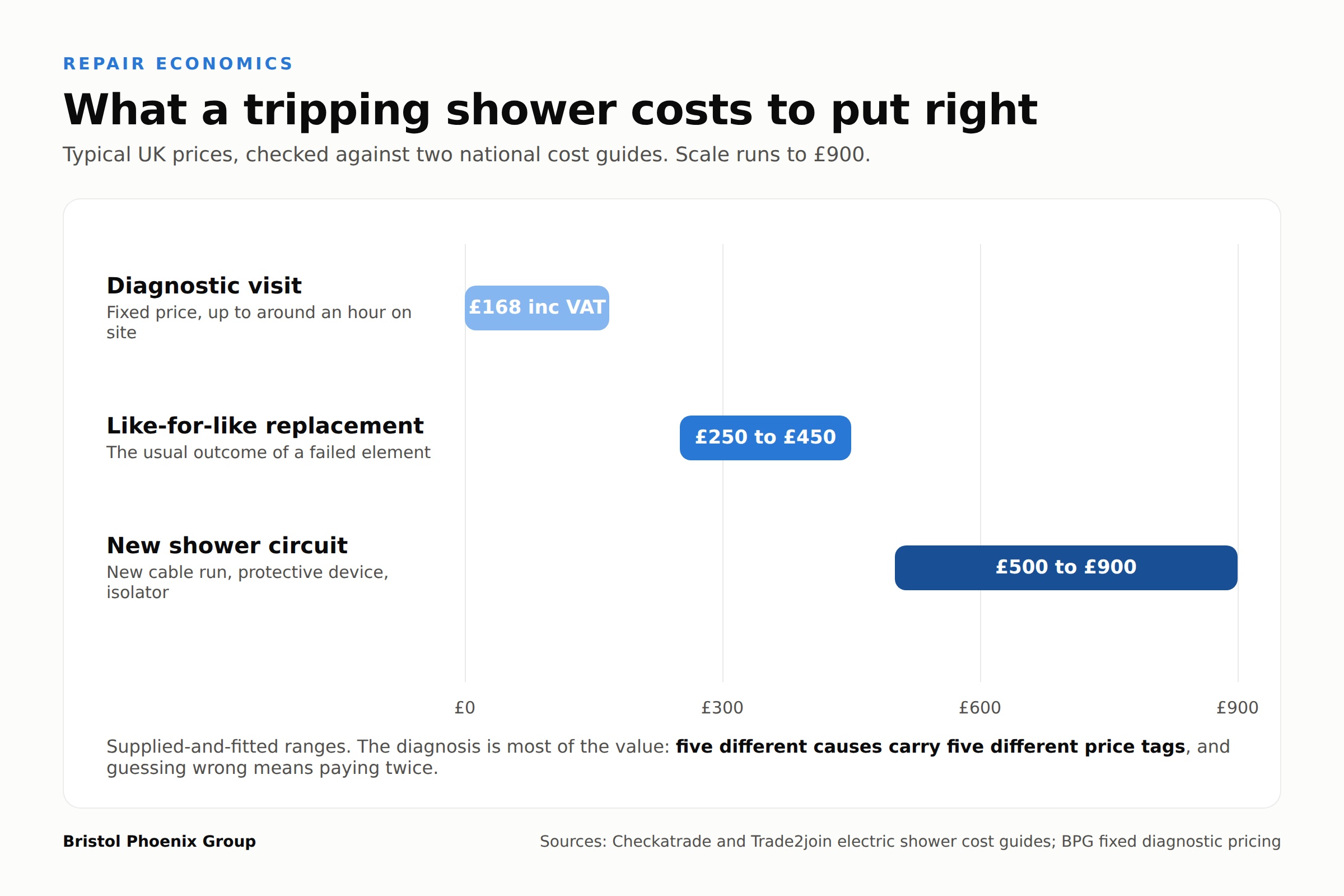
Shower faults are one of the areas where the diagnosis is most of the value, because the five causes above have five different price tags and guessing wrong gets expensive. Here is how the numbers usually land.
| Job | Typical cost | Notes |
|---|---|---|
| Diagnostic visit (our fixed price) | £140 + VAT (£168 inc VAT) | Up to around an hour on site: safe isolation, testing, and the fix there and then where possible |
| Pull cord switch replacement | Often the cheapest fix on the page | Frequently done within the diagnostic visit, plus a modest cost for the switch itself |
| Like-for-like shower replacement | Roughly £250 to £450 supplied and fitted | The usual outcome of a failed element on a standard unit |
| New shower circuit or first-time installation | Roughly £500 to £900 | New cable run, protective device and isolator; notifiable work |
Those ranges are consistent with what national trade platforms report. Checkatrade puts a standard electric shower installation at around £400 for supply and fit, with a like-for-like swap taking about two hours, while Trade2join quotes £250 to £450 for replacing an existing electric shower and £500 to £900 for a new installation. Where quotes climb beyond that, it is usually because the job uncovered an undersized cable, a full consumer unit or a long cable run, not because showers are secretly luxurious. Our own diagnostic pricing is fixed and published on our electrical fault finding page, so you know the cost of an answer before we arrive.
A Worked Example: The Shower That Lasted Ten Minutes
Picture a 1930s semi in Knowle. The bathroom has a 9.5kW shower, eight years old, used twice a day by a family of four. For the past fortnight it has run for about ten minutes and then dropped the RCD, taking the kitchen sockets with it. Cold showers work fine, which nobody in the house considers an acceptable solution, and the tripping is getting earlier each week.
The pattern already tells the story: hot-only tripping on an RCD, in a hard-worked unit of that age, is the signature of an element leaking to earth as it expands with heat. On a job like this the electrician confirms it with an insulation resistance test at the shower’s terminals, checks the pull cord switch and board connections while everything is open, and finds the element reading far below the acceptable threshold. The unit is not economically repairable, so the answer is a like-for-like 9.5kW replacement on the existing circuit, tested and signed off the same visit.
The arithmetic for a job of that shape: £168 including VAT for the diagnostic hour, and a replacement inside the £250 to £450 supplied-and-fitted range, with the final figure depending on the unit chosen. Call it somewhere around £420 to £600 all in, and a family back in hot water without the house going dark at breakfast. Compare that with the cost of guessing: a new pull cord switch that fixed nothing, a bigger breaker that should never have been fitted, and the same fault still tripping a fortnight later.
Straight Answers for South Bristol Bathrooms
The housing stock we work in shapes the faults we find. South Bristol’s Victorian terraces and interwar semis in Bedminster, Southville, Knowle, Totterdown, Brislington and Whitchurch were never designed for 46 amp bathroom appliances, so showers here are routinely the heaviest thing ever asked of the wiring, sometimes through boards that predate the shower by decades. That combination is exactly why a tripping shower deserves a proper diagnosis rather than a parts lottery.
As a NAPIT-approved team based in South Bristol, we test rather than guess: safe isolation, insulation resistance readings, and a written picture of what failed and why, with any further work quoted before it happens. If your shower keeps tripping the fuse box, or the pull cord has started crackling its own warning, get in touch through our contact page and describe the fault. We will tell you honestly what it sounds like, what the visit costs, and what we would do in your bathroom if it were ours.