Ask three electricians how long does a rewire take and you will get three different answers, all of them right. One is picturing an empty two bed flat with easy access. Another is picturing a furnished Victorian terrace with a loft conversion and a cat that opens doors. The honest answer depends on the property, whether anyone is living in it, and what the walls are hiding. We rewire homes across South Bristol every month, so in this guide we will give you real timelines by property size, explain where the days actually go, and flag what stretches the job in period homes.
Table of Contents
- How Long Does a Rewire Take? The Short Answer
- How Long to Rewire a 3 Bed House
- First Fix vs Second Fix: Where the Days Actually Go
- How Long Does a Rewire Take If You Stay Put?
- What Stretches a Rewire in Bristol’s Period Homes
- Take a Typical Bedminster Terrace: A Worked Example
- The Paperwork That Follows the Last Screwdriver
- Planning a Rewire Around Real Life
- Ready to Pin Down Your Own Timeline?
TL;DR
- A typical three bed house takes 5 to 10 working days to rewire, from strip out to final test.
- Small flats can be done in 4 to 7 days. Large or complex houses can run to 15 days or more.
- The work splits into first fix (cables in, the messy half) and second fix (faceplates, lights and the new consumer unit), with plastering in between.
- Staying in the house during the work usually adds two or three days to the schedule.
- Bristol’s Victorian and Edwardian terraces bring solid walls, lath and plaster ceilings and past DIY surprises, all of which stretch the rewire duration.
- Budget extra days for plaster drying, decoration and Building Control notification. The certificate matters as much as the cable.
How Long Does a Rewire Take? The Short Answer
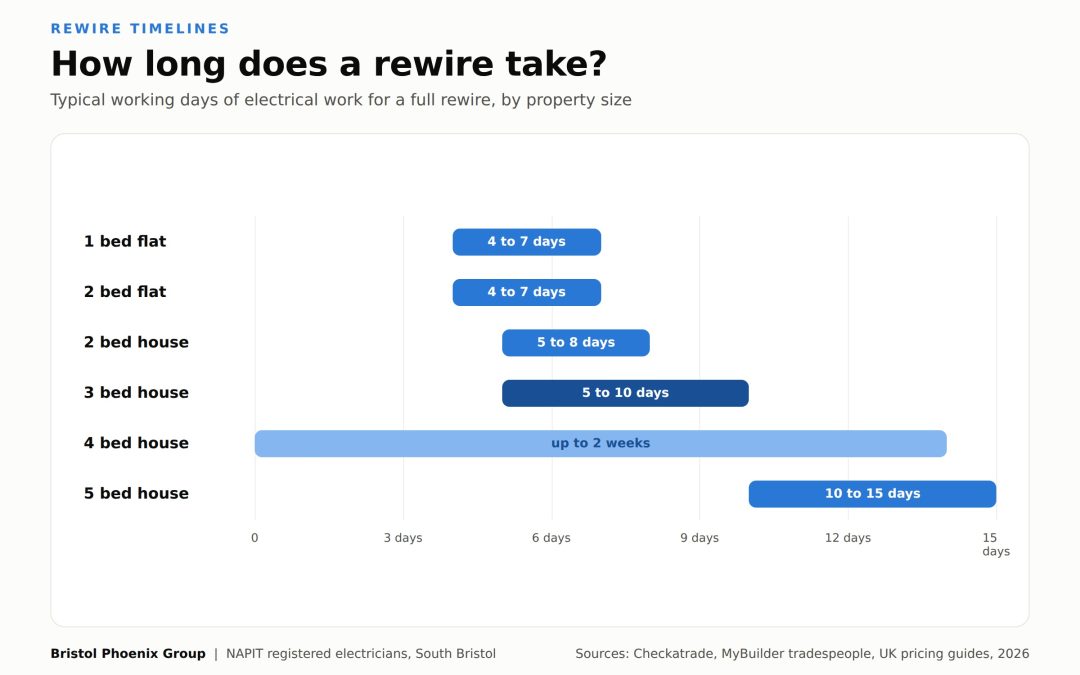
For most homes, a full rewire takes between 5 and 10 working days of electrical work. National guides put the spread wider than that once you include every property type: Checkatrade’s guide quotes 4 to 5 days for a two bedroom house and 6 to 10 days for a three bedroom house with two bathrooms, with larger properties taking longer.
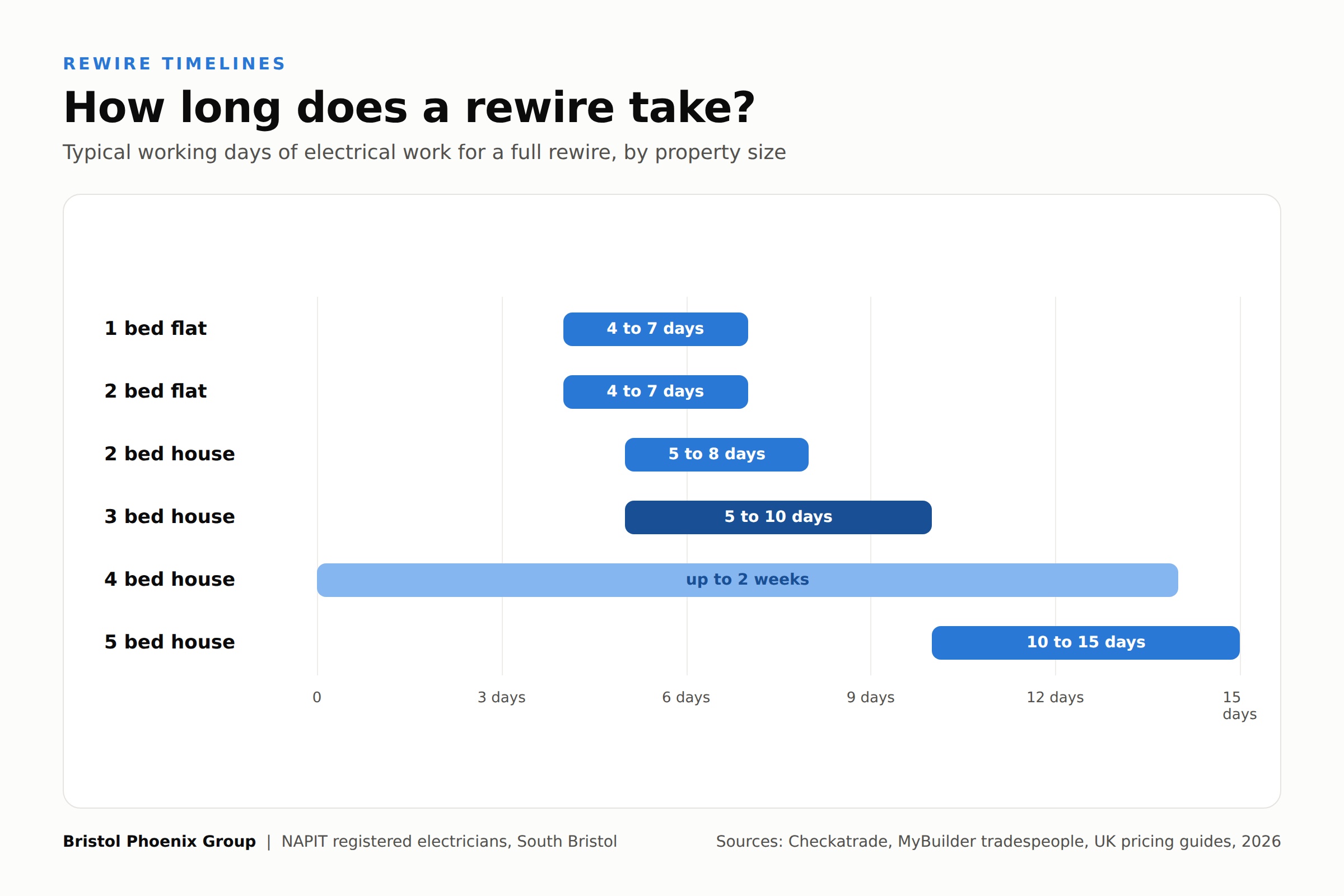
Here is how the timelines shake out by property size. These figures line up with our own jobs across South Bristol and with the national guides, and they assume a full rewire rather than a partial one.
| Property type | Typical rewire duration | What moves the needle |
|---|---|---|
| 1 bedroom flat | 4 to 7 days | Access to floors and ceilings, freeholder rules |
| 2 bedroom flat | 4 to 7 days | Concrete floors can slow cable routes |
| 2 bedroom house | 5 to 8 days | Occupied or empty, spec of fittings |
| 3 bedroom house | 5 to 10 days | Number of bathrooms, extensions, occupancy |
| 4 bedroom house | Up to 2 weeks | Circuit count, outbuildings, loft rooms |
| 5 bedroom house | 10 to 15 days | Sheer cable mileage, high spec lighting |
Those are working days on the electrical side. A rewire also needs plastering and decoration afterwards, and plaster dries at its own pace no matter how much anyone hovers over it. If you want the full picture of what the job involves from survey to certificate, our complete house rewire guide walks through every stage.
How Long to Rewire a 3 Bed House
The three bed is the question we get asked most, because it is the most common house in Bristol and most of the country. The honest range is 5 to 10 working days for the electrical work, and where you land in that range comes down to a few things.
An empty three bed with clear access is at the fast end. When tradespeople were asked this exact question on MyBuilder, most answers fell between 3 and 7 days, and nearly every electrician made the same caveat: those quick times assume a vacant house. Two electricians in an empty property can strip out and re-cable at a pace that is simply not possible when they are working around beds, wardrobes and a family’s evening routine.
A furnished, occupied three bed with a couple of bathrooms and a decent lighting spec is at the slow end. Extra bathrooms mean more circuits and more work in tiled areas where nobody wants to drill twice. Downlights, outside sockets and garden power all add hours that become days.
So when you compare quotes and one firm says four days while another says eight, they are not necessarily disagreeing. They are pricing different assumptions. Ask each one what they have assumed about occupancy, spec and access, and the gap usually closes.
First Fix vs Second Fix: Where the Days Actually Go
Every rewire splits into two halves with a pause in the middle. Once you understand the shape of the job, the timeline stops being mysterious.
First fix: the messy half
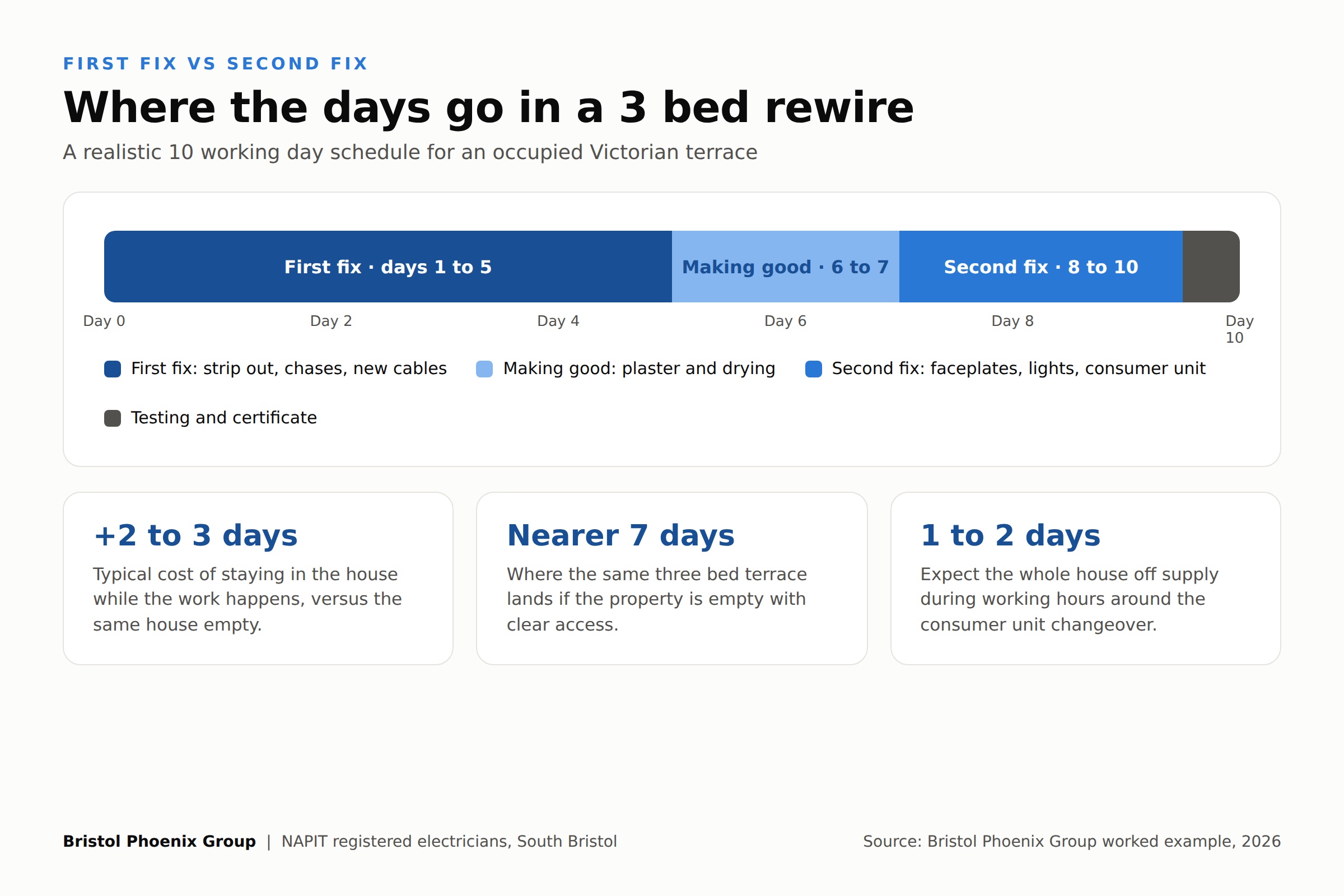
First fix is where the old wiring comes out and the new cables go in. Carpets lifted, floorboards up, chases cut into walls, cables run to every socket, switch and light position. On a three bed this is typically 3 to 5 days, and it is the noisy, dusty stretch that gives rewires their reputation. It is also where surprises live: the moment a floor comes up is the moment you find out what the last fifty years of DIY actually did.
The pause: making good
Once cables are in, the plasterer fills the chases and patches the walls. That is a day or two of work, but the drying time matters more than the trowel time. Painting straight onto damp plaster is a mistake you only make once.
Second fix: the house comes back to life
Second fix is the satisfying bit. Faceplates on, light fittings up, and the new consumer unit installed and energised. This usually runs 2 to 3 days on a three bed. If your fuse box is the only part of your installation showing its age, that is a different, smaller job, and our guide to new fuse box costs covers it separately.
Testing and certification
The last day belongs to the test instruments. Every circuit gets inspected and tested, the results are recorded, and an Electrical Installation Certificate is issued. It is a tedious few hours that turns a pile of cable into a documented, certified installation, and no reputable electrician will skip it.
How Long Does a Rewire Take If You Stay Put?
You can live through a rewire. Plenty of our customers do. But it changes the arithmetic, and it is worth being honest about how.
Working around furniture, keeping one room habitable, restoring power each evening and sequencing the work room by room all take time. As a rule of thumb, staying in the house adds two or three days to the schedule compared with the same house empty. There will also be a day or two, usually around the consumer unit changeover, when the whole house is off supply during working hours.
Moving out, even partially, buys speed. This is why so many rewires happen in the gap between buying a house and moving in, or between tenancies. If you have the option, take it: the job is faster, cheaper and kinder to everyone’s nerves.
If you are staying, a few things genuinely help:
- Clear each room before the electricians reach it, even just pulling furniture to the centre.
- Agree a rolling room plan so there is always somewhere to sleep and somewhere to make tea.
- Plan for the days the power is off. Flasks, phone power banks and a neighbour’s fridge cover most of it.
- Anyone working from home on calls all week may want to book a desk elsewhere during first fix. Chasing walls is not a background noise anyone can talk over.
What Stretches a Rewire in Bristol’s Period Homes
South Bristol is a wonderful place to be an electrician, and a demanding one. The Victorian and Edwardian terraces of Bedminster, Southville, Totterdown and Windmill Hill, and the 1930s semis of Knowle and Brislington, were all built long before anyone imagined a kitchen with a dozen appliances. Rewiring them is bread and butter work for us, but the buildings add days in predictable ways.
Solid walls. Many period homes have solid brick walls rather than modern cavity construction. Chasing solid brick is slower than cutting into plasterboard, and the making good afterwards is more involved.
Lath and plaster ceilings. Original ceilings are brittle and unforgiving. Fishing cables through them without bringing half the ceiling down takes patience, and patience takes time.
Layers of history. A hundred year old house has usually been wired two or three times already, rarely with the old cable removed. Finding rubber insulated cable or a mix of colour codes under the floor is common. If you have ever lifted a board and found black, red and grey cables sharing a joist, our guide to old wiring colours in the UK will help you date what you are looking at.
Loft conversions and extensions. Half of Totterdown seems to have a loft room, and every one adds circuits, smoke detection and access questions that a plain two storey house does not have.
Textured coatings and old materials. Some older decorative coatings and boards need checking before anyone disturbs them. Where testing is sensible, it happens before work starts, and it is another reason period homes deserve a proper survey rather than a guess over the phone.
None of this should put you off an older house. It just means the timeline quote should come from someone who has actually walked around it. We survey before we price precisely because two identical looking terraces can be a week apart in labour.
Take a Typical Bedminster Terrace: A Worked Example
Take a typical scenario: a three bed Victorian terrace off North Street, solid walls, lath and plaster ceilings upstairs, one family bathroom, and the owners staying in the house with two children. A full rewire with a sensible lighting spec might run like this:
- Week before: survey done, layout agreed room by room, consumer unit position confirmed.
- Days 1 to 5, first fix: strip out and new cable runs, working front to back so the family always has a usable room. The solid walls and original ceilings cost roughly a day compared with a modern house.
- Days 6 and 7, making good: the plasterer fills chases and patches. The electricians are off site while the walls dry.
- Days 8 to 10, second fix: faceplates, lights, and the consumer unit changeover, with one planned day of full power down time.
- Day 10, afternoon, testing: every circuit tested, certificate issued, Building Control notified.
Call it ten working days, two of them the price of staying put. The same house empty would land nearer seven. Neither number is a promise, because no two terraces are the same behind the plaster, but it shows you the shape of a realistic schedule and where the flex lives.
The Paperwork That Follows the Last Screwdriver
A rewire is not finished when the lights come on. It is finished when the paperwork exists, and the paperwork is not optional.
A full rewire is notifiable work under Part P of the Building Regulations. Approved Document P defines notifiable work as the installation of a new circuit, the replacement of a consumer unit, or additions and alterations to circuits in special locations such as bathrooms. A rewire ticks every box on that list. Using a registered electrician means the notification happens through their competent person scheme without you lifting a finger. As a NAPIT registered firm based in South Bristol, we handle that notification as a standard part of every rewire, and you receive the certificate for your records.
That certificate earns its keep later. Landlords in England must have their rented property’s electrics inspected at least every 5 years by a properly qualified person under rules explained in the government’s electrical safety guidance, and a fresh rewire with a certificate makes those inspections routine. Our guide to electrical certificates for landlords covers the detail. For owner occupiers, Electrical Safety First recommends a periodic inspection at least every 10 years.
Why the fuss? Because the stakes are real. Buckinghamshire Fire and Rescue Service notes that over half of all accidental house fires are caused by electricity, with faulty electrics causing around four thousand fires in the home each year. A rewire done properly, tested properly and certified properly is how a house leaves that statistic behind for decades.
Planning a Rewire Around Real Life
A few practical thoughts from jobs we have scheduled over the years.
Sequence it with other work. If you are renovating, the rewire’s first fix should happen after strip out and before plastering. Booking the electrician and plasterer as a coordinated pair saves a week of waiting. Builders we work with across Bristol plan it exactly this way, and our rewiring and new build wiring service slots into a wider build programme as easily as a single house job.
Use empty windows. Between completion and moving day, or between tenancies, is the golden slot. The house is empty, the timeline is short, and the decoration happens once rather than twice.
Budget time as well as money. On cost, a three bed full rewire typically sits in the £4,500 to £8,000 bracket nationally, a range that current UK pricing guides back up, and our house rewire cost guide breaks down in full. Whatever the money number, add the plaster drying and decorating time to your mental calendar, because the electrical finish date is not the same as the house feeling finished.
Get the survey. Any firm quoting a fixed timeline without seeing the property is guessing. A walk round takes an hour and turns a guess into a schedule.
Ready to Pin Down Your Own Timeline?
General ranges are useful, but your house is specific. The year it was built, the walls it hides, whether you are staying in it, and what you want on the other side all set the real number of days.
If you are in Bristol or the surrounding area and weighing up a rewire, we are happy to look at your property, talk through first fix and second fix in plain English, and give you a written timeline alongside the price. No pressure and no jargon, just a straight answer about how long your rewire would take. Get in touch with Bristol Phoenix Group and tell us about the house, and we will take it from there.