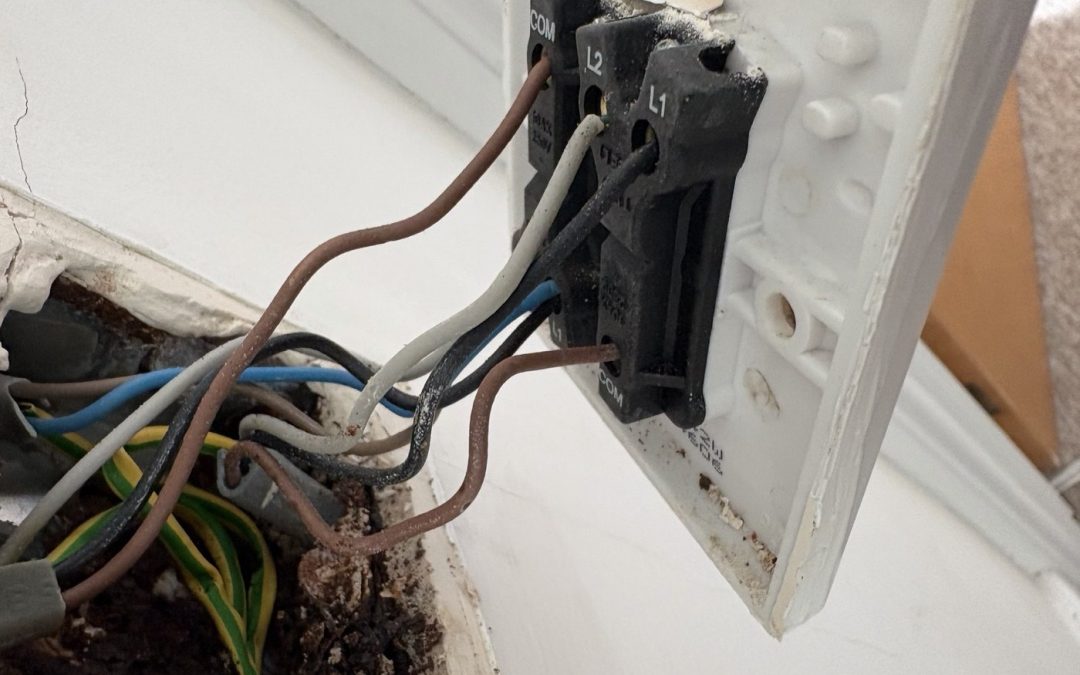
A rental property needs a full rewire when the EICR shows the installation itself is worn out, not just carrying one or two faults: several C2 codes spread across different circuits, lighting with no earth, rubber or fabric insulated cable, or an old fuse board with no RCD protection. One C2 on its own is a repair, not a rewire. This guide covers rewiring a rental property for landlords in Bristol: the findings that tip the balance, what it costs, how to fit the work between tenancies with the least void time, and the certificate at the end that covers your inspection duties for the next five years.
When an EICR says a rewire is needed, and when it does not
The phrase “EICR says rewire needed” worries landlords more than it should, because an unsatisfactory report is usually fixable with remedial work. An EICR comes back unsatisfactory when it records a C1 (danger present), a C2 (potentially dangerous) or an FI (further investigation needed). Under the government’s electrical safety standards guidance, that work must be completed within 28 days, or sooner if the report says so, and councils can fine landlords up to £40,000 for breaches. We have explained what each code means in our guide to EICR codes.
A rewire becomes the honest answer when the faults form a pattern rather than a list. The findings we weigh up on a Bristol EICR before recommending one:
- Several C2s landing on the same ageing circuits, so fixing one fault just moves the problem along the cable
- No earth on the lighting circuits, which is common in the Victorian terraces of Bedminster and Totterdown where the original lighting wiring was never upgraded
- Rubber or fabric insulated cable, which hardens and cracks with age, and any remaining lead sheathed wiring
- A fuse board with no RCD protection sitting on an installation that is already decades old, where a board change alone would be a new front door on a condemned house
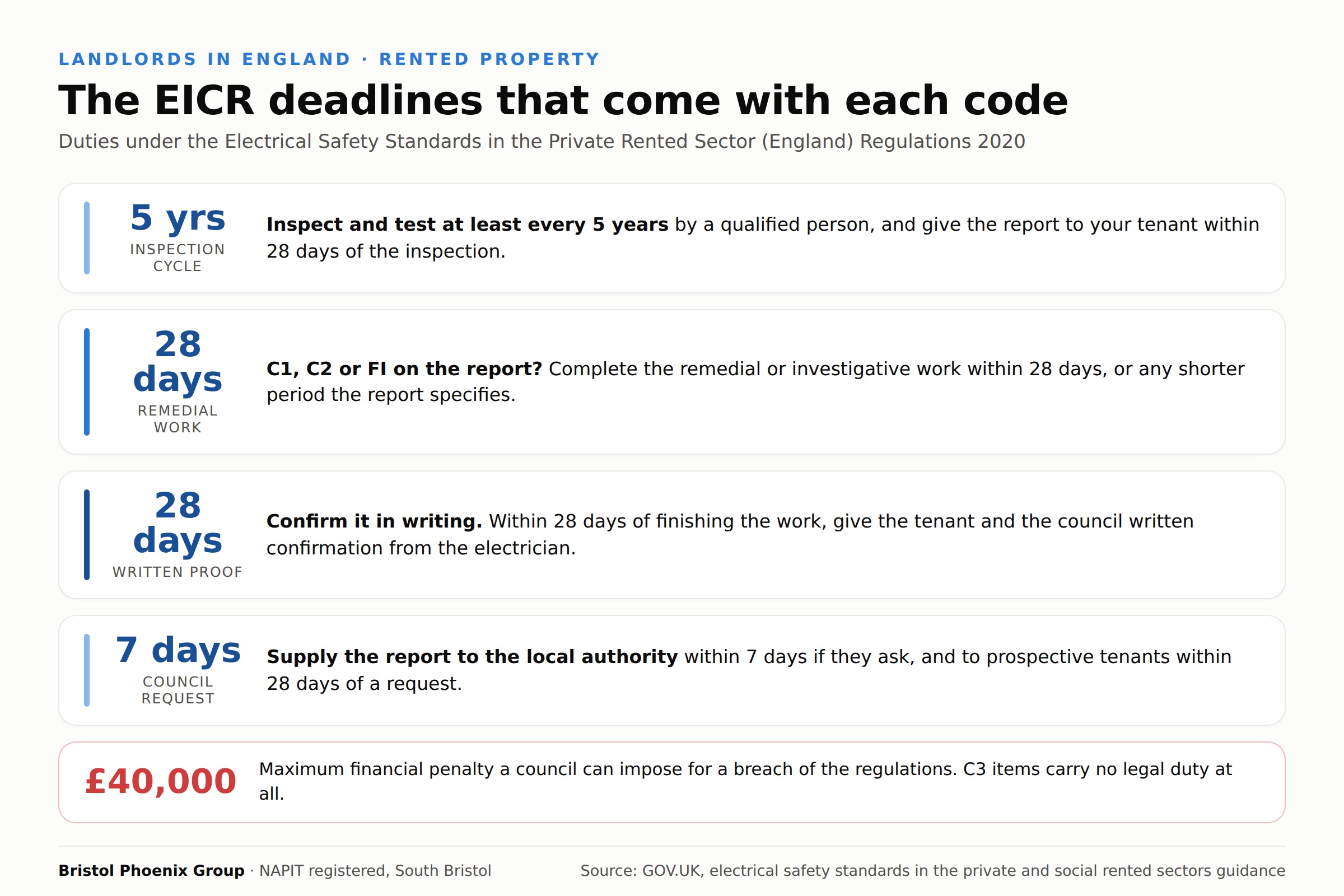
If you are buying a buy to let at auction with no recent paperwork, assume nothing. We test plenty of tired three-bed terraces where the seller swore the electrics were fine, and the report tells a different story. Rewiring a buy to let before the first tenancy is far cheaper than rewiring it around a tenant two years in.
Between tenancies is the cheapest way to do it
A rewire between tenancies costs the same in labour but far less in hassle. An empty two or three bed house takes our Bristol electricians roughly five to eight working days of electrical work, and we have set out real timelines in how long a rewire takes. With a tenant in place the same job runs slower and harder: floor coverings up room by room, power off for hours at a time, furniture moved twice, and a tenant whose goodwill wears thin by day three. We ask owners to move out for full rewires where they can, and in a rental the void between tenancies is that empty window, already built into your year.

The sequencing that keeps void time short: get the EICR or a free rewire survey done while the outgoing tenant is still in, with their permission, so the written quote is agreed before checkout day. We then book the start for the first days of the void: first fix, second fix, testing and certification, with the decorator following us in. If the kitchen or bathroom is being refreshed in the same void, tell us, because new circuits for those rooms are far cheaper to run while the walls are already open.
The spec that makes a let easy to manage
A rewire is the one chance to set the property up so the electrics stop generating phone calls. Everything we install is designed, tested and certificated to the current edition of BS 7671, the IET Wiring Regulations, and for rentals we push three things.
First, an RCBO consumer unit. Our boards come with an RCBO on every circuit and surge protection as standard, which means a fault on the shower circuit trips the shower circuit and nothing else. On the older dual RCD boards, half the house goes dark and the tenant phones you at 9pm. RCBOs cut those calls out almost entirely.

Second, mains powered interlinked smoke and heat alarms wired in during the rewire. The smoke and carbon monoxide alarm regulations require landlords to ensure at least one smoke alarm on each storey used as living accommodation, and a carbon monoxide alarm in any room with a fixed combustion appliance, excluding gas cookers. Battery alarms satisfy the letter of the rules, but interlinked mains alarms with battery back-up, fitted while the ceilings are already open, cost £420 plus VAT for two smoke and one heat alarm as part of a rewire and never need a tenant to remember batteries.
Third, enough sockets. Tenants do not buy extension leads for fun; they buy them because a bedroom has one single socket behind the headboard. Doubling up sockets during a rewire costs a fraction of what it costs later, and it removes the daisy-chained leads that show up as talking points on the next inspection.
What a landlord rewire costs in Bristol
Our rewire prices are published, fixed in writing after a free survey, and the same anywhere in Bristol. The landlord rewire cost for a house, all plus VAT:
| Property | House, from | Flat, from |
|---|---|---|
| 1 bedroom | £4,700 | £4,500 |
| 2 bedrooms | £5,050 | £4,850 |
| 3 bedrooms | £5,400 | £5,200 |
| 4 bedrooms | £5,750 | £5,550 |
| 5 or more | £6,100 | £5,900 |
Those are starting prices for a basic specification. Concrete ground floors add £1,200 to £1,850 because cables must be routed differently, interlinked alarms add £420, and making good after the chasing is around £395 if you want us to arrange it. There is a full price calculator on our house rewiring in Bristol page. Every rewire is notified through NAPIT under Part P and covered by the NAPIT Work Quality Guarantee for six years after completion, which matters to a landlord because the guarantee survives even if the installer does not.
The paperwork: an EIC instead of your next EICR
This is the part landlords are most often not told. At the end of a full rewire you receive an Electrical Installation Certificate, an EIC, plus the Building Regulations compliance certificate from the Part P notification. The government’s guidance for landlords states that if premises have been completely rewired they should have an EIC, that landlords can provide a copy of the EIC to tenants and, if requested, the local council, and that the landlord will then not be required to carry out further checks or provide a report for five years after the EIC has been issued. In plain terms, the rewire resets your five year inspection clock, so the money is not buying safety alone, it is buying five years of compliance.
Electrical Safety First still advises landlords to carry out a visual inspection once a year or between tenancies, which we would echo: certificates do not spot the scorched extension lead a tenant has hidden behind the sofa. Our landlord electrical safety page covers the full set of duties, costs and dates in one place.
Rewiring an HMO is a different job
Everything above describes a single let: the two or three bed terrace or semi with one household in it. A licensed shared house carries extra requirements on fire alarm systems, emergency lighting and the consumer unit, set against Bristol City Council’s licensing standards, and the price and programme both change. If that is your property, read our guide to rewiring an HMO instead.
Planning a rewire before the next tenancy?
We are Bristol Phoenix Group, a NAPIT approved and TrustMark Trading Standards Approved electrical contractor (TrustMark licence 4257835) based in Bishopsworth, South Bristol. Our home ground is the Victorian terraces of Bedminster, Totterdown and Knowle and the 1930s semis of Bishopsworth and Whitchurch, and we regularly rewire rentals across North Bristol too, from Bishopston and Horfield to Henleaze and Westbury-on-Trym. We hold a 5.0 Google rating across 140 reviews, and every quote is fixed in writing before work starts.
If an EICR has raised the question, or a tenancy is ending and the void is your window, send us the report or the address through our contact page or call 0117 244 7382. You can also find us through our South Bristol and Bedminster pages, or start with the team of electricians in Bristol landlords already rate.