
Rewiring an HMO costs more than rewiring the same house for a family, and the difference is not padding. Our full rewires start at £4,500 plus VAT, a five bedroom Bristol house starts at £6,100 plus VAT, and a licensed shared house then adds the extra circuits, the interlinked fire alarm system and the paperwork that Bristol City Council expects to see before it grants or renews a licence. This guide sets out exactly what those extras are, why they exist, and what rewiring an HMO in Bristol actually costs once they are included.
Why rewiring an HMO is a different job
A family of four and five unrelated sharers can live in the same Victorian terrace, but electrically they are different buildings. Five adults each run their own kettle habits, their own heaters, their own chargers and often their own mini fridge, and they do it behind five locked bedroom doors. The landlord is not there to notice a warm socket or a tripping circuit, and no single tenant feels responsible for the hallway. The wiring has to carry more load, fail more gracefully and protect people who may never have met each other.
That is why an HMO rewire is designed around the licence, not just around the standard full rewire we would fit in an owner occupied home. Get the design right once and the house sails through its licence inspections for years. Get it wrong and you pay twice: once for the rewire and again for the remedials the council asks for.
The licence sets the specification
In England, a property needs a mandatory HMO licence when it is rented to five or more people who form more than one household and share facilities such as a kitchen or bathroom. A licence is valid for a maximum of five years, and renting out an unlicensed HMO can carry an unlimited fine.
Bristol goes further. Since 6 August 2024 the city has run a citywide additional licensing scheme covering HMOs where three or four people from two or more households share basic facilities. In practice, almost every sharer house in Bristol now needs a licence of one kind or another, and every licence comes with electrical and fire safety conditions attached. Our guide to HMO licences in Bristol covers which scheme applies to which property, so here we will stick to what the conditions mean for the wiring.
The extra circuits a shared house carries
When we rewire a licensed HMO, the circuit schedule grows well beyond what a family home needs. The usual pattern looks like this:
- A socket circuit for each letting room, so one tenant overloading their room does not drop their neighbour’s electrics too. Where rooms have fixed panel heaters, each heater often gets its own circuit as well.
- A kitchen designed for five or six people cooking in shifts: typically two socket circuits plus dedicated circuits for the oven and hob, because a sharer kitchen at 6pm works harder than most family kitchens ever do.
- A landlord’s supply for the hall, stairs and landing lighting and for the fire alarm system, kept separate from the tenants’ circuits. If a tenant trips something in their room, the escape route stays lit and the alarms stay powered.
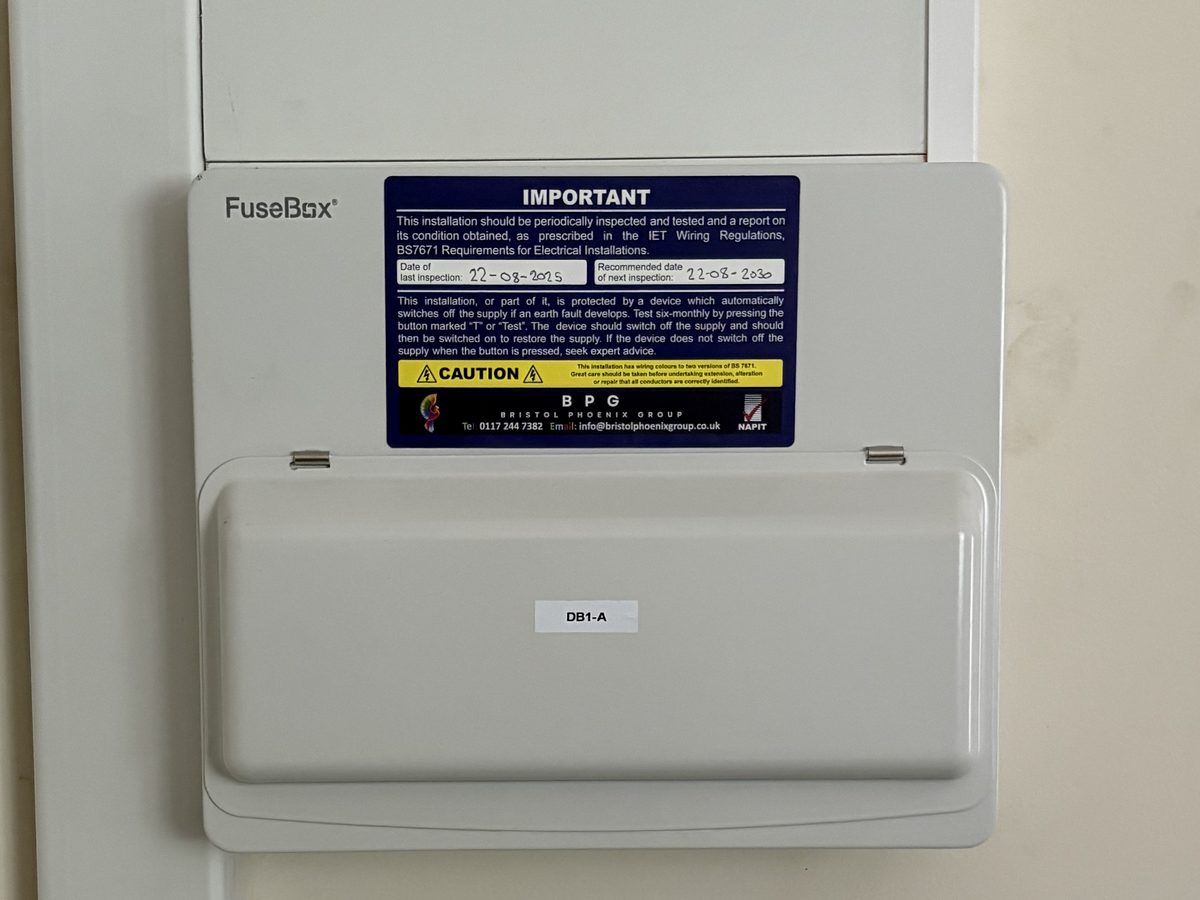
All of it lands in a consumer unit with an RCBO on every circuit and a typed, labelled circuit schedule. An RCBO protects each circuit individually, so a fault in one bedroom trips that bedroom and nothing else. In a family home that is a convenience. In an HMO it is the difference between one phone call and five, which is why we fit RCBO boards with surge protection as standard on every rewire.
Fire alarms and emergency lighting: what Bristol expects
This is the part national rewire guides never cover, and it is where HMO rewires earn their price difference. Bristol City Council’s fire safety standards for licensable HMOs set out the alarm system by property type. For a typical shared house of up to six occupants over one to three storeys, the standard is a Grade D1 system with LD2 coverage to BS 5839-6:2019. Where seven or more people share, it steps up to LD1.
In plain English: Grade D1 means mains powered alarms with sealed, tamper proof battery back up, all interlinked so that when one sounds, they all sound. LD2 coverage means detection in the escape route (the hall and every landing) plus the high risk rooms, which in a sharer house means the kitchen and any shared living room. Because the alarms are interlinked and mains powered, the cabling for them belongs in the rewire. Retrofitting an interlinked system after the walls are made good means chasing cables twice, which is why doing it during the rewire is so much cheaper.
The same council standards call for emergency lighting on the escape route where it has no borrowed light or where the route is long or complex, to BS 5266-1. A straightforward two storey terrace with a window above the front door often does not need it. A deep three storey house with a dog leg staircase usually does. It is a survey question, not a guess, and it is another circuit on that landlord’s supply.
What rewiring an HMO costs in Bristol
Our rewire prices are published and fixed in writing after a free survey. Full rewires start at £4,500 plus VAT, and by house size they run from £4,700 plus VAT for a one bedroom house to £6,100 plus VAT for five bedrooms or more, which is where most licensed HMOs sit. On top of that base, an HMO specification typically adds the extra letting room circuits, the Grade D1 LD2 alarm system (our standard linked set of two smoke alarms and one heat alarm is £420 during a rewire, and a licensed HMO usually needs more heads than that), emergency lighting where the survey says the escape route needs it, and making good at around £395. Concrete ground floors add £1,200 to £1,850 on any rewire.
For context, national price guides put an ordinary full rewire at £6,000 to £9,500 for a three bedroom house and £8,000 to £13,000 for four bedrooms, with five bedroom houses commonly quoted at £12,000 to £18,000 or more. Those figures are for a family specification, before any HMO extras. Published local pricing with the HMO items itemised in writing tends to land well under the top of those ranges, and you can see exactly what you are paying for.
Picture a typical case: a five bedroom Victorian terrace in Southville, let to five sharers, last rewired decades ago. The base rewire starts at £6,100 plus VAT. The survey adds a socket circuit per letting room, a twin circuit kitchen, the landlord’s supply, a Grade D1 LD2 alarm system covering the hall, both landings, the kitchen and the lounge, and making good. Every line appears in the written quote before anyone lifts a floorboard, so the licence application and the budget are settled at the same time.
When to rewire an HMO: the gap between tenancies
A full rewire means lifting floors and chasing walls in every room, and in a shared house there is no polite way to do that around five tenancies. The gap between one group of sharers leaving and the next arriving is the natural window. An empty house is quicker and safer to work in, and a larger sharer house typically takes ten to fifteen working days, so an August changeover in a student let leaves room to rewire, make good and redecorate before the new tenancy starts. If a licence renewal is coming and the EICR is likely to be unsatisfactory, planning the rewire into the changeover beats discovering the problem mid tenancy.
Much of South Bristol’s rental stock is Victorian and Edwardian terracing, and in Southville, Totterdown and Bedminster we regularly open up sharer houses still running on a patchwork of old rubber insulated circuits, 1970s additions and a fuse board with no RCD protection at all. The housing stock around Bedminster and the rest of BS3 was built for coal fires and two lights per floor, not five adults working from home.
After the rewire: certificates and the five year cycle
A rewire is notifiable work under Part P of the Building Regulations. As NAPIT approved electricians we certify and notify it ourselves, you receive an Electrical Installation Certificate, and the work is covered by the NAPIT Work Quality Guarantee for six years. The business is also TrustMark Trading Standards Approved, licence 4257835.
From there the cycle is simple. Under the electrical safety regulations for rented homes in England, the installation must be inspected and tested at least every five years by a qualified person, and your licence conditions expect a satisfactory report on file. A freshly rewired house makes that first five year EICR a formality rather than a gamble. Our HMO electrical safety service covers the EICRs, alarm testing and any remedials from £350 plus VAT for an HMO EICR, so the house that passed its licence inspection keeps passing it.
Talk to us about your HMO
We are Bristol Phoenix Group, NAPIT approved and TrustMark Trading Standards Approved electricians based in Bishopsworth in South Bristol, with more than 130 five star Google reviews. We rewire and certify sharer houses across BS3, BS4, BS13 and BS14 and regularly work across North Bristol too. If you are planning a rewire around a tenancy changeover or a licence renewal, get in touch for a free survey and a fixed written quote, or call us on 0117 244 7382.