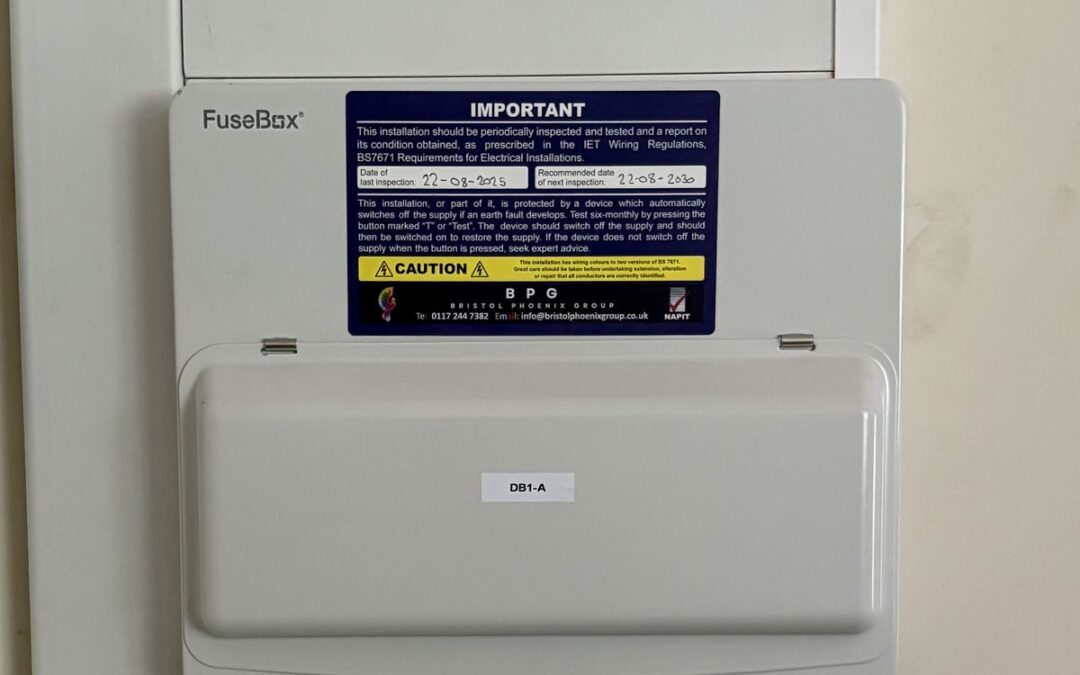
What is an RCBO? It stands for Residual Current Breaker with Overcurrent protection, and it is two safety devices rolled into one: a circuit breaker (MCB) that guards against overloads and short circuits, and an RCD that cuts the power in milliseconds if electricity leaks to earth, through a damaged cable or through a person. One RCBO protects one circuit, which is exactly why modern consumer units are built around them.
If you have had a quote for a new fuse board recently, or an electrician has walked you through an EICR, the word has probably come up. This guide explains the rcbo meaning in plain English, how an RCBO differs from the single RCD protecting everything in an older board, and when the choice actually matters for a home in Bristol.
What Does RCBO Stand For?
RCBO is short for Residual Current Breaker with Overcurrent protection. Unpack that and you get the two jobs it does at once:
- Overcurrent protection is the circuit breaker side, the job an MCB does. If a circuit is overloaded, or a live and neutral touch in a short circuit, the device trips before the cable overheats. Cables that overheat start fires: Home Office figures reported by NAPIT show 24,083 accidental dwelling fires in England in the year ending March 2023, with around 29 percent caused by misuse of equipment or appliances such as overloaded sockets and faulty devices.
- Residual current protection is the RCD side. The device constantly compares the current flowing out on the live with the current coming back on the neutral. If some of it has gone missing, leaking to earth through damaged insulation, a wet connection or a person, it disconnects within milliseconds. A 30mA RCD trips at a level well below what it takes to cause a fatal shock.
An MCB alone does the first job. An RCD alone does the second. An RCBO does both, for one circuit, in one unit that clips onto the same rail in your consumer unit.
MCB, RCD and RCBO Side by Side
| Device | Protects against | Covers | Where you’ll see it |
|---|---|---|---|
| MCB | Overload and short circuit | One circuit | Most boards fitted since the 1990s |
| RCD | Earth leakage and electric shock | Several circuits at once | Older split-load and dual RCD boards |
| RCBO | Both of the above | One circuit | Modern boards, one per circuit |
The regulations are part of the reason RCDs are everywhere now. Under BS 7671, the IET Wiring Regulations, socket-outlets rated up to 32A need additional protection from a 30mA RCD, a requirement the IET explains in Regulation 411.3.3, with only narrow exceptions. The regulations do not dictate how you provide that protection though. A single RCD covering half the board complies. So does an RCBO on every circuit. The difference shows up in how the installation behaves when something goes wrong.
RCBO vs Single RCD: Why One Per Circuit Wins
Picture a typical dual RCD board, the kind fitted in thousands of Bristol homes between roughly 2008 and the late 2010s. Two RCDs sit at the top, each covering a bank of circuits. A fault on any one circuit in a bank trips the RCD for the whole bank. A faulty element in the oven can take out the sockets, the fridge freezer and half the lights in one go, and you find out at 7am in the dark.
That is the nuisance tripping problem, and it is the main argument for RCBOs. With an RCBO on every circuit:
- A fault trips only the circuit it is on. The freezer stays cold while the shower circuit is off.
- Fault finding is faster and cheaper, because the tripped device tells you exactly which circuit has the problem.
- Earth leakage does not accumulate. Every appliance leaks a tiny, harmless current to earth, and on a shared RCD those small leaks add up until the RCD sits close to its tripping point. One circuit per device means far more headroom.
The trade-off used to be cost, since an RCBO costs more than a plain MCB. Prices have come down enough that we no longer think the saving justifies a shared RCD board in a normal house, which is why every rcbo consumer unit we fit, a FuseBox metal board, comes with an RCBO on every circuit and surge protection as standard. Our consumer unit replacement price for the 8 to 12-way board most houses need is a fixed 780 GBP plus VAT, and the full price breakdown, including what affects it, is in our guide to new fuse box costs.
How to Tell What Your Board Has
Open the flap on your consumer unit and look at the row of switches:
- One or two wide devices with a test button, feeding banks of smaller switches with no buttons: an RCD board. The small switches are MCBs.
- A test button on every individual switch: RCBOs. Each circuit has its own combined protection.
- No test buttons anywhere, or ceramic fuse holders with rewirable fuse wire: no RCD protection at all. Worth getting inspected, as a board like this predates the modern shock protection requirements entirely.
The housing stock around our South Bristol base makes every one of these a regular sight. The Victorian terraces of Bedminster and Southville often carry a newer board on a very old installation. The 1930s semis in Knowle and Headley Park and the ex-council houses of Bishopsworth, Hartcliffe and Whitchurch frequently still have 1980s boards with no RCD, or a single RCD covering everything. The same mix turns up across North Bristol too, from Bishopston and Redland to Henleaze and Westbury-on-Trym. If you are not sure what you are looking at, our South Bristol electricians can tell you in minutes during an inspection.
Do You Need to Upgrade to RCBOs?
Honest answer: not always, and be wary of anyone who says otherwise without seeing your board.
A dual RCD board in good condition, properly installed and testing correctly, is not dangerous and does not need replacing just because RCBOs exist. The regulations are not retrospective, so a board that met the standard when it was fitted can stay in service. Where an upgrade earns its keep:
- Your board has no RCD protection at all. On an EICR this is likely to be coded as a defect, and for landlords that matters: under the Electrical Safety Standards in the Private Rented Sector (England) Regulations 2020, gov.uk guidance requires rental electrics to be checked at least every 5 years by a properly qualified person, and defects have to be put right.
- Nuisance tripping is a fact of life in your house. If one appliance keeps plunging half the house into darkness, per-circuit protection fixes the frustration at the source.
- The board is being replaced anyway, during a rewire, an extension or after an unsatisfactory EICR. At that point RCBOs are the obvious specification, and fitting anything less is a false economy.
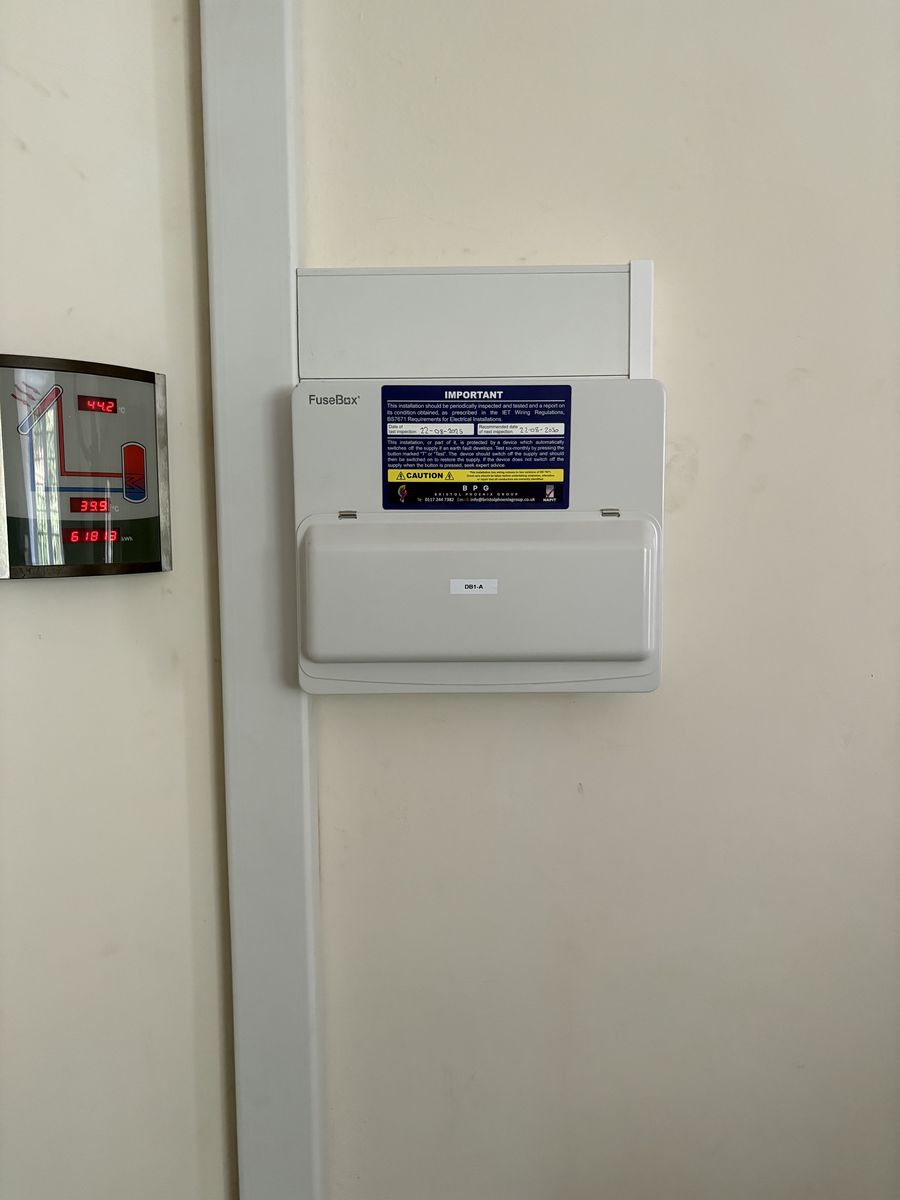
A consumer unit replacement is notifiable work under Part P of the Building Regulations, so whoever does it should be registered with a competent person scheme. We are NAPIT registered and TrustMark Trading Standards Approved (licence 4257835), and every board change we do is tested, certificated and notified to building control on your behalf.
Questions We Get Asked About RCBOs
What is an RCBO in simple terms?
It is a single device that does the jobs of an MCB and an RCD together: it switches a circuit off if it is overloaded or shorted, and it switches it off if current leaks to earth. RCBO stands for Residual Current Breaker with Overcurrent protection.
What is the difference between an RCD and an MCB?
An MCB (miniature circuit breaker) protects the cable on one circuit: it trips when too much current flows, from an overload or a short circuit. An RCD (residual current device) protects people: it trips when current leaks to earth, the kind of fault that can give someone an electric shock, and on older boards one RCD often covers several circuits. An RCBO does both jobs for a single circuit, which is why a board with an RCBO on every circuit is the layout we fit as standard.
What is the difference between an RCBO and an RCD?
An RCD only detects earth leakage, usually covers several circuits at once, and needs MCBs alongside it for overload protection. An RCBO does both jobs for one circuit, so a fault trips only that circuit rather than a whole bank.
Why does my RCBO keep tripping?
Because it is doing its job. Repeated tripping usually means a faulty appliance on that circuit, moisture in a fitting or socket, or damaged cable insulation. Unplug everything on the circuit and reset it: if it holds, plug things back in one at a time to find the culprit, and if it trips with nothing plugged in, the wiring itself needs investigating.
Can I swap an MCB for an RCBO myself?
No. Working inside a consumer unit means working next to live parts, the device has to be the right type and rating for the circuit and the board, and the circuit needs testing afterwards. It is a job for a registered electrician.
Are RCBOs a legal requirement?
Not by name. BS 7671 requires 30mA RCD protection for socket-outlets up to 32A and for most circuits in a home, but it does not say the protection must come from RCBOs rather than shared RCDs. RCBOs are simply the better way to meet the requirement on a new board.
How much does an RCBO consumer unit cost in Bristol?
Our fixed price is 780 GBP plus VAT for the 8 to 12-way board most houses need, or 680 GBP plus VAT for a 6-way board in a flat or small home, always with RCBOs on every circuit and surge protection included. Every quote is confirmed in writing before any work starts.
Talk to Us About Your Fuse Board
If your consumer unit is a mystery, or it keeps tripping and you are tired of resetting it in the dark, we can help. Bristol Phoenix Group is based in Bishopsworth and covers the whole city, from Bishopsworth, Bedminster and Knowle across to North Bristol, with over 100 five-star Google reviews behind us. Get in touch for a free written quote, or call us on 0117 244 7382.