
What is a consumer unit? It is the modern fuse box: the metal enclosure, usually in a hallway cupboard or under the stairs, that takes the electricity supply entering your home and splits it into separate, protected circuits using a main switch, circuit breakers and RCDs. It is the single most important piece of safety equipment in a home’s electrics, which is why surveys and EICRs always mention it by name. Here is what is inside one, how it differs from an old fuse box, and the signs yours is due a replacement.
A survey report lands, or an electrician hands over an EICR, and somewhere in the middle sits a sentence about “the consumer unit”. If that sent you searching for what is a consumer unit, here is the short answer: it is the box, usually grey, usually hiding in a hallway cupboard or under the stairs, that takes the electricity coming into your home and splits it into protected circuits. It is the single most important piece of safety equipment in your electrical installation. We fit, test and replace these boards across South Bristol every week, so what follows is the explanation we give at kitchen tables, minus the jargon.
Table of Contents
- What Is a Consumer Unit in Plain English
- What Does a Consumer Unit Do, Part by Part
- Fuse Box vs Consumer Unit: Is There a Difference
- Why Modern Consumer Units Are Metal
- Signs Your Consumer Unit Needs Replacing
- What It Means for Landlords and House Buyers
- A Worked Example from a 1930s Semi
- What Replacement Involves and Roughly What It Costs
- Consumer Unit FAQs
- Talk to Us About Yours
TL;DR
- A consumer unit is the modern fuse box: the distribution board that splits your incoming electricity supply into individual circuits and protects each one.
- Inside you will find a main switch, circuit breakers (MCBs or RCBOs) that guard against overloads, and RCDs that guard against electric shock.
- “Fuse box” and “consumer unit” describe the same job. The difference is the technology: rewirable fuses on an old board, resettable safety devices on a new one.
- Since Amendment 3 of the wiring regulations, domestic consumer units must sit in a steel or other non-combustible enclosure, which is why new boards are metal.
- Warning signs include rewirable fuses, a wooden backboard, no RCD test button, scorch marks and buzzing. Any of these deserves a professional look.
- We are a NAPIT registered contractor based in South Bristol, and consumer unit checks and replacements are bread and butter work for us.
What Is a Consumer Unit in Plain English
Strip away the trade vocabulary and the consumer unit meaning is this: it is the point where the electricity supply enters your home and gets divided up, controlled and protected. One cable comes in from your electricity meter. The consumer unit splits that supply into separate circuits, one for the downstairs sockets, one for the lights, one for the cooker, one for the shower, and stands guard over every one of them.
Each circuit gets its own protective device. If a fault develops, a damaged cable, an overloaded socket, water where it should not be, the device for that circuit switches off in a fraction of a second. The rest of the house carries on as normal. That is the whole idea: contain the problem, cut the power fast, keep people safe.
You will hear the same box called a fuse box, a fuse board, a breaker box or a distribution board. Electricians and the wiring regulations say consumer unit. Everyone is pointing at the same grey box.
What Does a Consumer Unit Do, Part by Part
Open the flap on a modern board and you will see a row of switches. Each one has a specific job, and knowing what does a consumer unit do at the level of its parts makes every future conversation with an electrician easier.
The Main Switch
The big double-width switch, usually at one end. It disconnects the entire installation in one movement. If you ever smell burning or see smoke from an electrical accessory, this is the switch to pull before you do anything else. Every adult in the house should know where it is. Ours is labelled; plenty we inspect are not.
MCBs: The Overload Protection
MCB stands for miniature circuit breaker. These are the slim single switches, one per circuit, and they are the direct descendants of the old rewirable fuse. Draw too much current through a circuit, or create a dead short, and the MCB trips instantly. Where a blown fuse meant hunting for fuse wire by torchlight, a tripped MCB is reset by flicking it back up once the fault is sorted.
RCDs: The Shock Protection
RCD stands for residual current device. It does a different and cleverer job. It constantly compares the current flowing out to your circuits with the current flowing back. If some of it goes missing, because it is leaking to earth through a damaged cable or, worse, through a person, the RCD disconnects in milliseconds. That speed is what turns a potentially fatal shock into a nasty surprise. On many boards one RCD covers a bank of several circuits, which is why a single fault can sometimes take out half the house.
RCBOs: Both Jobs in One Device
An RCBO combines the MCB and the RCD in a single unit, so each circuit gets its own overload and shock protection. The practical benefit is precision. A fault on the tumble dryer circuit trips that circuit alone, and the freezer, the wifi and the landing light stay on. Full RCBO boards cost a little more and are what we fit as standard when a board is replaced.
Surge Protection
Many new boards also include an SPD, a surge protection device. It absorbs brief voltage spikes, from switching on the network or nearby lightning activity, before they reach the sensitive electronics that now fill every home. On a street of Victorian terraces full of laptops and solar inverters, it is a sensible addition rather than a gimmick.
Fuse Box vs Consumer Unit: Is There a Difference
People ask us the fuse box vs consumer unit question a lot, usually after a surveyor has used one term and an electrician the other. Functionally they are the same thing: the distribution point for your home’s electricity. The difference is generation. “Fuse box” tends to describe the older technology, and the gap between the two matters more than the naming.
| Feature | Old fuse box | Modern consumer unit |
|---|---|---|
| Overload protection | Rewirable or cartridge fuses | MCBs or RCBOs, resettable switches |
| Shock protection | Usually none | RCDs or RCBOs on virtually all circuits |
| Enclosure | Bakelite or plastic, often on a wooden board | Steel or other non-combustible enclosure |
| After a fault | Replace fuse wire by hand | Fix the fault, flick the switch |
| Surge protection | None | Commonly included |
| Labelling | Faded, if present | Circuit schedule required |
A rewirable fuse does one thing: it melts when the circuit is overloaded. It offers nothing against electric shock, it depends on someone fitting the right thickness of fuse wire, and we still find boards where a previous owner “upgraded” a lighting fuse with whatever wire was in the drawer. That is not a repair, it is a slow-motion incident report.
Why Modern Consumer Units Are Metal
If you have noticed that every new consumer unit is a steel box where the old one was plastic, that is regulation rather than fashion. Amendment 3 of the 17th Edition of BS 7671 introduced Regulation 421.1.201, which requires consumer units and similar switchgear in homes to have enclosures made of steel or another non-combustible material, a requirement NAPIT explains here and one that remains in force under BS 7671:2018+A4:2026, the current edition of the wiring regulations, published 15 April 2026 with the previous edition withdrawn on 15 October 2026. The logic is blunt: if a connection inside the board overheats, a steel enclosure contains the fire instead of feeding it.
The scale of the problem justifies the bluntness. The Institution of Engineering and Technology reported in April 2026 that there are around 19,300 accidental domestic fires linked to electricity each year, about 53 percent of all accidental house fires in England. The same IET research found that 79 percent of adults feel confident about the overall electrical safety of their homes, that fewer than a third have had their household electrics checked by a qualified electrician in over a decade, and that one in five did not know checks were required at all. Confidence and evidence are pointing in opposite directions there, and the consumer unit sits right at the middle of the gap.

Signs Your Consumer Unit Needs Replacing
Fire and rescue services in England attended 22,877 accidental dwelling fires in the year to March 2025, and the point of a modern board is to keep your home out of that statistic. A consumer unit does not have an expiry date printed on it, but certain features date a board immediately and some demand action. Here is what we look for:
- Rewirable fuses. Ceramic or Bakelite carriers with visible fuse wire. The clearest possible sign the board predates modern protection.
- A wooden backboard. Common in unmodernised period homes across Bedminster, Totterdown and Southville. Timber and warm electrics are poor housemates.
- No RCD test button. No button marked T or Test means no RCD, which means no dedicated shock protection on those circuits.
- Scorch marks, heat discolouration or a hot smell. Signs of a loose or failing connection inside. This one is urgent.
- Buzzing or crackling. A healthy board is silent. Persistent noise is a conversation with an electrician waiting to happen.
- Frequent unexplained tripping. Sometimes the fault is an appliance, sometimes it is the board itself. Either way it needs diagnosing, not just resetting.
- A C2 code on an EICR. If an inspection has classified the board as potentially dangerous, the report will say so and the fix usually means replacement.
One or more of these does not mean your house is about to catch fire tonight. It means the safety layer between a fault and a fire is thinner than it should be, and thinner than it is cheap to make it.
What It Means for Landlords and House Buyers
For landlords, the consumer unit is not optional homework. Rented homes in England must have their electrical installation inspected and tested at least every five years by a properly qualified person, as set out in the government’s electrical safety standards guidance, and an ageing board is one of the most common reasons a report comes back unsatisfactory. Local authorities can fine a landlord up to £40,000 for breaching those standards, so an old board is not a corner worth cutting. We cover the paperwork side in detail in our guide to the electrical certificate for landlords.
For buyers, the consumer unit is the thirty-second survey you can do yourself at a viewing. A modern metal board with a printed circuit schedule suggests the electrics have been looked after. A Bakelite antique on a wooden base suggests the price of the house is not the last cheque you will write. Neither tells you everything, only an inspection does that, but it sets expectations early.
A Worked Example from a 1930s Semi
Picture a typical 1930s semi in Knowle. The buyers have just moved in, the survey mentioned “dated electrical distribution equipment”, and under the stairs sits a brown Bakelite fuse box on a timber board, plus a separate switch of mysterious purpose that nobody has touched since decimalisation.
An electrician’s assessment would run like this. The board has rewirable fuses and no RCD protection, so nothing in the house has dedicated protection against electric shock. The cabling is a mix: some circuits rewired in the 1980s, the originals untouched. Two realistic paths follow. If testing shows the cabling itself is sound, a straight board change to a modern all-RCBO metal consumer unit brings protection up to current standards and typically takes a day. If testing shows the rubber-insulated originals are still live, the honest advice is a rewire, because bolting a new board onto perished cables is upgrading the smoke alarm while the chimney is on fire. Our guide to house rewire costs walks through that second path in detail.
The point of the example: the consumer unit is sometimes the whole answer and sometimes the messenger. Testing first, quotes second, is the order that protects your wallet.
What Replacement Involves and Roughly What It Costs
A straightforward consumer unit replacement is typically a day’s work: power off, old board out, new board in, every circuit tested and certified, Building Regulations notification lodged, which our NAPIT registration lets us handle for you. Consumer unit replacement is notifiable work under Part P of the Building Regulations, so whoever does yours, make sure the paperwork exists.
On money, the short version: a typical UK consumer unit replacement lands between £350 and £750 including parts and labour, with the exact figure driven by circuit count and the condition of what the electrician finds. We keep the detailed numbers in one place rather than repeating them across the site, so see our full new fuse box cost guide for the breakdown, and our consumer unit replacement service page for how we approach the job locally.
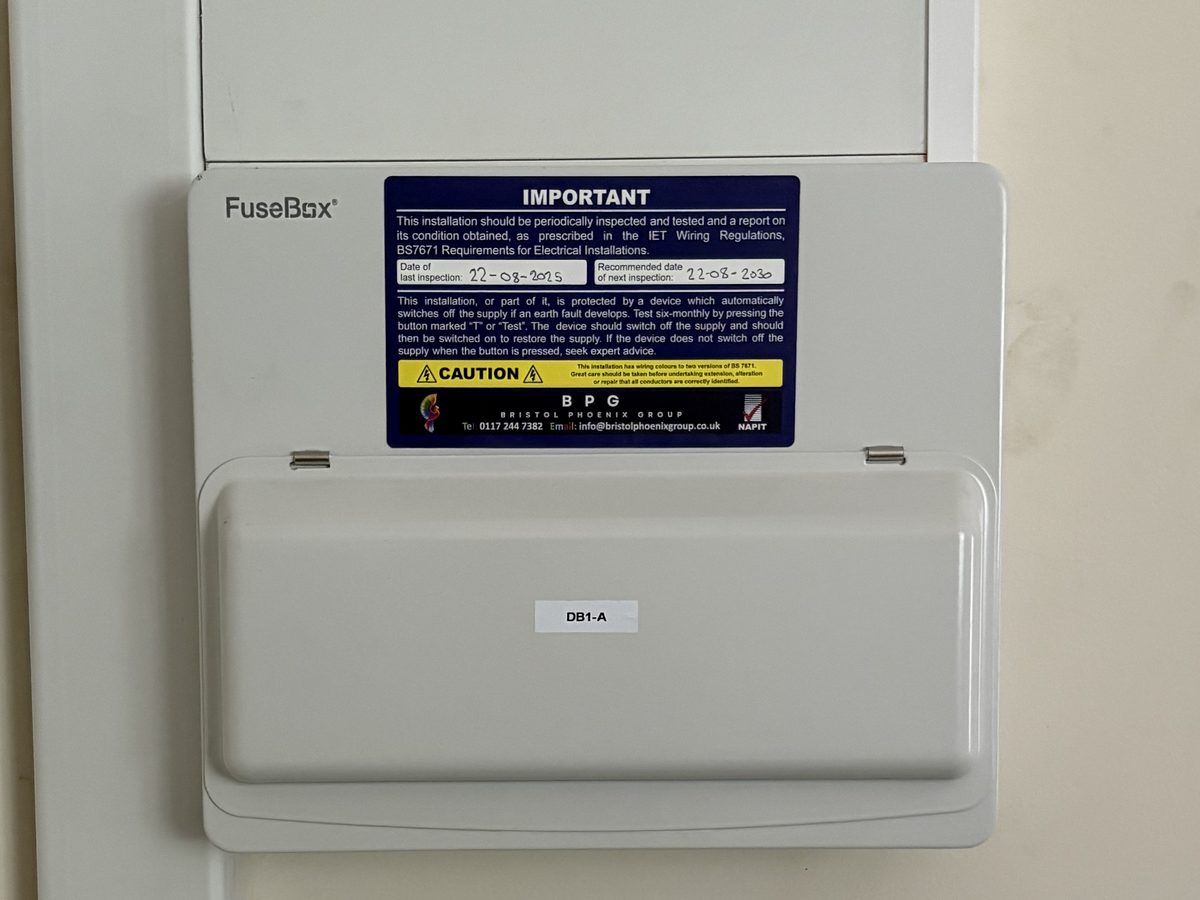
For our own part, a fixed-price Bristol Phoenix Group consumer unit replacement starts from £680 + VAT for a straightforward single-occupancy board, rising with circuit count and what we find once the old one is open. You get that figure confirmed before we start, not after.
Consumer Unit FAQs
What is a consumer unit in simple terms?
It is the modern fuse box: the unit that takes the single electricity supply entering your home, splits it into individual circuits, and automatically cuts the power to any circuit that develops a fault. Main switch, circuit breakers and RCD shock protection, all in one enclosure.
Is a consumer unit the same as a fuse box?
Same role, different generation. A fuse box protects circuits with melting fuse wire and usually offers no shock protection. A consumer unit uses resettable MCBs or RCBOs plus RCD protection, in a metal enclosure. If yours still has actual fuses, it is worth an assessment.
How long does a consumer unit last?
There is no fixed lifespan, and age alone is not the trigger. The trigger is what the board lacks: RCD protection, a non-combustible enclosure, capacity for modern loads like an EV charger (the government grant currently covers 75% of the cost up to £500 for eligible households, until 31 March 2027) or an electric shower. A sound board that ticks those boxes can stay; one that does not is due a conversation regardless of its birthday.
Can I replace a consumer unit myself?
No. Beyond the obvious danger of working at the origin of the supply, consumer unit replacement is notifiable under Part P of the Building Regulations, and the finished job needs testing and certification that only a competent, registered electrician can provide. This is one of the few jobs where DIY genuinely has no upside.
Why does my consumer unit keep tripping?
Tripping is the board doing its job; the question is what it is protecting you from. A faulty appliance, moisture in an outdoor fitting, a damaged cable or an overloaded circuit are the usual suspects. If resetting has become a household routine, stop resetting and start diagnosing.
Talk to Us About Yours
If anything above sounded like a description of the box in your hallway, a proper assessment beats guesswork. We are Bristol Phoenix Group, a NAPIT registered electrical contractor based in South Bristol, and we inspect, upgrade and replace consumer units across the city and the surrounding area for homeowners, landlords, builders and small commercial clients. Send us a photo of your board and a note of what it is doing, and we will give you an honest read on whether it needs attention now, soon or not at all. Call us on 0117 2447 382 or reach us through our contact page. No drama, no upselling, just a straight answer about the most important grey box you own.