
For a licensed Bristol HMO, the certificate itself, the EICR, costs from £350 plus VAT with us, against £200 plus VAT for a studio or one bed family home. That is the headline HMO electrical certificate cost, but it is not the whole bill: Bristol City Council’s licensing also leans on a fire alarm servicing certificate every 6 or 12 months depending on the system, an emergency lighting declaration where escape lighting is fitted, and whatever remedial work a C2 code triggers, which is the real swing factor. This guide prices each piece for a Bristol shared house, with a worked example for a five bedroom HMO near the end.
It is written for landlords and letting agents, not tenants. If you let an ordinary family home rather than a shared house, our EICR cost guide covers your side of the fence, and our landlord electrical safety page sets out the duties that apply to every rental, HMO or not.
Table of contents
- HMO electrical certificate cost at a glance
- Which certificates a Bristol HMO licence actually leans on
- Why the cost runs higher than a family home
- The remedial costs that follow a C2
- A worked example: a five bedroom Bristol HMO
- HMO electrical checks across Bristol
- Questions we get asked
HMO electrical certificate cost at a glance
| Certificate or work | How often | Our price |
|---|---|---|
| HMO EICR (one board, up to 12 circuits) | At least every 5 years | From £350 + VAT |
| Second consumer unit, outbuilding or landlord supply | Tested with the EICR | Priced before booking |
| Fire alarm servicing certificate, Grade C or D system | Every 12 months | Quoted with the EICR |
| Fire alarm servicing certificate, Grade A panel system | Every 6 months | Itemised fixed quote |
| Emergency lighting test and declaration, where fitted | Kept in working order, declaration on request | Quoted with the alarm service |
| Typical remedial work after a C2 | Within 28 days of the report | £120 to £780 + VAT for the common items, itemised quote |
Every figure above is our published rate, the same anywhere in Bristol, and all prices are plus VAT. As a sanity check against the wider market, a June 2026 trade pricing guide puts a 4 to 6 bedroom HMO EICR at £250 to £450, rising to £450 to £800 for large shared houses of seven bedrooms or more, and a national firm’s guide updated in September 2026 prices a 5 bedroom home at £300 to £400 outside London. Our from £350 figure sits inside both ranges, and unlike a range, it is fixed in writing before we arrive.
Which certificates a Bristol HMO licence actually leans on
Whichever licence your shared house needs, mandatory for five or more sharers or additional for three or four, the electrical paperwork underneath is the same. Our HMO licence guide walks through which licence applies and what each one costs; this page stays on the certificates.
The EICR comes first. The government’s electrical safety guidance requires the fixed wiring of every rented home, HMOs included, to be inspected and tested by a qualified person at least every 5 years. A copy of the report goes to existing tenants within 28 days, to a new tenant before they move in, and to the council within 7 days if it asks. Remedial work flagged by the report has to be finished within 28 days, or sooner if the report says so, and councils can impose a financial penalty of up to £40,000 for breaches. For offences committed from 1 May 2026 those penalties are handled under the civil penalty rules of the Renters’ Rights Act 2025, so the enforcement route has become shorter, not softer.
Bristol then adds its own layer. The council’s licence conditions expect a satisfactory fire alarm servicing certificate carried out in the previous 6 months for a Grade A panel system, or in the previous 12 months for the Grade C and D systems most shared houses have, following BS 5839-6:2019. The same conditions expect emergency lighting to be maintained to BS 5266-1:2016 with a declaration that it works, available whenever the council asks. And the council’s fire safety standards for licensable HMOs only require escape lighting in the first place where the route out has no borrowed light or is long or complex, so plenty of two storey shared houses never need it at all.
So the certificate pack for a licensed Bristol HMO is really three documents: an EICR less than 5 years old, an alarm servicing certificate less than 6 or 12 months old, and, where lighting is fitted, an emergency lighting declaration. We issue all three from one visit wherever the house allows it, which is cheaper than three separate call-outs from three separate firms.
Why the HMO electrical certificate cost runs higher than a family home
An HMO EICR is the same inspection as a family home EICR, done to the same BS 7671 standard. It costs more because there is simply more of everything. A shared house usually carries more circuits, often a second consumer unit or a separate landlord’s supply feeding the hall lighting and the alarm system, and every bedroom has a lock on the door, so access has to be arranged with each tenant rather than one household. The wiring also works harder: five bedrooms each running a heater, a fridge and a dozen chargers put a room by room load on circuits that were designed for one family.
We see this weekly in the housing stock around us. The tall Victorian terraces off North Street in Bedminster and Southville turned into four and five bed sharer houses, and the inter-war semis in Knowle and Bishopsworth that three or four sharers have dragged into additional licensing, both tend to hide unlabelled boards and circuits added over decades. Finding, testing and labelling all of it is exactly what the inspection is for, and it is why we record which board feeds what, so the next inspection is quicker.
Our from £350 plus VAT HMO rate covers one fuse board with up to 12 circuits on a single phase supply. A second board, an outbuilding or a three phase supply is priced before booking, not sprung on you afterwards. For comparison, our ordinary home EICRs run from £200 plus VAT for a studio or one bed, rising by bedroom count, and the full scale is on our EICR Bristol page.
The remedial costs that follow a C2
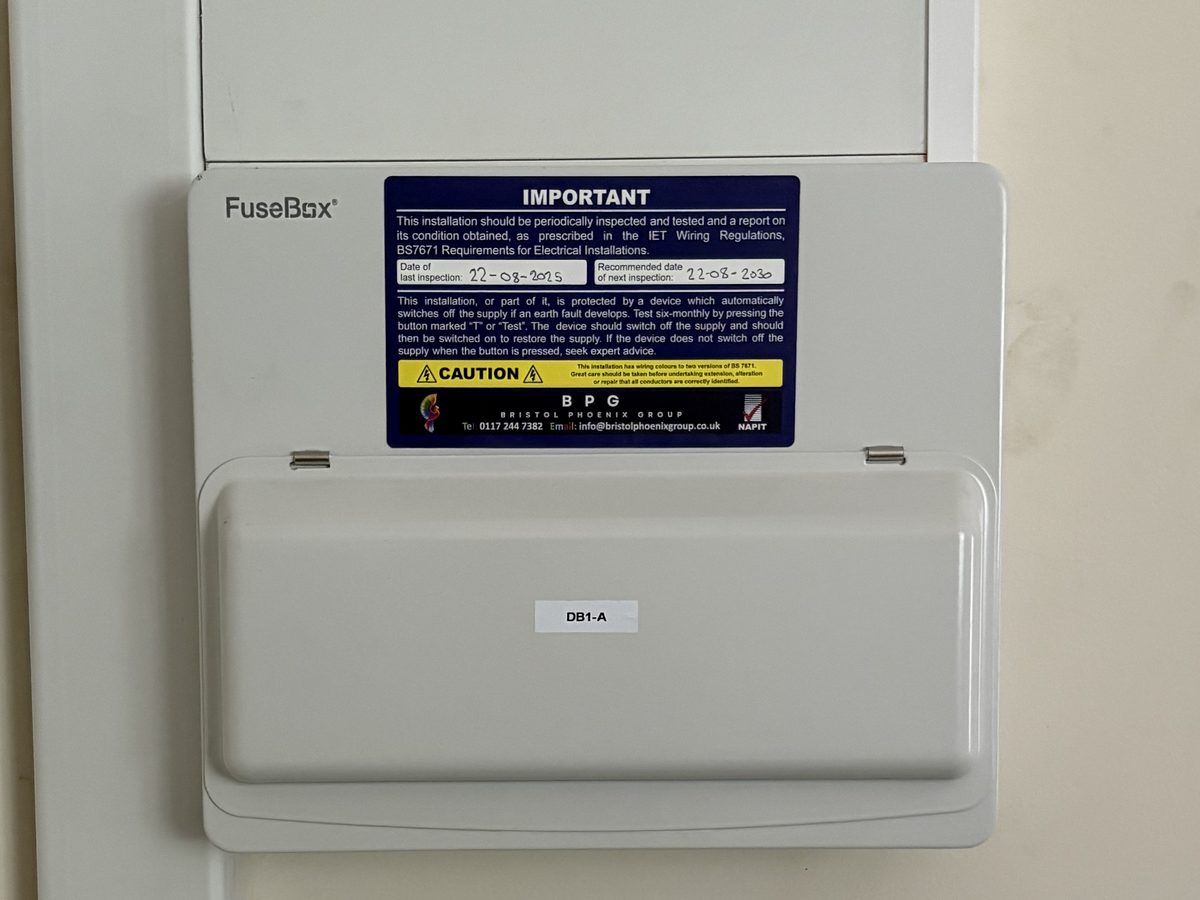
A C2 code means potentially dangerous, and it makes the report unsatisfactory until the work is done, within the 28 day limit above. In Bristol’s shared houses the usual culprits are a consumer unit that predates RCD protection, main bonding to the gas and water that is missing or undersized, and the odd circuit added without protection when a kitchen was extended. None of it is exotic, and most of it has a published price: a consumer unit replacement is £680 plus VAT for a 6 way board or £780 plus VAT for the 8 to 12 way board most houses need, a like for like mains smoke alarm is £120 plus VAT, and tracing a stubborn fault is £140 plus VAT for the first visit. Alarm system upgrades and emergency lighting are itemised in a fixed quote after the inspection.
Two things worth knowing. Remedial work is never part of our inspection price, so the report stays independent, and you are free to take it to another electrician. And a C3 observation, unlike a C2, leaves the report satisfactory: improvement recommended is not the same as work required.
A worked example: a five bedroom Bristol HMO
Picture a typical five bedroom Victorian terrace let to five sharers on individual agreements. Five people from five households sharing a kitchen means a mandatory HMO licence, which Bristol City Council currently charges £1,886 for a new application, lasting up to 5 years. The council refunds £150 against the second payment where satisfactory safety certificates, the EICR among them, reach it before the licence is issued, so the paperwork on this page claws back part of the fee.
The electrical side of that application looks like this. The EICR is from £350 plus VAT, assuming one board of up to 12 circuits; a house like this often has a landlord supply for the hall and alarms, which we price before booking. With up to six occupants the council’s standard asks for a Grade D1, Category LD2 alarm system: interlinked mains powered smoke detectors in the hall, on each landing and in the lounge, with a heat detector in the kitchen. That is a Grade D system, so the servicing certificate needs renewing every 12 months, and we quote the service alongside the EICR so one visit covers both. Emergency lighting only enters the picture if the staircase fails the borrowed light test, which in a standard terrace with a window on the half landing it usually does not.
If the report comes back satisfactory and the alarms pass their service, that is the whole certification bill for the licence cycle: the EICR, a modest annual alarm service, and nothing else until year five. If the report picks up C2s, the common outcome in a house that has not been inspected since its last licence is bonding plus a new consumer unit, which adds £780 plus VAT for the board most houses need. The expensive surprises are rare, and they are exactly what the inspection exists to catch before a fire or a council officer does.
HMO electrical checks across Bristol
We are a NAPIT approved and TrustMark Trading Standards Approved contractor (TrustMark licence 4257835) based in Bishopsworth, and South Bristol is home ground: BS3, BS4, BS13 and BS14, from Bedminster, Southville and Totterdown through Knowle to Bishopsworth and Whitchurch. Bedminster landlords carry the heaviest paperwork in the city, with selective licensing for ordinary rentals and additional licensing for small HMOs running side by side in the same ward, so it is where we test the most shared houses. Our South Bristol page lists the patch street by street.
North of the river we cover Bishopston, Horfield, Cotham, Redland, Henleaze, Westbury-on-Trym and Southmead, BS6, BS7, BS9 and BS10, regularly. That is where the tall student and young professional HMOs cluster near Gloucester Road, and where the 2024 licensing schemes brought plenty of three and four bed sharer houses into scope for the first time. The full detail of what we do for shared houses, grades, interlinking and all, is on our HMO electrical safety page.
Questions we get asked
Do three sharers really need HMO electrical checks in Bristol?
Yes. Three or four people from two or more households sharing a kitchen or bathroom need an additional licence anywhere in the city, and the licence leans on the same EICR and alarm certificates as a big HMO. The 2020 electrical safety regulations apply to the house regardless of whether it is licensed.
How often does an HMO EICR need renewing?
At least every 5 years, or sooner if the report sets a shorter interval. Bristol’s licence conditions expect a replacement report within two months of the old one expiring, so the renewal is worth booking before the five years are up, not after.
Is the HMO fire alarm certificate cost part of the EICR?
No, they are separate documents to separate standards: the EICR covers the fixed wiring to BS 7671, while the alarm servicing certificate covers the detection system to BS 5839-6. We quote them together and do both in one visit where access allows, which is the cheapest way to keep both current.
Booking the certificates for your Bristol HMO
Every price in this guide is published, fixed and the same anywhere in Bristol, and every quote is given in writing before work starts. We are rated 5.0 on Google across 134 reviews, and we plan HMO inspections around tenants and letting agents rather than expecting the house empty. For an EICR, an alarm service or both on one visit, get in touch or call 0117 244 7382 and we will confirm the price for your house before anything is booked.