Around four in five UK electric car charging sessions happen at home overnight, which is why the box on your wall matters more than most buyers realise. I fitted my first home charge point years ago in Bedminster, talking a nervous homeowner out of running an extension lead from her kitchen socket. These days our vans are out two or three times a week doing exactly that job, and the questions barely change: which charger, how fast, what’s it going to cost? Here are the nine chargers we’d call the best home EV charger choices for a Bristol customer in 2026, plus four more that came close, scored against six things that actually matter once the unit’s on your wall.
Table of Contents
Jump to any section below, or read straight through.
- TL;DR: The Quick Answer
- Comparison Table
- Criteria Breakdown Summary
- 1. Ohme Home Pro
- 2. Myenergi Zappi
- 3. Hypervolt Home 3 Pro
- 4. Pod Point Solo 3S
- 5. Andersen A3
- 6. Wallbox Pulsar Max
- 7. Easee One
- 8. EO Mini Pro 3
- 9. Tesla Wall Connector Gen 3
- Notable Mentions
- FAQ
- Final Thoughts
TL;DR: The Quick Answer
Nine chargers, ranked by what each one does best:
- Ohme Home Pro: auto tariff matching
- Myenergi Zappi: strongest solar diversion
- Hypervolt Home 3 Pro: most polished app
- Pod Point Solo 3S: best all-round value
- Andersen A3: best looking, hidden cable
- Wallbox Pulsar Max: smallest, cheapest option
- Easee One: tethered or untethered, one unit
- EO Mini Pro 3: most discreet design
- Tesla Wall Connector Gen 3: fastest on three-phase
Two things worth knowing before you spend a penny: 7.4kW is the real ceiling for most UK homes on a single-phase supply, whatever number’s printed on the box. And the EV chargepoint grant (the old OZEV scheme) has narrowed hard: homeowners with their own driveway are no longer eligible at all, renters and flat owners can claim 75% of installation costs up to £500, and three related landlord and fleet schemes closed to new claims on 26 May 2026. Budget for the full cost and treat any grant as a bonus, not a plan.
Comparison Table: All Nine Chargers at a Glance
| Charger | Best Known For | Power Output | Price | Where to Buy |
|---|---|---|---|---|
| 1. Ohme Home Pro | Automatic tariff matching | 7.4kW | From £540 (unit); £900-£1,250 installed | Ohme Home Pro |
| 2. Myenergi Zappi | Solar diversion | 7.4kW (22kW three-phase) | £800-£900 (unit); £900-£1,500 installed | Myenergi Zappi |
| 3. Hypervolt Home 3 Pro | Most polished app | 7.4kW | £690-£700 (unit); £1,000-£1,200 installed | Hypervolt Home 3 Pro |
| 4. Pod Point Solo 3S | Nationwide trust | 3.6kW, 7kW or 22kW | £799-£1,099 (unit); £800-£1,300 installed | Pod Point Solo 3S |
| 5. Andersen A3 | Hidden cable storage | 7kW/7.4kW | From £995 (unit); £1,374-£1,800+ installed | Andersen A3 |
| 6. Wallbox Pulsar Max | Compact size | 7.4kW | £500-£639 (unit); £900-£1,250 installed | Wallbox Pulsar Max |
| 7. Easee One | Charging flexibility | 1.4kW-7.4kW (dynamic) | £489-£899 (unit); £900-£1,100 installed | Easee One |
| 8. EO Mini Pro 3 | Discreet styling | 7.2kW (22kW three-phase) | £500-£746 (unit); £966-£1,250 installed | EO Mini Pro 3 |
| 9. Tesla Wall Connector Gen 3 | Raw charging speed | Up to 22kW three-phase (7.4kW single-phase) | £1,000-£1,300 installed (earth rod extra) | Tesla Wall Connector Gen 3 |
Criteria Breakdown Summary: How We Scored Each Charger
We score six things every time, in the same order: power, tariff-matching, solar, build and warranty, how much of a headache installation turns out to be (which is where home EV charger installation cost comes in), and value. Real-world output on a single-phase supply is what counts for power, not the three-phase number most driveways will never see. Tariff and solar scores boil down to one question: can this thing shift your charging to 2am on its own, or are you setting a timer by hand every night?
That tariff-shifting behaviour isn’t just clever design, it’s the law. Under the Electric Vehicles (Smart Charge Points) Regulations, every new home charger sold in Great Britain must default to a randomised delay of up to ten minutes before it starts charging, and hold off through the weekday peak windows of 8am to 11am and 4pm to 10pm unless you override it. Every charger on this list meets that baseline; where they differ is how much further they take it.
None of this comes from a press release. It’s independent testing, published specs and what real owners say once the install van has gone, because a spec sheet won’t tell you a charger keeps dropping its WiFi every January. If you’re purely chasing the fastest Level 2 home EV charger on this list, skip straight to the Tesla Wall Connector, but you’ll need three-phase power at your property before that number means anything. Everyone else: the best home EV charger is the one that matches your tariff, your car and your wall, not whichever box has the biggest kW printed on the side.
1. Ohme Home Pro: The Tariff-Matching Specialist
We fit more of these than almost anything else on our books, usually for the same reason: it reads your tariff directly instead of making you set a schedule by hand. It’s a compact, tethered unit with a colour screen built in, running off a 4G SIM rather than leaning on your home WiFi, which matters when your router’s nowhere near the consumer unit.
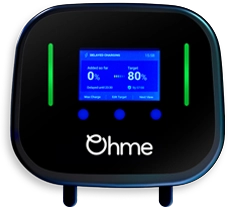
At 7.4kW it’s tethered only, so measure your cable length and think about where you park before ordering. The unit’s IP65 rating shrugs off the weather once it’s fitted, and it qualifies for OZEV grant funding where you’re eligible. Set it up once, and it runs itself around your cheapest rate. Our one gripe: no solar diversion, so panel owners should look elsewhere, and a weak 4G signal near the consumer unit can occasionally cause grief.
On our scorecard: Power 3.5/5, Tariff-matching 5/5, Solar 2/5, Build & warranty 3.5/5, Installation 4/5, Value 4/5. Owners on the OVO Energy community forum describe years of reliable use, the odd dropped connection sorted with a router restart. Pricing starts from £540 for the unit alone; fitted, you’re typically looking at £900 to £1,250. For hands-off, cheap-rate charging, this is the best home EV charger to start with. Where to find: Ohme Home Pro.
2. Myenergi Zappi: Built for Solar Homes
Built in Grimsby, the Zappi solves one problem: what happens to spare solar generation once the immersion heater’s had its share. A CT clamp on your meter tails measures panel output against household use, and it routes anything spare into your car rather than selling it back to the grid for a few pence a unit. I used to recommend this to every solar customer without much thought. Now I ask more questions first: commissioning it properly takes longer than people expect.

It runs at 7.4kW on a standard supply, or up to 22kW with three-phase power, tethered or untethered. Solar accuracy is where it wins outright: nothing else reads spare generation as precisely, and built-in PEN fault protection matters given how common PME earthing is across UK homes. It’s also the largest box in the lineup, the app buries basic settings a couple of taps deeper than Hypervolt’s, and commissioning takes longer than most rivals.
Scored out of five: Power 4.5, Tariff-matching 4, Solar 5, Build & warranty 3.5, Installation 4, Value 3.5. Trustpilot holds it at 4.1 out of 5 across more than 2,700 reviews. Support hold times are the main complaint; the install experience itself gets consistent praise. The unit runs £800 to £900, and once solar integration’s included, installed pricing typically lands at £900 to £1,500. Where to find: Myenergi Zappi.
3. Hypervolt Home 3 Pro: The App Experience Leader
Every charger here has an app. Hypervolt’s is the one people genuinely enjoy using, which is a strange thing to say about a bit of home electrical kit. Boost, Eco and Super Eco modes let you decide how much control to hand over, anywhere from full manual charging through to letting it run entirely around your tariff without you touching it again.

Designed and built in the UK, it delivers 7.4kW through a tethered cable in 5m, 7.5m or 10m lengths, with a cable tidy thrown in. Support is dependable, the warranty’s extendable, and the Eco modes hold their own against Zappi’s solar handling despite Hypervolt never marketing itself as a solar charger. The catch: tethered only rules it out if you want your own cable, it wants solid WiFi for its cleverest features, and the styling is quite industrial for a period house wall.
Our numbers: Power 3.5, Tariff-matching 4.5, Solar 4.5, Build & warranty 4.5, Installation 3.5, Value 3.5, all out of five. Trustpilot reviewers keep mentioning fast, professional installs; where the feedback turns negative, it’s almost always about delivery timing rather than the unit itself. Full pricing’s in the table above, unit and installed both. Where to find: Hypervolt Home 3 Pro.
4. Pod Point Solo 3S
More UK electric cars charge through this network than almost any other, and that scale shows in how the Solo 3S is put together: sensible, well tested, backed by a company most drivers already know from a supermarket car park. What Car? put it top for value among thousands of reviews.

You can specify it at 3.6kW, 7kW or 22kW. Automatic power balancing keeps it working safely alongside the rest of your home’s load, and over-the-air updates mean it keeps improving without a call-out. Five-year warranty, flexible cable choice, a simple app that doesn’t try to do too much, spot on for anyone who’d rather not think about it twice. If we’re being picky, it won’t hunt out your cheapest overnight rate on its own, and the box is a bit larger than it needs to be, but neither has ever been the reason a customer called us back.
On our scorecard: Power 4, Tariff-matching 3, Solar 3, Build & warranty 4.5, Installation 4.5, Value 4.5, out of five. On Trustpilot, the recurring theme is reliability and engineers who turn up on time. Pricing starts from £799 to £1,099 for the unit, £800 to £1,300 installed. If you want the best home EV charger without surprises, this is usually it. Where to find: Pod Point Solo 3S.
5. Andersen A3: The Design Statement Piece
Design comes first here, charging second, and the A3 proves it: the cable disappears completely into the housing when not in use, leaving a smooth box that’s the best-looking home charger sold in the UK. Dozens of finishes are available, from render-matching neutrals to bold colours, with proper solar integration built in too.

Output sits at 7kW or 7.4kW depending on the finish, and Andersen backs it with a seven-year warranty and a cable that shrugs off a British winter without complaint. That design comes at a cost: it’s the priciest option of the nine, output is capped below rivals on three-phase supplies, and the striking finishes add further expense on top of an already high starting price.
Scored out of five: Power 3, Tariff-matching 3.5, Solar 3.5, Build & warranty 5, Installation 3.5, Value 2.5. It holds an excellent 4.8 out of 5 on Trustpilot from more than 1,800 reviews, with a small number of owners reporting reliability faults after fitting. Installed is where the real number lives: home EV charger installation cost typically runs £1,374 to £1,800 or more once finish and earthing work are factored in, against a unit price from £995. Where to find: Andersen A3.
6. Wallbox Pulsar Max
At just 1.3kg, the Pulsar Max is the smallest home charger sold in the UK, obviously so next to a Zappi. It’s an easy pick for narrow porches, tight side returns, or anywhere a bulkier box would look wrong on the wall.
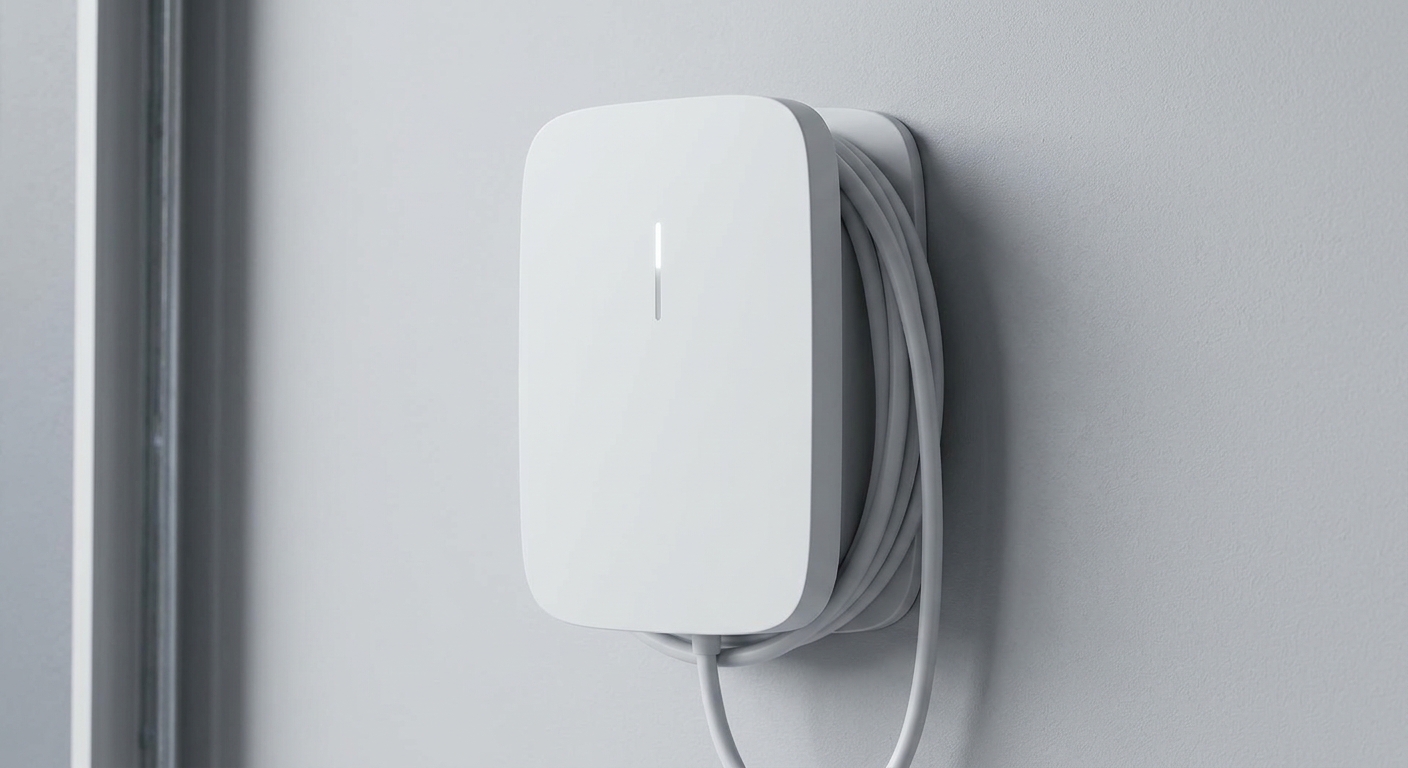
It still delivers a full 7.4kW despite the size, available tethered or untethered, with WiFi, Bluetooth and Alexa control built in. Six colours and the lowest entry price here make it an easy recommendation for anyone hunting the best home EV charger on a tighter budget. The warranty runs shorter than most rivals, there’s no screen on the unit itself, and the cable simply hooks onto the side rather than tucking away anywhere.
Our numbers: Power 3.5/5, Tariff-matching 3.5/5, Solar 3/5, Build & warranty 4/5, Installation 4/5, Value 4.5/5. Owners on the MG EVs community forum report dependable, unremarkable charging, which is exactly what you want from a box on a wall. A few needed a firmware update before Octopus Go would schedule correctly; five minutes and it was sorted. £500 to £639 for the unit, £900 to £1,250 installed is typical. Where to find: Wallbox Pulsar Max.
7. Easee One: Two Chargers in One Box
Nordic design shows through immediately: a compact unit built around interchangeable covers and real flexibility rather than one fixed configuration. It’s the only charger here that switches between tethered and untethered use on the same unit, so a change of car doesn’t mean buying a new charger. Thinking about a second EV soon? That’s exactly who this is built for.

Output flexes dynamically between 1.4kW and 7.4kW depending on what your supply can spare, with load balancing and PEN fault protection built in, so a separate earth rod isn’t normally needed. I’ll be straight with you: we’ve had two come back on us in the last year with the same fault, a power module fault needing a full swap under warranty. Solar diversion needs a separate accessory, the app is noticeably more basic than Hypervolt’s or Zappi’s, and installer support around Bristol is patchier than the bigger names.
On our scorecard: Power 4, Tariff-matching 3, Solar 2.5, Build & warranty 4, Installation 4.5, Value 4, out of five. Reviews on Trustpilot average 4.4 out of 5 from over 1,000 owners, though our own experience has been more mixed than that average suggests. You’re looking at £489 to £899 for the unit, £900 to £1,100 once it’s fitted. Where to find: Easee One.
8. EO Mini Pro 3: You’ll Forget It’s There
Built in Britain and designed for restraint, this is the most discreet charger here by some distance, small enough to fade into a wall rather than announce itself. We fitted one on a Georgian terrace on Royal York Crescent where the owner didn’t want anything visible from the pavement, and it was the only one small enough to tuck behind a downpipe.

It delivers 7.2kW on a standard supply or up to 22kW with three-phase power, tethered or untethered, with a remote locking schedule that’s actually useful for controlling when the socket or cable can be used.
That’s about where the good news ends. The app draws more bug complaints than any charger we’ve covered. Solar handling feels bolted on rather than designed in, nowhere near Zappi’s CT-clamp accuracy, and its Trustpilot score is the lowest of the nine.
Scored out of five: Power 3.5/5, Tariff-matching 2.5/5, Solar 2.5/5, Build & warranty 4/5, Installation 4/5, Value 4/5. The MG EVs community forum tells a rougher story than the star rating suggests: early fault-mode issues came up more than once, and the reviews skew noticeably more negative than for any rival on the market. The unit alone is £500 to £746; get it installed and budget £966 to £1,250. Where to find: EO Mini Pro 3.
9. Tesla Wall Connector Gen 3: Got Three-Phase Power at Home?
This wallbox is deliberately minimal: a sleek black slab with no screen and barely any branding, earning its place here purely on output. On a three-phase supply it reaches 22kW, making it the fastest Level 2 home EV charger here, borrowing the American term for what the UK simply calls fast AC charging.

Drop it onto a standard single-phase supply, which describes most UK homes, and it settles at the same 7.4kW as the rest, so that headline speed only matters if you’ve actually got three-phase power at your property. Load sharing lets multiple units split available capacity if you add a second charger later, and the four-year warranty is solid. Tesla’s tariff smarts and solar handling, mind you, lag well behind the specialists on this list. Most installs also need an earth rod, since the Wall Connector skips the open-PEN fault protection that Zappi and Easee build in, extra cost that catches some buyers out.
Our numbers: Power 4.5/5, Tariff-matching 2.5/5, Solar 1.5/5, Build & warranty 4/5, Installation 2.5/5, Value 3/5. Users on the Tesla Motors Club forum call it solid once it’s set up. Occasional WiFi issues come up, and firmware updates have generally sorted them. Typical installed pricing runs £1,000 to £1,300, with an earth rod often adding to that figure. Where to find: Tesla Wall Connector Gen 3.
Notable Mentions: Four Chargers That Almost Made the Cut
These four didn’t quite crack the top nine, but each earns a mention in any wider conversation about the best home EV charger UK buyers are weighing up.
Simpson & Partners Home Series V3. This one topped an independent UK test outright, earning a full five out of five with a ten-year warranty, longer than anything else on this list. See the Simpson & Partners Home Series V3.
Ohme ePod. Ohme’s untethered model, running the same tariff-reading automation as the Home Pro in a smaller body for anyone who’d rather bring their own cable. Details on the Ohme ePod page.
Indra Smart LUX. At under 80mm deep, it’s the slimmest charger on the market and fully submersible too, useful anywhere exposed to driving rain or coastal weather. More on the Indra Smart LUX.
Zaptec Go 2. The first UK home charger with vehicle-to-grid built in: your car’s battery could eventually feed power back into your home rather than only draw from it. More on the Zaptec Go 2.
FAQ: Your Home EV Charger Questions Answered
Here are the six questions Bristol homeowners ask most often, whether they’ve already chosen a charger or they’re still weighing it up.
Which is the best home EV charger overall in 2026?
For most Bristol households we’d point you to the Ohme Home Pro: it reads your tariff automatically and asks the least of you once it’s fitted. The Zappi still wins if solar panels are the priority, and the Pod Point Solo 3S is the safe, no-surprises pick if you’d rather not compare specs at all. There’s no single best home EV charger for every driveway, only the one that matches your tariff, your car and your supply.
Do I need planning permission for a home EV charger in the UK?
Most houses won’t need it. Permitted development rights generally cover a home charge point, but listed buildings, their curtilage and conservation areas facing a road can be exceptions, and flat owners usually need freeholder consent too. When unsure, call your planning department first.
Can I install a home EV charger myself?
No. It’s hardwired as notifiable work under Part P, so most homeowners book a professional EV charger installation rather than attempting the wiring themselves. That settles the hardwired vs plug-in home EV charger debate: a granny lead runs from an ordinary socket, but every wallbox on this list wires into its own circuit, which means a certified electrician for home EV charger installation has to handle the connection, earthing and paperwork.
What’s the real difference between a tethered and an untethered charger?
A tethered charger has the cable permanently attached: lift it, plug in, go; the fixed length just means thinking about where you park. An untethered charger gives you a bare Type 2 socket and you bring your own cable, useful if you might switch cars or want a spare in the boot. Most of our customers go tethered, it’s one less thing to lose. Unless you’ve a real reason to switch, we’d point you the same way.
Am I eligible for the EV chargepoint grant (formerly OZEV)?
Only if you’re a renter, a flat owner or a landlord, not a homeowner with your own driveway. Renters and flat owners can claim 75% of installation costs up to £500, and landlords can claim up to £500 per socket, though three related schemes for fleets and commercial landlords closed to new claims on 26 May 2026. If you’re a landlord fitting a charger alongside other electrical work, it’s worth checking both jobs in one visit. Everyone else should plan around our EV charger installation cost guide rather than counting on a grant.
How long does a home EV charger installation take?
Most straightforward jobs are done within a day once your supply’s been surveyed. That survey checks your consumer unit, earthing and cable route, and tells us whether you’re looking at a few hours or something longer. Jobs stretch out when a consumer unit upgrade or an earth rod is needed, so ask for a survey before committing to a date.
Final Thoughts: Which Charger Comes Out on Top?
If you make us pick just one, it’s the Ohme Home Pro, our own go-to when someone wants us to just choose, since it does more of the hard thinking around your tariff than anything else here. But the right answer still shifts depending on your electricity supply, your tariff, whether solar panels are on the roof yet, and how much you care what the box looks like once fitted.
Chasing hands-off savings on a smart tariff? The Ohme Home Pro or Hypervolt Home 3 Pro do more thinking for you than most rivals. Solar’s the priority? The Zappi still wins on accuracy. Want a trusted name, or something for a tight space? Look at the Pod Point Solo 3S or Wallbox Pulsar Max.
A few things apply whatever you choose:
- 7.4kW is the ceiling for almost every UK home on a single-phase supply, no matter what a 22kW badge on the box might promise
- Tariff automation varies hugely between chargers, so check what your supplier actually supports before you buy, not after
- Solar diversion only earns its keep once panels are on the roof or firmly on the plan
- The hardwired vs plug-in home EV charger question is settled the moment you charge regularly: every unit on this list needs its own circuit, certified under BS 7671, which updates to Amendment 4:2026 on 15 October 2026, the date every new installation has to work to the current edition
We’re Bristol Phoenix Group, a NAPIT approved electrician in South Bristol, rated 5.0 on Google from over 118 reviews, fitting chargers like these across Bedminster, Knowle, Whitchurch, Hartcliffe and Long Ashton most weeks of the year. Every job starts with a survey of your supply, consumer unit and earthing, so you know upfront if an upgrade’s needed, exactly what a certified electrician for home EV charger installation should check before quoting a number. Our fixed EV charger pricing starts from £780 + VAT, and landlords often add a periodic EICR (from £180 + VAT) to the same visit, so you get a clear home EV charger installation cost with nothing sprung on you later. Know which unit you want, or fancy our recommendation for the best home EV charger for your supply and tariff? Get in touch or call us on 0117 2447 382 and we’ll give you a fixed price.