
What is a partial rewire? It is a rewire of one defined part of your home rather than the whole installation: one floor, one or two circuits, or the rooms touched by an extension or loft conversion. A full rewire replaces every cable, every socket and switch, and the consumer unit in a single certificated job. Whether a partial rewire is enough comes down to one question, and it is not about age or price: is the wiring you plan to keep genuinely sound? In this guide we explain what a partial rewire covers, what it costs, and the decision rule we use on surveys across Bristol.
What a Partial Rewire Covers
A partial rewire replaces the cabling, back boxes and accessories in a defined area or on defined circuits, then connects the new work back to your existing consumer unit or a new one. Typical scopes we quote for in Bristol look like this:
- One floor of the house, usually upstairs or downstairs, where the other floor was rewired during an earlier refurbishment.
- A single circuit type, most often the lighting circuits, because lighting cable in older homes tends to be the first thing to fail testing.
- A kitchen or bathroom being refitted, where the walls are open anyway and it would be daft not to renew the wiring while they are.
- The rooms affected by an extension, garage conversion or loft conversion, wired as new circuits alongside the untouched rest of the house.
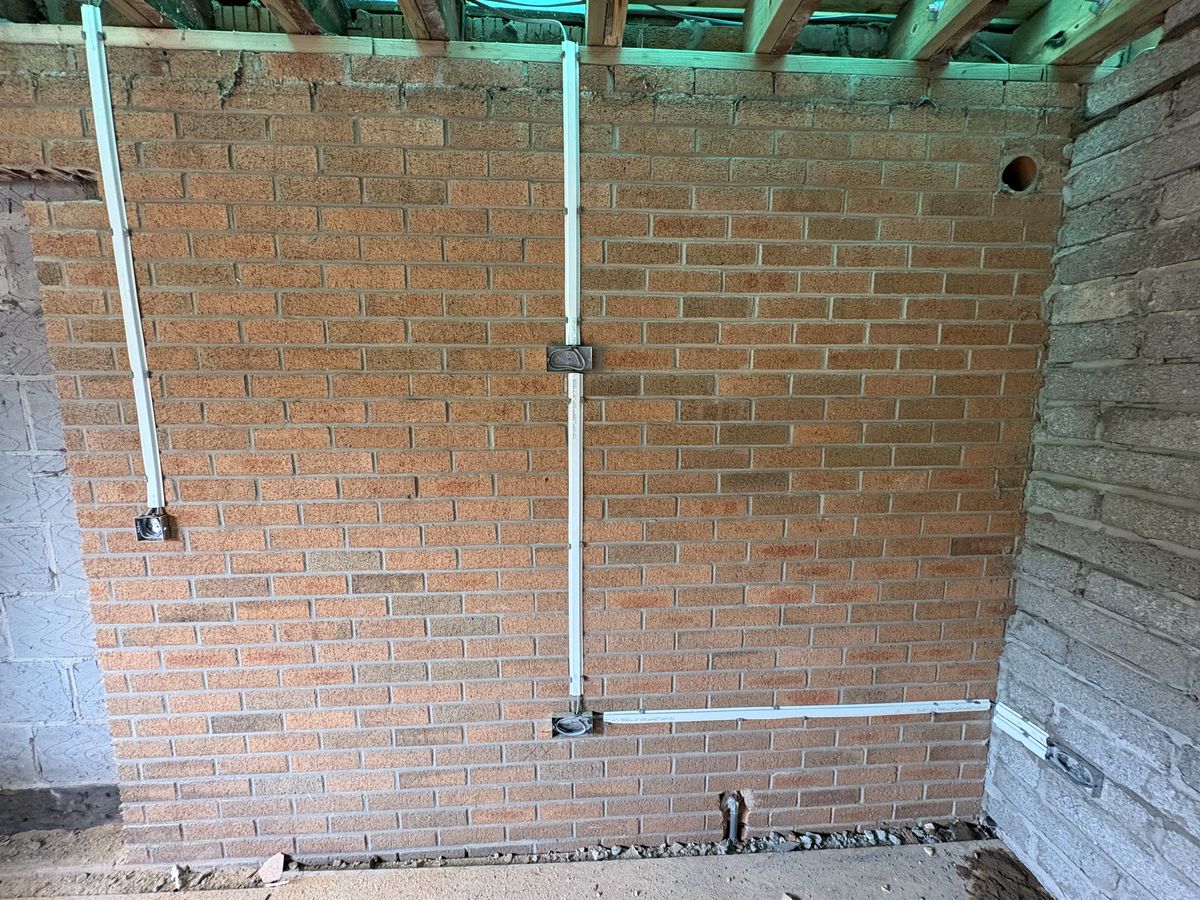
What a partial rewire never does is make the wiring you keep any younger. That matters, and it is where the decision rule below comes in.
Partial Rewire vs Full Rewire: The Real Difference
The difference is scope, but the practical consequences show up in cost, disruption and paperwork.
| Partial rewire | Full rewire | |
|---|---|---|
| Scope | One floor, one or two circuits, or the rooms around an extension or conversion | Every circuit, accessory and the consumer unit, throughout the property |
| Typical cost | Roughly £300 to £800 for a single room and £500 to £1,500 for a kitchen; most multi-room partial jobs land between £1,500 and £6,000 | From £4,500 with us, depending on bedrooms and spec; see our house rewire cost guide |
| Disruption | Days, confined to the rooms being worked on | Longer, floors and walls opened through the whole house; we ask customers to move out where they can |
| Certification | Electrical Installation Certificate for the new work only; the old wiring keeps its age and its faults | The whole installation certificated and notified in one go |
| Makes sense when | Testing shows the rest of the installation is healthy | The problems are spread through the house, not parked in one corner of it |
One point worth underlining from that table: after a partial rewire, only the new work carries fresh certification. If you are selling or letting the property, a surveyor or an periodic inspection will still judge the installation as a whole.
Do I Need a Full or Partial Rewire? Our Decision Rule
National guides give you definitions. What most of them will not give you is a rule you can actually use, so here is ours, and it is the same one we apply on surveys.
Test first, decide second. The honest way to choose is dead and live testing of the circuits you intend to keep, the same tests an electrician runs during an EICR. If the insulation resistance, earth continuity and disconnection times on the retained circuits all pass, a partial rewire is a sound spend. If the retained circuits fail or scrape through, every pound spent on a partial rewire is a pound you will spend again when the rest catches up with you, usually within a few years and usually at the least convenient moment.
Three findings push us firmly towards recommending a full rewire instead:
- Pre-1977 cable colours throughout. Red and black cores are not dangerous in themselves, but they date the installation. Our guide to old UK wiring colours explains how to read what you have.
- Rubber or fabric-insulated cable anywhere. Rubber insulation from the 1950s and earlier goes brittle and crumbles when disturbed. One run of it usually means more of it hiding elsewhere.
- A fuse box with rewirable fuses and no RCD protection. If the consumer unit predates modern protection, the circuits behind it are rarely in better shape than the board itself.
There is good reason not to guess at this. Figures published by the Institution of Engineering and Technology in April 2026 put electricity behind around 19,300 accidental domestic fires a year, about 53 per cent of all accidental house fires in England. The same release found that fewer than a third of adults had their home’s electrics checked by a qualified electrician in the past decade. An ageing installation that has never been tested is exactly the situation a partial rewire can paper over.
What a Partial Rewire Costs
Because the scope varies so much, partial rewires are priced from a survey rather than off a rate card. As a sanity check, current national price guides put most partial rewires between £1,500 and £6,000 depending on how many circuits and rooms are involved, with a single room typically £300 to £800 and a kitchen £500 to £1,500. Our own house rewire cost guide breaks the same figures down in more detail.
For comparison, our full rewires start from £4,500 plus VAT for a basic specification, with a three bedroom house from £5,400 plus VAT, fixed in writing after a free survey. There is a price calculator on our house rewiring page. That comparison is worth making before you commit: if a partial rewire quote is heading past £3,000 on a house that will need the rest done within a few years, the full job often works out cheaper than two halves, because scaffolding the work twice means paying twice for access, making good and testing.
Signs You Need a Partial Rewire
On the other side of the ledger, these are the situations where a partial rewire is usually the right call rather than a compromise:
- The house was rewired in living memory but an extension, loft conversion or garage conversion is adding rooms that need their own circuits.
- A kitchen or bathroom refit has the walls open, and the local wiring is older than the rest of the house.
- An EICR has failed one circuit, commonly the lighting, while the rest of the installation tested clean.
- Half the house was rewired by a previous owner and testing confirms that half is sound, so only the untouched half needs doing.
That last one is more common in Bristol than you might think, and it brings us to the local picture.
What We Find in Bristol Homes
South Bristol is our home ground, and its housing stock almost tells you the likely answer before the tester comes out. The Victorian and Edwardian terraces of Bedminster and Southville in BS3 have usually been rewired at least once, but often in stages: a kitchen done in the nineties, bedrooms untouched since the seventies. Those mixed-age installations are where testing earns its keep, because the answer is rarely all good or all bad. The 1930s semis around Knowle and Headley Park, and the post-war estates of Bishopsworth, Hartcliffe and Whitchurch in BS13 and BS14, tend to be more consistent: either the whole house was rewired at some point or none of it was, which makes the full-or-partial call more clear cut. North of the river, in Bishopston, Horfield, Redland and Westbury-on-Trym, the larger period properties throw up the same staged-rewire pattern as BS3, with the added fun of more floors to run cable through.
If you are local, our South Bristol and Bedminster pages cover the areas we work in most.
Certification: The Part Nobody Should Skip
A partial rewire that adds or alters circuits is notifiable work under Part P of the Building Regulations, so it needs to be done by an electrician who can self-certify, or signed off by building control at your cost. Every notifiable job we complete is certificated and registered through NAPIT, and covered by the NAPIT Work Quality Guarantee for six years. Landlords have an extra reason to get the paperwork right: Government rules require rental properties to have their electrics checked at least every 5 years by a properly qualified person, and NICEIC guidance recommends homeowners have theirs inspected at least once every 10 years. A partial rewire done without certification will surface at exactly those moments.
Questions We Get Asked
Can you do a partial rewire without redecorating the whole house?
Mostly, yes. The disruption stays in the rooms being rewired, and good chasing and making good keeps it manageable. Floors usually need lifting along cable routes, so it pairs well with new carpets or flooring.
Will a partial rewire pass an EICR?
The new circuits will. An EICR tests the whole installation though, so if the retained wiring has problems, the report will say so. That is why we test before quoting rather than after.
Can you rewire one room at a time over several years?
You can, but each visit carries its own setup, testing and certification cost, so the total runs well past a single job. It makes sense when budget forces it, and we will sequence the work so the riskiest circuits go first.
Talk to a Bristol Rewiring Specialist
If you are weighing up a full or partial rewire anywhere in Bristol, the free survey settles it. We are Bristol Phoenix Group, a NAPIT approved and TrustMark Trading Standards Approved electrical contractor (TrustMark licence 4257835) based in South Bristol, with over 100 five-star Google reviews. We will test what you have, tell you plainly which parts are worth keeping, and put a fixed price in writing either way. Call us on 0117 244 7382 or get in touch through the website for a free written quote.