
The plaster is dry, the mist coat is on, and for the first time since the slab went down the place looks like a house rather than a site. Then somebody checks the programme and asks when the electrician is back. Second fix electrics is that return visit: the stage where sockets, switches, light fittings and the consumer unit turn a wired shell into a working installation, and where the testing happens that turns a boxful of cable into paperwork a building control body will accept. We covered first fix electrics, the half of the job that gets buried, in a separate guide. This is the other half: what the second fix stage covers, when it happens, what it costs, and why rushing it is where snagging lists are born.
Table of Contents
- What Second Fix Electrics Actually Covers
- Second Fix After Plastering: Where the Stage Sits
- First Fix vs Second Fix: The Same Split From the Other Side
- The Consumer Unit Goes In at Second Fix
- Testing and Certification: The Part That Is Not Optional
- Why Rushing Second Fix Causes Snagging
- Take a Typical Southville Loft Conversion
- Second Fix on Small Commercial Fit-Outs
- What Second Fix Electrics Costs
- Booking Second Fix Electrics in Bristol
TL;DR
- Second fix is everything you can see or switch, plus the proof it works: faceplates, light fittings, alarm heads, fans, the consumer unit fitted and connected, then inspection, testing and certification.
- It starts once the plaster is dry, ideally after the mist coat, and needs to finish before the decorator’s final coats and the kitchen fitter’s end panels close things in.
- BS 7671 requires every installation to be inspected and tested before it goes into service. The Electrical Installation Certificate is not an optional extra, it is part of the product.
- On notifiable work, the Building Regulations compliance certificate has to reach the occupier and building control within 30 days of completion.
- Most electricians charge £40 to £60 an hour, and a second fix visit is usually priced per point within the whole job rather than as a separate day rate.
- The decisions that stall second fix are never electrical. Faceplate finishes, pendant positions and kitchen end panels stall it. Freeze them before the electrician is on the stairs.
What Second Fix Electrics Actually Covers
The first fix test was simple: if it disappears behind plaster, plasterboard, screed or a floor deck, it is first fix. Second fix is the mirror of it. If you can see it, switch it or plug into it, it belongs to second fix. Ask what is second fix electrical work and most answers stop at sockets and switches, which is a bit like describing decorating as opening the paint.
On a typical domestic job the visit covers the faceplates on every socket and switch, the light fittings, pendants and downlights, the cooker connection unit, the shower isolator, extractor fans, outside lights, and the smoke and heat alarm heads that go onto the cabling run at first fix. Data and TV outlets get terminated onto the draw wires somebody sensibly left in the wall. The consumer unit is fitted and connected, which surprises people who assumed it went in months ago. And then comes the part that separates a finished installation from a collection of nicely aligned faceplates: dead testing, live testing, and the certificate.
What Is Not Second Fix
No new cable routes. That is the whole point of the split. A socket that nobody ran a cable to is not a second fix job, it is a first fix problem arriving late, and it now involves a lifted floor or a chased wall and a decorator doing the same wall twice. Our first fix electrics guide covers how to freeze layouts early enough that this never happens. The two guides are two halves of one process, and the builders who run smooth jobs treat them that way.
Second Fix After Plastering: Where the Stage Sits
The second fix window opens when the plaster is dry enough to fix to and closes when the decorator starts final coats. Inside that window there is an order that saves arguments. Decorators prefer the mist coat and first full coat done before faceplates go on, because cutting in around fifty accessories is slow and nobody enjoys wiping emulsion off brushed steel. Second fix after plastering, after the mist coat, before the final coats: that sequence keeps every trade off each other’s toes.
Kitchens complicate it, as kitchens complicate everything. Appliances need their connections made before the fitter boxes them in with end panels, and sockets above the worktop cannot be finished until the splashback or tiling is done. On most kitchen jobs the electrician makes two short second fix visits rather than one, and a programme that pretends otherwise is quietly planning a snag.
How long does it take? On a full three bed rewire the second fix half typically runs two to three days, as our guide to how long a rewire takes sets out day by day. On an extension or loft conversion it is often a single day, provided the decisions were made. That last clause is doing a lot of work, and we will come back to it.
First Fix vs Second Fix: The Same Split From the Other Side
We published this table in the first fix guide, and it earns its keep from either direction. First fix is followed by the plasterer. Second fix is followed by the decorator and then the client, which is why the standard of finish suddenly matters as much as the wiring behind it.
| Item | First fix | Second fix |
|---|---|---|
| Cable runs to every point | Yes | No |
| Back boxes and pattresses | Yes | No |
| Earthing and main bonding conductors | Yes | No |
| Consumer unit position and tails route | Yes | Unit fitted and connected at second fix |
| Alarm and data cabling | Yes | Heads and outlets only |
| Sockets, switches and faceplates | No | Yes |
| Light fittings and downlights | No | Yes |
| Fans, isolators and connection units | No | Yes |
| Testing, inspection and certification | No | Yes |
On a whole house project the two stages sit either side of the plastering, and the second half is the quiet, clean one. It is also the half where the client is watching, because by now they have moved from looking at drawings to standing in rooms.
The Consumer Unit Goes In at Second Fix
The board position and the tails route were settled at first fix, but the unit itself waits. There are good reasons. A consumer unit hung early on a live site collects plaster dust in its terminals, paint on its enclosure and, on some sites, a mysterious absence by week three. Fitting it at second fix means it goes onto a finished wall, gets populated with the right protective devices for the final circuit line-up, and is energised in a controlled way rather than being live next to a wet trade for a month.
Second fix is when each circuit is landed on its breaker or RCBO, the labelling is done properly rather than in biro on masking tape, and the installation is energised circuit by circuit as testing progresses. If the project includes replacing an ageing board as part of wider works, our consumer unit replacement page sets out exactly what a compliant board includes and what we charge for one.
Testing and Certification: The Part That Is Not Optional
Here is the bit that separates second fix from shelf assembly. BS 7671 Regulation 641.1 requires, in the IET’s words, “every installation, during erection and on completion, to be inspected and tested before being put into service to verify, so far as is reasonably practicable, that the requirements of BS 7671 have been met”, as set out in the IET’s guidance on initial verification. In practice that means dead tests before anything is energised, continuity of protective conductors, ring circuit continuity, insulation resistance and polarity, then live tests once it is safe to switch on, earth fault loop impedance and RCD operation among them.
The results go onto an Electrical Installation Certificate. Approved Document P is plain about it: electrical installers who are registered competent persons “should complete a BS 7671 electrical installation certificate for every job they undertake”, and the certificate goes to the person ordering the work. Where the work is notifiable, a new circuit, a replacement consumer unit, or additions and alterations in special locations, the Building Regulations compliance certificate must reach the occupier and the building control body within 30 days of completion. Our guide to the Part P Building Regulations walks through what triggers notification and what the paperwork chain looks like.
None of this is bureaucratic decoration. The Home Office counted 23,795 accidental dwelling fires in England in the year ending March 2026, according to its detailed analysis of fires attended by fire and rescue services. Testing exists so that the installation you hand over is not quietly on that path. As a NAPIT approved contractor we self-certify notifiable work, which means the building control notification happens through our registration rather than becoming one more thing on the builder’s list.
| Document | What it proves | Who gets it |
|---|---|---|
| Electrical Installation Certificate (EIC) | The new installation or circuits were inspected and tested to BS 7671 | The person ordering the work, kept with the property file |
| Schedule of test results | The measured values behind the certificate, circuit by circuit | Attached to the EIC |
| Building Regulations compliance certificate | Notifiable work was carried out by a registered competent person | Occupier and building control, within 30 days of completion |
Why Rushing Second Fix Causes Snagging
Second fix is where a programme that has slipped tries to claw the time back, because it is the last trade stage before decoration. That is exactly why rushed second fix shows up so reliably on snagging lists. The wiring behind the wall might be perfect. What the client sees is the faceplate that got painted around, and what building control sees is the certificate that never arrived.
The classics, all of which we have been asked to put right on somebody else’s job at one time or another:
- Faceplates fitted before the final coat, then either painted around or removed and refitted with chewed screw heads.
- Downlights cut and fitted before anyone checked the insulation or joist positions above, so two of them sit off-line in the one room where symmetry shows.
- Alarm heads still in their boxes at handover because the ceilings were painted late, on the one item that had a legal reason to be finished.
- A consumer unit with no circuit labels, or labels that say Lights and Sockets on a board with nine circuits.
- Kitchen end panels fitted over appliance connections before the electrician made them, so the fitter comes back to remove panels they fitted the day before.
- No test results because the last two circuits were not complete when the tester was on site, which means another visit and a certificate issued later than the completion date anyone told building control.
Every one of those is a sequencing failure, not an electrical one. The fix is the same as at first fix: a dated line in the programme that every trade has seen, and decisions frozen before the visit starts.
Take a Typical Southville Loft Conversion
Picture a dormer loft conversion on a terraced street in Southville: a bedroom, a small en suite, and a stair with a window over it. First fix went in with the studwork, the room has been boarded, skimmed and mist coated, and the second fix visit is booked for the Thursday.
The morning is fittings: faceplates on six sockets, switches at the stair head and door, downlights in the en suite, a pendant in the bedroom, the extractor fan connected through its isolator, and the heat and smoke alarm heads clicked onto their bases. The afternoon is the part nobody watches: continuity and insulation resistance on the new circuits, polarity, the circuits landed and labelled at the board, loop impedance and RCD tests with the power on, and the results written up on the certificate that evening. One visit, one day, because the fittings were on site and the decisions were made.
Now run the same job with one change: the client sees the mist coated room and decides the pendant should be six downlights. That is not a second fix change. It is new cable routes above a finished ceiling, which means either lifting boards in the eaves or cutting and patching the ceiling, then a plasterer and decorator returning for one room. The Thursday visit becomes three visits across a fortnight and the handover date moves. The cost of a change scales with how finished the surface it lives behind already is, and by second fix everything is finished.
Second Fix on Small Commercial Fit-Outs
On office and small commercial jobs the same stage exists with different fittings: floor boxes and dado outlets instead of bedroom sockets, modular panels into a suspended ceiling grid, data outlets terminated and patched, and emergency lighting fitted and function tested before sign-off. The certification stakes are, if anything, higher. In the Home Office’s figures for the year ending March 2026, electrical distribution was the largest specified ignition source in fires in other buildings, the category that includes offices and shops, at 17 per cent. The wiring itself, in other words, is the thing most likely to start a fire in a commercial building, which is why the testing at second fix is not a formality.
We carry out fit-out electrics, office rewires and commercial EICRs across Bristol alongside the domestic work, and the sequencing conversation with a shopfitter is word for word the one we have with a house builder. When does the ceiling grid close, when do the desks arrive, and is the electrician done, tested and certificated before either.
What Second Fix Electrics Costs
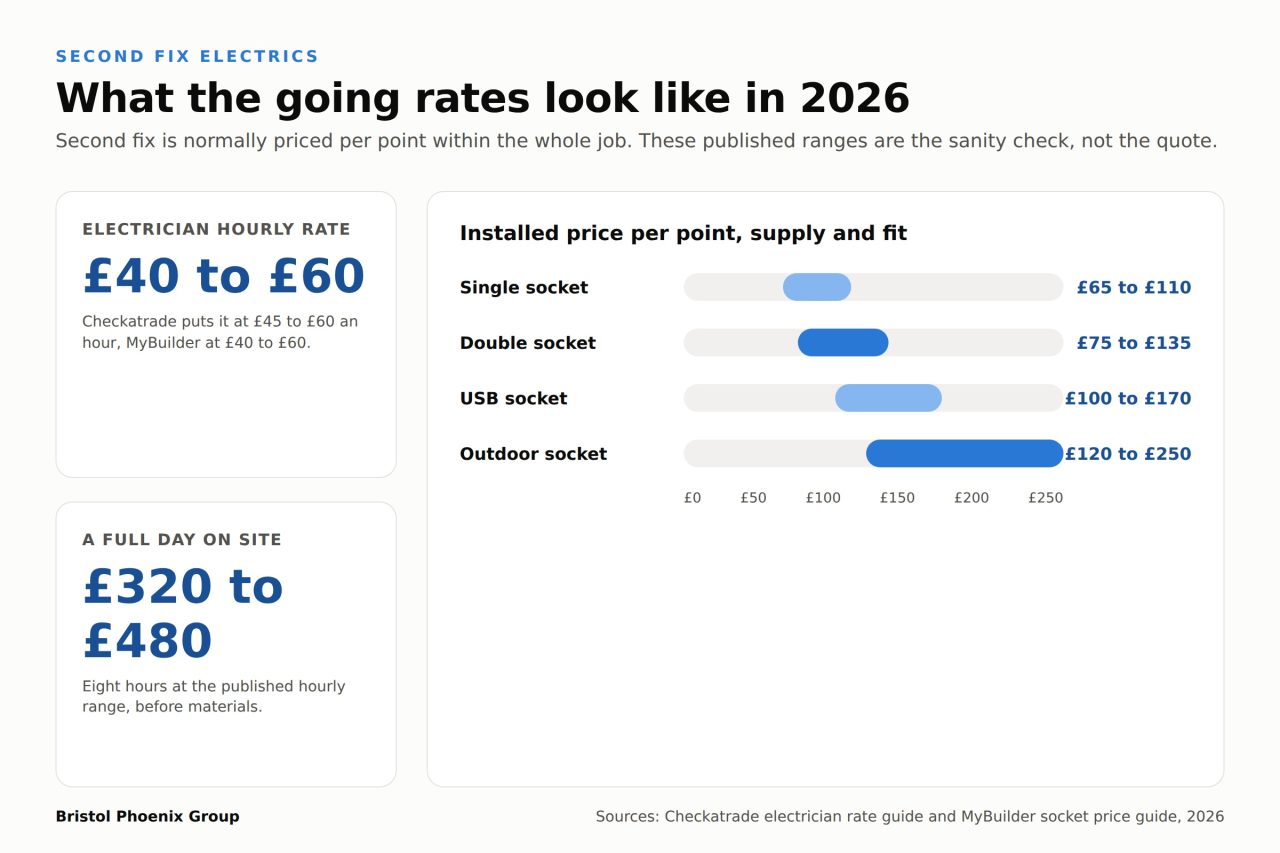
Second fix is usually priced as part of the whole installation, per point, rather than as a standalone visit, because the fair price depends on what was first fixed and to what spec. That said, the going rates are public enough. Electricians in the UK typically charge £45 to £60 an hour according to Checkatrade’s 2026 rate guide, and £40 to £60 an hour according to MyBuilder’s pricing guide, which puts a full day somewhere between £320 and £480 before materials.
For individual additions priced on their own, MyBuilder’s current figures give a feel for the per-point maths:
| Item | Typical installed price |
|---|---|
| Single socket | £65 to £110 |
| Double socket | £75 to £135 |
| USB socket | £100 to £170 |
| Outdoor weatherproof socket | £120 to £250 |
Treat those as sanity-check ranges rather than quotes. A second fix visit on a job we first fixed is priced with the job, and a second fix visit rescuing somebody else’s first fix is priced after we have seen the first fix. Specification moves the number more than labour does: brushed steel and dimmer modules cost more than white plastic, and forty downlights cost more than eight pendants. On whole house projects the second fix element is wrapped into the rewire price, and our house rewiring page shows where it lands in the overall sequence.
Booking Second Fix Electrics in Bristol
We are a NAPIT approved contractor based in South Bristol, and second fix is the stage of the job where we spend the most time in finished rooms in Bedminster, Southville, Totterdown and the rest of the city’s terraced streets, as well as on extensions, loft conversions and small commercial fit-outs across Bristol. Our new build and extension wiring service covers first and second fix as one package, which is the cleanest way to make sure the certificate at the end matches the cables at the start.
If you are a builder holding a programme with a decorator booked and a gap where the second fix should be, the useful conversation is the early one. Tell us what was first fixed, who fixed it, and when the plaster went on, and we will tell you what the visit needs and how long it will take. You can get in touch with our team to talk through a specific job.
Second fix electrics is the stage everyone can finally see, which is precisely why it rewards patience. The jobs that hand over cleanly are the ones where the last week was calm, the faceplates went onto painted walls, and the certificate was signed before anyone asked where it was.