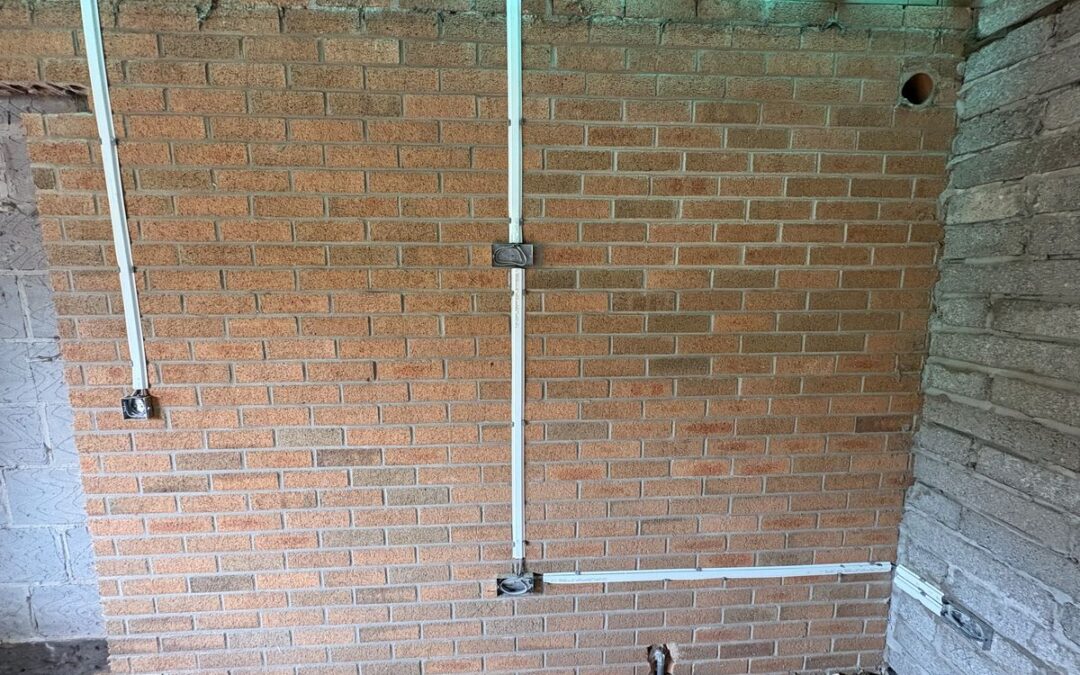
An existing garage or outbuilding needs rewiring, rather than another repair, when the wiring itself is past saving: perished rubber insulation, bare twin and earth clipped loosely along damp brickwork, a DIY tangle of flex and chocolate-block connectors, or sockets with no RCD protection at all. A repair only makes sense when the installation is sound and one part of it has failed. Rewiring a garage or outbuilding means stripping that old wiring out and replacing it with a properly protected supply, modern cable, RCD protection and fittings rated for the conditions, and for most Bristol garages the job lands between £400 and £2,000 plus VAT depending on whether the supply from the house needs renewing too.
We rewire garages, workshops and garden buildings across Bristol every month, so here is how to tell which side of the repair or rewire line yours sits on, what the job involves, what the regulations say and what it should cost.
The signs the old garage wiring has to go
Garages get the wiring nobody would accept in a kitchen. The house gets rewired, the garage gets forgotten, and forty years later it is still running on whatever was screwed to the wall in the 1980s. These are the things we find again and again in older Bristol garages, and any one of them points towards a rewire:
- Cable run on the surface with no mechanical protection, stapled to timber or draped across the roof trusses, often with the sheath cracked where sunlight or damp has got at it.
- Rubber or fabric-insulated cable from the 1960s or earlier. The insulation hardens, crumbles and falls away, leaving live conductors exposed exactly where you store the lawnmower.
- No RCD protection on the sockets. BS 7671 requires socket-outlets rated up to 32 A to have additional protection from a 30 mA RCD, as the IET’s Wiring Matters guidance sets out, and an old garage circuit fed straight off a rewireable fuse has nothing of the sort.
- Damp-damaged fittings: rusted socket faces, green corrosion on terminals, or indoor-rated switches on a wall that runs with condensation every winter.
- Lighting tapped off a house circuit through a joint box nobody can find, so one fault in the garage takes out half the house, and nothing about it appears on any certificate.
- Extension leads doing the job of fixed wiring, running through a window or a drilled hole to power a freezer or a workbench permanently.
None of this is theoretical. Home Office figures for England record that dwelling fires starting in wiring, cabling and plugs killed four people in 2020/21 and left another 120 injured or needing checks, and that is just one year of one category. Old, unprotected wiring in a damp building attached to your home deserves more respect than it usually gets.
Repair or rewire: how we decide
The honest test is whether the installation as a whole could pass an inspection. One failed socket on an otherwise sound, RCD-protected circuit is a repair, and our fault finding visit at £140 plus VAT will usually sort it. But when the cable itself has perished, the earthing is missing or the whole thing was never installed to any standard, replacing one fitting is painting over rot. You would be paying good money to make a dangerous installation look tidier.
A rewire is also the point where the garage stops being an afterthought. If you are planning a workshop, a utility space or an EV charger down the line, the rewire is the moment to size the supply for it, because opening a trench twice is the most expensive way to do anything.
What rewiring a garage or outbuilding actually involves
A proper garage rewire is a small installation in its own right, not a long extension lead. For a detached garage or outbuilding it typically means:
- A new supply from the house, usually steel wire armoured (SWA) cable, either buried at depth in a trench or clipped along a wall or fence line with proper fixings, replacing whatever unprotected cable was there before.
- Its own small consumer unit, or RCBO protection for each circuit, so a fault in the garage trips the garage and not the kitchen. Whether a separate board is worth it for your building is a question we answer fully in our garage consumer unit guide.
- Separate circuits for lighting and sockets, sized for what the building will actually do, with spare capacity for anything you have mentioned wanting later.
- IP-rated sockets and light fittings that shrug off the damp and dust a garage actually contains, rather than indoor fittings slowly corroding on the wall.
- 30 mA RCD protection on the socket circuits, which is not a nice-to-have but a requirement of BS 7671.
- Full testing, an electrical installation certificate, and notification to building control through our NAPIT registration, so the work exists on paper as well as on the wall.
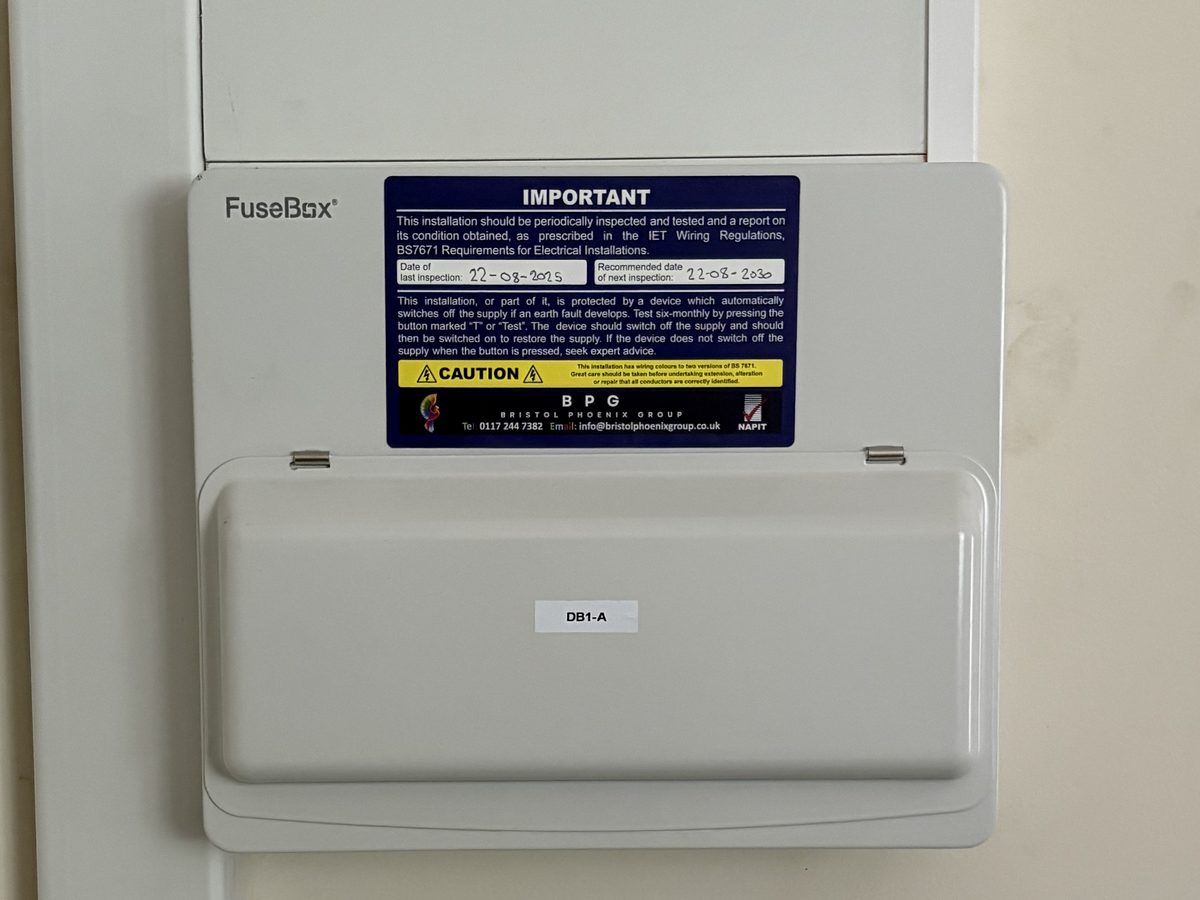
Our garage and garden room electrics service covers all of this, from the survey through to the certificate.
Outbuilding electrics regulations: Part P and paperwork
People are often surprised that the Building Regulations reach the bottom of the garden. They do. Approved Document P applies Part P to electrical installations in outbuildings such as sheds, detached garages and greenhouses whenever they share a supply with the house, and it makes three kinds of work notifiable: installing a new circuit, replacing a consumer unit, and additions or alterations in special locations such as around a pool or sauna.
A garage rewire almost always includes a new circuit, which makes it notifiable work. In practice that means the electrician doing it should be registered with a competent person scheme, should test the finished installation, and should hand you an electrical installation certificate with building control notified on your behalf. We do that through NAPIT, and because every notifiable job we complete is registered, it is covered by the NAPIT Work Quality Guarantee for six years. If someone offers to wire your outbuilding for cash with no paperwork, the discount is not a discount. It will surface on the next EICR or house sale, and putting uncertified work right costs more than doing it properly once.
Garage rewire cost: what to budget
Costs split cleanly on one question: is the existing supply from the house sound, or does it need replacing too? Market rates from current UK price guides put the ranges like this:
| Job | Typical UK range |
|---|---|
| Rewiring a garage on an existing sound supply | £400 to £800 |
| Detached garage with a new SWA supply, board, sockets and lighting | £800 to £2,000 |
| Small garage consumer unit, fitted | £180 to £600 |
| Trenching for buried cable | £15 to £25 per metre through lawn, £30 to £60 through concrete |
Those are national ranges, and Bristol sits comfortably inside them. Our own published prices cover the pieces around the job too: an outdoor weatherproof double socket is £295 plus VAT and an outdoor security light starts at £180 plus VAT, with small jobs from £95. For the rewire itself we quote a fixed price in writing after a free survey, because the honest number depends on the cable run, the ground it crosses and what the building will be used for, and we would rather measure than guess.
Take a typical pre-cast concrete garage behind a 1930s semi: one lighting circuit, four double sockets, a new 10 metre SWA run from the house and a small board with RCBOs. That job sits in the middle of the £800 to £2,000 bracket, and leaving a spare way in the board for a future EV charger circuit costs almost nothing at this stage. If the house board needs replacing at the same time, pairing the two saves duplicated labour and testing, and our house rewiring page sets out the guide prices for the house side.
Rewiring a garage or outbuilding in Bristol: what the local stock throws at us
South Bristol is our home ground, and its garages have a character of their own. The inter-war semis around Headley Park, Bedminster Down and Bishopsworth often came with detached or pre-cast concrete garages that were wired once, decades ago, and never touched again. The Victorian terraces of Bedminster and Southville have rear workshops and lean-tos fed by some of the most creative DIY wiring we come across anywhere in the city. Out in Knowle, Whitchurch and Hartcliffe the post-war stock usually has a sounder house installation, but the garage supply is often a spur that was never designed for a freezer, a tumble dryer and a bench grinder all at once. We cover all of it from our Bishopsworth base, and our South Bristol page lists every area. North Bristol, from Bishopston and Horfield across to Henleaze and Westbury-on-Trym, gets the same service and the same fixed prices.
Questions we get asked
Can I just run an extension lead to the garage instead?
As a permanent arrangement, no. Extension leads are for temporary use, and a lead running through a window to power a freezer year round is exactly the kind of setup that fails first in damp weather. A single properly installed circuit is safer and surprisingly affordable.
Do I need building control involved to rewire a detached garage?
If the work includes a new circuit, yes, it is notifiable under Part P. A registered electrician deals with that for you as part of the job, and you should receive a certificate without having to ask for it.
How long does rewiring a garage take?
Most single garages are one to two days on site, depending on whether a trench is needed. We confirm the time alongside the fixed written quote once we have seen the building.
Talk to us about your garage or outbuilding
If your garage wiring shows any of the signs above, or you simply have no idea when it was last looked at, we are happy to tell you plainly whether it needs a repair, a rewire or nothing at all. Bristol Phoenix Group is NAPIT approved and TrustMark Trading Standards Approved (licence 4257835), based in South Bristol and rated five stars across more than 100 Google reviews. Call 0117 244 7382 or send us the details through our contact page and we will come back with a free written quote.