
Walk through almost any office in Bristol at four o’clock on a January afternoon and the lighting will tell you a story. Half the ceiling grid flickering at different colour temperatures, one corner lit like an interrogation room, another so dim the person sitting there has given up and bought a desk lamp from Argos. Office lighting is one of those things nobody thinks about until it starts causing headaches, quite literally, and by then the fix is usually overdue. In this guide we’ll cover what the guidance actually expects in lux terms, whether an LED office lighting upgrade means a retrofit or a rewire, what glare does to screen work, and what a realistic office lighting installation costs for a small to medium Bristol office.
Table of Contents
- What Good Office Lighting Actually Looks Like
- Office Lighting Regulations UK: What You Have to Meet
- LED Office Lighting Upgrade: Retrofit, Replace or Rewire
- Screens, Glare and the DSE Problem
- Lighting Controls: Where the Savings Hide
- What Office Lighting Installation Costs in Bristol
- Emergency Lighting and the Compliance Paper Trail
- Why Bristol Offices Are Rarely Straightforward
- Getting Your Office Lighting Sorted
TL;DR
- HSE guidance (HSG38) puts office work in the “perception of detail” category: an average of 200 lux with no spot below 100 lux, while the CIBSE office lighting guide works to 300 to 500 lux over desks depending on the task.
- Linear fluorescent tubes (T5, T8 and friends) could no longer be placed on the UK market from 1 February 2024, so replacement tubes are drying up and LED is now the default answer.
- Most offices need a fitting swap to LED panels rather than a full rewire, but old wiring, a layout change or adding proper controls can tip the job into first fix territory.
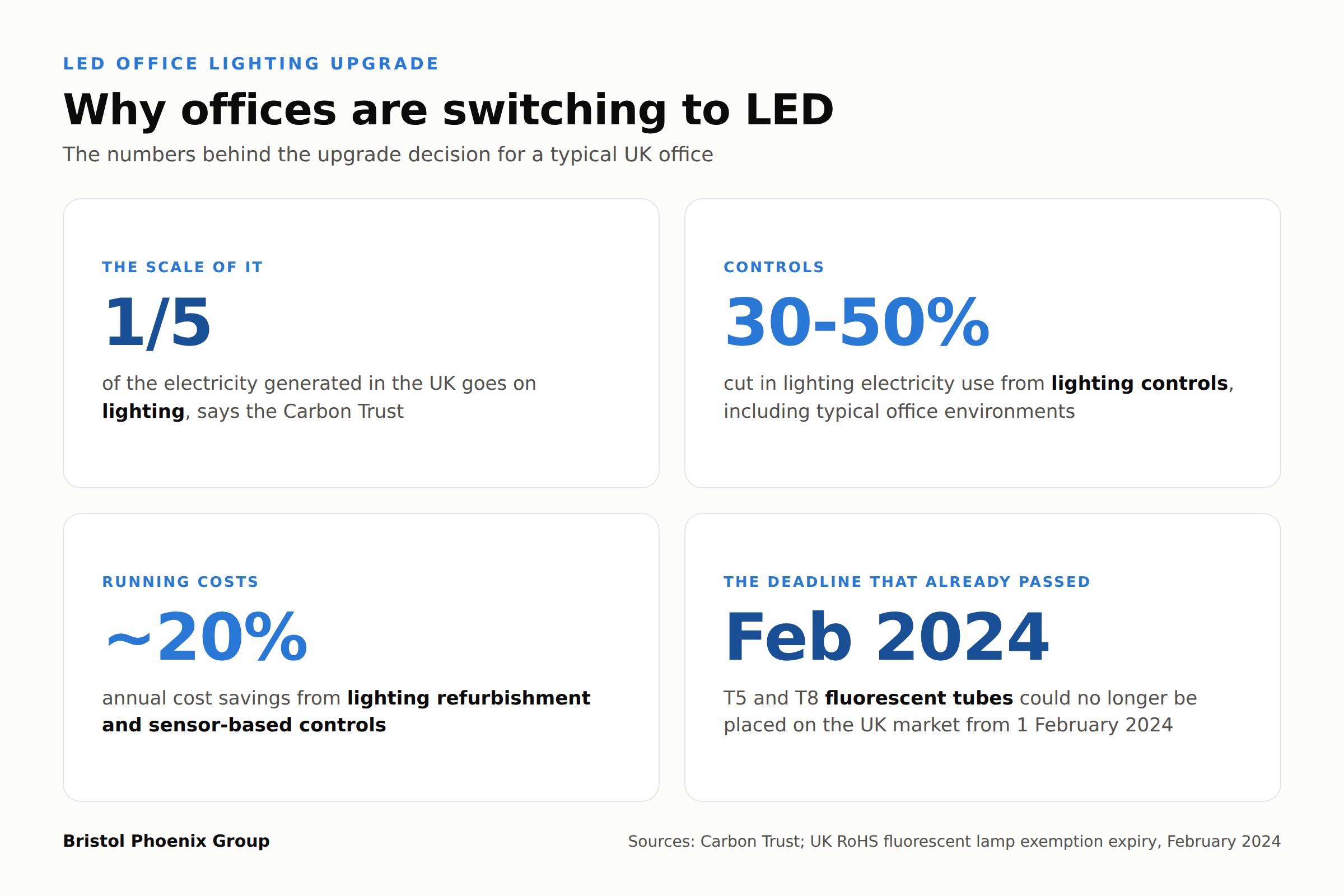
- The Carbon Trust reckons lighting accounts for a fifth of the electricity generated in the UK, and that lighting controls alone can cut lighting electricity use by 30 to 50 percent in typical office environments.
- Budget guidance: electricians run at roughly £45 to £60 an hour, with day rates typically £200 to £400, and a straightforward panel-for-fitting swap sits at the lower end of per-point pricing. A small Bristol office usually lands in the low thousands, not the tens of thousands.
- We’re Bristol Phoenix Group, NAPIT registered and based in South Bristol, and commercial lighting installation in Bristol offices is exactly the kind of fit-out work we take on.
What Good Office Lighting Actually Looks Like
Lighting design in an office splits into two jobs that people constantly muddle together. Ambient lighting is the general layer that lets you walk around, read a whiteboard and find the kettle: in most offices that’s the ceiling grid of panels or battens doing steady, even coverage. Task lighting is the focused layer for the actual work: the light landing on your desk, your keyboard, the drawing you’re marking up. A good scheme gets both right. A bad scheme cranks the ambient layer until the whole room is bright enough for surgery and wonders why everyone still squints.
Evenness matters as much as brightness. A room that averages a respectable lux figure can still have a gloomy corner where someone spends eight hours a day, which is why the guidance quotes minimum figures as well as averages. Colour temperature matters too: for office work we’d normally specify a neutral white in the region of 4000K, which reads as clean and alert without the blue-tinged glare that makes a room feel like a fridge.
The good news is that modern LED panels make all of this far easier than it was in the fluorescent era. The output is stable, the light is even across the diffuser, and you can pick colour temperature off a datasheet instead of hoping the wholesaler has matching tubes.
Office Lighting Regulations UK: What You Have to Meet
Employers have a legal duty to light workplaces properly, and the practical detail of what “properly” means lives in guidance rather than in the statute itself. The two documents worth knowing are the Health and Safety Executive’s guidance note HSG38, Lighting at Work, and the lighting industry’s own standards, chiefly BS EN 12464-1 and the CIBSE lighting guides that sit alongside it.
HSG38 classes general office work as “work requiring perception of detail” and recommends an average illuminance of 200 lux, with a minimum measured illuminance of 100 lux at any point. That minimum figure is the one people miss: an office can hit the average comfortably while a desk under a failed fitting sits well below it. The HSE’s guidance also gives useful reference points either side of the office figure: around 50 lux for a corridor or walkway, 300 lux for a process control room, and 750 lux where someone is studying an engineering drawing. The principle is simple enough: the more detailed the task, the more light it needs.
Design practice goes further than the HSE floor. The CIBSE office lighting guidance, LG7, works to a maintained illuminance of 300 to 500 lux over the task area: around 300 lux for lighter tasks such as data retrieval or telesales, and 500 lux for writing and copy typing. Treat the HSE numbers as the floor you must not fall through and the CIBSE numbers as the level a competent designer actually aims for.
The standards are not standing still either. The 2021 revision of BS EN 12464-1 nudged several applications upwards, with the CIBSE Journal noting, for example, that general classroom activities moved from 300 lux to 500 lux, and that designers should step up a level, say from 500 lux to 750 lux, where the work or the people doing it need it. The direction of travel is clear: more light, better delivered.
Recommended light levels at a glance
| Area or task | Guidance figure | Where it comes from |
|---|---|---|
| Corridors and walkways | Around 50 lux | HSE guidance |
| General office work, minimum at any point | 100 lux | HSE HSG38 |
| General office work, average | 200 lux | HSE HSG38 |
| Lighter desk tasks (data retrieval, telesales) | Around 300 lux | CIBSE LG7 |
| Writing and copy typing | Around 500 lux | CIBSE LG7 |
| Studying detailed drawings | Around 750 lux | HSE guidance |
LED Office Lighting Upgrade: Retrofit, Replace or Rewire
When an office comes to us about its lighting, the conversation usually lands on one of three routes, and the right one depends on the age of the installation, what’s above the ceiling tiles, and what the business wants the space to do.
Route one: lamp-for-lamp retrofit
Swapping fluorescent tubes for LED retrofit tubes in the existing fittings is the cheapest ticket in, but it’s rarely the one we recommend for a whole office. Retrofit tubes have to get along with the fitting’s existing control gear, some need the fitting rewired internally anyway, and you keep every other limitation of the old fittings: tired diffusers, dated optics, no controls. Fine for a handful of fittings in a storeroom, but as the main plan for an office it’s a haircut when the chair itself needed replacing.
Route two: new LED fittings on the existing circuits
This is the bread and butter LED office lighting upgrade. The existing lighting circuits stay, and the old fluorescent fittings come out in favour of LED panels or battens sized and spaced to hit the lux levels above. In a standard suspended ceiling this is quick, clean work, and it’s the point at which it’s worth adding emergency fittings and basic controls, since the ceiling is already open. Done properly it includes checking the condition of the circuit wiring while everything is accessible, because a smart new panel on crumbling 40-year-old cable is lipstick on a problem.
Route three: rewire the lighting circuits
Sometimes the honest answer is that the wiring itself is done: ancient cable, no CPC where you’d want one, circuits that make no sense for the current layout, or a fit-out that moves walls and needs the lighting designed from scratch. That becomes first fix work, with new cabling, new switching or control wiring, and usually a tidy-up at the distribution board at the same time. If the office is still running on an old board with rewirable fuses, that conversation happens sooner rather than later. It’s more disruption, but it’s the version that doesn’t need revisiting in five years.
The fluorescent phase-out is forcing the issue
If your ceiling is still full of fluorescent tubes, the decision is being made for you. Exemptions allowing mercury in double-capped linear fluorescent lamps, which covers the familiar T5, T8 and T12 tubes, expired on 1 February 2024, meaning they can no longer be placed on the UK market. Using the tubes you have remains perfectly legal, and wholesalers can sell through old stock, but the supply is finite and shrinking. Every failed tube from here on is a nudge towards LED, and it’s better to plan that move across the whole office than to do it one flickering fitting at a time.
Screens, Glare and the DSE Problem
Almost everyone in an office works at a screen, and screens are unforgiving of bad lighting. The HSE puts it plainly: directional sources of light can bounce off reflective surfaces such as display screens and cause glare. The result is people tilting monitors, angling themselves away from windows, or working under a fitting they’ve quietly asked facilities to disconnect.
Designing this out is not complicated, it just has to be thought about before the fittings go in rather than after. Panels with proper diffusers rather than bare-lamp battens, sensible positioning relative to desks and windows, blinds where low winter sun rakes across the room, and layouts that avoid putting a bright source directly in the reflected line of sight of a bank of monitors. The screen-heavy office is also where the difference between ambient and task lighting earns its keep: a moderate, even ambient layer with decent task lighting beats one overpowered ceiling every time. If your team ends the day rubbing their eyes, the lighting scheme is a suspect worth interviewing.
Lighting Controls: Where the Savings Hide
Here’s the part that turns a lighting job from an expense into an investment. According to the Carbon Trust, lighting accounts for a fifth of the electricity generated in the UK, and UK businesses and the public sector could save up to £700m a year by making their lighting more efficient. Two of their figures matter for an office budget: installing lighting controls can cut lighting electricity use by 30 to 50 percent in settings that include typical office environments, and cost-effective measures such as lighting refurbishment and sensor-based controls can lead to annual cost savings of around 20 percent.
In practice, controls for a small office mean a few sensible things rather than a building management system. Occupancy sensors in meeting rooms, WCs, kitchens and stores, so the rooms that are empty most of the day light themselves only when needed. Daylight dimming on the rows of fittings nearest the windows, so the panels ease off when the sky is doing the work. Zoned switching so one person working late lights one zone, not the whole floor. None of this is exotic, all of it is wired in most easily while the fittings are being changed anyway, which is why we push for controls to be part of the upgrade conversation rather than a bolt-on afterwards.
What Office Lighting Installation Costs in Bristol
Every office is different, so treat these as honest ranges rather than a menu. For context on labour, Checkatrade’s current guide puts electricians at £45 to £60 an hour, day rates typically land between £200 and £400 as we set out in our house rewire cost guide, and MyJobQuote puts like-for-like light fitting swaps at £40 to £80 labour per fitting. Commercial work in a live office carries a little more overhead than a domestic job: access equipment, working around desks and IT, and sometimes doing the noisy parts out of hours.
With that anchoring, here’s the realistic shape of it for a small to medium Bristol office:
| Job | Typical range | Notes |
|---|---|---|
| LED panel swap into existing grid, per fitting | £70 to £130 supplied and fitted | Standard 600×600 panels, straightforward suspended ceiling |
| Occupancy sensor, per room | £80 to £150 supplied and fitted | Meeting rooms, WCs, kitchens, stores |
| Emergency light fittings, per point | £100 to £180 supplied and fitted | Escape routes and exits, self-contained fittings |
| Whole small office refit (10 to 20 fittings) | Roughly £1,500 to £4,000 | Fittings, sensors and emergency lighting, existing circuits reused |
| Lighting circuit rewire as part of a fit-out | Priced per job, day rate labour | Depends entirely on layout, access and design |
Those first four rows are our practical steer for typical conditions, anchored to the national labour figures above, not quotes. Ceiling type, access and fitting choice move the numbers, which is why a quick look at the space beats any table on the internet.
Picture a typical example: a ten-desk office above a shop on North Street, with twelve tired fluorescent fittings in a suspended ceiling, no controls, and two emergency lights that predate the tenancy. A sensible scheme swaps in twelve LED panels, adds occupancy sensors to the kitchen, WC and meeting room, and brings the emergency lighting up to scratch on the escape route. That’s in the region of two days on site for a two-person team plus materials, and it lands comfortably inside the whole-office range in the table rather than anywhere near a five-figure fit-out. The electricity saving from the panels and sensors then chips away at the cost every working day, which is more than you can say for most office refurbishment spending.
Emergency Lighting and the Compliance Paper Trail
Two compliance items ride along with almost every office lighting job. The first is emergency lighting: escape routes and exits need illumination that keeps working when the normal lighting fails, and the design standard for that is the BS 5266 series. If your emergency fittings are ancient, untested or simply absent, the fire risk assessment for the premises will eventually say so, and the cheapest time to fix it is while the ceiling is already open for the LED upgrade.
The second is the condition of the fixed installation itself. Commercial premises are expected to keep their electrical installation maintained and periodically inspected, and lighting circuits are part of that inspection. If your office hasn’t had its wiring inspected in living memory, a commercial EICR before a lighting upgrade is the logical order of operations: it tells you whether route two or route three above is the honest answer, before anyone has bought a single panel. We cover exactly what’s involved on our commercial EICR page, and the same visit often shapes the lighting design.
Why Bristol Offices Are Rarely Straightforward
Bristol’s office stock is wonderfully varied and electrically chaotic. A huge amount of the city’s smaller office space lives in converted buildings: Victorian terraces around Southville, Bedminster and Old Market carved into studios and suites, warehouse conversions near the harbourside, and older commercial buildings in the centre where a suspended ceiling from the 1980s hides wiring from considerably earlier. We regularly lift a ceiling tile expecting one lighting circuit and find three generations of them, each abandoned slightly less carefully than the last.
Conversions also inherit odd switching from their previous lives, single circuits feeding what are now separate tenancies, and natural light that varies wildly across one floor, from a glazed frontage to a back room that has never seen the sun. That is exactly where daylight dimming and sensible zoning earn their money. None of this is a reason to dread the work. It’s a reason to have the scheme designed by someone who has stood in these buildings before, rather than priced off a floor plan and a hope.
Getting Your Office Lighting Sorted
The pattern for getting this right is short: check what condition the circuits are in, design to the lux levels the guidance expects, choose LED fittings and controls that suit the space, and fold the emergency lighting in while the ceiling is open. Done in that order, an office lighting upgrade is a tidy, predictable job that pays some of its own bill through the electricity meter.
We’re Bristol Phoenix Group, a NAPIT registered electrical contractor based in South Bristol, and office lighting installation sits alongside commercial EICRs and fit-out electrics in the commercial work we do across the city. If your office is somewhere between “a bit dim” and “actively flickering”, get in touch and tell us about the space: how many desks, what ceiling type, and what the lighting is doing that it shouldn’t. We’ll follow up with a proper look at the space and a written price, and the corner by the printer can stop feeling like an interrogation.