
The best way to find a good electrician is to check them against public records before you ever pick up the phone: look them up on the Registered Competent Person Electrical register, ask for proof of insurance, read their recent reviews for detail rather than the star count, and get an itemised written quote that says whether VAT is included. That is how to find a good electrician in five minutes flat, and it filters out almost every cowboy before they get near your fuse board. The rest of this guide walks through all nine checks we would run on any trade, including ourselves.
TL;DR: check the electrician is on the Registered Competent Person Electrical register, ask what their Part P registration covers, ask to see an ECS card, confirm public liability insurance, read their last ten reviews, insist on an itemised written quote with VAT stated, confirm which certificate you will receive and who notifies Building Control, look for TrustMark if you want an extra layer of vetting, and walk away from anyone who wants cash with no paperwork.
Contents
- Why the checks matter
- How to find a good electrician: the nine checks
- Run the nine checks on us
- Finding a good electrician in Bristol specifically
- Questions people ask about finding a good electrician
Why the checks matter
Electrical work is one of the few trades where a bad job can sit hidden in a wall for years. Government figures recorded 22,877 accidental dwelling fires in England in the year ending March 2025, and in the Home Office’s last detailed cause analysis, faulty appliances and leads accounted for 15% of accidental dwelling fires in 2019/20. You cannot see whether a connection has been torqued properly or a circuit tested. What you can see, before any work starts, is whether the person doing it is registered, insured and willing to put their price in writing. Those checks are free and they take minutes.
How to find a good electrician: the nine checks
1. Start with the register, not the search results
England and Wales have one official place to check a domestic electrician: the Registered Competent Person Electrical register. Every business listed there is registered with a government-authorised Competent Person Scheme Operator, which means they have been authorised to self-certify that their work complies with the Building Regulations. If a firm is not on that register, they can still do some types of electrical work legally, but notifiable jobs like a rewire, a new circuit or a consumer unit change would need separate Building Control involvement, at your cost. So the first question is not “are you any good?” but “can I find you on the register?” Search by company name or postcode and the answer takes thirty seconds.
2. Understand what Part P registration actually means
When an electrician says they are “Part P registered with NAPIT” or “NICEIC approved”, here is what that means in practice. Part P is the section of the Building Regulations that covers electrical safety in homes, and we have a full plain-English guide to Part P and what counts as notifiable work. Scheme members are assessed before they are approved, and gov.uk confirms their work is then subject to ongoing inspections, yearly for the first two years. Registration is not a one-off badge. The scheme operator comes back and looks at real installations. NAPIT and NICEIC are the two scheme operators you will meet most often in Bristol, and membership of either is a genuine, checkable standard rather than a logo on a van.
3. Ask to see an ECS card
Scheme registration covers the business. The ECS card covers the person standing in your hallway. The Electrotechnical Certification Scheme accredits the qualifications and experience of individual workers in the electrical industry, and cards can be verified in real time through ECS Check. A Gold Card means a fully qualified electrician rather than a labourer or an improver. A good electrician will not be offended if you ask; ours is printed on our credentials page.
4. Ask about insurance before the quote, not after a problem
Two policies matter. Public liability insurance pays out if the work damages your property or injures someone. Employers’ liability insurance matters when the firm sends anyone other than the owner. Ask for the certificate, check the dates, and be wary of any trader who gets defensive about it. A legitimate firm has these documents to hand because their scheme operator requires them.
5. Read reviews for detail, not the star total
A 4.9 from three hundred reviews tells you less than you think until you open them. Read the most recent ten and look for specifics: named jobs, how problems were handled, whether quotes matched final bills, whether the place was left tidy. Reviews that mention certificates arriving promptly are a particularly good sign, because paperwork is where weaker firms go quiet. Review patterns matter too. A burst of five-star reviews in one week followed by silence reads very differently from a steady trickle over years.
6. Get an itemised written quote that mentions VAT
“It’ll be about eight hundred” is not a quote. A proper quote lists what is being done, what is included (materials, testing, certification, making good), what is excluded, and whether the price includes VAT. That last one catches people out constantly: a VAT-registered firm quoting “780” could mean 780 or 936 depending on wording. We publish our prices for Bristol openly and give every quote in writing before work starts, which means there is nothing to argue about afterwards. Any established firm can do the same.
7. Confirm the paperwork you will receive
Every real electrical job ends with a certificate. New circuits, rewires and consumer unit changes should come with an Electrical Installation Certificate (EIC). Smaller alterations like adding a socket to an existing circuit get a Minor Electrical Installation Works Certificate. A condition inspection of existing wiring produces an EICR. For notifiable work, the electrician’s scheme membership is what lets them notify Building Control on your behalf, and you should receive that compliance certificate too. Ask which documents you will get before you accept the quote. If the answer is vague, so is everything else.
8. Look for TrustMark if you want an extra layer
TrustMark is the Government Endorsed Quality Scheme for work in and around the home, and registered businesses have been vetted to meet required standards with a commitment to good customer service. It is not a substitute for the electrical register, it sits on top of it, and a smaller subset of firms carry both. Some TrustMark firms, ours included, have also been through the Trading Standards Approved check, where Trading Standards has examined and approved the business directly.
9. Know the red flags
Walk away from anyone who wants cash only, cannot name the certificate you will receive, has no checkable address or registration number, or pressures you to decide on the doorstep. Honest firms are busy; they do not need an answer in the next ten minutes. And if a price looks dramatically cheaper than every other quote, the difference usually comes out of the testing, the certification or the materials, which are exactly the parts you cannot see.
Run the nine checks on us
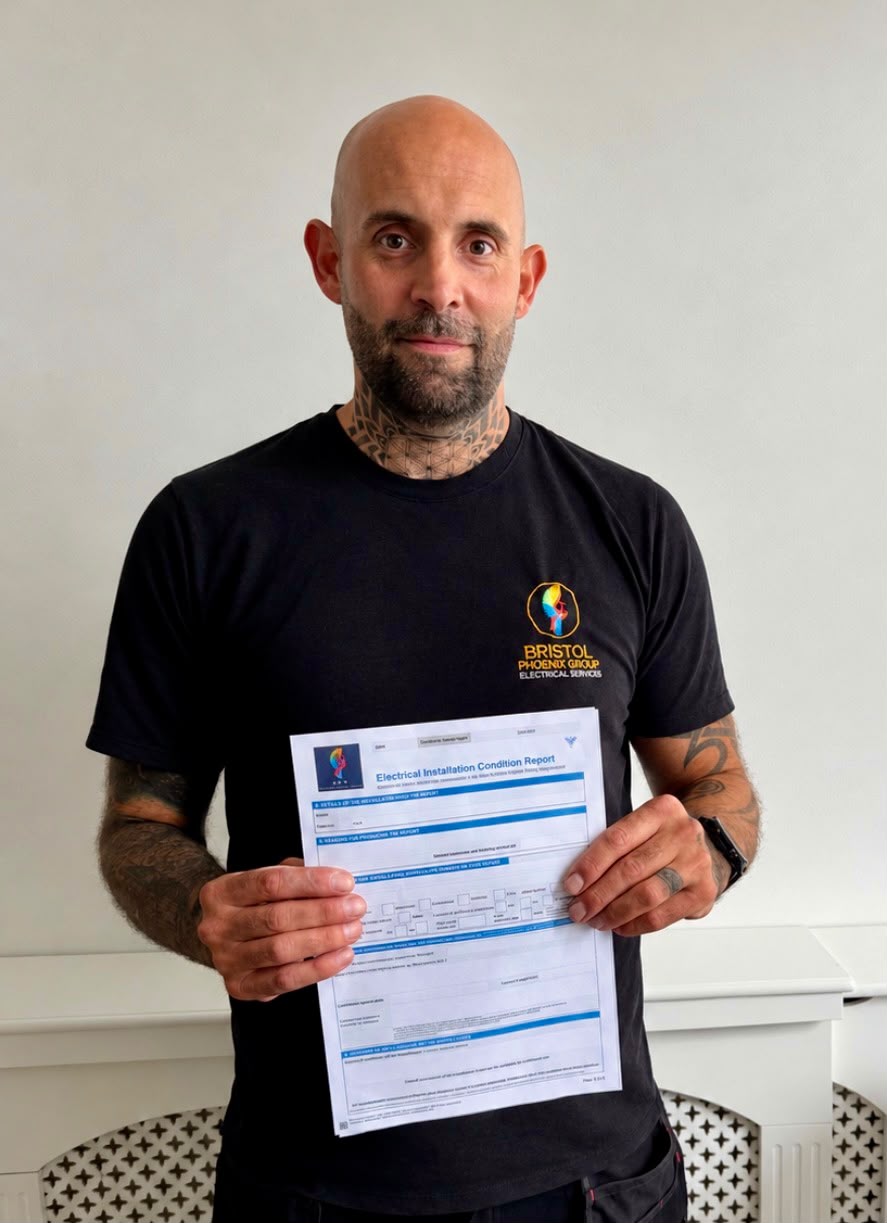
The fastest way to show how this works is to be the worked example. Bristol Phoenix Group is NAPIT member 23603, which you can look up on the Registered Competent Person Electrical register. We are TrustMark Trading Standards Approved under licence 4257835. Luke holds ECS Gold Card C0092657. We carry public liability insurance of 2 million pounds and employers’ liability of 10 million pounds, and the certificates are published on our credentials page rather than produced on request. Our Google reviews stand at 5.0 across 134 reviews, and every price on the website is the price anywhere in Bristol, plus VAT, confirmed in writing before work starts. If a firm you are considering can match that paper trail, book them with confidence, whoever they are.
Finding a good electrician in Bristol specifically
The checks above work anywhere in the UK. In Bristol there is one extra thing worth knowing: the housing stock varies street by street, and an electrician who knows it will quote more accurately. Much of South Bristol, from the Victorian terraces of Bedminster and Knowle to the 1930s and post-war semis of Bishopsworth, Hartcliffe and Whitchurch (BS3, BS4, BS13 and BS14), still hides rubber-insulated cable, fuse wire boards and decades of DIY additions behind tidy plasterwork. A local firm that has opened a hundred of those walls will spot the signs during the survey rather than on day two of the job. The same applies north of the river in Bishopston, Horfield, Henleaze and Westbury-on-Trym (BS6, BS7, BS9 and BS10), where larger period homes bring their own wiring quirks. We are based in Bishopsworth and cover the whole city, with South Bristol as home ground.
Questions people ask about finding a good electrician
Is there a list of registered electricians in the UK?
Yes. For England and Wales, the Registered Competent Person Electrical register at electricalcompetentperson.co.uk is the official search for electricians registered to work in homes. You can search by company name, registration number or postcode.
How do I check an electrician is qualified in the UK?
Check the business on the competent person register, then ask the individual for their ECS card, which accredits their qualifications and experience and can be verified through ECS Check. Together those two checks cover both the firm and the person.
What questions should I ask an electrician before hiring?
Four questions do most of the work. Which scheme are you registered with, and what is your registration number? What certificate will I receive for this job? Does the quote include VAT, materials and making good? And who notifies Building Control if the work is notifiable?
Should an electrician always give a written quote?
For anything beyond a trivial fix, yes. A written, itemised quote protects both sides, and a firm that resists putting numbers on paper before the job is telling you how the end of the job will go.
Is the cheapest quote ever the right choice?
Sometimes, if the paperwork checks out. Prices genuinely vary between firms with different overheads. But when one quote sits far below the rest, ask what has been left out. Testing and certification are the usual casualties, and they are the parts that keep you safe and keep the sale of your house simple later.
Do good electricians charge for quotes?
Most established domestic firms, including us, quote for free from a description, photos or a short visit. Be cautious of fees just to attend and price a straightforward job, though a paid diagnostic visit for fault finding is normal and fair.
Talk to an electrician you can check up on
If you are in Bristol and want a firm you can verify in five minutes, start with our credentials page, then run us through the register yourself. Bristol Phoenix Group is a NAPIT-approved, TrustMark Trading Standards Approved electrical firm based in South Bristol, covering the whole city. Tell us what you need through the contact page or call 0117 244 7382, and you will get a written, itemised quote with VAT stated before any work starts.