
Garages have quietly become the hardest working rooms in Bristol. What used to store a lawnmower and a box of Christmas decorations now runs a table saw, charges a car, or houses a home gym with a treadmill and a heater going at once. The wiring rarely gets the same upgrade. If you are wondering whether you need a garage consumer unit, a small fuse board dedicated to the garage itself, rather than yet another extension lead trailed through the kitchen window, this guide walks through when a separate board earns its keep, how the supply gets there, what the rules say, and what it all costs. We fit these regularly across South Bristol, so the numbers below come from real jobs, not guesswork.
Table of Contents
- What a Garage Consumer Unit Actually Is
- Spur or Separate Board: When a Garage Needs Its Own Consumer Unit
- Getting Power There: SWA Armoured Cable Runs
- RCD Protection: The Non-Negotiable Part
- Part P, Building Control and Sign-Off
- Garage Consumer Unit Cost: What to Budget
- A Worked Example: Powering a Workshop in South Bristol
- Common Garage Electrics Mistakes We Find
- Planning Garage Electrics? Talk to Us
TL;DR
- A garage consumer unit is a small dedicated fuse board, usually 2 to 8 ways, that gives a garage or workshop its own protected circuits instead of everything hanging off one spur from the house.
- Light use in an attached garage can often run from the house board. Workshop tools, EV charging, heaters or a garden office almost always justify a separate board fed by armoured cable.
- Running a new circuit to an outbuilding is notifiable work under Part P, so it needs a registered electrician who can self certify, or a building control application.
- Budget roughly £180 to £600 for the board itself fitted, and £800 to £2,000 all in for a typical detached garage supply including cable, trenching, circuits, testing and certification.
- The job is often cheapest when bundled with other work such as an EICR, a house board upgrade or a rewire, because the testing and paperwork overlap.
What a Garage Consumer Unit Actually Is
A garage consumer unit is exactly what it sounds like: a smaller version of the main fuse board in your house, mounted in the garage and serving only the circuits out there. Where a house board might have 10 or 12 ways, a consumer unit for a garage usually has 2 to 8, typically one for lighting, one or two for sockets, and spare ways for whatever comes next, which these days usually means an EV charger. If you want a refresher on what the main board does, our plain English guide to what a consumer unit is covers the house side of the equation.
The garage board does three jobs. It splits the incoming supply into separate protected circuits, so a tripped saw does not kill the lights while you are holding the workpiece. It puts the protection close to where faults actually happen, in a building full of damp, dust and power tools. And it gives you local isolation: one switch in the garage turns everything off, without a walk back to the house in the rain.
Modern boards for this job are metal, fitted with RCBOs or an RCD plus circuit breakers, and sized with spare capacity. Fitting a bare minimum 2 way board with no spare ways saves about thirty pounds and costs you a second visit the day you buy an electric car. We fit bigger boards than strictly necessary for the same reason we carry more cable than the job needs: the future has a habit of turning up.
Spur or Separate Board: When a Garage Needs Its Own Consumer Unit
Not every garage needs its own board, and it would be dishonest to pretend otherwise. The honest dividing line is load and distance, and it is worth being clear about which side of it you sit on before anyone quotes you.
When a Spur From the House Is Enough
An attached garage with a light, a socket for the lawnmower charger and a freezer can often run happily from the existing house board, wired as its own circuit or fused spur with RCD protection. The run is short, the load is small, and a separate board would be solving a problem you do not have. We tell people this regularly. It is not the answer that makes us the most money, but it is the right one.
Workshop Tools and Heavier Loads
The picture changes the moment the garage becomes a workshop. A table saw, a dust extractor, a compressor and a 2kW heater running together will overwhelm a single spur, and the symptoms are predictable: warm plugs, nuisance tripping, lights dipping every time a motor starts. A separate consumer unit for a garage workshop puts sockets and lighting on their own properly rated circuits, sized for motors that draw hard on startup. If you are tripping breakers in the house every time you switch something on outside, the wiring is telling you something.
EV Charging From a Garage
A 7kW car charger is the single heaviest appliance most homes will ever gain, and garages are a natural place to put one. A charger needs its own dedicated circuit with its own protection, and if the garage is detached, feeding that circuit from a garage sub board on an adequately sized armoured supply is usually the tidy way to do it. The charger installation itself is a separate cost, and our guide to EV charger installation costs puts realistic numbers on that side of the job. The point for this guide is simpler: if an EV is anywhere in your five year plan, size the garage supply for it now, because digging the trench twice is nobody’s idea of value.
Garden Offices and Converted Outbuildings
The same logic applies to garden offices, studios and workshops at the end of the plot. Heating, lighting, a computer setup and a kettle add up quickly, and the building is far enough from the house that local protection and isolation stop being nice to have and start being the only sensible design. Almost every garden office we wire in South Bristol gets its own small board as standard. We go deeper on this in our guide to office lighting.
Getting Power There: SWA Armoured Cable Runs
A detached garage gets its power through SWA, steel wire armoured cable, run from the house board to the garage board. The armour is there because the cable typically lives underground, where a spade or a fence post has no way of knowing it exists. This is the part of the job people underestimate, because most of the cost is not the shiny board on the wall, it is the unglamorous business of getting power to it safely.
Cable Size, Route and Volt Drop
Cable sizing is where a proper design pays for itself. A long run at a decent load loses voltage along the way, and an undersized cable means dim lights, sluggish tools, and a supply that can never take an EV charger. The fix is boring and effective: calculate the load, measure the route, and size the cable with headroom, which is why we will always ask what you plan to do in the garage before quoting, not just what is in there today. Routes matter too. A cable clipped along a boundary wall is cheaper than a trench across a patio, and a trench through lawn is far cheaper than cutting through concrete. As a guide, installed SWA runs from around £15 to £25 per metre through soft ground, rising to £30 to £60 per metre through concrete.
Earthing: Why Your Garage Might Need Its Own
Here is the technical wrinkle that separates a proper outbuilding supply from a long extension lead in disguise. Depending on how your house is earthed, it is not always safe to export the house earth to a detached building, and the garage may need its own earth electrode driven into the ground beside it, known as a TT arrangement. You do not need to remember the terminology. You just need an electrician who checks the earthing arrangement before quoting rather than discovering it on the day, because it affects both the design and the price. It is one of the things we confirm on a survey before any digging starts.
RCD Protection: The Non-Negotiable Part
Every circuit in a garage should have RCD protection, the fast acting trip that cuts power in milliseconds when current leaks to earth, through a damaged cable or through a person. Garages are precisely where that protection earns its keep: damp floors, metal tools, cables that get knocked about, and drills that occasionally find things hidden in walls. The current edition of the IET Wiring Regulations, BS 7671:2018+A4:2026, is what a new garage installation is designed and certified against, and RCD protection for sockets and buried cables sits at the heart of it.
On new garage boards we fit RCBOs on most jobs, which combine the circuit breaker and RCD in one device per circuit. The practical benefit is simple: a fault on the socket circuit trips the socket circuit, and the lights stay on. In a windowless garage with a spinning blade, that is not a luxury.
The stakes are not theoretical. The Institution of Engineering and Technology reports around 19,300 accidental domestic fires linked to electricity each year, about 53% of all accidental house fires in England. Garages contribute more than their share, because they collect exactly the combination that starts fires: old wiring, high loads and nobody watching.
Part P, Building Control and Sign-Off
Now the paperwork, which is shorter than people fear but stricter than people assume. Running a new circuit to a garage is notifiable work under Part P of the Building Regulations. Approved Document P defines three categories of notifiable work: installing a new circuit, replacing a consumer unit, and additions or alterations to circuits in special locations. A garage supply is a new circuit, and the document is explicit that garages and sheds sharing their electricity with a dwelling are not exempt.
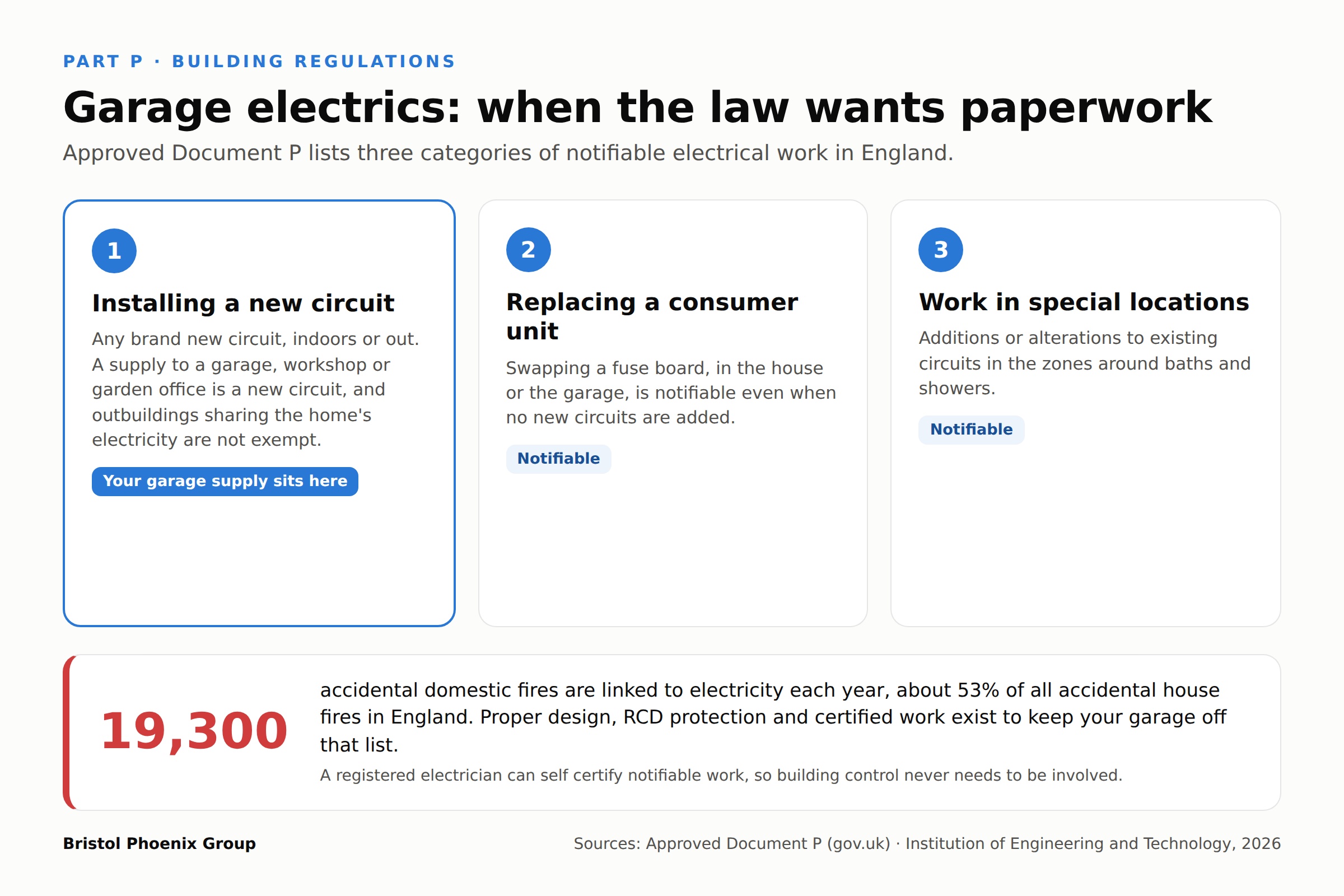
In practice you have two routes. An electrician registered with a competent person scheme can self certify the work, and you receive an Electrical Installation Certificate plus a Building Regulations compliance certificate, with no council involvement. Or you apply to building control yourself, pay their fee, and they arrange inspection. The first route is simpler and almost always cheaper. We are NAPIT registered, so notifiable work we complete is self certified as standard, and the certificates matter beyond the day of the job: when you sell the house, the buyer’s solicitor will ask for them by name. A garage full of sockets with no paperwork is the kind of loose thread that unravels at the worst possible moment in a sale. Our guide to Part P building regulations covers the fine print.
Garage Consumer Unit Cost: What to Budget
Prices vary with distance, ground and ambition, so treat anything quoted sight unseen with suspicion. That said, the ranges below reflect what current UK price guides show and match what we see on real jobs. The garage sub board cost on its own is modest; the supply run is what moves the total.
| Item | Typical UK range | Notes |
|---|---|---|
| Garage consumer unit, fitted | £180 to £600 | Small 2 to 4 way boards at the lower end, 6 to 8 way RCBO boards with spare ways at the top |
| SWA armoured cable, installed | £15 to £60 per metre | Soft ground at the lower end, concrete cutting at the top |
| Attached garage circuits from house board | £400 to £800 | Lighting and sockets where the house board has capacity |
| Detached garage, full supply and board | £800 to £2,000 | Cable, trenching, board, circuits, testing and certification |
Those figures line up across independent sources: Elec-Mate’s 2026 garage electrics guide puts a detached garage installation at £800 to £2,000 with the board itself at £300 to £600 fitted, while ZappyApp’s 2026 outbuilding guide puts a detached garage at £900 to £2,000 and a small sub board at £180 to £380 fitted. Expect Bristol quotes to sit slightly above national midpoints, as South West labour rates generally do.
Two ways to make the budget work harder. First, if your main house board is due for replacement anyway, doing both at once saves duplicated labour and testing, and our new fuse box cost guide gives you the baseline for that side, typically £350 to £750 for a straightforward domestic board change. Second, if the garage work is part of a bigger project, an extension, a garden office build or a rewire or new build wiring installation, folding the outbuilding supply into that job is nearly always cheaper than doing it as a standalone visit later. The same bundling logic applies if you are booking an EICR: the inspection already involves testing and paperwork, so pairing it with remedial or upgrade work shares the overhead.
A Worked Example: Powering a Workshop in South Bristol
Picture a typical 1930s semi in Knowle with a single detached garage at the end of a 12 metre garden path. The owner is setting up a woodworking bench: table saw, bandsaw, extractor, decent lighting, and a socket he would like to trust with a battery charger overnight. Today the whole lot runs off one extension lead from the kitchen, which is exactly the sort of arrangement that keeps electricians in business and insurers in exclusions.
The sensible design is a 6 way metal RCBO garage board fed by SWA from the house. The survey confirms the house board has a spare way and the earthing suits the run. The trench crosses lawn rather than patio, which keeps the digging honest. Call it 16 metres of cable once the route rises and turns, a day and a half on site including making good, then dead and live testing and certificates. On the ranges above, that job lands somewhere in the middle of the £800 to £2,000 bracket, with spare ways left for a future EV charger circuit so the trench never needs to be opened again. The extension lead retires to light duties, where it belonged all along.
Common Garage Electrics Mistakes We Find
After enough garage surveys around South Bristol, the same handful of problems keeps appearing. Ordinary twin and earth cable run outdoors where armoured cable should be, sometimes stapled along a fence with the optimism of a previous owner who moved before winter. Sockets daisy chained off a single spur until one warm plug serves half a workshop. No RCD protection anywhere, on circuits feeding power tools in a building with a concrete floor. Old rewireable fuse boxes in garages that have not been touched since the seventies, quietly guarding circuits their designers never imagined. And extension leads doing structural work, plugged into other extension leads, feeding freezers through window frames.
None of this is a reason for panic, and most of it is fixable in a day or two of proper work. But garage electrics consumer unit questions are the classic case where DIY spirit outruns DIY knowledge, because the garage feels like a low stakes place to have a go. The loads say otherwise. If any of that list sounds like your garage, an inspection is a cheap way to find out where you stand before deciding what to spend.
Planning Garage Electrics? Talk to Us
A garage consumer unit is one of those jobs that is invisible when done well: the tools run, the charger charges, nothing trips, and there is a certificate in the drawer that will not embarrass you when you sell. Getting there takes a proper survey, a design sized for what you actually plan to do out there, and paperwork that stands up.
Bristol Phoenix Group is a NAPIT approved electrical contractor based in South Bristol, and outbuilding supplies, board upgrades and workshop wiring are bread and butter work for us across the city, for homeowners, landlords, builders and small commercial clients alike. Whether that starts with our consumer unit installation service or just a conversation about whether your garage needs its own board at all, get in touch and tell us what you are planning. We will give you a straight answer, even when the answer is that a spur will do.