
The electrics for a typical single storey extension in Bristol come to between £1,500 and £3,500 plus VAT for the wiring itself, and if your existing fuse board cannot take the new circuits, a consumer unit replacement adds £680 to £920 plus VAT on top. That is the extension electrics cost question answered in one line: almost all of the spread comes down to how many circuits the new space needs and whether your board has room for them. This guide breaks the number down properly, for the homeowner budgeting the build and the builder pricing the job, including the first fix and second fix split, the fuse board question, and the certificates building control will ask for before sign-off.
What the electrics for an extension actually involve
A new extension is new wiring, not an extension lead from the nearest socket. Building a rear kitchen-diner, a side extension or a garden-facing living room means running new circuits back to the consumer unit, and a kitchen-diner is the hungriest room in the house. A typical one needs most of this list:
- A ring final circuit for the kitchen sockets, kept separate from the rest of the house
- A dedicated cooker circuit, sized for an induction hob and double oven rather than whatever was there before
- A lighting circuit, often with two or three switching positions and a run of downlights
- Radial circuits for fixed appliances where the design calls for them
- Extensions to the main protective bonding, checked and brought up to current standards while the floor is open
A simpler side extension or home office extension might need only two or three circuits. Either way, every new circuit is notifiable work under Approved Document P of the Building Regulations, which lists the installation of a new circuit and the replacement of a consumer unit as work that must be certified and notified. More on what that means for your paperwork further down.
First fix and second fix: when the electrician needs to be on site
Extension wiring happens in two visits, and the timing against the builder’s programme matters more than most people expect.
First fix is the cabling stage: cables clipped through the joists and studwork, back boxes set into the blockwork, everything run back towards the consumer unit. It happens once the structure is up and the roof is watertight, and it must be finished before the plasterboard goes on, because every cable run gets buried. Our guide to first fix electrics covers the stage in detail.
Second fix is everything you can see: sockets, switches, light fittings and the final connections at the board, followed by testing and certification. It happens after plastering, usually alongside the decorator rather than ahead of them.
For builders, the practical point is sequencing. We need a clear run at first fix between frame-up and boarding, then a second visit once the plaster is dry. On a typical single storey extension that is one to two days of first fix and a day of second fix and testing. Miss the first fix window and the choice is chasing finished walls or delaying the boarding, and both cost money. Our new build and extension wiring page is written for exactly this handoff, and we are used to working to a site programme rather than around one.
Do I need a new consumer unit for an extension?
This is the question that moves the budget most, and the honest answer is: sometimes, and you want to know before the slab is poured, not after.
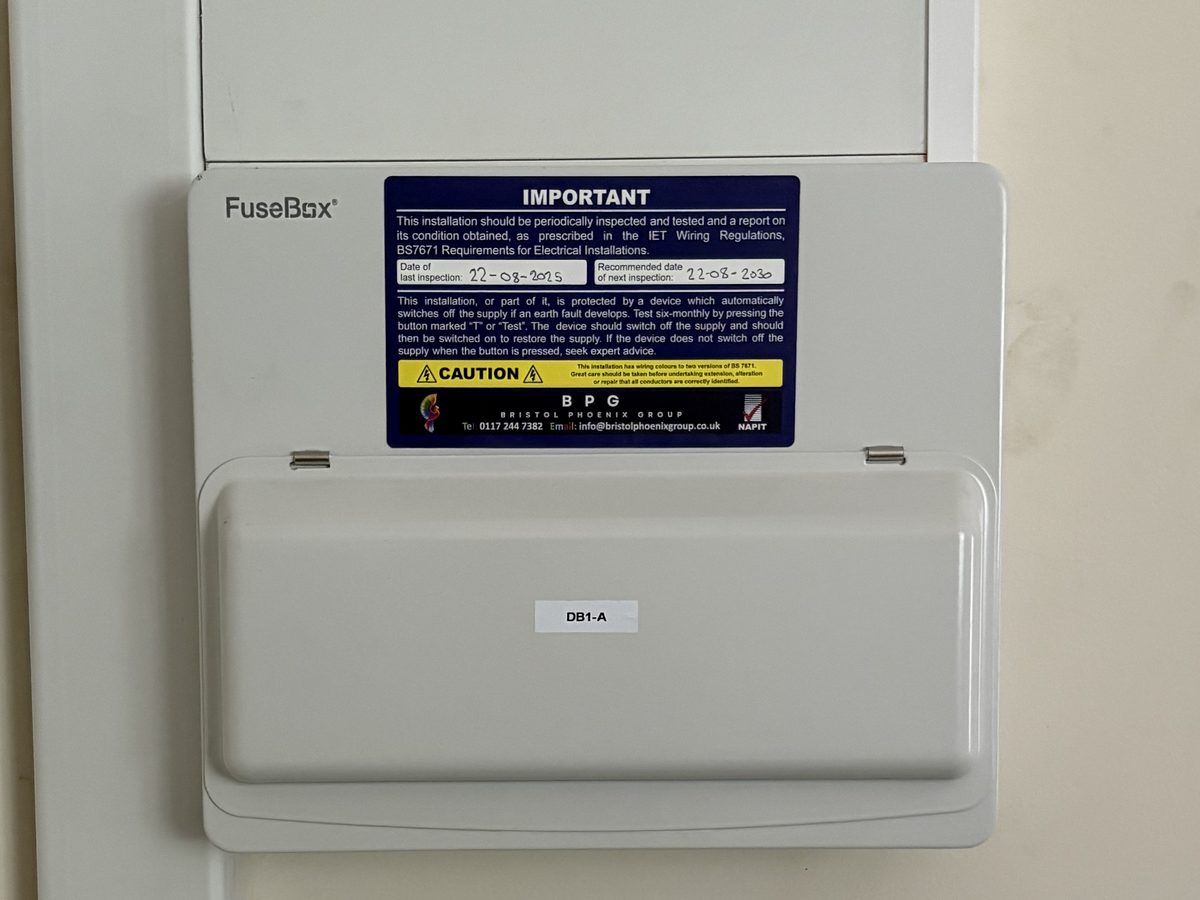
Your existing board can take the new circuits if it has spare ways, the right protection for each new circuit, and an installation in good enough condition to add to. Plenty of Bristol boards fail at least one of those tests. The 1930s semis around Headley Park and Whitchurch, and the Victorian terraces of Bedminster and Southville, often still carry older boards with no spare ways, and sometimes a rewireable fuse box that predates RCD protection entirely. Adding circuits to a board like that is not work we can sign off, so a replacement becomes part of the job.
Our consumer unit prices are fixed and published: £780 plus VAT for the 8 to 12 way FuseBox board most houses need, with an RCBO on every circuit and surge protection as standard, £680 plus VAT for a 6 way board in a flat or small home, £920 plus VAT for 15 ways, and larger boards or three-phase from £1,195 after a survey. Full details and photos are on our consumer unit replacement page. If the board is being replaced anyway, doing it at first fix stage is the cheapest moment it will ever have: the circuits are already disconnected and the electrician is already there.
Extension electrics cost: the numbers
Here is how the figures stack up, from national guides and from our own published prices. National guide figures are indicative; our prices are fixed.
| Item | Guide price | Source |
|---|---|---|
| New circuit, installed | £250 to £450 | National electrician cost guide, October 2026 |
| Electrician day rate | £200 to £350 | National electrician cost guide, October 2026 |
| Mechanical and electrical first and second fix, 20 m² rear extension (electrics and plumbing together) | £2,500 to £4,500 inc VAT | National single storey extension cost guide, August 2026 |
| Consumer unit replacement, 8 to 12 way board (our fixed price) | £780 plus VAT | Bristol Phoenix Group published price |
| Consumer unit, 6 way board (our fixed price) | £680 plus VAT | Bristol Phoenix Group published price |
Those national figures line up with what we see quoting across Bristol: the wiring for most single storey extensions lands between £1,500 and £3,500 plus VAT, sitting at the lower end for a simple side extension with a handful of circuits and the upper end for a big kitchen-diner with a full lighting design. We do not price extension wiring from a rate card, because no two extensions carry the same circuit count. Every job gets a free survey and a fixed written quote before work starts, which is the same promise that sits behind every price on this site.
What drives the extension electrics cost up or down
Four things explain most of the difference between two quotes for what sounds like the same extension. Circuit count is the big one: every dedicated circuit is more cable, another way on the board and more testing. The kitchen specification is the second, and it is why a kitchen-diner extension costs more to wire than a bedroom of the same size; our kitchen rewire cost guide shows the same forces at work inside an existing room. The third is the route back to the board. In much of South Bristol the meter and board sit in a front hallway cupboard, so a rear extension means a long cable route through the original house, and chasing solid brick under old lime plaster takes longer than dropping cables through a modern stud wall. The fourth is the board itself, covered above.
One thing that should not drive the price: distance from the van. We are based in Bishopsworth and our prices are the same anywhere in Bristol, from South Bristol, where BS3, BS4, BS13 and BS14 are home ground, up to Westbury-on-Trym, Henleaze and Horfield in the north of the city.
A worked example: picture a rear kitchen-diner in Headley Park
Take a typical project for this part of the city: a 1930s three bed semi with a 20 m² rear kitchen-diner extension going on the back. The design needs a kitchen ring, a cooker circuit, a lighting circuit with twelve downlights, and a radial for the utility corner. The original board is an elderly rewireable fuse box with no spare ways, so it is replaced as part of the job. Indicatively, with VAT included:
| Element | Indicative cost |
|---|---|
| Labour: first fix, second fix and testing | £1,500 |
| Cable, back boxes, containment and sundries | £430 |
| Accessories and lighting allowance | £380 |
| Consumer unit replacement, 8 to 12 way (fixed price) | £936 |
| Certification and notification | Included |
| Total | £3,246 |
Take the board out of that picture, because yours has spare ways and modern protection, and the same extension wires for around £2,300. Both versions sit comfortably inside the national £2,500 to £4,500 band for the combined mechanical and electrical fix once plumbing is added on top, which is a useful sanity check when a quote looks too good or too steep.
Part P, building control and the paperwork
Every new circuit in your extension is notifiable under Part P, and building control will not sign the extension off without the electrical paperwork. Done properly, the trail looks like this: the electrician issues an Electrical Installation Certificate for the new work, and because we are registered with NAPIT under the competent person scheme, we notify building control through NAPIT and a compliance certificate follows to you within 30 days of completion, which is the route Approved Document P sets out for registered installers. No separate building control fee for the electrics, no inspector visit to arrange, and the certificate sits in the file your building control completion certificate depends on. Our plain English guide to Part P and what is notifiable covers the rules in full. If anyone offers to wire your extension without this paperwork, the saving is not a saving: unregistered work surfaces at the worst moment, usually when you sell.
Extension-only wiring or a whole house job?
An extension is wired as new work from the board, so it does not force a rewire of the original house. But if the survey shows wiring near the end of its life, the extension build is the cheapest moment you will ever have to deal with it, with floors up, walls open and the trades already on site. A full rewire starts from £4,500 plus VAT, priced by bedroom count on our house rewiring page, and an EICR from £200 plus VAT settles the question of whether the old wiring has life left in it before you commit either way.
Questions we get asked
Can the builder’s electrician handle the whole thing?
If they are registered with a competent person scheme such as NAPIT or NICEIC, yes. Ask to see the registration before first fix, not after. If the builder does not have a regular electrician, this is the gap we fill most often: builders across Bristol bring us in for first and second fix on a programme, and the certification lands without anyone chasing it.
How long do the electrics add to an extension build?
Usually nothing, if the sequencing is right. First fix runs alongside the other first fix trades, and second fix takes a day at the finishing stage. The electrics only delay a build when they are booked late and the boarding has to wait.
Does wiring a house extension need planning permission?
Planning permission and electrical compliance are separate tracks. The extension itself may or may not need planning, but the electrics always fall under the Building Regulations, and the certification described above is what satisfies them.
Talk to us about your extension
We are Bristol Phoenix Group, a NAPIT registered and TrustMark Trading Standards Approved electrical contractor (TrustMark licence 4257835) based in South Bristol, rated 5.0 on Google across 134 reviews. If you are planning an extension in Bristol, or you are a builder with a programme and a gap where the electrician should be, send us the drawings and we will come back with a fixed written quote: call 0117 244 7382 or use our contact page. Free survey, fixed price in writing, and the paperwork handled through NAPIT so your building control sign-off is never waiting on us.