
If you have searched for the electrician hourly rate UK homeowners are paying in 2026, you have probably found the same frustrating answer we would give at a dinner party: it depends. That answer is true and useless in equal measure. So here is the useful version. The current cost guides put a typical UK electrician at £45 to £60 an hour, around £335 to £400 a day, with minimum or call-out charges of £80 to £150 on top for smaller visits. In this guide we break down where those figures come from, what pushes a rate up or down, the hidden extras that turn a £45 an hour quote into a £600 invoice, and how our own published Bristol prices compare. We are Bristol Phoenix Group, a NAPIT registered electrical contractor based in South Bristol, and we spend a lot of time re-quoting jobs where the first price was not quite the whole price.
Table of Contents
- What Is the Electrician Hourly Rate in the UK in 2026?
- Electrician Day Rates: What a Full Day Costs
- Call-Out Fees and Minimum Charges Explained
- What Moves an Electrician’s Hourly Rate
- Hourly Rate vs Fixed Price: Which Protects You?
- The Hidden Fees Checklist
- A Worked Example: One Fault, Two Very Different Bills
- Electrician Prices in Bristol: What We Publish and Why
- Get a Written Price Before Anyone Picks Up a Screwdriver
TL;DR
- The typical electrician hourly rate UK wide in 2026 is £45 to £60, with the average around £50 an hour before VAT and materials.
- Day rates run from about £335 to £400 for a full day, depending on which guide you read and where you live.
- Many electricians apply a minimum or call-out charge of £80 to £150, which usually covers travel and the first hour.
- Out-of-hours and urgent work typically costs £75 to £125 an hour, and can reach £100 or more in London.
- The quoted hourly rate is rarely the full story: VAT, materials, certification and minimum charges all land on top.
- A fixed written price protects you better than an hourly rate, because the risk of the job overrunning sits with the electrician rather than with you.
- Our own Bristol prices are published and fixed: small jobs from £95 + VAT, EICRs from £200 + VAT, fault finding £140 + VAT for the first visit.
What Is the Electrician Hourly Rate in the UK in 2026?
Two of the most widely used national cost guides were updated in 2026, and helpfully they broadly agree. Checkatrade’s May 2026 guide puts the standard rate at £45 to £60 an hour, with the average around £50. MyBuilder’s guide, updated in August 2026, lands at around £45 an hour for standard work, rising to £60 in London and the South East.
So when someone asks how much does an electrician cost UK wide, the honest one-line answer for 2026 is: about £50 an hour for planned daytime work, before VAT and materials.
Two words in that sentence do a lot of heavy lifting: planned and daytime. Urgent and out-of-hours work is priced very differently. MyBuilder puts urgent requests at £75 to £125 an hour, and Checkatrade puts emergency call-outs at £80 to £100 an hour, usually around £90. That is roughly double the standard rate for the same pair of hands, which is why it nearly always pays to book electrical work in advance rather than wait for it to become urgent at 9pm on a Sunday.
Bristol sits close to the national averages. We are below London and the wealthier corners of the South East, but the South West is not a cheap region either, and rates here have crept up along with everything else since materials and insurance costs jumped.
Electrician Day Rates: What a Full Day Costs
For bigger jobs, most electricians quote a day rate rather than an hourly one. The electrician day rate UK guides quote for 2026 sits between £335 (MyBuilder) and £400 (Checkatrade, based on an eight hour day). If your job will take two or three days, expect the quote to be built from that figure plus materials.
Here is how the main time-based charges compare across the two 2026 guides.
| Charge type | Checkatrade (May 2026) | MyBuilder (Aug 2026) |
|---|---|---|
| Standard hourly rate | £45 to £60, average about £50 | About £45, up to £60 in London and the South East |
| Full day rate | About £400 | About £335 |
| Minimum or call-out charge | Applied by many firms, varies | £80 to £150 |
| Urgent or out-of-hours hourly rate | £80 to £100, usually about £90 | £75 to £125 |
A quick sanity check on those numbers: at £45 to £50 an hour, eight hours comes to £360 to £400, so the two day rates are really the same maths with slightly different assumptions about breaks and travel. Neither guide includes VAT or materials, which matters more than most people realise. We will come back to that.
Call-Out Fees and Minimum Charges Explained
The electrician call out fee is the charge that surprises people most, mainly because it is often mentioned only after the visit is booked. MyBuilder’s 2026 guide puts the typical minimum or call-out charge at £80 to £150, and notes some firms charge a flat £30 to £100 before any work begins at all.
In fairness to the trade, there is a real cost behind it. An electrician who drives across the city, diagnoses your problem in twenty minutes and drives back has still spent half a morning on your job. The minimum charge covers that. The problem is not that call-out fees exist. The problem is when they are not mentioned up front, or when they land on top of an hourly rate you thought already covered the visit.
Questions worth asking before anyone comes out:
- Is there a call-out or minimum charge, and does it include the first hour of work?
- Is the hourly rate charged in full hours or half hours? Rounding up to the next full hour adds up quickly.
- Does the clock start when they arrive, or when they leave the depot?
- Is the figure you have been given inclusive of VAT?
Our own approach at Bristol Phoenix Group is different in structure rather than just in price: we publish fixed prices for defined jobs, so the conversation about minimum charges mostly never needs to happen. A socket replacement is £95 + VAT whether it takes us twenty minutes or an hour. You can see the full list on our Bristol electrician prices page.
What Moves an Electrician’s Hourly Rate
Two electricians in the same city can quote £40 and £65 an hour for the same job and both be pricing rationally. Here is what actually drives the difference.
Qualifications and scheme registration
A registered electrician carries the cost of assessment, insurance, calibrated test equipment and annual scheme membership with a body such as NAPIT or NICEIC. That overhead is real, but it buys you something valuable. Under the government’s competent person scheme rules, you do not need to apply for building regulations approval yourself if you use someone registered with a competent person scheme. Use an unregistered installer for notifiable work and someone has to pay the council’s building control fee instead, and that someone is usually you.
The safety case is not theoretical either. According to IET research published in April 2026, around 19,300 accidental domestic fires linked to electricity occur annually in the UK, roughly 53% of all accidental house fires in England, and 30% of adults have not had their household electrics checked by a qualified electrician in over a decade. Cheap unregistered work has a way of becoming expensive registered work later, with interest.
Location
London tops the table, as it does for most trades. Checkatrade notes rates in the capital can reach around £100 an hour once emergency, weekend or minimum charges are factored in, and MyBuilder puts standard London and South East rates at up to £60 an hour. Bristol and the wider South West sit in the middle of the national range: cheaper than London, dearer than much of the North.
Urgency and out-of-hours work
Evening, weekend and urgent work typically runs at £75 to £125 an hour across the 2026 guides, a premium of 25 to 50% or more over standard rates. If a fault can safely wait until a scheduled weekday visit, waiting is nearly always the cheaper option.
VAT registration
A VAT registered firm adds 20% to the bill. Sole traders under the VAT threshold do not, which can make them look 20% cheaper on paper for the same gross price. Always ask whether a quoted figure includes VAT, and get it in writing.
Materials, certification and notification
The hourly rate covers labour. Cable, accessories, a replacement consumer unit, the electrical installation certificate and the building control notification are all extra unless the quote says otherwise. MyBuilder notes materials commonly add 5 to 30% or more to a job. A quote that looks light on detail is usually light on inclusions.
Hourly Rate vs Fixed Price: Which Protects You?
Here is the quiet truth about hourly rates: they transfer all the risk to you. If the job takes longer than expected, you pay for the overrun. If the electrician is slow, you pay for the slowness. You are effectively underwriting someone else’s estimate with your own money.
A fixed written price flips that. The electrician has to scope the job properly before quoting, because the cost of getting it wrong is theirs. It rewards accurate surveying and punishes guesswork, which is exactly the incentive you want pointing at your wiring.
There is one honest exception: diagnosis. Fault finding cannot always be scoped in advance, because nobody knows how deep the fault runs until testing starts. Even then the time-based element can be capped and agreed in writing. Our fault finding service in Bristol is £140 + VAT for the first visit, which covers up to around an hour on site, with a half day at £320 + VAT and a full day at £620 + VAT agreed before we continue, never sprung on you afterwards.
If a firm will only work on an open-ended hourly basis for a job that could perfectly well be surveyed and priced, ask yourself who benefits from the meter running.
The Hidden Fees Checklist
Most disputes about electrician bills are not about the rate. They are about the gap between the number quoted and the number invoiced. Before you accept any quote, check these four:
- A call-out or minimum charge on top of the hourly rate. £80 to £150 is typical. If the first hour is charged twice, once inside the minimum and once on the clock, query it.
- VAT left off the quote. A £500 job becomes £600 at the point of invoice. Ask for the VAT-inclusive figure in writing.
- Certification and notification charged separately. Notifiable work needs a certificate and a building control notification. Both should be named in the quote, not discovered on the invoice.
- Estimates that grow. An estimate is not a quote. If the figure is described as an estimate, ask what would make it change and get the ceiling in writing.
A Worked Example: One Fault, Two Very Different Bills
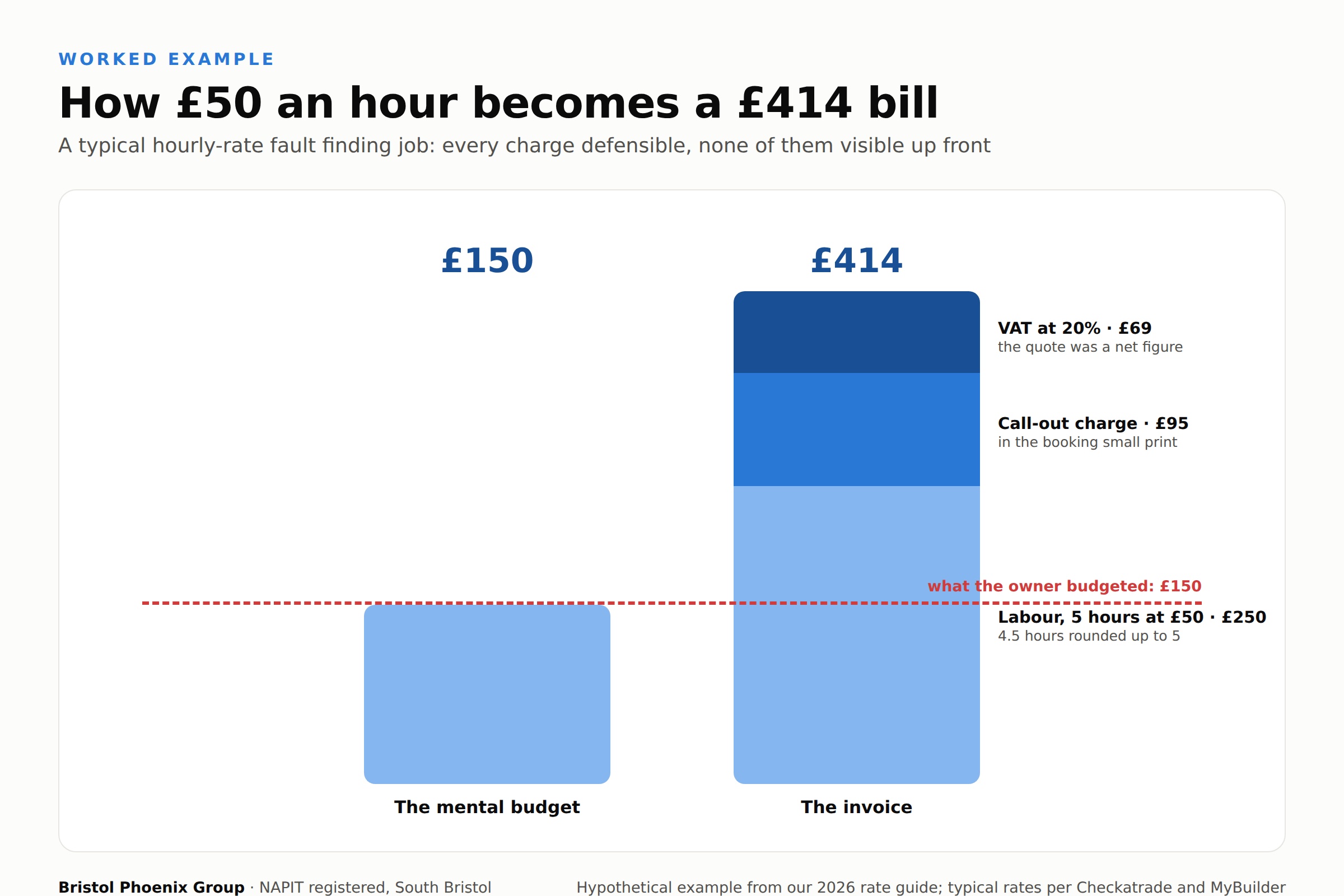
Picture a typical scenario. A three-bed terrace in Bedminster has a circuit that trips every few days, no obvious pattern, and the owner books an electrician on an hourly rate of £50, quoted over the phone.
The electrician arrives, and the meter starts. Diagnosis takes two and a half hours, because intermittent faults are stubborn like that. The culprit is a damaged cable behind the kitchen units. Repair and retesting takes another two hours. Four and a half hours becomes five on the invoice, because the firm rounds to the hour. Then the £95 call-out charge appears, mentioned in the booking confirmation nobody read. Then VAT, because the quoted £50 was net. The bill: 5 hours at £50, plus £95, plus 20% VAT. £414 in total, for a job the owner had mentally budgeted at £150.
Nobody lied in that story. Every charge was defensible on its own. The problem is that the true shape of the price was never visible up front.
Now take the same fault priced our way: £140 + VAT for the first visit covering the first hour or so of diagnosis, then a written figure for the repair before it starts, agreed while the electrician is still standing in the kitchen. The total might land in a similar place if the fault is deep. The difference is that the owner said yes to the real number, at each stage, rather than discovering it on an invoice.
Electrician Prices in Bristol: What We Publish and Why
We publish our prices because we got tired of the industry treating them like state secrets. If you are comparing electrician prices Bristol wide, these are ours, fixed and in writing before we start, always plus VAT:
- House rewiring: from £4,500 + VAT for a one-bed flat and from £5,400 + VAT for a three-bed house, depending on the size of the property, always surveyed first with a written specification. See our house rewiring in Bristol page.
- EICRs and landlord certificates: from £200 + VAT for a studio or one-bed home, £225 + VAT for a two-bed, £250 + VAT for a three-bed. Full detail on our EICR testing in Bristol page.
- Consumer unit replacement: from £680 + VAT including the survey, testing, certification and notification.
- Small jobs: from £95 + VAT, with published prices for sockets, switches and light fittings on our small jobs electrician page.
- Fault finding: £140 + VAT for the first visit, £320 + VAT for a half day, £620 + VAT for a full day.
- EV chargers: from £780 + VAT including the charger on a standard installation.
Set against the national picture, a £50 an hour electrician doing a full day plus materials plus VAT will invoice somewhere around £500 to £600 for a day of unscoped work. Our full day of fault finding is £620 + VAT with the scope agreed first, and everything else we do carries a fixed price, so you know the number before we know your postcode. We are NAPIT registered, based in South Bristol, and we work across the city from Bedminster and Knowle to Clifton and Fishponds, for homeowners, landlords, builders and small commercial clients.
Get a Written Price Before Anyone Picks Up a Screwdriver
The 2026 rate guides are useful for one thing above all: they tell you what normal looks like, so you can spot a quote that is quietly abnormal. £45 to £60 an hour is normal. £335 to £400 a day is normal. A £400 bill for a £150 mental budget is, sadly, also normal, and it is the part you can avoid.
Whatever you are planning, get the price in writing before the work starts, check what it includes, and use someone registered with a competent person scheme so the paperwork is part of the job rather than an extra. If the job is in Bristol or nearby, we will happily give you a fixed written price against anything in this guide. Get in touch with us here and tell us what needs doing. We will tell you what it costs, in full, before we start. No meter, no mystery.