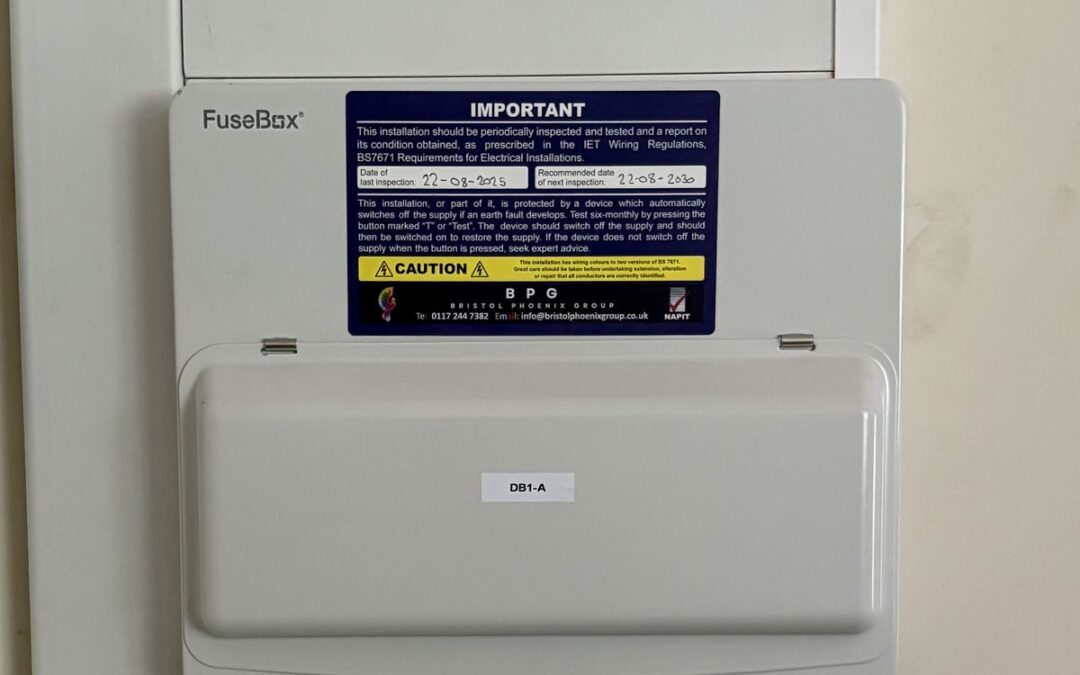
Does an HMO need a special consumer unit? No. There is no such thing as an HMO-only fuse board, and the regulations never name one. What a shared house does need is the right version of a normal consumer unit for an HMO setting: a metal board with an RCBO on every circuit, surge protection, spare ways, a clear circuit schedule and a position every tenant can actually reach. Get those five things right and the board will sail through the HMO EICR and the licence inspection. Get them wrong and the fuse board becomes the most expensive line on the remedial quote.
We fit consumer units in Bristol shared houses every month, from student lets in Bedminster to licensed HMOs in Knowle and Bishopsworth, so this guide covers what we actually install, where it goes and what it costs.
Why an RCBO on every circuit is the heart of a consumer unit for an HMO
In a family home, a tripped RCD is an annoyance. In a five-bedroom shared house it is five separate complaints, usually at 11pm.
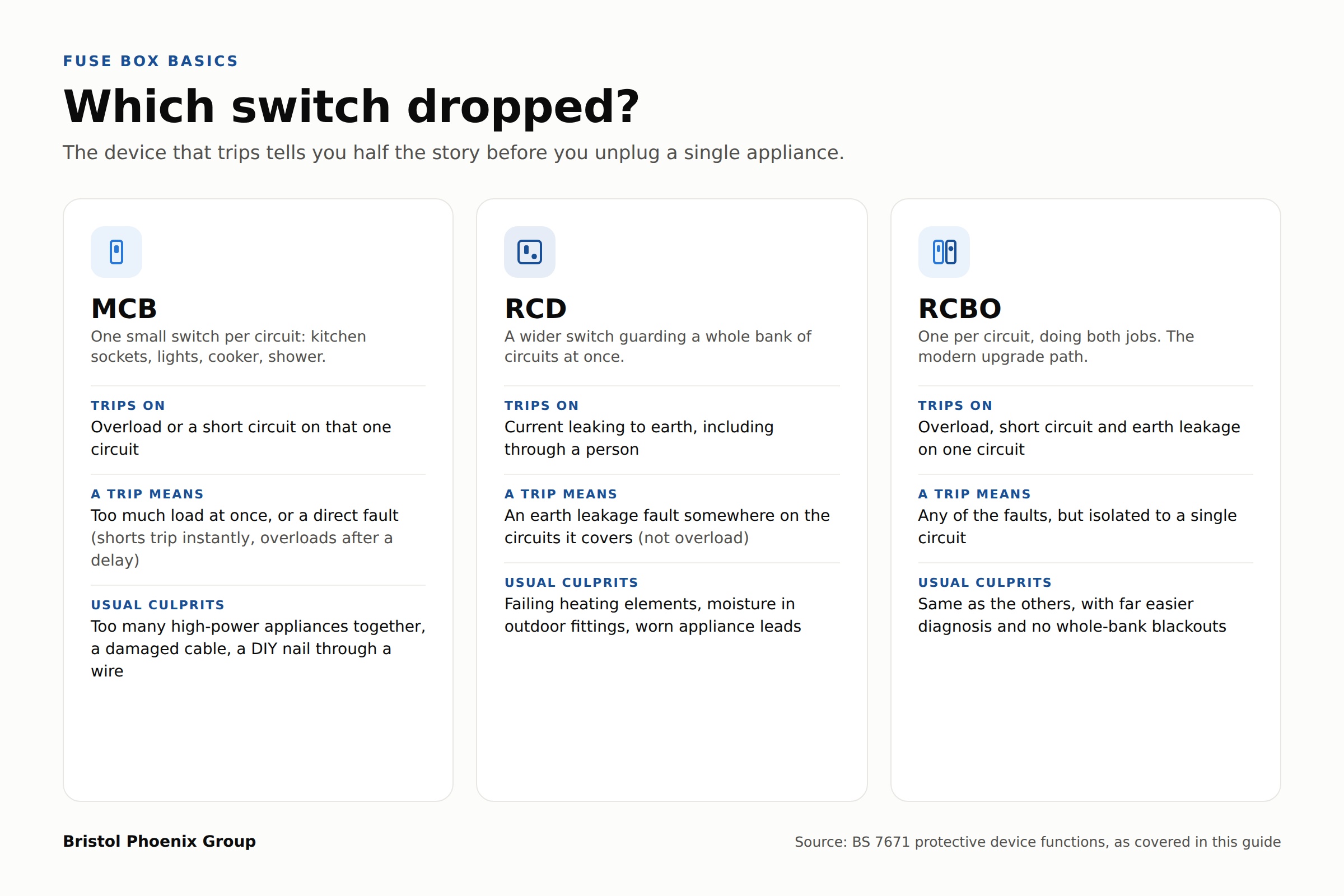
Older boards, and plenty of budget new ones, use one or two RCDs that each protect a group of circuits. When one tenant’s faulty kettle leaks current to earth, the RCD serving that whole group drops out, and it takes the kitchen, half the bedrooms and the Wi-Fi router with it. Nobody knows whose appliance did it, so the landlord gets the phone call instead.
An RCBO board solves this properly. An RCBO is a breaker that combines the overload protection of an MCB with the shock protection of an RCD, fitted one per circuit. The faulty kettle now trips the kitchen sockets and nothing else. The other circuits stay live, the fault is obvious from the board label, and the electrician who attends can go straight to the right circuit instead of unplugging the whole house. For a property where five or six adults live independent lives on one electrical installation, we consider RCBOs the only sensible choice, which is why every board we fit has an RCBO on every circuit as standard.
HMO consumer unit requirements: what the rules actually say
Three sets of rules decide what an HMO fuse board has to be.
BS 7671, the wiring regulations
Since 1 January 2016, Regulation 421.1.201 has required consumer units in homes to be made of a non-combustible material, in practice steel, a change brought in after fire investigators traced a run of house fires to overheating connections inside plastic boards (Professional Electrician has a plain summary). A plastic board that was fitted before then is not automatically a fail, but no competent electrician will fit a new one, and in an HMO escape route it matters more than anywhere else, because the board is often in the one hallway everyone uses to get out.
The current edition, as amended in 2022, also expects protection against transient overvoltages in most installations. Regulation 443.4 requires surge protection where the consequences of a surge include injury, failure of a safety service such as a fire alarm, or significant financial loss, and for other cases protection is still to be provided unless the owner formally declares they will accept the risk (Hager’s Amendment 2 overview explains the change). An HMO with a mains-powered, interlinked fire alarm system fed from the board is a textbook case for fitting the surge protection device rather than signing it away, which is why it comes as standard in our boards.
The landlord electrical safety regulations
The Electrical Safety Standards in the Private Rented Sector (England) Regulations 2020 require the fixed electrical installation, and the consumer unit is its centrepiece, to be inspected and tested at intervals of no more than five years, with any remedial or further investigative work the report calls for completed by a qualified person within 28 days (regulation 3 of the 2020 Regulations). That 28-day clock is worth remembering: if an HMO EICR gives the board a C2, the replacement is not a someday job.
Bristol City Council licence conditions
Bristol’s HMO licence conditions go a step further than the national rules. The council can demand a genuine EICR less than five years old within seven days of asking, any code 1 or code 2 defects must be remedied and FI codes followed up, and the landlord must ensure every electrical installation is in proper working order and safe for continued use (Bristol City Council’s licensing conditions, section 4). What that five-yearly report involves, what it costs and how remedial work is priced is all on our landlord electrical safety page. An inspector who opens a cupboard and finds an unlabelled 1970s fuse board with no RCD protection is going to keep reading, so the board sets the tone for the whole visit.
Where the board should go, and the labelling that keeps inspectors happy
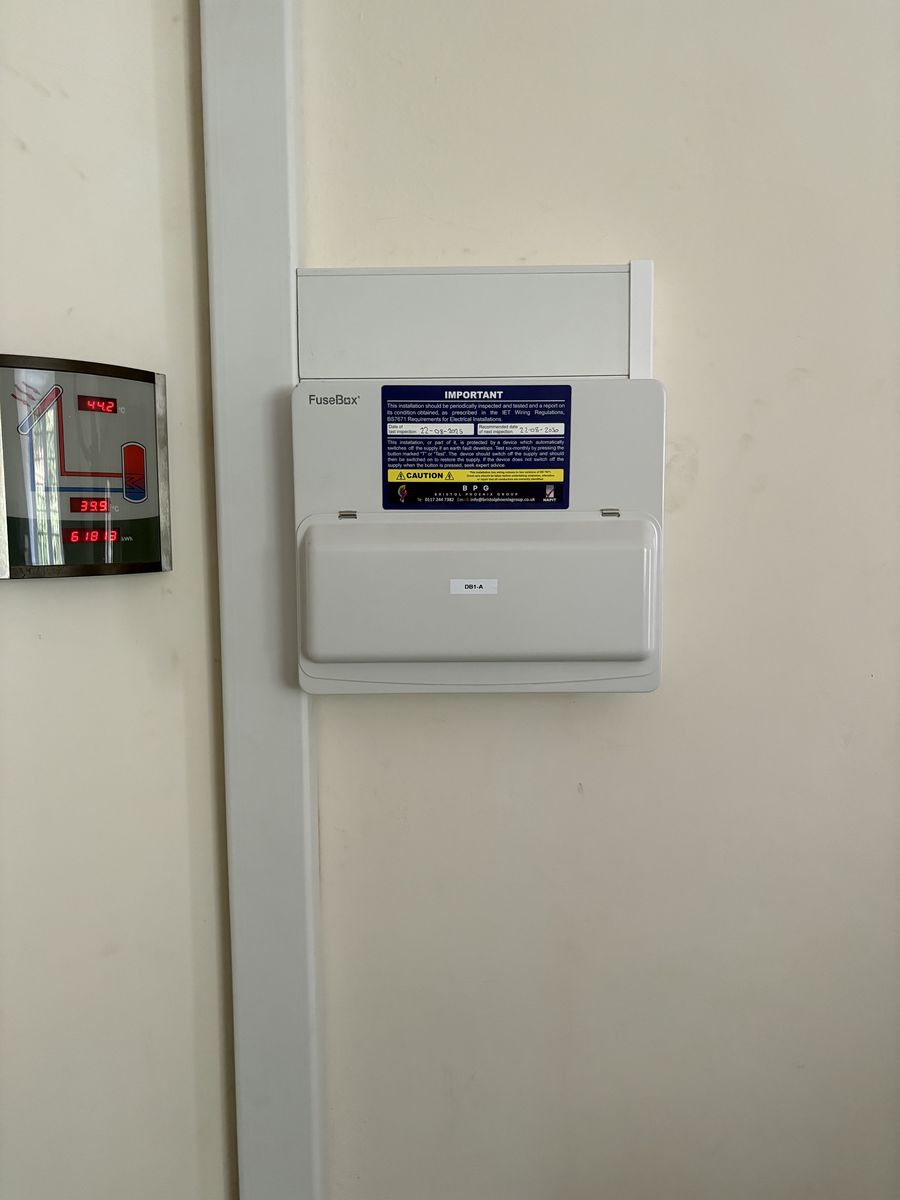
In the Victorian terraces of Bedminster and Southville, and the 1930s semis around Bishopsworth, Headley Park and Knowle that make up most of South Bristol’s shared houses, the board usually lives in the hallway, under the stairs or in a cupboard by the front door. That is normally fine, with three conditions.
- Every tenant must be able to reach it without going through someone else’s bedroom. If a trip at midnight can only be reset by waking the tenant in the converted front room, the layout has failed, and we have seen exactly that layout proposed in loft and garage conversions.
- It must not be buried. A board behind coat hooks and four bags of laundry fails the reasonable access test, and in a cupboard used for storage we fit a simple guard or move the board.
- Mounting height matters: modern practice puts switchgear where it can be operated without a stepladder, roughly eye level, not in the old position a foot off the floor.
Labelling is the cheapest win in the whole job. Every circuit gets a plain-English label, bedroom 1, bedroom 2, kitchen sockets, fire alarm, not “lights 2”, plus a printed circuit schedule in a wallet next to the board. The council inspector can read it, the next electrician can test against it, and the tenant group chat can report “kitchen sockets tripped” instead of “the electric’s gone”.
One board or two? When a landlord’s supply makes sense
Most HMOs run happily on one board, sized honestly. A five-bedroom shared house rarely needs fewer than ten ways once you count two or three socket circuits, kitchen, cooker, shower, lighting up and down, fire alarm and a spare or two, so the small boards that suit a flat are usually the wrong buy.
A second, smaller board earns its place in two situations. The first is the larger or converted HMO where communal services, the interlinked fire alarm, emergency lighting in the escape route, hallway lights and door entry, sit on their own landlord’s supply, so a fault in a bedsit can never silence the fire alarm, and the landlord keeps control of the circuits that protect everyone. The second is the outbuilding or garage conversion fed by its own sub-main, which gets a small board of its own rather than a long string of spurs. Whether a second board is worth it in your property is a survey question, not a catalogue question, and the survey is free.
How the wrong board gets coded on an HMO EICR
Picture a typical six-bed student HMO off North Street: a plastic split-load board from the 1990s in the under-stair cupboard, two RCDs covering everything, half the labels missing, no surge protection, and a grill plugged in somewhere upstairs that trips the right-hand RCD most weekends. On the HMO EICR, that board typically earns a stack of observations: a C3 for the plastic enclosure if it is otherwise sound, a C2 where there is no RCD protection on socket circuits or the enclosure is damaged or scorched, and an FI where the inspector cannot establish what a circuit feeds. One C2 makes the whole report unsatisfactory, which starts the 28-day remedial clock and, in a licensed Bristol HMO, invites the council’s seven-day document request. Under BS 7671:2018+A4:2026 an FI code no longer fails the report on its own, but it should still be investigated within the same 28 days. In that state the sensible money goes on one new RCBO board rather than piecemeal fixes to a dying one.
HMO consumer unit cost in Bristol
Our consumer unit prices are published and fixed, the same anywhere in Bristol, and every board is a metal FuseBox unit with an RCBO on every circuit and surge protection as standard. The full breakdown lives on our consumer unit replacement page.
| Board size | Typical property | Price (plus VAT) |
|---|---|---|
| 6-way RCBO board | Flats and small homes | £680 |
| 8 to 12-way RCBO board | Most houses and smaller HMOs | £780 |
| 15-way RCBO board | Larger HMOs with shower and outbuilding circuits | £920 |
| Larger and three-phase boards | Big conversions, after survey | from £1,195 |
Every board change is certified, notified to building control through our NAPIT registration and covered by the NAPIT Work Quality Guarantee for six years. If the EICR is what triggered the work, our HMO EICRs start from £350 plus VAT, and the HMO electrical safety page covers the certificates and interlinked fire alarms Bristol licensing expects. If the inspection points at the wiring rather than just the board, our guide to rewiring an HMO covers that bigger conversation.
Sorting the fuse board in your Bristol HMO
Bristol Phoenix Group is a NAPIT-approved and TrustMark Trading Standards Approved electrical contractor (TrustMark licence 4257835) based in South Bristol, rated 5.0 on Google across more than 130 reviews. We look after shared houses across the city, with Bedminster and the rest of South Bristol as home ground, and quotes are free and in writing before any work starts. If your HMO board needs upgrading, or an EICR has left you with a remedial list and a deadline, get in touch or call 0117 244 7382 and we will give you a straight answer on what the board needs and what it will cost.